
The best camera monopods give photographers extra support without the bulk of a tripod. They are especially useful for wildlife, sports, events, travel, and handheld video when mobility matters.
This roundup compares 10 camera monopods across carbon fiber and aluminum designs, compact travel models, video-focused options, and monopods with detachable or foldable bases.
Best 10 Camera Monopods Picks for 2026
Best Lightweight Pick

- Weighs only 9.44 ounces
- Folds to 16.75 inches
- Supports up to 5 pounds
Best For: Travelers and hikers using lightweight camera setups
Best Heavy-Duty Option
Manfrotto 290 Carbon Fiber Monopod

- Supports up to 22 pounds
- Carbon fiber construction
- Reaches 59.4 inches
Best For: Heavy camera and videography setups
Best Multi-Mode Design

- Supports up to 11.02 pounds
- Folds to 16.9 inches
- Converts to selfie and walking-stick modes
Best For: Travel and outdoor photographers wanting versatile support
Best Compact Carbon Fiber Pick
- 400-gram carbon fiber design
- Folds to 15 inches
- Reversible dual-thread mount
Best For: Travel photographers prioritizing compact carbon fiber support
Best Value Camera Monopod
NEEWER T222 Extendable Monopod
- Extends to 66 inches and folds to 20.5 inches
- Includes a detachable three-leg support base
- Supports up to 11 pounds under optimal conditions
Best For: Travelers and photographers wanting flexible support
Best 2-in-1 Camera Monopod

- Converts from tripod to monopod
- 71-inch maximum height with a 360-degree ball head
- Supports up to 33 pounds vertically
Best For: Creators needing tripod and monopod flexibility
Best Premium Camera Monopod
- Foot-operated pedal enables quick locking and swiveling
- Carbon fiber weighs 2.8 pounds and supports 17.6 pounds vertically
- Three-in-one design with quick-release mounting
Best For: Fast-paced video, wildlife, sports, and event shooting
Best Portable Camera Monopod

- Supports up to 17.6 pounds
- Folds to 17.3 inches
- Interchangeable rubber and spike feet
Best For: Travel, vlogging, and outdoor photography
Best Heavy-Duty Camera Monopod
SmallRig Carbon Fiber Video Monopod

- Extends to 68.9 inches
- Supports up to 33.07 pounds at the legs
- One-button lift-and-lock operation
Best For: Heavy camera rigs and video production
Best Compact Camera Monopod

- Folds to only 17 inches
- Reaches a 63-inch maximum height
- Rubber and metal foot options
Best For: Travel and adaptable outdoor shooting
Best Lightweight Pick – Altura Photo 62-Inch Monopod
If portability is a priority, this camera monopod offers a compact aluminum design that reaches 62 inches while weighing only 9.44 ounces. It folds to 16.75 inches and includes a carry pouch, making it convenient for travel, hikes, and everyday photography.
Best For: Travelers, hikers, and photographers who want a lightweight monopod for DSLR or mirrorless cameras.
Pros:
- Very light and compact, with a 16.75-inch folded length.
- Supports cameras and accessories up to 5 pounds.
- Includes a foam grip, wrist strap, rubber foot, and retractable spike.
Cons:
- The 5-pound weight limit is lower than some heavier-duty options.
- Its aluminum construction may be less premium than carbon fiber alternatives.
The Altura Photo is a practical choice when low carry weight matters most. Its rubber foot and retractable spike also make it adaptable to indoor and outdoor surfaces.
Best Heavy-Duty Option – Manfrotto 290 Carbon Fiber Monopod
For photographers who need more support, this carbon fiber camera monopod combines a 22-pound stated load capacity with a 59.4-inch maximum height. Its four-section design enables quick height adjustments, while the carbon fiber build keeps its weight to 1.1 pounds.
Best For: Photographers and videographers carrying heavier cameras or accessories.
Pros:
- High 22-pound weight limit for demanding setups.
- Carbon fiber construction with a relatively low 1.1-pound weight.
- Four sections support rapid height adjustments.
- Includes rubber leg warmers and an angled wrist strap.
Cons:
- Its 19.29-inch folded length is less compact than some travel-focused models.
- It is not listed as water resistant.
The Manfrotto 290 is the strongest choice in this group for payload capacity. Choose it when stability and load support are more important than the smallest packed size.
Best Multi-Mode Design – ULANZI TB12 61-Inch Monopod
This versatile camera monopod is designed for photographers who want more than traditional single-leg support. The five-section aluminum pole extends to 61 inches, folds to 16.9 inches, and can also serve as a selfie stick or walking and hiking stick.
Best For: On-the-go photographers who want one compact support tool for travel, wildlife, and outdoor use.
Pros:
- Lightweight 0.83-pound design with a compact 16.9-inch folded size.
- Supports cameras up to 11.02 pounds.
- Offers monopod, selfie-stick, walking-stick, and trekking-pole modes.
- Five sections provide multiple height settings up to 61 inches.
Cons:
- It is not listed as water resistant.
- Aluminum construction is heavier than the lightest carbon fiber options.
The ULANZI TB12 stands out for flexibility. Its combination of low weight, useful load capacity, and outdoor-oriented modes makes it a strong all-purpose travel companion.
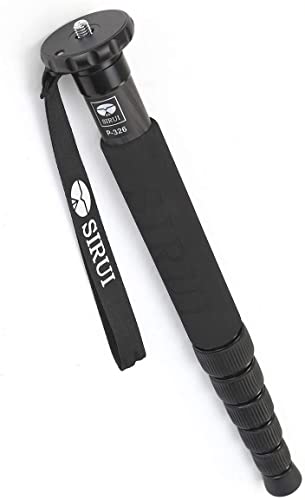
Best Compact Carbon Fiber Pick – SIRUI P-326 Travel Monopod
SIRUI Camera Monopod P-326 6 Section Carbon Fiber Compact Lightweight Travel Monopod
Check Price On AmazonThe SIRUI P-326 is a compact carbon fiber camera monopod built for travel. Its six-section design folds to 15 inches, weighs 400 grams, and extends to 60.6 inches, while the reversible mounting screw supports both 1/4-20 and 3/8-16 connections.
Best For: Travel photographers seeking a compact carbon fiber monopod with flexible mounting compatibility.
Pros:
- Eight-layer carbon fiber construction keeps the weight to 400 grams.
- Six-section design folds to a very compact 15 inches.
- Reversible 1/4-20 and 3/8-16 mounting screw.
- Includes a wrist strap, hand grip, and silicon twist locks.
Cons:
- The supplied notes do not specify a maximum extended height in a separate product detail, though the listed item length is 60.6 inches.
- Six sections may require more adjustments than a simpler four-section design.
The P-326 is an appealing option when packed size and carbon fiber construction are key considerations. Its dual-thread mounting plate also improves compatibility with different camera accessories.
Best Value Camera Monopod – NEEWER T222 Extendable Monopod
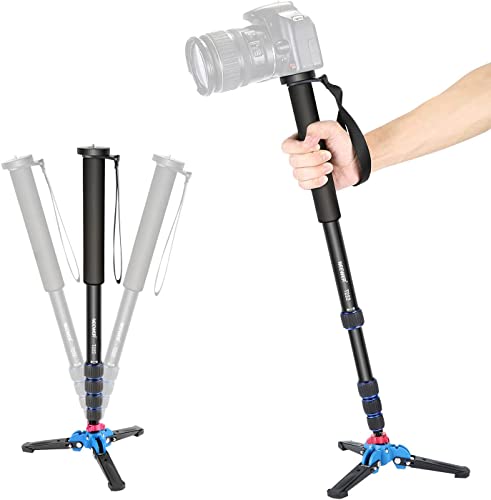
If you want versatile camera monopods for travel, events, or general outdoor shooting, the NEEWER T222 combines an extendable aluminum pole with a detachable three-leg support base. It reaches 66 inches, folds to 20.5 inches, and supports up to 11 pounds under optimal conditions.
Best For: Photographers who want a lightweight monopod that can also stand with its included base.
Pros:
- Aluminum-alloy construction with an 11-pound maximum recommended load.
- Five-section adjustment system covers multiple shooting heights.
- Detachable tripod base supports panoramic rotation and can accept a mini tripod through the 3/8-inch bottom hole.
- Foam handle and compact folded length make it practical to carry outdoors.
Cons:
- The camera must be held by hand when mounted on the monopod or it may fall.
- The product is not water resistant.
- The included base provides support but is not a substitute for a full-size tripod in every setup.
The NEEWER T222 is a flexible choice among camera monopods, especially if you value portability and occasional hands-free support. Its aluminum build and useful height range are appealing, but careful handling is essential when using it without the base.
Best 2-in-1 Camera Monopod – SmallRig CT-10 Tripod Monopod
The SmallRig CT-10 is one of the more adaptable camera monopods because it converts from a full tripod into a monopod. Its aluminum construction, 360-degree ball head, and 16- to 71-inch height range suit photography and content creation with cameras, phones, and other compatible devices.
Best For: Creators who want one support system for tripod work, monopod shooting, and low-angle photography.
Pros:
- Converts between a tripod and monopod for hiking, travel, and studio use.
- 360-degree metal ball head supports horizontal and vertical positioning.
- Central pole can be inverted for low-angle and macro photography.
- Supports up to 33 pounds vertically, with three additional 1/4-inch threaded holes for accessories.
Cons:
- At 3.4 pounds, it is heavier than a basic travel monopod.
- Telephoto lenses may require an additional tripod mount ring or lens mount for better balance.
- The supplied details list a 43 cm folded size, while the stated minimum height is 16 inches, so packing dimensions should be confirmed before purchase.
The CT-10 is a strong option if you need more than a simple camera monopod. Its conversion design and high vertical load rating add versatility, though its heavier build may matter when carrying it on longer outings.
Best Premium Camera Monopod – IFOOTAGE Cobra 3 Carbon Fiber
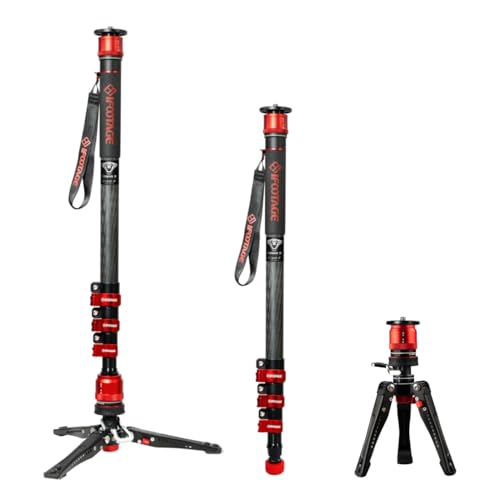
The IFOOTAGE Cobra 3 is a carbon-fiber choice for camera monopods, built around fast operation and flexible support. Its foot-operated locking system, automatic quick-release plate, and 5.9- to 71-inch height range are useful for sports, wildlife, wedding, and other fast-moving shoots.
Best For: Videographers and event photographers who need quick repositioning and stable support with heavier camera setups.
Pros:
- Foot pedal locks and unlocks the monopod for 360-degree swiveling without bending down.
- Carbon-fiber construction keeps the 2.8-pound monopod relatively light while supporting up to 17.6 pounds vertically.
- Three-in-one design can function as a monopod, tabletop mini tripod, low-profile base, stabilizer extension, or hiking stick.
- Convertible 1/4-inch and 3/8-inch mounting screws work with cameras, gimbals, scopes, microphones, and video lights.
Cons:
- The 27-inch collapsed length is longer than some compact camera monopods.
- The product is not water resistant.
- Its specialized pedal and quick-release features may be more than casual photographers need.
The Cobra 3 stands out among camera monopods for speed, modularity, and carbon-fiber portability. The extended feet and adjustable damping are especially useful for controlled pans and tilts, while the higher price typically associated with this feature set should be weighed against your shooting needs.
Best Portable Camera Monopod – NEEWER TP41
The NEEWER TP41 is a lightweight choice for photographers seeking portable camera monopods for travel, outdoor shooting, or everyday video work. Its aluminum construction supports up to 17.6 pounds while folding to 17.3 inches.
Best For: Travelers, vloggers, and outdoor photographers who want a compact monopod with interchangeable feet.
Pros:
- Lightweight 0.88-pound design with wrist strap and rubber grip
- Adjusts from 26.6 to 61 inches using quick flip locks
- Supports up to 17.6 pounds
- Includes rubber feet and steel spike feet for different surfaces
Cons:
- Not water resistant
- Requires a compatible holder or adapter for phones and some action cameras
With its low weight, compact folded size, broad screw compatibility, and convertible feet, the TP41 is a practical all-around option when portability matters most.
Best Heavy-Duty Camera Monopod – SmallRig Carbon Fiber Video Monopod
The SmallRig carbon fiber video monopod is built for demanding camera and video setups. It reaches 68.9 inches, uses a one-button lift-and-lock system, and includes quick-release feet for faster transitions between shooting positions.
Best For: Videographers and photographers using heavier cameras, gimbals, cages, or fluid and ball heads.
Pros:
- Extends to 68.9 inches and collapses to 29.9 inches
- One-button height adjustment supports quick, one-handed operation
- Monopod legs support loads up to 33.07 pounds
- Offers 1/4-20 and 3/8-16 mounting compatibility
Cons:
- Weighs 5.51 pounds, making it less travel-friendly than lighter models
- Minimum height is 30 inches, limiting low-angle positioning
The S5565 prioritizes stability, capacity, and fast video workflow over minimal weight. Its carbon fiber and aluminum construction make it a strong fit for more substantial rigs.
Best Compact Camera Monopod – K&F CONCEPT MS16
The K&F CONCEPT MS16 is a compact aluminum option for photographers who need flexible height adjustment without carrying a full-size support system. Its five-section design reaches 63 inches and folds to just 17 inches.
Best For: Outdoor photographers and travelers who need a small monopod with adaptable feet and broad device compatibility.
Pros:
- Five-section design adjusts from 17 to 63 inches
- Folds to 17 inches for convenient transport
- Supports up to 22 pounds
- Dual rubber and metal foot design works on hard or soft ground
Cons:
- Not water resistant
- Five-section construction may require more adjustments than simpler designs
The MS16 balances a compact folded size with a useful 63-inch maximum height. Its anti-slip padding, wrist strap, and dual-interface design make it a flexible choice for mobile shooting.
How We Picked the Best Camera Monopods
We selected these Camera Monopods by comparing the features that have the greatest effect on real-world usability: construction material, maximum height, folded size, section count, weight, stability, locking hardware, mounting compatibility, and portability. We also considered whether each model is better suited to still photography, video, travel, or general-purpose support.
Carbon fiber models typically reduce weight and vibration, making them appealing for travel and long shooting sessions. Aluminum monopods are often more affordable and can provide dependable durability, although they may weigh slightly more. Models with detachable or foldable bases offer additional support but can be bulkier than simple single-foot designs.
Quick Comparison
| Best For | What to Look For |
|---|---|
| Travel photography | Lightweight carbon fiber or compact aluminum construction |
| Sports and wildlife | Fast height adjustment, rigid sections, and a secure foot |
| Video recording | High load capacity, smooth movement, and a compatible head |
| Maximum versatility | Detachable base, tripod-style feet, or ball-head compatibility |
| Budget buying | Reliable twist or lever locks and a standard 1/4-inch or 3/8-inch mount |
Key Buying Factors for Camera Monopods
Material and Weight
Carbon fiber is a strong choice when portability is important. It tends to be lighter and better at damping vibration, while aluminum offers a lower-cost option with solid everyday durability.
Height and Folded Length
Choose a maximum height that lets you work comfortably without constantly bending over. A shorter folded length is valuable for airline travel, backpacks, and crowded venues. More sections usually improve compactness but may add setup time.
Locks, Feet, and Stability
Twist locks are compact, while lever locks are often faster to operate and easier to inspect. A rubber foot works well on hard surfaces; interchangeable spikes or a foldable base can improve traction and stability on varied terrain.
Camera and Head Compatibility
Check the mounting thread and rated load before attaching a heavy DSLR, telephoto lens, or video rig. A ball head can improve still-photo positioning, while a fluid-style head is generally better for controlled video movement.
Who Should Buy Which Camera Monopods?
Travel photographers should prioritize compact carbon fiber designs or lightweight aluminum models that fit easily into luggage. Sports and wildlife shooters should favor rigid monopods with quick adjustments and dependable feet. Videographers should look for models designed around heavier rigs, stable bases, and compatible video heads.
For occasional use, an affordable aluminum monopod can provide excellent value. If you frequently carry equipment for long periods, upgrading to carbon fiber may reduce fatigue. Buyers who want a monopod to stand briefly on its own should consider a detachable or foldable base, while photographers who need the smallest and fastest setup may prefer a traditional single-foot design.