
Camera sliders with 360-degree rotation can add controlled movement to time-lapses, product videos, panoramic shots, and macro photography without requiring a full motion-control rig.
This roundup compares 10 options ranging from compact manual spinners and focusing rails to motorized panoramic heads, helping you match rotation control, payload, portability, and camera compatibility to your setup.
Best 10 Camera Sliders with 360 Degree Rotation Picks for 2026
Best Heavy-Duty Pick

- 360-degree rotating platform
- Adjustable 14.5–27-inch arm
- Supports camera payloads up to 5 lb
Best For: Stable rotating camera setups and larger production rigs
Best Compact 2-in-1

- Slider and panorama mount in one kit
- Automatic ping-pong motion
- 750 g maximum recommended payload
Best For: Portable phone, GoPro, and lightweight mirrorless shooting
Best Commercial Spinner
RAUBAY 360 Camera Spinner Lite

- Horizontal and top-view surround modes
- Quiet, stable bearing operation
- 2 kg maximum camera load
Best For: Product photography, commercial video, and 3D scanning
Best Remote-Controlled Head

- 360° horizontal and 35° vertical rotation
- Eight speeds with 20 m+ remote range
- Supports cameras under 1 kg
Best For: Remote panoramic shooting with phones and lightweight cameras
Best All-Around Rig
Olylogic Portable 360° Camera Slider
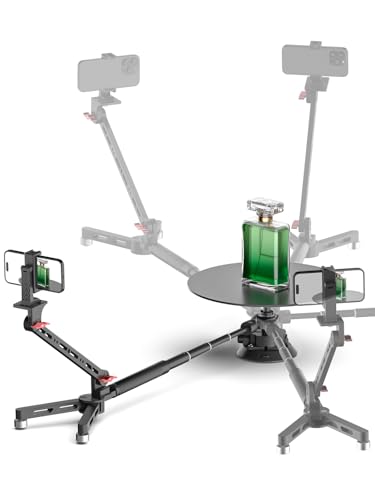
- Full 360-degree rotation for dynamic angles
- Adjustable 21.25- to 43.3-inch range
- Includes suction base, phone holder, and ball head
Best For: Versatile video productions and on-location filming
Best Compact Dolly
NEEWER SD001 360° Camera Dolly

- Moves in straight lines or circles
- 360-degree rotation and 90-degree tilt
- Pocket-sized aluminum body with phone clamp
Best For: Portable tabletop and smartphone shooting
Best for Time-Lapse
FOTGA 360° Rotating Stabilizer

- Completes one 360-degree rotation in 60 minutes
- Battery-free operation for simple time-lapse setup
- Supports cameras, GoPro devices, and smartphones
Best For: Slow panoramic time-lapse footage and travel
Precision Macro Pick
NiSi NM-200S Macro Focusing Rail

- 1mm-per-rotation precision with 180mm travel
- 360-degree rotating clamp for orientation changes
- Arca-Swiss and 1/4-inch/3/8-inch mounting options
Best For: Precise macro focusing and tripod-based close-up photography
Panoramic Rotation Choice
Pukoko 360-Degree Camera Slider

- Supports horizontal, tracking, and panoramic modes
- CNC bearing is designed for quiet, stable movement
- 2.5 kg maximum recommended load and 8.04 kg product weight
Best For: Panoramic, product, and multi-angle commercial video work
Four-Axis Macro Option
NEEWER GM-MP3 Macro Rail Slider

- Four-axis positioning with dual 100mm lead-screw sliders
- 360-degree swivel for alternate macro camera angles
- 745g aluminum-alloy build supports up to 2.5kg
Best For: Portable macro, close-up, and time-lapse camera positioning
Best Heavy-Duty Pick – Glide Gear REVO 50
The Glide Gear REVO 50 is a strong option for creators searching for camera sliders with 360 degree rotation and a larger, more stable platform. Its adjustable arm, aluminum construction, ball head, and phone mount support flexible camera positioning for productions such as commercials and music videos.
Best For: Filmmakers who need a sturdy rotating setup with adjustable reach and support for cameras or smartphones.
Pros:
- 360-degree rotating platform supports immersive shots from different angles.
- Adjustable extension ranges from 14.5 to 27 inches.
- Supports camera payloads up to 5 pounds, with a platform capacity of up to 40 pounds.
- Includes a ball head and cell phone mount.
Cons:
- At approximately 20 pounds, it is less convenient to transport than compact slider systems.
- Its stated camera payload is limited to 5 pounds despite the higher platform capacity.
The REVO 50 stands out when stability and payload capacity matter more than minimizing gear weight. Verify your camera’s weight and available setup space before buying.
Best Compact 2-in-1 – GripGear MovieMaker
The GripGear MovieMaker combines a compact camera slider with a panorama mount, making it a versatile choice among camera sliders with 360 degree rotation. It works with phones, GoPros, mirrorless cameras, and other compatible devices, while its motor provides automatic motion for slides, panoramas, and time-lapse sequences.
Best For: Mobile creators who want a lightweight, app-free slider and panorama system for travel, interviews, B-roll, and time-lapse work.
Pros:
- 2-in-1 design switches between horizontal sliding and panoramic panning.
- Supports vertical, horizontal, and upside-down mounting.
- Ping-pong motion can automate continuous back-and-forth movement.
- Includes a rechargeable battery rated for up to 2.5 hours and multiple 1/4-inch mount points.
Cons:
- The maximum recommended payload is 750 g.
- Longer tracks up to 6 meters are sold separately.
- Its compact track length may be limiting for extended camera moves.
MovieMaker is a practical choice when portability and flexibility are priorities. Its lower payload limit makes it better suited to smartphones, action cameras, and lighter mirrorless setups than heavier camera rigs.
Best Commercial Spinner – RAUBAY 360 Camera Spinner Lite
The RAUBAY 360 Camera Spinner Lite is designed for creators who need camera sliders with 360 degree rotation for product photography, commercial video, 3D scanning, and bullet-time effects. Its bearings are designed for smooth, quiet operation, and the platform can be assembled for horizontal surround or top-view surround shooting.
Best For: Product photographers and commercial video creators who need a stable rotating platform with multiple shooting configurations.
Pros:
- Supports 360-degree horizontal surround and top-view surround shooting.
- Offers up to 120 degrees of vertical camera-angle adjustment.
- Quiet, stable bearings are intended to reduce shaking during operation.
- Lightweight Lite version weighs approximately 17.6 pounds and supports installation on solid wooden countertops.
Cons:
- The maximum camera load is 4.4 pounds (2 kg).
- It is not water resistant.
- Its countertop-oriented installation may require a suitable solid wooden surface.
The Spinner Lite is a specialized platform rather than a conventional linear slider. Choose it when controlled surround, top-view, or product-rotation shots are more important than long lateral camera travel.
Best Remote-Controlled Head – Soonpho M4 Panoramic Head
The Soonpho M4 is a motorized panoramic head for creators comparing camera sliders with 360 degree rotation and wanting remote control. It provides 360-degree horizontal rotation, 35-degree vertical rotation, eight speed settings, and a rechargeable battery for panoramic, time-lapse, and live-streaming applications.
Best For: Smartphone, DSLR, and camcorder users who want remotely controlled panoramic movement on a tripod, monopod, or stand.
Pros:
- Remote control adjusts 360-degree horizontal and 35-degree vertical rotation.
- Offers eight speed settings and a remote range exceeding 20 meters.
- Supports devices under 1 kg with a 1/4-inch quick shoe plate.
- Built-in rechargeable battery includes a battery display button.
Cons:
- Horizontal and vertical rotation cannot operate simultaneously.
- Its 1 kg payload limit excludes heavier camera setups.
- It is a rotating pan-tilt head rather than a linear slider with extended track travel.
The M4 is a convenient solution for remote panoramic movement when you already have a tripod or stand. Keep the payload under 1 kg and plan shots around its single-plane-at-a-time rotation limitation.
Best All-Around Rig – Olylogic Portable 360° Camera Slider
For creators searching for camera sliders with 360 degree rotation, the Olylogic Portable 360 Degree Spinner combines full-angle movement with an adjustable 21.25- to 43.3-inch setup. Its suction-cup base, phone holder, and camera ball head make it adaptable for dynamic video work.
Best For: Music videos, commercials, product content, and on-location filming that benefits from broad camera movement.
Pros:
- Provides full 360-degree rotation for immersive perspectives.
- Adjustable length supports more precise shot composition.
- Aluminum construction, suction-cup base, phone holder, and ball head offer flexible setup options.
- Dual bearings and slide-to-shoot operation are designed for fluid repositioning.
Cons:
- At 6 pounds, it is less lightweight than compact tabletop options.
- The suction-cup mounting approach may require a suitable smooth surface.
This is the most adaptable choice of the three when you need a configurable rig with full rotational movement and support for phones or cameras. Its size and weight are worth considering for highly mobile setups.
Best Compact Dolly – NEEWER SD001 360° Camera Dolly
The NEEWER SD001 is a practical pick among camera sliders with 360 degree rotation for tabletop and floor-level shooting. Its four wheels support straight or circular movement, while the ball head rotates 360 degrees and tilts 90 degrees for flexible framing.
Best For: Compact product shots, smartphone videos, mirrorless-camera work, and portable panoramic or panning setups.
Pros:
- Supports both linear and circular movement by adjusting the wheels.
- Soft rubber wheel rings provide smooth, quiet motion on suitable surfaces.
- 360-degree ball-head rotation and 90-degree tilt expand framing options.
- Compact 7.76-ounce aluminum design includes a rotatable phone clamp with cold shoe.
Cons:
- Not suitable for telephoto lenses.
- An action-camera adapter is sold separately.
- Its maximum recommended load is 6.6 pounds, so larger setups need careful checking.
Choose the SD001 when portability and tabletop maneuverability matter most. It offers more movement variety than a basic straight slider, though its small-wheel design is better suited to compact camera and phone setups.
Best for Time-Lapse – FOTGA 360° Rotating Stabilizer
For slow, deliberate motion, the FOTGA 360° Rotating Tripod Time Lapse Stabilizer offers a one-hour full rotation. It is a straightforward option for camera sliders with 360 degree rotation when the goal is adding smooth panning movement to time-lapse footage.
Best For: Long-duration time-lapse videos, travel projects, and lightweight GoPro, smartphone, or camera setups.
Pros:
- Completes a 360-degree rotation over 60 minutes for slow, smooth pans.
- Requires no battery and is simple to set up.
- Includes a 1/4-inch mounting screw, GoPro adapter, and tripod/slider thread compatibility.
- Lightweight aluminum construction weighs 7.5 ounces.
Cons:
- Maximum load is 1.32 pounds, limiting heavier camera setups.
- Its fixed one-hour rotation pace is less flexible for faster motion shots.
- It is designed for rotation rather than adjustable linear sliding.
The FOTGA is the focused choice for gradual time-lapse movement rather than general-purpose camera dolly work. Its low weight and battery-free operation make it convenient for travel, provided your equipment stays within the load limit.
Precision Macro Pick – NiSi NM-200S Macro Focusing Rail
If you need camera sliders with 360 degree rotation for close-up work, the NiSi NM-200S focuses on controlled macro positioning rather than cinematic travel. Its 1mm-per-rotation adjustment, 180mm range, and rotating clamp make it practical for fine framing and camera-orientation changes.
Best For: Macro photographers who need precise focus adjustments and flexible tripod mounting.
Pros:
- Provides 1mm movements per rotation across a 180mm adjustment range.
- 360-degree rotating clamp allows camera-orientation changes without removing the rail.
- Arca-Swiss compatibility, long quick-release plate, and 1/4-inch and 3/8-inch mounting options support varied setups.
- Quick-position button helps with larger positioning changes.
Cons:
- Designed primarily for macro focusing, not long cinematic slider movements.
- The supplied notes do not specify a maximum camera-load rating.
The NM-200S is a strong choice when precision matters more than travel length. Its 360-degree clamp is especially useful for changing orientation during detailed macro sessions.
Panoramic Rotation Choice – Pukoko 360-Degree Camera Slider
For camera sliders with 360 degree rotation aimed at panoramic or product footage, this Pukoko system combines a rotating mechanism with a T-slot round tube. It is built for stable multi-angle recording, but buyers should plan around its 2.5 kg maximum recommended load and required accessories.
Best For: Product videos, panoramic shooting, 3D scanning, and other multi-angle production setups.
Pros:
- Supports horizontal, tracking, and panoramic recording modes.
- CNC-manufactured bearing is intended to provide quiet, stable operation.
- T-slot tube construction is designed to resist deformation and improve structural stability.
- Suitable for commercial shooting and 360-degree-view projects.
Cons:
- Maximum recommended load is 2.5 kg.
- Requires a separate panoramic ball-head tripod head, 1/4-inch quick-release plate, and 2.5 kg dumbbell plate.
- At 8.04 kg, the system is relatively heavy to transport.
This is the most production-oriented option of the group for rotating and panoramic shots. Its stability-focused construction is appealing, but the extra required components and substantial weight should be included in your setup plan.
Four-Axis Macro Option – NEEWER GM-MP3 Macro Rail Slider
The NEEWER GM-MP3 is a practical choice among camera sliders with 360 degree rotation for macro photography and close-up filming. Its dual lead-screw sliders provide four-way positioning, while the rotating top section helps create alternate camera angles and compositions.
Best For: Macro photography, close-ups, time-lapse videos, and portable precision camera positioning.
Pros:
- Offers four-axis movement for left, right, forward, and backward adjustments.
- Dual sliders provide 100mm of movement each and 200mm combined movement in the same direction.
- 360-degree swivel and 90-degree swivel positioning support creative camera angles.
- Weighs 745g while supporting cameras up to 2.5 kg.
Cons:
- Positioning locks must be pushed down to stabilize the camera.
- The system is intended for macro and close-up positioning rather than extended cinematic travel.
- It is not water resistant.
With its four-axis layout and manageable 745g weight, the GM-MP3 balances precision and portability well. It is particularly compelling for close-up shooters who want more directional control than a single-axis rail provides.
How We Picked the Best Camera Sliders with 360 Degree Rotation
We focused on the features that most affect real-world shooting: rotation control, camera support, movement smoothness, mounting flexibility, portability, and ease of operation. The selection includes manual and motorized designs, compact smartphone-friendly tools, macro focusing rails, and heavier platforms intended for DSLR or mirrorless cameras.
Because these products serve different purposes, we did not treat a small macro rail and a high-capacity rotating platform as interchangeable. Instead, the comparison emphasizes the type of movement each design is built to provide and the shooting scenarios where it is most useful.
Quick Comparison
| Best For | Look For | Product Types That Fit |
|---|---|---|
| Time-lapse and panoramas | Motorized rotation, interval control, and stable tripod mounting | Motorized heads and rotating stabilizers |
| Product videos | Steady 360-degree movement and adequate payload capacity | Rotating platforms and camera spinners |
| Macro photography | Fine adjustment, low play, and a secure quick-release system | Macro rails and focusing sliders |
| Travel and smartphone shooting | Low weight, compact storage, and simple controls | Mini slider-and-panorama kits |
Key Buying Factors for Camera Sliders with 360-Degree Rotation
Rotation Control
Manual platforms are straightforward and useful for repeatable product positioning, while motorized models are better for time-lapse sequences and consistent panoramic motion. Check whether speed, direction, interval, or duration can be adjusted.
Payload and Balance
Confirm the stated capacity for your complete setup, including the camera, lens, battery, cage, microphone, and phone clamp. A higher payload rating does not replace careful balancing; uneven loads can produce wobble or strain the rotating mechanism.
Movement Type
Some products rotate the camera around a fixed point, while others combine rotation with linear sliding or macro focusing. Choose a true slider when you need controlled translation, and a rotating head or platform when the main effect is a panoramic turntable motion.
Mounting and Compatibility
Look for standard 1/4-inch or 3/8-inch connections, Arca-compatible plates, tripod-mount options, and included adapters. Verify that the plate, clamp, and screw arrangement fits your camera or smartphone before buying.
Power and Workflow
Motorized units may use batteries, USB power, a remote, or an app. If you shoot outdoors, consider runtime and replacement options. For quick setups, physical controls and a remote can be more dependable than an app-dependent workflow.
Who Should Buy Which Camera Sliders with 360 Degree Rotation?
Choose a motorized panoramic head if you primarily create time-lapse footage, rotating product shots, or automated panoramas. Choose a high-capacity rotating platform for heavier DSLR or mirrorless setups and tabletop product work.
Choose a compact spinner or mini motion-control kit if portability matters most or you mainly use a smartphone, action camera, or lightweight camera. Choose a macro focusing rail when precise forward-and-back camera movement matters more than cinematic panning.
For the most versatile setup, prioritize standard mounting threads, a secure quick-release plate, smooth adjustment, and enough capacity for your heaviest lens. Those details matter more than a headline rotation specification alone.