
Staying connected is easier when every hiker has a dependable radio that is simple to carry, quick to operate, and suited to changing trail conditions. The best compact radios for hiking groups balance range, battery life, weather resistance, and practical controls.
We’ve gathered 10 two-way radio options for different group sizes and budgets, from straightforward FRS sets to more advanced handhelds with expanded channel features. Use the guide below to narrow your choice before comparing the individual products.
Best 10 Compact Radios for Hiking Groups Picks for 2026
Best Group Value

- Six rechargeable FRS radios for larger groups
- NOAA alerts, VOX, and LED flashlights
- Typical range of 0.6–1.5 miles
Best For: Hiking groups needing six matching radios
Most Programmable

- App, CPS, and CHIRP programming support
- Up to 999 channels with repeater capability
- USB-C charging and broad receive coverage
Best For: Small teams wanting customizable GMRS radios
Best Weather Protection

- IP67 waterproof and floating construction
- NOAA, SOS, dual watch, and dual PTT features
- Up to 120 hours of listed battery life
Best For: Wet-weather hikes and rugged outdoor use
Best Lightweight Family Pack

- Four lightweight, color-coded FRS radios
- USB-rechargeable batteries rated for 3–4 days
- VOX, flashlight, earpieces, and 204 privacy codes
Best For: Families and casual hiking groups
Trail-Ready Connectivity

- 22 FRS channels with 121 privacy codes
- NOAA alerts and hands-free iVOX
- Rechargeable battery with long standby
Best For: Hiking groups needing weather alerts and hands-free use
Lightweight Team Pick

- About 4.2 ounces per radio
- 22 FRS channels and loud 1W speaker
- USB-C rechargeable design with belt clip
Best For: Small teams hiking in generally dry conditions
Group-Size Value

- Six radios for families and larger groups
- 22 channels with 99 privacy-code sets
- Rainproof design, VOX, and LED flashlights
Best For: Hiking clubs and families needing six radios
Rugged Group Pick

- IP67 waterproof, floating, and 2-meter drop protection
- Up to 24 hours from a 2000mAh rechargeable battery
- Group button, NOAA weather, and AI noise reduction
Best For: Wet-weather hikes and groups needing rugged, clear communication
Battery-Saver Pick
MaxTalker MT10 Rechargeable Walkie Talkies

- Up to 72 hours of standby from a 1200mAh battery
- VOX hands-free operation and built-in LED flashlight
- 22 channels with 99 privacy-code sets
Best For: Casual family hikes where long standby matters
Programmable Radio Pick
Quansheng UV-K5(8)/UV-K6 Two-Way Radio
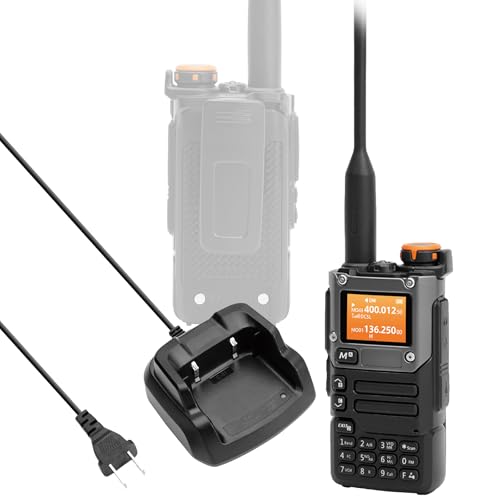
- VHF/UHF multi-band operation with up to 200 channels
- CHIRP and keypad programming support
- Rechargeable battery, VOX, scanning, and weather reception
Best For: Radio-savvy hikers wanting configurable outdoor communication
Best Group Value – MaxTalker MT10 Six-Pack
For groups comparing compact radios for hiking groups, the MaxTalker MT10 offers six rechargeable units with simple FRS operation. Its 22 channels, 121 privacy codes, NOAA alerts, VOX, and LED flashlights cover the basics for coordinating a larger party.
Best For: Hiking groups and families that need six matching radios with rechargeable batteries.
Pros:
- Six-radio pack helps equip a larger hiking party.
- USB-C rechargeable 1200mAh batteries offer standby time of up to 72 hours.
- NOAA alerts, VOX, LED flashlights, and 22 FRS channels add useful trail features.
Cons:
- Not water resistant, so it needs protection in wet conditions.
- Typical range is about 0.6–1.5 miles, with the 5-mile figure dependent on ideal conditions.
The MT10 is a practical choice when group quantity matters most. Its feature set is useful for day hikes and camping, but the lack of water resistance makes a protective pouch worthwhile.
Most Programmable – BAOFENG UV-5G Mini GMRS
The BAOFENG UV-5G Mini is a compact two-pack for hikers who want more control than basic FRS radios provide. It supports GMRS transmission, app programming, up to 999 channels, USB-C charging, and repeater capability, though its advanced setup may require more learning.
Best For: Small hiking teams and outdoor users who want programmable GMRS radios and broad receive coverage.
Pros:
- App, CPS, and CHIRP programming options support flexible setup.
- Up to 999 channels and GMRS repeater capability provide room for customization.
- USB-C charging works with power banks, car adapters, and other USB sources.
- Receives FM, airband, NOAA, VHF/UHF, and other listed signals.
Cons:
- Two-pack is less suitable for larger hiking groups without additional radios.
- Its advanced features may be more complex than a simple license-free FRS radio.
This is the most versatile option for technically minded hikers, especially those already familiar with GMRS channels and programming. For straightforward group communication, a simpler FRS model may be easier to deploy.
Best Weather Protection – Gaswei G2pro+ Floating Radios
For wet trails and demanding conditions, the Gaswei G2pro+ stands out among compact radios for hiking groups with an IP67 waterproof, floating design. These rechargeable FRS radios also include NOAA alerts, dual watch, dual PTT, SOS transmission, and adjustable power modes.
Best For: Hiking, boating, and outdoor groups that prioritize waterproofing and rugged construction.
Pros:
- IP67 casing is waterproof, floating, and designed for harsh environments.
- Two-watt high-power mode is rated for up to 6 miles or more over open water, depending on conditions.
- NOAA alerts, SOS transmission, dual watch, and vibration alerts support trail preparedness.
- Rechargeable batteries are listed with up to 120 hours of battery life.
Cons:
- Only two radios are included, so larger groups may need multiple packs.
- The 7-inch height makes it less pocket-friendly than smaller handheld designs.
The G2pro+ is the strongest pick when rain, splashes, or accidental drops are realistic concerns. Its larger, feature-rich design trades some compactness for durability and emergency-oriented functions.
Best Lightweight Family Pack – Radioddity FS-T3 Four-Pack
The Radioddity FS-T3 is a lightweight four-pack designed for simple family and group communication. Its compact palm-size body, USB-rechargeable batteries, 22 FRS channels, VOX, flashlight, and included earpieces make it approachable for hiking groups with children or mixed experience levels.
Best For: Families and casual hiking groups seeking lightweight, easy-to-use radios in different colors.
Pros:
- Four color-coded radios help users identify their units quickly.
- Lightweight 4.16-ounce design and metal belt clips suit active outings.
- USB-rechargeable 1500mAh batteries are rated for up to 3–4 days.
- Includes earpieces, VOX, 204 privacy codes, and a flashlight.
Cons:
- Listed range is about 3 miles in open land and can be shorter around buildings.
- It is splash resistant rather than fully waterproof.
The FS-T3 balances group quantity, low weight, and ease of use. It is a sensible family hiking option, provided the radios are kept out of heavy rain or standing water.
Trail-Ready Connectivity – Topsung Long-Range FRS Radios
For groups comparing compact radios for hiking groups, the Topsung set combines 22 FRS channels, privacy codes, hands-free iVOX, and a rechargeable 1800mAh battery. Its backlit LCD, loud audio, and NOAA weather-alert access make it practical for changing trail conditions and group coordination.
Best For: Hiking groups that want rechargeable radios with weather alerts and hands-free communication.
Pros:
- 22 FRS channels with 121 privacy codes and compatibility with most FRS radios.
- iVOX voice activation supports hands-free communication while hiking or climbing.
- NOAA weather alerts, backlit LCD, low-battery alert, and automatic power saving add useful trail features.
- USB fast charging provides up to 72 hours of standby after about three hours of charging.
Cons:
- The supplied notes do not specify a precise real-world transmission range.
- Weather-alert access is useful, but it does not replace a dedicated emergency communication device.
Choose this model when feature coverage matters as much as portability. It is especially appealing for groups that value NOAA alerts, hands-free operation, and long standby time on multi-day outings.
Lightweight Team Pick – BAOFENG T22 Compact Radios
The BAOFENG T22 is a strong option among compact radios for hiking groups when low weight and simple charging are priorities. Each radio weighs about 4.2 ounces, includes a belt clip, supports 22 FRS channels, and charges through a widely available USB-C connection.
Best For: Small hiking teams that prioritize pocket-friendly size, loud audio, and USB-C charging.
Pros:
- Ultra-compact design with a secure clip for pockets or belts.
- 22 license-free FRS channels help teams find less crowded communication channels.
- 1W speaker is designed to provide clear, loud audio in noisy environments.
- USB-C charging works with wall chargers, computers, power banks, and car ports.
Cons:
- The radios are not water resistant, which limits suitability for wet-weather hikes.
- The listed maximum range is up to three miles, with actual performance depending on terrain and obstructions.
- The supplied information contains differing battery-capacity references, so buyers should verify the included battery specification.
For dry-weather hikes and organized outdoor teams, the T22 offers a particularly portable design and convenient charging. Its lack of water resistance is the key limitation to consider before taking it on exposed or rainy trails.
Group-Size Value – JIANUA Six-Pack Hiking Radios
For larger groups seeking compact radios for hiking groups, this six-pack supplies enough units for broad team coverage without relying on phones. The radios offer 22 channels, 99 privacy-code sets, USB-C charging, adjustable VOX, belt clips, backlit LCDs, and built-in LED flashlights.
Best For: Families, hiking clubs, and larger outdoor groups that need six radios in one package.
Pros:
- Six radios provide strong value for family outings and organized hiking groups.
- 22 channels and 99 CTCSS/DCS privacy-code sets help groups manage interference.
- USB-C rechargeable batteries support about 8–12 hours of continuous use under stated conditions.
- Compact, drop-proof, rainproof radios include belt clips, adjustable VOX, and LED flashlights.
Cons:
- The stated five-mile range applies to open areas; forested or obstructed terrain may reduce it to about 0.6–1.2 miles.
- The included 1200mAh batteries offer less stated capacity than some larger rechargeable radios.
- Six units may be more than needed for couples or very small hiking parties.
This is the practical choice when every member of a larger party needs a radio. Its weather-oriented design and included flashlights add trail utility, while realistic range expectations remain important in wooded terrain.
Rugged Group Pick – SAMCOM T5 FRS Walkie Talkies
For compact radios for hiking groups that may face rain, mud, drops, or noisy trails, the SAMCOM T5 emphasizes durability and clear communication. Its rechargeable battery, weather features, and group-broadcast button make it especially practical when several hikers need to stay coordinated.
Best For: Hiking groups that prioritize rugged weather protection, long battery life, and one-button group communication.
Pros:
- IP67 waterproof and dustproof construction, with a floating design and metal-reinforced shell rated for 2-meter drops.
- AI noise cancellation helps filter wind, machinery, and crowd noise.
- 2000mAh rechargeable battery offers up to 24 hours of use, with USB-C charging and a dual charging base.
- Group button, NOAA weather channels, SOS flashlight, and FM radio add useful trail features.
Cons:
- The two-radio set may be limiting for larger hiking groups unless additional compatible units are added.
- The listed maximum range is dependent on conditions and terrain.
The T5 is the most trail-ready option here for groups expecting wet weather, accidental drops, or strong wind. Its FRS operation requires no license, while the group button can simplify check-ins when multiple people need the same message.
Battery-Saver Pick – MaxTalker MT10 Rechargeable Walkie Talkies
The MaxTalker MT10 is a straightforward choice among compact radios for hiking groups, combining a rechargeable battery, hands-free VOX, weather scanning, and broad channel compatibility. It is suited to casual outdoor coordination where extended standby matters more than waterproofing.
Best For: Family hikes and casual groups wanting rechargeable radios with long standby time and simple hands-free use.
Pros:
- 1200mAh lithium battery supports USB-C charging and up to 72 hours of standby time.
- 22 FRS channels and 99 privacy-code sets offer many channel combinations.
- NOAA weather scanning, VOX hands-free operation, and an integrated LED flashlight support outdoor use.
- Compatible with other brands using the same channel and privacy code.
Cons:
- It is not water resistant, so it needs extra protection in rain or around water.
- The listed range is up to 5 miles in open areas, and actual hiking range can vary with terrain.
The MT10 makes sense for hikers who want low-maintenance charging and long standby without paying for a rugged waterproof build. Its compact feature set is practical for family outings, but wet-weather users should choose a protected storage solution.
Programmable Radio Pick – Quansheng UV-K5(8)/UV-K6 Two-Way Radio
For hikers seeking compact radios for hiking groups with more control over frequencies and settings, the Quansheng UV-K5(8)/UV-K6 offers VHF/UHF capability, a dual-band display, programming support, and a rechargeable battery. It is a more technical option than the FRS models and is best suited to users comfortable configuring a two-way radio.
Best For: Experienced outdoor users who want programmable VHF/UHF operation, scanning features, and a compact rechargeable handheld.
Pros:
- Supports multi-band transmitting and receiving with up to 200 channels listed in the supplied notes.
- CHIRP and keypad programming provide more configuration flexibility.
- Includes dual-frequency/channel display, channel scanning, VOX, FM radio, and weather-channel reception.
- Rechargeable battery and charging base support field use.
Cons:
- The supplied notes do not specify water resistance or drop protection.
- Its broader programming and frequency features may require more setup than simple FRS radios.
- The listed communication range is 1–3 miles, depending on conditions and terrain.
The Quansheng is the flexibility pick rather than the simplest group radio. Its programming and dual-band functions can appeal to radio-savvy hikers, but users should confirm applicable transmission rules and configure the radios before heading out.
How We Picked the Best Compact Radios for Hiking Groups
We focused on features that matter outside rather than headline range claims alone. Each option was considered for portability, channel access, battery or charging convenience, ease of use, and suitability for group communication. We also looked for practical hiking features such as weather resistance, floating designs, NOAA weather access, VOX operation, bright displays, and built-in lights.
Advertised range depends heavily on terrain, trees, buildings, weather, antenna position, and local interference. In wooded or mountainous areas, real-world range can be much shorter than an open-field specification. For most hiking groups, dependable controls and compatible radios are more valuable than the largest claimed distance.
Quick Comparison
| Best For | Features to Prioritize | Recommended Type |
|---|---|---|
| Large hiking groups | Multiple compatible units, clear audio, rechargeable batteries | Four- or six-pack FRS set |
| Wet or water-adjacent trails | IP rating, waterproofing, floating construction | Water-resistant or floating FRS radio |
| Families and beginners | Simple controls, VOX, readable display | Basic FRS walkie-talkie |
| Experienced radio users | More channels, dual-band support, programming options | Advanced handheld radio |
| Emergency preparedness | NOAA weather channels, strong battery life, flashlight | Feature-rich rechargeable model |
Key Buying Factors for Compact Radios for Hiking Groups
Compatibility and Channels
For a group to communicate, radios must share compatible channels and privacy-code settings. FRS models are generally the simplest choice because they are designed for license-free short-range group use in the United States. More advanced GMRS or dual-band radios may offer additional capabilities, but check local rules and licensing requirements before transmitting.
Range and Audio Clarity
Prioritize intelligible audio, a strong speaker, and controls that are easy to use with cold or gloved hands. A radio with a practical range in your terrain is more useful than one with an impressive open-area claim.
Battery Life and Charging
Rechargeable packs reduce disposable-battery waste and simplify preparation for a day hike. Check charging connectors, included cables, charging time, and whether spare batteries or a power bank can keep the group operating on longer trips.
Weather Protection and Size
Rain, mud, drops, and accidental immersion are common trail risks. Look for a stated water-resistance rating or floating design, while keeping weight and bulk low enough for shoulder straps or pack pockets.
Useful Controls
VOX can help when hands are occupied, though wind and nearby voices may trigger it accidentally. NOAA weather access, a flashlight, a lock button, a backlit display, and adjustable volume can all improve field usability.
Who Should Buy Which Compact Radios for Hiking Groups?
Choose a larger rechargeable pack if you regularly hike with several people or want spare units. Waterproof or floating models are best for rainy routes, river crossings, and boating-oriented outings. Beginners and families should favor simple FRS radios with clear controls, while experienced users may prefer programmable or dual-band handhelds—provided they understand setup and regulatory requirements.