
Standalone DJ controllers give you a more flexible way to perform, letting you mix from USB drives, streaming services, or onboard media without relying on a laptop. The right model can simplify setup while still offering responsive jog wheels, detailed displays, effects, and performance controls.
We compared 10 leading options for portability, workflow, connectivity, audio features, and live-use practicality so you can choose a system that fits your space, skill level, and performance goals.
Best 10 Dj Controllers with Standalone Mode Picks for 2026
Best Portable Pro Pick
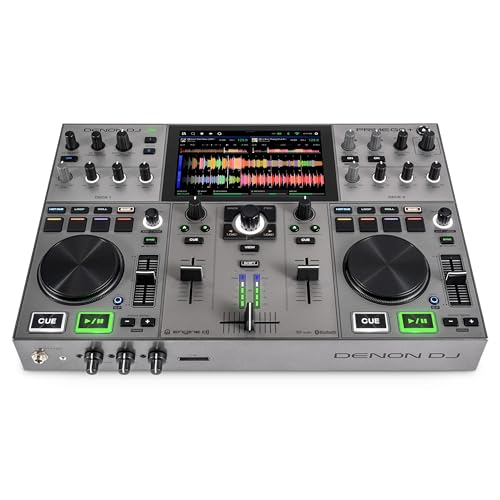
- Battery-powered standalone operation
- Wi-Fi streaming and extensive FX
- Professional outputs in a compact chassis
Best For: Mobile DJs needing advanced, laptop-free performance
Best Club-Style Choice

- Standalone USB playback for rekordbox sets
- 10.1-inch touchscreen and CDJ-style layout
- Beat FX, Sound Color FX, and 16 pads
Best For: DJs wanting familiar club-style controls without a laptop
Best All-in-One Value

- Battery-powered with built-in speakers
- Wi-Fi, streaming, USB, and SD support
- Wireless DJ-light control and touchscreen mixing
Best For: Portable practice and casual sets with minimal equipment
Best Budget USB Deck

- Standalone USB playback without a laptop
- Touch jogwheel and waveform display
- MIDI mode for VirtualDJ control
Best For: Beginners learning USB-based mixing on a budget
Top Standalone Pick

- Laptop-free Engine DJ performance with Wi-Fi, USB, SD, and Dropbox support
- Built-in speakers plus a 7-inch adjustable touchscreen
- Wireless lighting control and broad audio connectivity
Best For: All-in-one mobile, home, and casual performance setups
Four-Deck Standalone Choice
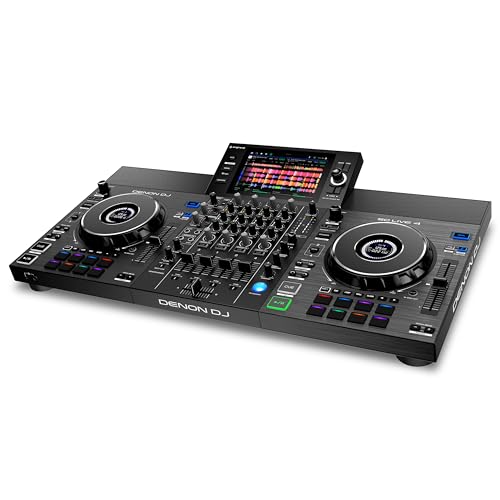
- Four-channel Engine DJ controller with laptop-free operation
- Built-in speakers, Wi-Fi streaming, USB, and SD support
- Serato DJ and Virtual DJ compatibility with extensive outputs
Best For: Four-deck DJs and flexible mobile or club-oriented setups
Value Standalone Option

- Two-channel laptop-free mixing with SD, USB, Dropbox, and streaming
- Built-in speakers and 7-inch touchscreen simplify setup
- Includes performance pads, four effects, and wireless Philips Hue control
Best For: Beginners and casual DJs seeking simple standalone mixing
Best White Standalone DJ Controller
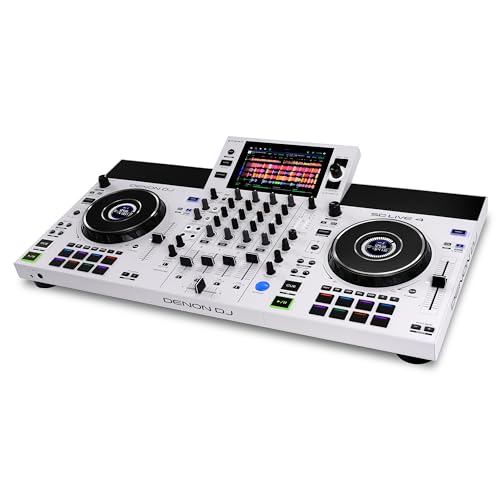
- Laptop-free Engine DJ operation with four-channel mixing
- Wi-Fi, Bluetooth, SD, and USB music access
- Built-in speakers and onboard Stems
Best For: Mobile DJs, livestreamers, and home practice
Best Hybrid Mixer Workflow

- Four-channel mixer with phono and line inputs
- Dual USB connections for seamless DJ handoffs
- Jog displays, FX paddles, EQ, and performance modes
Best For: Hybrid digital-and-analog DJ setups
Best Motorized Standalone System
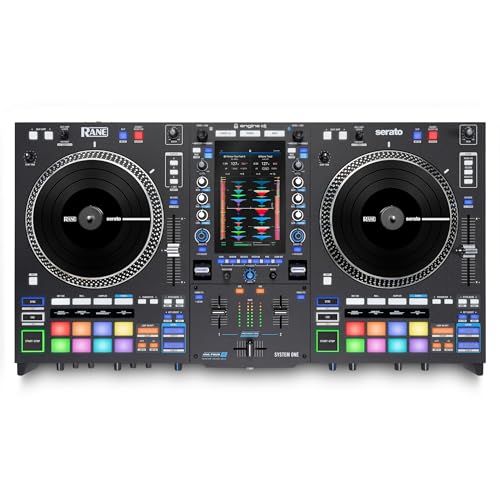
- Motorized aluminum platters with laptop-free Engine DJ operation
- Standalone Stems, streaming, USB, SD, and internal-drive support
- Professional I/O, touchscreen control, and extensive FX
Best For: Open-format and performance-focused DJs
Best Portable Pro Pick – Denon DJ PRIME GO+
The Denon DJ PRIME GO+ is a strong choice among dj controllers with standalone mode for performers who need a compact, battery-powered setup. Its Engine DJ OS, Wi-Fi streaming, streaming-service support, and professional outputs make it suitable for laptop-free sets at home, mobile gigs, or smaller venues.
Best For: DJs who prioritize portability, battery operation, streaming access, and advanced standalone performance features.
Pros:
- Battery-powered design with Engine DJ OS for laptop-free performances.
- Built-in Wi-Fi supports access to more than 100 million tracks across multiple streaming services.
- Includes extensive FX, standalone Stems support, wireless updates, and onboard song analysis.
- Offers balanced XLR, booth, RCA, AUX, microphone, USB, SD, and Bluetooth connectivity.
Cons:
- Its feature-rich design may be more than beginners need.
- Standalone Stems require pre-rendering with Engine DJ Desktop and a one-time software license purchase.
- Battery operation requires charging before mobile performances.
The PRIME GO+ stands out when mobility and feature depth matter most. It combines a small, 8.11-pound chassis with professional I/O and a broad set of creative tools, making it a particularly versatile standalone option.
Best Club-Style Choice – Pioneer DJ XDJ-RX3
The Pioneer DJ XDJ-RX3 is a practical pick among dj controllers with standalone mode for DJs who want a familiar club-style workflow without bringing a laptop. It runs prepared rekordbox sets from USB drives and adds a large touchscreen, performance pads, and built-in effects for expressive live mixing.
Best For: DJs preparing USB-based sets for home practice, mobile work, and small-venue performances.
Pros:
- Two-channel standalone operation works with prepared rekordbox USB sets.
- 10.1-inch touchscreen and CDJ-style layout provide a familiar club-oriented interface.
- Includes Beat FX, Sound Color FX, and 16 performance pads.
- Hardware unlock supports rekordbox Performance mode and computer control with Serato DJ Pro.
Cons:
- At 21 pounds, it is substantially less portable than battery-powered alternatives.
- The supplied notes specify USB-set playback rather than built-in streaming access.
- Its larger footprint may be less convenient for compact setups.
The XDJ-RX3 is best suited to DJs who value a club-inspired layout and dependable USB workflow over maximum portability. Its larger chassis and touchscreen favor a more permanent home setup or gig-ready rig.
Best All-in-One Value – Numark Mixstream Pro Go
The Numark Mixstream Pro Go is one of the more approachable dj controllers with standalone mode for flexible, laptop-free mixing. It combines battery power, built-in speakers, a touchscreen, Wi-Fi streaming, and media-card support, while also offering integrations with Serato DJ and VirtualDJ.
Best For: DJs who want a portable standalone controller with built-in sound, streaming, and lighting-control features.
Pros:
- Battery-powered operation includes built-in speakers and dedicated speaker volume control.
- Supports streaming services, USB drives, SD cards, Dropbox libraries, and Bluetooth audio input.
- 7-inch touchscreen, 6-inch jog wheels, and Engine DJ OS support laptop-free performances.
- Provides balanced XLR and RCA outputs, microphone input, and separate headphone connections.
Cons:
- Standalone Stems require pre-rendering with Engine DJ Desktop and a one-time software license purchase.
- Its built-in speakers are convenient but may not replace a PA system for larger venues.
- The broad feature set may take time to learn fully.
The Mixstream Pro Go is a versatile option for practice, casual events, and mobile sets where convenience matters. Built-in speakers and extensive music-source support make it especially useful when you want to start mixing with minimal additional equipment.
Best Budget USB Deck – Gemini MDJ-500
The Gemini MDJ-500 offers a straightforward entry point for shoppers comparing dj controllers with standalone mode. It plays prepared music directly from USB drives, provides a full-color waveform display and hot cues, and can also work as a MIDI controller for VirtualDJ when connected to a computer.
Best For: Beginners and home DJs who want affordable USB playback with an optional computer-based MIDI mode.
Pros:
- Standalone USB playback works without a laptop.
- Includes a 5-inch touch jogwheel, 4.3-inch waveform display, hot cues, and looping tools.
- Can control VirtualDJ as a mappable MIDI controller through USB.
- V-Case software supports playlists, track analysis, beatgrids, and cue-point preparation.
Cons:
- It is a single media player rather than a two-deck all-in-one system.
- Music access is based on USB preparation rather than built-in Wi-Fi streaming.
- The smaller display and control set are less comprehensive than larger standalone systems.
The MDJ-500 makes sense for learning beatmatching and building USB-based performance habits on a budget. Its MIDI mode adds useful flexibility, but DJs wanting an integrated two-deck setup will need to look at a larger system.
Top Standalone Pick – Numark Mixstream Pro+
The Numark Mixstream Pro+ is a flexible choice for DJs who want dj controllers with standalone mode and minimal extra gear. Its Engine DJ OS supports laptop-free mixing, while Wi-Fi, streaming services, USB, SD, Dropbox, built-in speakers, and a 7-inch touchscreen make it practical for home practice, mobile sets, and casual performances.
Best For: DJs who want an all-in-one, laptop-free controller with speakers, streaming, lighting control, and broad media options.
Pros:
- Standalone Engine DJ operation with USB, SD, Dropbox, and streaming support
- Built-in speakers and dedicated volume control for convenient practice or portable use
- Wireless control for compatible Philips Hue, Nanoleaf, and DMX lighting
- Balanced XLR, RCA, microphone, and dual headphone output options
Cons:
- Its two-deck layout may be less suitable for DJs specifically seeking four-deck control
- Stem performance requires tracks or playlists to be pre-rendered with Engine DJ Desktop
Choose the Mixstream Pro+ if convenience is a priority. It combines standalone playback, streaming, speakers, touchscreen control, and lighting features in a relatively compact controller.
Four-Deck Standalone Choice – Denon DJ SC LIVE 4
The Denon DJ SC LIVE 4 suits DJs comparing dj controllers with standalone mode who want four-deck capability without a computer. Engine DJ provides laptop-free performance, while Wi-Fi streaming, two USB inputs, an SD slot, built-in speakers, and compatibility with Serato DJ and Virtual DJ broaden its use.
Best For: DJs who need four-deck control, built-in speakers, streaming access, and flexible software compatibility.
Pros:
- Four-channel standalone controller with a 7-inch touchscreen
- Supports streaming services including Amazon Music Unlimited, Apple Music, TIDAL, Beatport, Beatsource, and SoundCloud Go+
- Built-in speakers support practice, mobile use, and compact performance setups
- Offers XLR main, RCA main, booth, two microphone, USB, SD, and headphone connections
Cons:
- At 13.6 pounds and approximately 28.3 inches wide, it is less compact than smaller controllers
- The supplied notes do not specify a current software-update date
The SC LIVE 4 is the stronger fit when four-deck mixing and connection flexibility matter more than minimizing size. Its standalone workflow and built-in speakers also make it useful for DJs who move between practice and performance environments.
Value Standalone Option – Numark Mixstream Pro
The original Numark Mixstream Pro is a straightforward option for shoppers seeking dj controllers with standalone mode at the center of their setup. It can play tracks from SD cards, USB drives, Dropbox, and supported streaming services without pre-analyzing tracks, and its built-in speakers and 7-inch touchscreen help keep the system self-contained.
Best For: Beginners and casual DJs who want simple two-channel standalone mixing with speakers and streaming.
Pros:
- Ready-to-use standalone workflow through SD, USB, Dropbox, and streaming sources
- Built-in speakers with dedicated volume control
- 7-inch touchscreen, two-channel mixer, performance pads, and four effects
- Balanced XLR and RCA main outputs plus microphone and two headphone connections
Cons:
- Two-channel design offers less deck capacity than the SC LIVE 4
- Its listed streaming support does not include Amazon Music Unlimited or Apple Music
- It is heavier than the Mixstream Pro+ at 13.47 pounds
The Mixstream Pro focuses on accessible, self-contained mixing rather than maximum expansion. It is a sensible pick for users who value easy setup, onboard sound, and direct access to personal or streaming libraries.
Best White Standalone DJ Controller – Denon DJ SC LIVE 4
The Denon DJ SC LIVE 4 WHITE is a practical choice among dj controllers with standalone mode for DJs who want laptop-free mixing, streaming access, and a distinctive booth-ready design. Its Engine DJ OS, four-channel layout, 7-inch screen, onboard Stems, and built-in speakers support both performance and practice.
Best For: Mobile DJs, livestreamers, and home users who want standalone mixing with streaming and built-in audio.
Pros:
- Runs laptop-free with Engine DJ OS and supports four-channel mixing.
- Built-in Wi-Fi, Bluetooth, SD storage, and USB inputs provide flexible track access.
- Onboard Stems, built-in speakers, and compatibility with Serato DJ Pro and Virtual DJ add versatility.
Cons:
- The 13.6-pound unit may be less convenient for frequent transport than smaller controllers.
- Its feature set may be more than beginners need for basic mixing.
The SC LIVE 4 WHITE stands out when you value an all-in-one workflow and easy access to streamed or stored music. The built-in speakers are especially useful for casual practice, while the four-deck design leaves room for more advanced sets.
Best Hybrid Mixer Workflow – Reloop Mixon 8 Pro
The Reloop Mixon 8 Pro suits DJs comparing dj controllers with standalone mode who also need flexible connections for turntables, media players, laptops, or an iPad. Its four-channel standalone mixer section supports digital and analog sources, while dual USB connectivity helps two DJs share the system.
Best For: Two-DJ setups and performers who mix digital software with turntables or external media players.
Pros:
- Four-channel mixer supports two phono and four line inputs for digital and analog sources.
- Dual USB audio connectivity supports two laptops and USB-C devices, including compatible iPads.
- Jog-wheel displays, FX paddles, EQ, filters, and multiple performance modes offer hands-on control.
Cons:
- The supplied notes do not identify an operating system for fully laptop-free standalone track playback.
- Its 12.9-pound design and broad feature set may require a learning period.
The Mixon 8 Pro is strongest as a flexible performance mixer rather than a clearly documented self-contained media player. Choose it when analog inputs, dual-computer handoffs, and extensive software performance controls matter most.
Best Motorized Standalone System – RANE SYSTEM ONE
The RANE SYSTEM ONE is a premium option among dj controllers with standalone mode, combining Engine DJ laptop-free operation with motorized 7.2-inch aluminum platters. It is built for DJs who want a turntable-style feel alongside streaming, USB, SD, internal storage, standalone Stems, and Serato integration.
Best For: Open-format and performance DJs who prioritize motorized platters, standalone Stems, and broad media-source flexibility.
Pros:
- Motorized platters preserve a turntable-inspired feel while running on Engine DJ OS.
- Supports USB, SD, an internal drive slot, multiple streaming services, Serato DJ Pro, and djay PRO.
- Offers standalone Stems, extensive FX, a vertical touchscreen, professional outputs, and SoundSwitch lighting support.
Cons:
- At 29.4 pounds, it is substantially heavier than the other listed controllers.
- The extensive controls and performance features may be excessive for simple home mixing.
- Its larger footprint requires more booth or table space.
The SYSTEM ONE is the most performance-oriented choice here, especially for DJs who want tactile platter control without giving up standalone flexibility. Its weight and size make it better suited to a permanent setup or carefully planned gigs than casual transport.
How We Picked the Best Dj Controllers with Standalone Mode
We evaluated these systems by looking at the features that matter most when performing without a computer. Our comparison considered standalone functionality, media and streaming support, screen quality, deck count, mixer layout, jog-wheel response, effects, portability, outputs, and overall workflow.
We also considered how well each controller serves different use cases, from mobile DJs and home users to performers who need club-style controls or a more tactile, performance-focused setup. Speaker integration, battery operation, wireless connectivity, and ecosystem compatibility were treated as practical advantages rather than automatic requirements.
Quick Comparison
| Best For | What to Prioritize | Ideal Features |
|---|---|---|
| Portable performers | Size, weight, and power options | Battery operation, compact layout, wireless features |
| Club-style mixing | Familiar professional workflow | Four channels, large jog wheels, strong outputs |
| Home and party DJs | Ease of use and built-in sound | Touchscreen, speakers, streaming support |
| Scratch and performance DJs | Tactile control and responsiveness | Motorized platters, performance pads, adjustable torque |
| Hybrid users | Standalone and computer flexibility | USB/MIDI support, software integration, multiple inputs |
Key Buying Factors for Dj Controllers with Standalone Mode
Media and Streaming Support
Check which file sources and streaming platforms are supported, and whether the controller requires an internet connection for streaming features. USB playback is useful for reliable gigs, while Wi-Fi and streaming access can expand your music library for casual sets and preparation.
Deck Count and Mixer Layout
Two-deck systems are generally simpler and more portable. Four-channel models provide more room for layering tracks, using external sources, or developing a club-style workflow. Make sure the channel count matches how you actually mix rather than paying for unused complexity.
Display and Navigation
A clear touchscreen or detailed onboard display reduces the need for a laptop. Look for fast browsing, waveform visibility, useful track information, and controls that remain easy to operate while performing.
Portability, Power, and Outputs
For mobile work, consider weight, carrying options, battery life, and whether speakers are built in. For professional setups, review balanced master outputs, booth connectivity, headphone monitoring, microphone inputs, and the available connection options for external gear.
Performance Controls
Jog-wheel feel, pads, looping, hot cues, beat effects, and filter controls all influence how expressive the system feels. DJs who scratch or prefer physical feedback should pay particular attention to platter design and response, while open-format performers may value fast browsing and dependable pad access.
Who Should Buy Which Dj Controllers with Standalone Mode?
Choose a compact battery-powered system if you regularly perform at venues with limited space or need quick setup. A controller with integrated speakers is convenient for practice, small gatherings, and mobile use where a separate sound system is unnecessary.
For DJs transitioning toward club equipment, prioritize a larger all-in-one system with a familiar mixer layout, strong outputs, and enough channels for more advanced sets. Scratch-focused performers should look for motorized platters and highly responsive performance controls. If you plan to switch between standalone operation and laptop software, choose a model with robust USB/MIDI integration so it can grow with your workflow.