
Testing a fiber connection at home does not always require professional equipment. The right tester can help identify breaks, confirm light levels, locate faults, or check whether a newly installed run is working correctly.
This roundup covers 10 fiber optic testers for home use, from compact visual fault locators and optical power meters to multifunction network testers and touchscreen OTDR devices. The best choice depends on your fiber type, connector needs, testing depth, and budget.
Best 10 Fiber Optic Testers for Home Use Picks for 2026
Portable All-in-One Tester

- Eight-wavelength optical power measurement
- Integrated OPM, VFL, and RJ45 testing
- FC/SC/ST interfaces with calibration support
Best For: Home users wanting several basic fiber-testing functions in one device
Fault-Finding Kit
Visual Fault Locator with Adapters

- Locates breaks, bends, cracks, and poor connections
- Includes five adapters and three patch cords
- Supports ST, SC, FC, and LC testing setups
Best For: Home troubleshooting across multiple fiber connector types
Network Service Tester
NF-8508 Cable and Fiber Analyzer

- Seven-wavelength power meter and VFL
- Adds PoE, cable length, port, and continuity tests
- Rechargeable battery with up to 10 hours of use
Best For: Home users testing both fiber and Ethernet networks
High-Capacity Pocket Tester

- Measures 10 standard wavelengths
- Stores up to 500 measurement sets
- Adds VFL, RJ45 testing, and LED lighting
Best For: Portable home testing with broad wavelength coverage and saved readings
Best Complete Kit
- Power meter and light source included
- Seven calibrated wavelengths
- Self-calibration and rugged housing
Best For: Home users needing a complete fiber test setup
Best Signal Detector

- Detects 850–1625 nm signals
- No setup or interpretation required
- Non-contact design with audible alerts
Best For: Quick signal-presence checks on fiber ports
Best Multifunction Tester
- OPM, VFL, and LAN tester combined
- -70 to +10 dBm measurement range
- Rechargeable battery and LCD display
Best For: Mixed fiber and home-network troubleshooting
Best Complete FTTH Kit
Komshine KLT-12E Loss Tester Toolkit
- Power meter, light source, and VFL included
- Includes fiber cleaning platform and supplies
- Portable, battery powered, shock-resistant case
Best For: Home FTTH installation, inspection, and loss testing
Best Advanced Diagnostic Tester

- OTDR with 1310/1550nm and event mapping
- Adds RJ45, PoE, IP camera, and Wi-Fi tools
- 5.4-inch touchscreen with curve storage
Best For: Advanced fiber and mixed network troubleshooting
Best Compact Multitool

- Power meter, VFL, RJ45 tester, finder, and flashlight
- Supports ten wavelengths and -70dBm to +10dBm
- Stores up to 500 readings in a compact body
Best For: Portable home fiber checks and basic network troubleshooting
Portable All-in-One Tester – OPM-VFL-1 Fiber Power Meter
For homeowners who want fiber optic testers for home use without carrying multiple tools, the OPM-VFL-1 combines an optical power meter, visual fault locator, and RJ45 tester. It supports eight wavelengths, FC/SC/ST interfaces, and a broad -70 to +6 dBm test range.
Best For: Home users who need basic fiber signal checks, visible fault tracing, and RJ45 testing in one portable unit.
Pros:
- Measures eight standard wavelengths from 850 to 1650 nm.
- Combines OPM, VFL, and RJ45 functions.
- Supports backlight selection, automatic shutdown, wavelength memory, and user calibration.
- Displays readings in both mW and dBm.
Cons:
- Two AA batteries are required but not included.
- Its optical power range ends at +6 dBm, lower than some alternatives.
This is a practical choice when convenience matters more than specialized features. Its universal fiber interfaces and integrated functions make it useful for occasional household troubleshooting.
Fault-Finding Kit – Visual Fault Locator with Adapters
This visual fault locator kit is among the more approachable fiber optic testers for home use when the main goal is finding breaks, bends, cracks, or poor connections. Its 2.5 mm universal connector works with ST, SC, and FC interfaces, while included adapters and patch cords expand compatibility.
Best For: Home network owners who need to trace visible fiber faults across several connector types.
Pros:
- Designed to locate breaks, bends, cracks, and poor connections.
- Includes FC, ST, LC, and SC adapters plus an FC-to-LC adapter.
- Comes with three short patch cords for panel troubleshooting.
- Compact and lightweight for field or household use.
Cons:
- Two AA batteries are not included.
- It is a visual fault locator kit rather than a power meter.
Choose this kit if connector flexibility and included accessories are more important than measuring optical signal strength. The patch cords can help test connections without removing fibers from a distribution panel.
Network Service Tester – NF-8508 Cable and Fiber Analyzer
The NOYAFA NF-8508 is a broad-purpose option among fiber optic testers for home use, combining optical testing with extensive copper-network diagnostics. It includes a seven-wavelength power meter, VFL, RJ45 functions, cable-length measurement, PoE testing, port flashing, and non-contact voltage detection.
Best For: Home network projects involving both fiber links and Ethernet, phone, or BNC cabling.
Pros:
- Measures seven wavelengths with a -70 to +10 dBm range.
- Includes continuity, cable scanning, port flashing, length, PoE, and VFL functions.
- Measures RJ45 cable lengths up to 200 m.
- Rechargeable 1500mAh battery provides up to 10 hours of use and charges via Type-C.
Cons:
- At 0.59 kg, it is heavier than the mini fiber testers listed here.
- Its many network features may be unnecessary for users checking fiber only.
This is the strongest fit for technically involved home installations. It costs portability in exchange for a much wider set of network-maintenance tools and a rechargeable battery.
High-Capacity Pocket Tester – M70-10 OPM and VFL
The M70-10 is a compact choice for fiber optic testers for home use, pairing a 10-wavelength optical power meter with a 10 mW visual fault locator, RJ45 wiring test, and LED light. Its -70 to +10 dBm range and included FC-LC adapter make it versatile for basic household fiber work.
Best For: Home users who want a pocket-sized tester with broad wavelength coverage and onboard result storage.
Pros:
- Tests 10 standard wavelengths, including 1270 and 1577 nm.
- Combines OPM, 10 mW VFL, RJ45 testing, and LED lighting.
- Stores up to 500 measurement sets.
- Claims measurement error below ±0.2 dB and includes an FC-LC adapter.
Cons:
- Two AAA batteries are required but not included.
- It is intended for basic testing rather than a larger professional test kit.
Among these options, the M70-10 stands out for wavelength coverage, compactness, and data storage. It is a good match for users who expect to repeat checks and want readings available for later review.
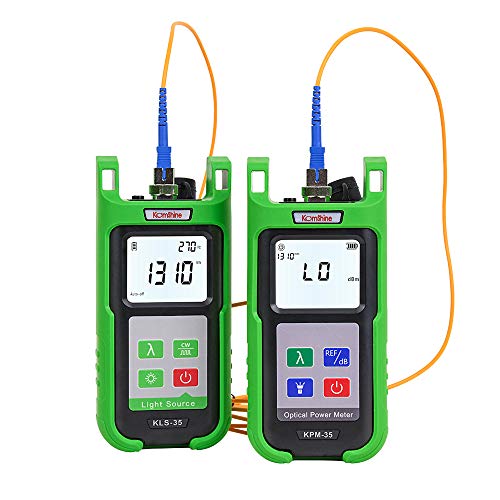
Best Complete Kit – Komshine KPM-35 + KLS-35-MS
For shoppers comparing fiber optic testers for home use, this Komshine set combines an optical power meter with a fiber light source. It supports seven calibrated meter wavelengths and both singlemode and multimode testing, making it a practical choice for broader fiber troubleshooting.
Best For: Home users who want a matched power-meter and light-source kit for FTTH and general fiber testing.
Pros:
- Includes both the KPM-35 power meter and KLS-35-MS light source.
- Supports seven meter wavelengths from 850 nm through 1625 nm.
- Offers self-calibration, automatic shutdown, LED backlight, and a 2 m drop-resistant silicone jacket.
Cons:
- Requires batteries rather than USB charging.
- At 0.45 kg, it is less compact than a single handheld detector.
- The kit may provide more equipment than needed for simple signal-presence checks.
This is the more comprehensive option when you need both measurement and a controlled light source. Its broad wavelength coverage and protective build make it well suited to repeated home or outdoor fiber checks.
Best Signal Detector – Fluke FiberLert-125
If you want a straightforward option among fiber optic testers for home use, the Fluke Networks FiberLert-125 detects optical signals without requiring setup or result interpretation. Light and sound alerts indicate whether a signal is present across singlemode and multimode fiber.
Best For: Home users who mainly need quick, non-contact signal-presence checks on ports and patch cords.
Pros:
- Detects optical power from 850 to 1625 nm on singlemode and multimode fiber.
- Uses visual and audible indicators without requiring setup or interpretation.
- Non-contact detection helps reduce the risk of damaging fiber connections.
- Includes two AAA batteries, automatic five-minute shutoff, and a two-year warranty.
Cons:
- It indicates signal presence rather than providing detailed dBm loss measurements.
- It does not include a separate light source or visual fault locator.
The FiberLert-125 is a focused diagnostic tool rather than a full measurement kit. Its compact design and simple alerts are useful when the main question is whether an optical signal is reaching a port or patch cord.
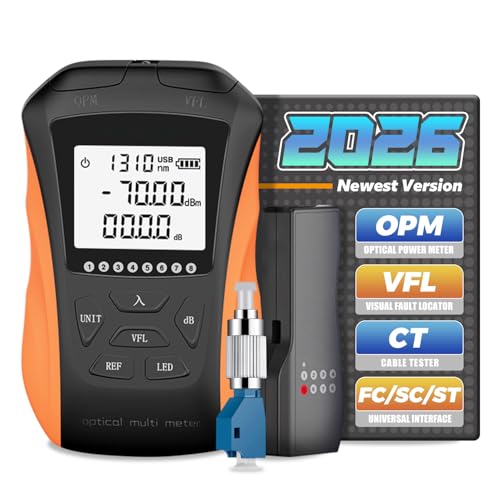
Best Multifunction Tester – Y8 Optical Power Meter
For a multifunction approach to fiber optic testers for home use, this Y8 unit combines an optical power meter, visual fault locator, and cable tester in one rechargeable device. It supports multiple fiber wavelengths and can also check LAN cable continuity.
Best For: Home users who want one portable tester for fiber power, visible fault tracing, and basic LAN cable checks.
Pros:
- Combines OPM, VFL, and cable-tester functions in one unit.
- Measures seven listed fiber wavelengths with a -70 dBm to +10 dBm range.
- Includes continuous and flashing red-light modes for locating breaks or bends.
- Uses a 1100 mAh rechargeable Li-ion battery with USB charging and an LCD display.
Cons:
- Its broad feature set may be unnecessary for users who only need signal detection.
- The supplied notes identify FC, SC, and ST compatibility, so other connector types may require an adapter.
- It is heavier than the compact FiberLert detector at 145 g.
This Y8 is the most versatile single-device choice in the group. The combination of optical measurement, fault locating, LAN continuity testing, and USB charging makes it practical for varied home networking tasks.
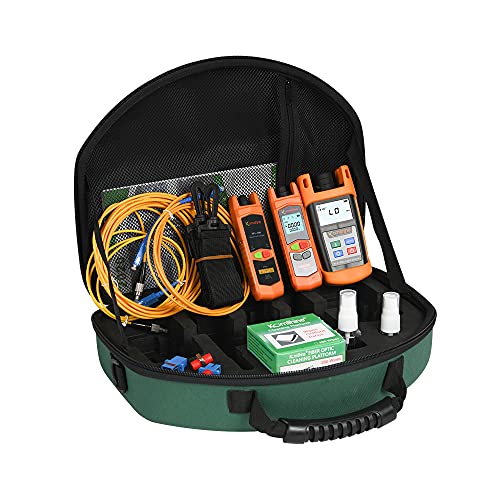
Best Complete FTTH Kit – Komshine KLT-12E Loss Tester Toolkit
For homeowners and installers comparing fiber optic testers for home use, the Komshine KLT-12E is a practical all-in-one FTTH kit. It combines optical power measurement, a 1310/1550nm light source, visual fault locating, a jump cable, and fiber cleaning supplies in a portable case.
Best For: Home fiber installation, inspection, cleaning, and basic loss testing.
Pros:
- Includes an optical power meter with a -70 to +10dB range.
- Combines a 1310/1550nm light source with a visual fault locator.
- Includes cleaning supplies, couplers, and a 1m jump cable.
- Portable, shock-resistant, waterproof, and battery powered.
Cons:
- The kit is more extensive than necessary for simple continuity checks.
- The supplied light source is specified for singlemode 1310/1550nm testing.
The KLT-12E makes sense when you want one organized kit for several FTTH tasks rather than a standalone meter. Its combination of testing and cleaning tools is especially useful during home network installation or troubleshooting.
Best Advanced Diagnostic Tester – WANLUTECH MT-5500 OTDR
The WANLUTECH MT-5500 is a strong option for experienced users seeking fiber optic testers for home use with broader network capabilities. Its OTDR supports 1310/1550nm testing and event mapping, while the handheld unit also adds power measurement, VFL, cable testing, PoE output, and IP camera tools.
Best For: Advanced home network troubleshooting, fiber-link diagnostics, and mixed Ethernet/IP-camera work.
Pros:
- OTDR offers 28dB/26dB dynamic range at 1310/1550nm.
- 5.4-inch touchscreen displays event maps and saved testing curves.
- Includes OPM, VFL, light-source, optical-loss, RJ45 TDR, and cable-tracing functions.
- Supports 4K IP camera testing, Wi-Fi analysis, and up to 30W PoE output.
Cons:
- The 1310/1550nm model does not support testing live fiber.
- Its extensive feature set may be more than casual home users need.
- It requires a 12V DC power input.
This is the most capable and specialized choice in the group. Choose it when you need OTDR event information and copper, PoE, or camera testing in one instrument, rather than only basic fiber power readings.
Best Compact Multitool – Portable 5-in-1 Fiber Tester
For straightforward fiber optic testers for home use, this portable 5-in-1 model keeps several everyday functions in one compact device. It combines an optical power meter, 15km visual fault locator, RJ45 tester, cable finder, and LED flashlight, with support for common connector types and ten wavelengths.
Best For: Home users who want portable fiber power readings, fault finding, and basic RJ45 checks.
Pros:
- Combines five useful functions in a pocket-friendly tester.
- Supports ten wavelengths from 850nm through 1650nm.
- Measures from -70dBm to +10dBm and displays mW or dBm.
- Stores up to 500 records and includes adjustable backlight and auto-shutdown.
Cons:
- It does not list an OTDR or optical light-source function.
- The supplied device is centered on basic testing rather than full fiber-link characterization.
This tester is a convenient fit for small tool bags and routine checks. Its broad wavelength support and built-in cable utilities make it more versatile than a basic power meter, while its compact design keeps it approachable for home use.
How We Picked the Best Fiber Optic Testers for Home Use
We focused on tools that are practical for homeowners, DIY network builders, small offices, and technically confident users. Selection factors included supported wavelengths, connector compatibility, measurement range, fault-finding features, ease of use, portability, battery charging, and the amount of information each tester provides.
Simple visual fault locators and power meters are generally easier to use, while combination kits add functions such as RJ45 testing, cable finding, light-source testing, or loss measurement. OTDR models offer the deepest analysis but require more setup knowledge and typically cost more.
Quick Comparison
| Tester type | Best for | Typical strengths | Potential limitation |
|---|---|---|---|
| Visual fault locator | Finding visible breaks and sharp bends | Simple operation and low cost | Limited measurement detail |
| Optical power meter | Checking received light levels | Useful numerical readings | May require a separate light source |
| Multifunction tester | Mixed fiber and Ethernet tasks | Several tools in one device | More controls and settings to learn |
| Loss tester kit | Basic link-loss verification | Includes meter and light source | Requires careful reference setup |
| OTDR tester | Detailed fault and distance analysis | Event maps and fault location | Higher price and steeper learning curve |
Key Buying Factors for Fiber Optic Testers for Home Use
Fiber Type and Wavelengths
Confirm whether you are testing single-mode, multimode, or both. Common wavelengths include 850, 1310, and 1550 nm, but compatibility varies by device. A tester must support the wavelengths used by your equipment to produce meaningful results.
Connector Compatibility
FC, SC, and ST connectors are common in fiber installations, while LC connectors are frequent in modern network hardware. Look for included adapters or a replaceable interface if your patch cables use different connector styles.
Testing Depth
Choose a visual fault locator for basic continuity and visible-break checks. Select an optical power meter when you need actual signal-level readings. A loss kit is better for evaluating link attenuation, while an OTDR is appropriate for locating events by distance.
Ease of Use and Portability
For occasional household troubleshooting, a compact rechargeable tester with a clear display is often more useful than a professional platform with complex settings. Backlit screens, automatic shutoff, durable cases, and USB charging can make a noticeable difference.
Who Should Buy Which Fiber Optic Testers for Home Use?
- For basic DIY checks: Choose a visual fault locator or a simple OPM/VFL combination.
- For homes with Ethernet and fiber: A multifunction model with RJ45 testing can reduce the number of tools you need.
- For installers and serious hobbyists: A loss tester kit provides more useful link verification than a standalone fault light.
- For advanced troubleshooting: Choose an OTDR when you need event maps, distance-to-fault readings, or detailed cable analysis.
Before buying, verify the connector adapters, wavelength support, measurement range, and included accessories. Also remember that power meters and OTDRs should be used carefully: clean connectors, follow the device reference procedure, and never look into an active fiber port.