
A portable screen can turn a meeting room, classroom, or backyard into a more comfortable viewing space. The right choice depends on more than diagonal size: setup time, aspect ratio, stability, and carrying size matter just as much.
These 10 picks span compact 50-inch tripod models through a 150-inch outdoor screen, so you can narrow your options by where and how you present.
Best 10 Portable Presentation Screen Picks for 2026
Best Adjustable Tripod
Paris Rhône 100-Inch Projector Screen

- 100-inch, 16:9 PVC screen
- Tripod adjusts from 64 to 85 inches
- Carry bag and ground nails included
Best For: Presenters moving between indoor rooms and outdoor venues
Best for Outdoor Groups
ZUVMITG 120-Inch Screen with Stand

- 120-inch front/rear projection surface
- Stakes, ropes, and sandbags included
- Washable fabric packs into carry bag
Best For: Larger outdoor groups needing flexible projector placement
Best for Classroom Presentations
PropVue 100-Inch Tripod Screen
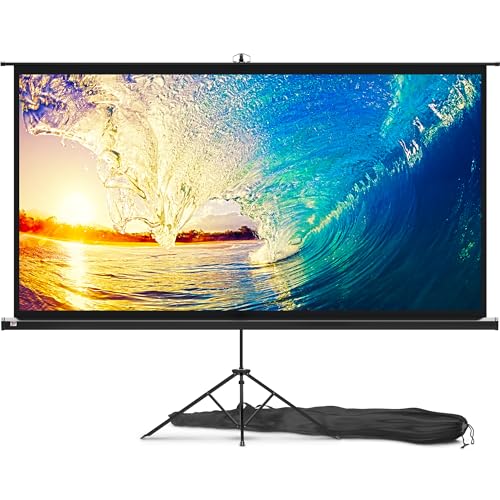
- 100-inch matte 16:9 screen
- Retractable, height-adjustable tripod
- Fitted carry bag included
Best For: Recurring presentations in classrooms and offices
Best for Small Spaces

- Compact 50-inch roll-up screen
- Stands on a floor or table
- Matte surface with black border
Best For: Close-range presentations in compact spaces
Best for Flexible Setup
VISULAPEX 80-Inch Screen with Stand

- 80-inch, 16:9 fiberglass screen
- Adjustable tripod and tensioned supports
- Carrying bag and roll-up storage
Best For: Adjustable indoor or outdoor setups
Best Lightweight 80-Inch Option
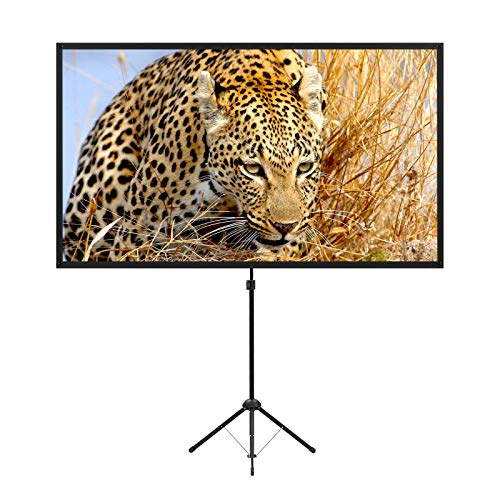
- Listed weight of 8.5 pounds
- 80-inch, 16:9 viewing area
- Adjustable tripod and carrying bag
Best For: Moving an 80-inch screen between venues
Best for Compact Presentations

- Compact 50-inch, 4:3 format
- Retractable matte screen
- Floor or tabletop tripod placement
Best For: Smaller rooms and 4:3 presentations
Best Lightweight Stand

- 80-inch screen with freestanding frame
- 5-pound design and padded carry bag
- 160-degree viewing angle
Best For: Lightweight, stand-based presentations on the go
Best Stable Large Screen
EMART 120-Inch Projector Screen

- 120-inch, 16:9 display
- Flat bases plus included water bags
- Elastic-connected frame parts
Best For: Larger groups needing a weighted freestanding screen
Best Packable Wall Screen
AAJK 150-Inch Projection Screen

- 150-inch, 16:9 viewing format
- Foldable 2.8-pound fabric screen
- Washable; requires mounting
Best For: Large displays with an available mounting surface
Best Adjustable Tripod – Paris Rhône 100-Inch Projector Screen
If your portable presentation screen needs to work indoors and outside, this 100-inch model offers a height-adjustable tripod and a PVC viewing surface. Its 16:9 format suits widescreen slides as well as movies.
Best For: Presenters who want a large screen they can reposition between rooms or take outdoors.
Pros:
- Tripod adjusts from 64 to 85 inches high.
- 1.5-gain PVC screen has a stated 160-degree viewing angle.
- Includes a carry bag and three ground nails for outdoor setup.
Cons:
- The 100-inch screen may be larger than needed in a small meeting space.
- PVC surface is less compact to pack than the foldable fabric screen in this lineup.
The adjustable stand makes this a flexible choice when screen height matters. For outdoor use, bring the included ground nails and choose a suitable spot to anchor the tripod.
Best for Outdoor Groups – ZUVMITG 120-Inch Screen with Stand
For a portable presentation screen that can serve a bigger group outside, this 120-inch, 16:9 model pairs a steel frame with a foldable milk-silk fabric surface. It supports projection from either the front or rear.
Best For: Larger backyard gatherings or events where rear-projection flexibility and outdoor anchoring are useful.
Pros:
- Includes four stakes, two ropes, and two sandbags to help secure the stand.
- Front and rear projection with a stated 160-degree viewing angle.
- Washable fabric folds into the included carry bag.
Cons:
- A 120-inch screen needs more setup space than a 50- or 100-inch option.
- Assembly involves a frame and separate anchoring accessories rather than a single retractable unit.
Its size and anchoring kit are the main reasons to choose it. Check that your venue has enough room for the frame and, outdoors, suitable ground or space for the included weights.
Best for Classroom Presentations – PropVue 100-Inch Tripod Screen
The PropVue is a portable presentation screen built around a familiar retractable tripod format. Its 100-inch, 16:9 matte screen and adjustable height make it a practical option for classrooms, offices, and other shared spaces.
Best For: Presenters who want a large tripod screen for recurring school, office, or community events.
Pros:
- Retractable design assembles in three steps and comes with a fitted carry bag.
- Adjustable tripod has wide legs for support.
- Matte screen lists 1.1 gain and a 160-degree viewing angle.
Cons:
- At a listed 17.6 pounds, it is heavier than some other screens in this roundup.
- The 100-inch format may be cumbersome in tight rooms.
This is a straightforward pick if presentations are your priority and you prefer a retractable screen over a frame assembled from separate pieces. Allow room for the tripod legs when choosing where to place it.
Best for Small Spaces – Pyle PRJTP53 50-Inch Screen
When a portable presentation screen must fit a desk, table, or compact room, the Pyle PRJTP53 offers a smaller 50-inch option. Its manual roll-up design can stand on a flat floor or tabletop.
Best For: Individual or small-group presentations where a full-size screen would take up too much space.
Pros:
- Retractable screen is designed for quick setup and travel.
- Works on a flat floor or table for flexible placement.
- Matte white surface has a black masking border for image alignment.
Cons:
- Its 50-inch size offers less viewing area for audiences seated farther away.
- No carry bag or outdoor anchoring accessories are listed in the supplied details.
Choose this model for portability and close-range viewing rather than a large audience. Its placement options are useful, but the small image area is the key trade-off.
Best for Flexible Setup – VISULAPEX 80-Inch Screen with Stand
This portable presentation screen pairs an 80-inch, 16:9 viewing area with an adjustable tripod, making it useful for presentations or movie nights in different locations. Its fiberglass screen has a black-coated back and a stated 1.2 gain.
Best For: Buyers who want an adjustable 80-inch screen for indoor or outdoor use.
Pros:
- Tripod adjusts from 59 to 89 inches floor-to-bottom.
- Spring-tensioned support tubes help keep the screen flat.
- Includes a carrying bag and rolls into a storage tube.
Cons:
- Needs at least 70 inches of width and, per the seller, more than 89 inches of indoor height.
- The 16:9 format may leave unused space with 4:3 presentation slides.
The height range is its main advantage if you expect to set up in varied spaces. Check the room dimensions before buying, especially for indoor use.
Best Lightweight 80-Inch Option – excelimage Portable Screen
At a listed 8.5 pounds, this portable presentation screen is a practical choice when you need an 80-inch display you can carry between venues. Its 16:9 screen uses four spring-tensioned aluminum tubes to help maintain a flat surface.
Best For: Buyers prioritizing a lightweight, full-size screen for changing indoor or outdoor locations.
Pros:
- 80-inch screen offers a stated 160-degree viewing angle.
- Foldable, adjustable tripod supports mobile use.
- Carrying bag holds the parts for transport.
Cons:
- Assembly involves separate tripod and support-tube parts.
- Its 16:9 shape is less suited to filling the screen with 4:3 content.
Choose this one if carrying weight matters but you still want an 80-inch image. Allow a little setup time to assemble the tensioned frame.
Best for Compact Presentations – Pyle 50-Inch Tripod Screen
This 50-inch portable presentation screen is a smaller alternative for classrooms, offices, and other settings where an 80-inch screen would be excessive. Its retractable design and tripod support quick placement on a flat floor or table.
Best For: Presenters who need a compact 4:3 screen for smaller spaces.
Pros:
- Retractable screen simplifies setup and packing.
- White matte fabric has a black masking border.
- Tripod can stand on a flat floor or table.
Cons:
- 50-inch size offers less viewing area than the 80-inch options.
- 4:3 aspect ratio will not fill the screen with 16:9 content.
The Pyle makes the most sense when compact placement and 4:3 material matter more than screen size. For a larger audience or widescreen content, consider an 80-inch 16:9 model instead.
Best Lightweight Stand – HOIN 80-Inch Projector Screen
The HOIN 80-inch portable presentation screen pairs a freestanding aluminum frame with a foldable polyester screen. At 5 pounds, it is a practical choice when you need to move between meeting rooms, classrooms, or occasional backyard screenings.
Best For: Presenters who want a lightweight, self-supporting screen that fits in a car trunk.
Pros:
- Includes a padded carrying bag for transport.
- Frame is designed for setup in a few minutes.
- 160-degree viewing angle accommodates people seated off-center.
Cons:
- At 80 inches, it offers less display area than the larger screens in this roundup.
- Outdoor use in wind may require securing the frame to the ground.
Choose this model when easy transport and a stand matter more than maximum screen size. Its double-sided projection fabric also gives you flexibility in where you place the projector.
Best Stable Large Screen – EMART 120-Inch Projector Screen
The EMART 120-inch portable presentation screen offers a larger display for group viewing, with a frame-supported surface designed to stay taut. Its flat bases and included water bags make it especially relevant when a standard lightweight stand may feel less secure.
Best For: Larger presentations or outdoor gatherings where stand stability is a priority.
Pros:
- 120-inch, 16:9 screen provides ample space for a group.
- Flat bases and included water bags add weight at ground level.
- Elastic-connected parts and a slide-over screen simplify assembly.
Cons:
- At 19.4 pounds, it is substantially heavier to carry than the other listed options.
- The weighted bases and water bags add setup steps when maximum stability is needed.
This is the more substantial stand-based option if you have room to transport it. The trade-off for its larger screen and weighted support is extra carrying weight.
Best Packable Wall Screen – AAJK 150-Inch Projection Screen
The AAJK 150-inch portable presentation screen delivers the largest image area of these three while folding into a backpack or suitcase. It is a fabric-only, wall-mount option rather than a freestanding setup, so plan where you will hang it before buying.
Best For: Large-format presentations or movie nights where a suitable mounting surface is available.
Pros:
- 150-inch, 16:9 format offers a 132-by-73-inch viewing area.
- Foldable, 2.8-pound design is easy to pack.
- Washable polyester fabric supports repeated use.
Cons:
- No stand is listed; installation requires a wall or another place to attach the screen.
- Its large dimensions call for substantial clear mounting space.
This screen makes sense if display size and compact storage outrank stand convenience. Check your available wall space and attachment method before choosing it for a presentation venue.
How We Picked These Portable Presentation Screens
We compared the listed screen sizes, aspect ratios, stand designs, materials, and included portability features. The selection covers compact pull-up tripod screens, mid-size screens with stands, and larger outdoor-oriented setups. Product descriptions do not establish real-world brightness, wrinkle resistance, or wind performance, so confirm those details through current specifications and buyer feedback before ordering.
Quick Comparison by Use
For close-range presentations in a small room, the two Pyle 50-inch tripod screens are the easiest size to accommodate; check their aspect ratios carefully, since one is listed as 4:3. The 80-inch options offer more image area without jumping to a 100-inch footprint, making them a starting point for multipurpose rooms. The 100-inch screens suit larger groups when you have adequate projector distance. The 120-inch options and 150-inch outdoor screen prioritize a bigger image but require more setup space and careful attention to stability.
Key Buying Factors for a Portable Presentation Screen
Match the Aspect Ratio to Your Content
A 16:9 screen suits widescreen slides and most video. A 4:3 screen can work well for older presentation formats, but widescreen content will use less of its surface. Check your projector’s output and the slides you use most often rather than choosing by screen size alone.
Check Size Against the Room
Measure the available wall or floor area, ceiling height, and likely viewing distance. Remember that a screen’s diagonal measurement is not its width, and the stand may extend beyond the viewing surface. Also confirm that your projector can produce a sharp, sufficiently bright image at the intended size and placement.
Consider Setup, Transport, and Stability
A 50-inch roll-up tripod is convenient when one person needs to move between rooms. Larger screens with separate frames or stands may take more time and room to assemble. For outdoor use, look at the supplied anchoring options, such as sandbags, and follow the manufacturer’s guidance; a large screen can catch the wind. Check packed dimensions and weight if the screen must fit in a car, closet, or carry bag.
Read Material Claims Carefully
A listed gain figure describes how a screen directs reflected light, but it does not guarantee a better picture in every room. Likewise, “4K HD” describes intended compatibility, not the resolution your projector will deliver. If rear projection matters, verify that the specific model supports it; do not assume every outdoor screen does.
Who Should Buy Which Portable Presentation Screen?
Choose a 50-inch Pyle tripod screen for frequent travel or tight meeting spaces, selecting 4:3 only if that format fits your content. Consider an 80-inch screen with a stand for mixed presentations and occasional movie nights. Move to a 100-inch model when larger audiences justify the extra footprint. Choose a 120- or 150-inch option primarily for spacious venues or outdoor events, after checking projector brightness, packed size, and a safe way to secure the screen.