
The right vocal processor can add pitch correction, harmonies, reverb, delay, looping, and feedback control without forcing you to build a complicated rack system. For singers, streamers, podcasters, and live performers, phantom power support can also simplify microphone setup.
We compared 10 popular vocal processors and bundles across connectivity, vocal effects, ease of use, performance features, and overall versatility. Use the guide below to narrow the options by your microphone, setup, and performance goals.
Best 10 Vocal Processor with Phantom Power Picks for 2026
Best All-Around Value
AVE-100 Vocal Effects Processor

- 48V phantom power for condenser microphones
- Pitch correction, harmony, reverb, and delay
- Built-in looper and anti-feedback
Best For: Singers and creators wanting broad vocal features in one compact unit
Best for Auto-Tune Control
HeadRush VX5 Vocal Effects Pedal

- Antares Auto-Tune with Retune Speed and Humanize controls
- Switchable +48V phantom power
- 250-preset capacity with footswitch control
Best For: Live vocalists seeking hands-on Auto-Tune and performance control
Best for Streaming and Portability

- 16 voice effects and three-part harmony
- 48V phantom power with built-in mic enhancer
- USB recording and up to 3.5 hours on AA batteries
Best For: Streamers and mobile performers needing simple USB vocal processing
Best for Singing Guitarists

- Automatic harmony and pitch correction
- Up to nine simultaneous vocal effects
- Guitar input, vocoder, and built-in looper
Best For: Singer-guitarists building an integrated live pedalboard
Best Value Vocal Processor

- 16 voice effects with core vocal processing
- 48V phantom-powered XLR microphone input
- Includes cables, power supply, batteries, and cloth
Best For: Singers who want a flexible processor with useful accessories
Most Feature-Rich Vocal Processor

- Broad library of studio and creative vocal effects
- Automatic pitch correction plus harmony and doubling
- Designed for stage, recording, and livestreaming
Best For: Singers who prioritize creative effects and pitch tools
Best Complete Vocal Setup
Zoom V3 Bundle with Microphone
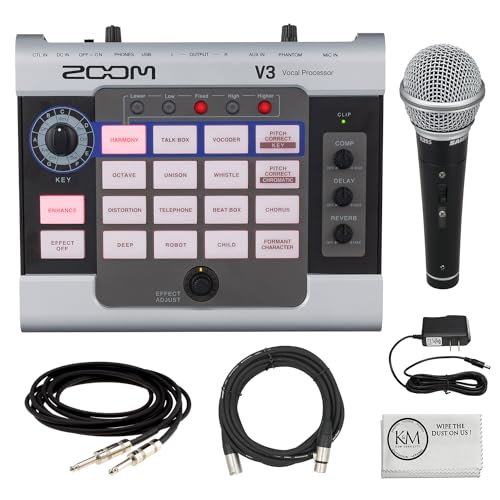
- V3 processor includes 48V phantom-powered XLR input
- Comes with a handheld cardioid dynamic microphone
- Includes cables, power supply, batteries, and cloth
Best For: New singers who want a processor-and-microphone package
Feature-Rich Doubling

- 48V phantom-power support
- Vocal doubling, reverb, and chorus effects
- Mixed or separate vocal and guitar outputs
Best For: Singers and guitarists wanting rich vocal doubling with simple pedal control
All-in-One Vocal Rig
AVE-100 Multi-Effect Vocal Processor

- Combo input with 48V phantom power
- Auto-tune, harmony, echo, and reverb
- Looper, OTG recording, and feedback reduction
Best For: Performers, podcasters, and streamers seeking broad vocal-processing features
Pitch-Control Pedal

- Optional 48V phantom power
- Pitch correction with delay and reverb
- Mixed or individual signal outputs
Best For: Singers seeking straightforward pitch correction in a compact stompbox
Best All-Around Value – AVE-100 Vocal Effects Processor
If you want a vocal processor with phantom power that covers core live and recording needs without a complicated setup, the AVE-100 is a versatile option. It combines pitch correction, harmony, reverb, delay, looping, and anti-feedback features in a compact unit.
Best For: Singers, streamers, karaoke users, and performers who want flexible vocal effects with condenser-microphone support.
Pros:
- Supports 48V phantom power for condenser microphones.
- Includes pitch correction, harmony, reverb, delay, and loop recording.
- KeyLearn detects the backing-track key for harmony and pitch-correction applications.
- Intelligent anti-feedback can help during live performances and stage use.
Cons:
- The supplied notes do not specify the total number of presets or effect combinations.
- Its 9V, 500mA power requirement may require a suitable power source for extended use.
The AVE-100 stands out as a practical entry-level-to-midrange choice for singers who want several essential effects, automatic key detection, and phantom power in one affordable-style package.
Best for Auto-Tune Control – HeadRush VX5 Vocal Effects Pedal
The HeadRush VX5 is a vocal processor with phantom power designed for performers who want hands-on pitch and effect control. Its dedicated Retune Speed and Humanize knobs make it easy to move from subtle correction to a pronounced Auto-Tune sound without a computer.
Best For: Live vocalists and producers who want recognizable Antares Auto-Tune, footswitch control, and programmable performance presets.
Pros:
- Uses the Antares algorithm for subtle pitch correction or a hard Auto-Tune effect.
- Offers switchable +48V phantom power and a premium XLR microphone preamp.
- Includes compressor, reverb, delay, chorus, and additional flavor effects.
- Stores up to 250 presets and supports hands-free control with two footswitches.
Cons:
- At about 1.2 kg, it is heavier than several compact vocal processors.
- The unit uses a power adapter rather than battery operation.
- Its extensive preset and routing features may take more setup time for beginners.
With real-time processing, harmony mode, USB audio, MIDI, and strong live controls, the VX5 is a feature-rich pick for performers who specifically want adjustable Antares Auto-Tune and stage-ready connectivity.
Best for Streaming and Portability – Zoom V3 Vocal Processor
The Zoom V3 is a portable vocal processor with phantom power for singers, streamers, and home recordists. It provides 16 voice effects, real-time three-part harmony, dedicated vocal controls, and USB recording in a battery-powered design.
Best For: Mobile performers, livestreamers, and creators who need condenser-microphone compatibility and direct USB connectivity.
Pros:
- Supports condenser microphones with built-in 48V phantom power.
- Provides 16 vocal effects and up to three-part harmonies in real time.
- Dedicated compression, reverb, and delay controls simplify sound shaping.
- Runs for up to 3.5 hours on four AA batteries and records over USB.
Cons:
- USB recording is specified at up to 32-bit/44.1kHz rather than higher sample rates.
- The notes identify one audio channel, which may limit more complex setups.
- Battery runtime is limited to approximately 3.5 hours per set of four AA batteries.
The V3 makes a strong case for creators who value portability and straightforward controls. Its phantom power, harmony effects, and USB interface cover common streaming and live-performance workflows without requiring extra recording hardware.
Best for Singing Guitarists – BOSS VE-500 Vocal Performer
The BOSS VE-500 is a vocal processor with phantom power built around pedalboard integration. It combines automatic harmony, pitch correction, extensive vocal effects, guitar-input processing, and looping for performers who sing and play guitar on stage.
Best For: Singing guitarists who want vocal and guitar control in one stompbox-style unit.
Pros:
- Provides automatic vocal harmony and pitch correction with BOSS algorithms.
- Processes vocals with up to nine effects at once, including reverb, delay, modulation, distortion, EQ, and filtering.
- Includes a dedicated guitar input and vocoder based on guitar input.
- Built-in looper supports layered vocal and guitar parts.
Cons:
- The supplied notes do not explicitly state a phantom-power specification.
- Its broad effect-routing options may require more planning than a simpler vocal pedal.
- The listed dimensions and weight may be less convenient for highly compact pedalboards.
The VE-500 is particularly compelling when vocal processing must work alongside guitar performance. Its extensive effects, harmony tools, looper, and guitar integration make it a stage-focused solution for singer-guitarists.
Best Value Vocal Processor – Zoom V3 Bundle with Cables
If you want a vocal processor with phantom power and useful accessories in one package, this Zoom V3 bundle is a practical starting point. It provides 48V phantom power for compatible microphones, along with voice effects, harmony, and essential vocal processing.
Best For: Singers who need a versatile vocal processor plus cables, power, and batteries.
Pros:
- 16 voice effects plus compression, reverb, delay, and Enhance
- 48V phantom-powered XLR microphone input
- Adds up to two voices for three-part harmonies
- Includes XLR and instrument cables, power supply, batteries, and cloth
Cons:
- The bundle does not include a microphone
- Controls are primarily knob-based, with no listed automatic pitch correction
As an all-in-one effects-and-accessories package, this Zoom V3 offers strong flexibility for singers who already have a microphone or plan to add one separately.
Most Feature-Rich Vocal Processor – BOSS VE-22 Vocal Performer
The BOSS VE-22 is a compact vocal processor for singers seeking a broad range of studio, creative, and performance effects. While the supplied details do not specify phantom power, it stands out for automatic pitch correction, real-time harmony, doubling, and support for recording and livestreaming.
Best For: Singers who want extensive vocal effects and pitch tools in a portable unit.
Pros:
- Includes compression, EQ, delay, echo, reverb, and specialty effects
- Offers automatic pitch correction for subtle or electronic-style results
- Provides real-time harmony and doubling functions
- Supports practice, recording, stage performance, and livestreaming
Cons:
- Phantom power is not specified in the supplied product details
- Does not include a microphone or audio cables
The VE-22 is the strongest choice here for singers prioritizing a wide effects library and creative vocal shaping, but buyers specifically seeking phantom power should verify microphone-power compatibility before purchasing.
Best Complete Vocal Setup – Zoom V3 Bundle with Microphone
This Zoom V3 package is a convenient option if you need a vocal processor with phantom power and a ready-to-use microphone setup. The processor includes a 48V phantom-powered XLR input, while the bundle adds a handheld cardioid dynamic microphone, cables, power, and batteries.
Best For: Singers building a basic vocal-effects setup without purchasing a microphone separately.
Pros:
- 48V phantom-powered XLR microphone input
- Includes 16 voice effects, compression, reverb, delay, and Enhance
- Adds up to two voices for three-part harmonies
- Includes handheld cardioid microphone, XLR cable, instrument cable, power supply, and batteries
Cons:
- The included microphone is dynamic, so phantom power may not be needed for it
- The package contains several accessories that may be unnecessary for buyers who already own cables or a microphone
For newcomers, this is the most convenient Zoom V3 configuration because it combines the processor and microphone in one purchase while retaining the V3’s harmony and effects features.
Feature-Rich Doubling – FV02 Vocal Doubling Pedal
The FLAMMA FV02 is a practical choice if you need a vocal processor with phantom power plus vocal doubling, reverb, and chorus-style effects. Its three vocal modes provide different EQ voicings, while guitar input and flexible output options make it useful for combined vocal-and-guitar setups.
Best For: Singers and guitarists who want vocal doubling, reverb, and simple live signal routing.
Pros:
- Supports 48V phantom power for compatible microphones.
- Provides vocal doubling, reverb, and chorus effects.
- Includes WARM, BRIGHT, and NORMAL vocal modes.
- Offers mixed or separate guitar-and-microphone outputs.
Cons:
- Its effects focus is narrower than a full multi-effect vocal processor.
- Requires a 9V, 500mA power source.
The FV02 stands out for performers who prioritize vocal thickening and straightforward pedal control. It is especially appealing when guitar integration and phantom-powered microphone support matter more than advanced pitch correction or looping.
All-in-One Vocal Rig – AVE-100 Multi-Effect Vocal Processor
The AVE-100 is a versatile vocal processor with phantom power for performers, streamers, podcasters, and home recording users. Its combo input supports dynamic, condenser, and ribbon microphones, while auto-tune, harmony, echo, reverb, looping, OTG recording, and feedback reduction cover a broad range of creative needs.
Best For: Singers and content creators who need vocal effects, recording features, and microphone flexibility in one compact unit.
Pros:
- Supports 48V phantom power through a 6.35mm/XLR combo input.
- Includes auto-tune, pitch correction, harmony, echo, and reverb effects.
- Offers intelligent feedback reduction and automatic key recognition.
- Adds looping, OTG recording, and a headphone jack.
Cons:
- The larger feature set may require more familiarization than a basic effects pedal.
- Its listed signal format is analog despite the broad recording and interface feature set.
With the widest feature set in this group, the AVE-100 is suited to users who want one device for live vocals and content creation. The combo input and phantom-power support also make it a flexible option for different microphone types.
Pitch-Control Pedal – FV01 Vocal Effects Processor
The FLAMMA FV01 is a focused vocal processor with phantom power for singers who want pitch correction and basic performance effects in a stompbox format. It offers optional 48V phantom power for condenser microphones, three vocal tone modes, delay, reverb, and flexible mixed or individual signal outputs.
Best For: Singers who want accessible pitch correction and vocal effects for live singing, streaming, or recording.
Pros:
- Provides optional 48V phantom power for condenser microphones.
- Centers on pitch correction while adding delay and reverb effects.
- Includes WARM, BRIGHT, and NORMAL tone modes.
- Can function as a microphone amplifier or traditional stompbox.
Cons:
- Its effects and feature set are more limited than the AVE-100.
- Requires a 9V, 500mA power source.
The FV01 is a sensible pick when pitch correction is the main priority and you prefer direct footswitch operation. Its phantom-power option and separate-output capability add useful flexibility without expanding into a larger multi-effect system.
How We Picked the Best Vocal Processor with Phantom Power
We focused on processors designed for singers and evaluated the features that matter most in real-world use: microphone compatibility, phantom power support, pitch correction, harmony generation, reverb and delay, looping, anti-feedback tools, footswitch control, and streaming connectivity. We also considered whether each unit suits beginners, stage performers, content creators, or more advanced users.
Bundles were assessed for the practical value of their included cables, microphones, power supplies, and accessories. Because product configurations can vary, confirm the current listing for exact inputs, outputs, power requirements, and phantom-power specifications before buying.
Quick Comparison
| Best For | Look For |
|---|---|
| Live singers | Footswitches, anti-feedback, durable controls, and low-latency effects |
| Streaming and podcasting | USB or OTG audio, simple routing, monitoring, and compact operation |
| Harmony and vocal layering | Key detection, intelligent harmonies, doubling, and looping |
| Beginners | Preset effects, clear controls, included accessories, and straightforward setup |
| Advanced performers | Programmable presets, extensive I/O, expression or foot control, and flexible signal routing |
Key Buying Factors for a Vocal Processor with Phantom Power
Microphone and Phantom-Power Compatibility
Check whether the processor provides the phantom power your condenser microphone requires and whether it supports your preferred microphone type. Dynamic microphones generally do not need phantom power, while many condenser models do. Also verify connector type, input gain, and whether phantom power can be switched independently.
Effects and Vocal Control
Pitch correction is useful for subtle tuning or stylized Auto-Tune effects, but harmony quality depends on key detection and the processor’s ability to track your voice or instrument. Reverb and delay help create space, while doubling, chorus, and looping are valuable for fuller solo performances.
Connections and Performance Workflow
For streaming, USB or OTG audio can reduce the need for extra interfaces. For stage use, prioritize balanced outputs, reliable footswitches, preset access, and anti-feedback features. Confirm that the unit offers the outputs and monitoring options required by your mixer, powered speaker, headphones, or recording system.
Power, Portability, and Included Extras
Some units use an included adapter, while others may support batteries or alternate power sources. Bundles can be convenient, but included cables and microphones should match your intended setup. A compact processor is easier to transport, though larger units may offer more controls and routing flexibility.
Who Should Buy Which Vocal Processor with Phantom Power?
Choose a feature-rich multi-effects unit if you perform live and need hands-free control, harmonies, looping, and dependable outputs. A compact pedal is a better fit for singers who want fast access to pitch correction or doubling with minimal setup. Streamers and podcasters should prioritize USB or OTG connectivity and simple monitoring. Beginners may benefit most from a bundle or processor with presets and included cables, while experienced performers should focus on programmable controls, signal routing, and compatibility with their existing microphone and PA system.