
Shopping for a 3D printer in 2026 means choosing between speed, ease of use, print quality, and upgrade paths. The best models now make setup simpler while delivering cleaner results for beginners and experienced makers alike.
Below, we focus on 10 standout 3D printers that balance value, reliability, and features such as auto leveling, high-speed printing, and multicolor workflows.
Best 10 3d Printers Picks for 2026
Beginner-friendly speed runner
Bambu Lab A1 Ready-to-Use FDM 3D Printer

- 10,000 mm/s² acceleration
- Full-auto calibration and leveling
- Quiet, easy-to-use touchscreen
Best For: Beginners and kids who want fast, low-hassle printing
Fast, easy starter pick
FLASHFORGE Adventurer 5M High-Speed 3D Printer

- One-click auto leveling
- Up to 600mm/s speed
- Power-loss recovery and run-out sensor
Best For: Users who want fast prints and simple setup
Enclosed performance upgrade
Bambu Lab P1S Ready-to-Use FDM 3D Printer

- 500mm/s speed with high acceleration
- Enclosed design for advanced filaments
- Auto bed leveling and 16-color support
Best For: Makers who want speed, enclosure, and multi-color potential
Remote-ready speed option
FLASHFORGE Adventurer 5M CoreXY 3D Printer

- 600mm/s travel speed
- 3-second nozzle changes
- App monitoring and auto leveling
Best For: Users who want fast printing and remote oversight
Fast Multicolor Flagship

- 600 mm/s printing with active flowrate compensation
- AMS 2 Pro enables multi-color and multi-material use
- Automatic calibration and quick setup in about 15 minutes
Best For: Users who want speed, automation, and multicolor convenience
Versatile Color Performer
ELEGOO Centauri Carbon 2 Combo
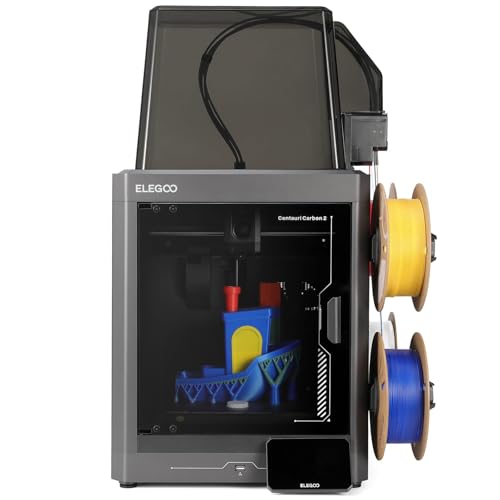
- 4-color printing with CANVAS color switching
- Fully automated calibration and monitoring
- CoreXY frame supports speeds up to 500 mm/s
Best For: Users who want multicolor printing with automation
Top Multi-Color CoreXY Pick
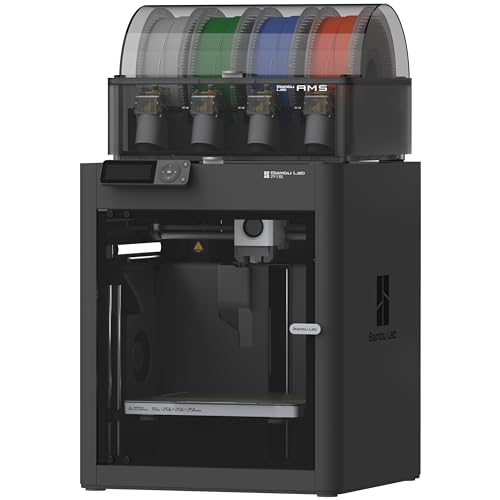
- Up to 16 colors with AMS
- 500mm/s high-speed printing
- Enclosed design with auto bed leveling
Best For: Fast enclosed printing with easy multicolor setup
Best Large-Format Multicolor Upgrade

- Up to 16 colors with CFS expansion
- 260 × 260 × 260 mm build volume
- 600mm/s speed with AI camera
Best For: Large-format printing with smart multicolor support
Beginner-friendly speed runner – Bambu Lab A1 Ready-to-Use FDM 3D Printer
If you want 3d printers that feel easy to start with but still print quickly, the Bambu Lab A1 is a strong fit. It combines high acceleration, automatic calibration, and quiet operation, so it’s geared toward users who want a smoother first experience without giving up performance.
Best For: Beginners, kids, and home users who want fast, low-hassle printing with room to grow into multi-color projects.
Pros:
- 10,000 mm/s² acceleration supports very fast printing.
- Full-auto calibration handles Z-offset, bed leveling, and more.
- Active flow rate compensation helps keep prints smooth and consistent.
- Quiet operation and a simple touchscreen make it easy to live with.
Cons:
- Multi-color printing requires AMS lite, which is sold separately unless you buy the combo.
- It is positioned more as a beginner-friendly machine than a fully enclosed advanced-filament setup.
Overall, the A1 stands out as a practical choice if you want a fast, automated 3d printer that reduces setup friction. It’s especially appealing when ease of use matters as much as print quality.
Fast, easy starter pick – FLASHFORGE Adventurer 5M High-Speed 3D Printer
Among high-speed 3d printers, the FLASHFORGE Adventurer 5M focuses on speed, simple setup, and reliable first layers. Its one-click auto leveling, quick warm-up, and vibration compensation make it a sensible pick for users who want to spend less time tuning and more time printing.
Best For: Makers who want quick setup, fast prints, and automatic leveling in a compact desktop machine.
Pros:
- Full-auto one-click leveling helps deliver a strong first layer.
- CoreXY design reaches up to 600mm/s with 20,000 mm/s² acceleration.
- Heats to 200°C in 35 seconds for less waiting.
- Filament run-out detection and power-loss recovery add convenience.
Cons:
- Open-frame design is best suited to open, well-ventilated environments.
- Print size is limited to 220 x 220 x 220 mm.
If you want a speedy printer that keeps the workflow simple, the Adventurer 5M is easy to understand. It delivers a strong mix of automation and performance for everyday printing jobs.
Enclosed performance upgrade – Bambu Lab P1S Ready-to-Use FDM 3D Printer
If you’re comparing 3d printers for speed and material flexibility, the Bambu Lab P1S is built to handle more ambitious projects. It offers high-speed printing, an enclosed design, and automatic bed leveling, making it a compelling option for users who want a capable desktop machine with fewer setup headaches.
Best For: Hobbyists and makers who want an enclosed printer for fast, high-quality prints and multi-color expansion.
Pros:
- 500mm/s speed and 20,000 mm/s² acceleration support very fast printing.
- Enclosed body helps improve performance with advanced filaments.
- Automatic bed leveling simplifies setup and improves consistency.
- Supports up to 16 colors when paired with Bambu Lab AMS.
Cons:
- Multi-color printing requires a separate AMS connection.
- Carbon/glass fiber reinforced polymer is not recommended.
The P1S is a solid choice when you want an enclosed 3d printer that blends speed with broader material support. It’s especially attractive if you plan to print more than basic PLA and want a machine that’s ready to use quickly.
Remote-ready speed option – FLASHFORGE Adventurer 5M CoreXY 3D Printer
For buyers shopping 3d printers that prioritize speed and workflow convenience, the FLASHFORGE Adventurer 5M is an easy machine to consider. It pairs automatic leveling with fast nozzle swaps, high-speed CoreXY motion, and app monitoring for a more streamlined printing experience.
Best For: Users who want rapid printing, easy maintenance, and remote monitoring in a compact desktop printer.
Pros:
- CoreXY structure reaches 600mm/s travel speed and 20,000mm/s² acceleration.
- One-click automatic leveling supports consistent first layers.
- 3-second nozzle changes and 35-second warm-up improve efficiency.
- Flash Studio app monitoring lets you check and adjust prints remotely.
Cons:
- Build volume is limited to 220 x 220 x 220 mm.
- The open design is best for well-ventilated spaces.
The Adventurer 5M is a practical pick if you want speed without a steep learning curve. Its mix of automation, fast heating, and app support makes it well suited to frequent everyday printing.
Fast Multicolor Flagship – Bambu Lab P2S Combo
If you’re shopping for 3d printers that can move fast without giving up detail, the Bambu Lab P2S Combo is built for that balance. It prints up to 600 mm/s, includes active flowrate compensation for cleaner layers, and pairs with the AMS 2 Pro for easy multi-color and multi-material workflows.
Best For: Buyers who want a high-speed printer with strong automation and ready-to-use multi-color printing.
Pros:
- Prints up to 600 mm/s while aiming to keep corners sharp and layers smooth.
- Ready to start in about 15 minutes with automatic calibration and quick-swap nozzles.
- AMS 2 Pro supports multi-color/multi-material printing and filament drying up to 65 °C.
- Adaptive airflow helps manage overhang cooling or chamber heat for different materials.
Cons:
- The printer itself does not support multi-color printing without the Combo bundle.
- Its feature set may be more than a casual user needs if speed and automation aren’t priorities.
This is a strong pick for makers who want a polished, fast 3d printer ecosystem with minimal setup friction. The bundled AMS 2 Pro adds practical material handling features, making it easier to keep printing consistently.
Versatile Color Performer – ELEGOO Centauri Carbon 2 Combo
Among modern 3d printers, the ELEGOO Centauri Carbon 2 Combo is positioned as a fast, automated option for color work and material flexibility. It offers 4-color printing through the CANVAS system, full automation for calibration and monitoring, and CoreXY motion for stable high-speed output.
Best For: Makers who want a speed-focused multicolor printer with broad material support and low-effort operation.
Pros:
- 4-color printing with instant color switching and smart filament detection.
- Supports a wide range of materials, including engineering-grade options.
- Fully automated calibration and monitoring simplify the printing process.
- CoreXY system and vibration compensation help improve speed and surface quality.
Cons:
- Its advanced feature set may be more than a basic user needs.
- The color and ecosystem features are geared toward a more integrated workflow.
This model makes sense if you want a 3d printer that combines multicolor convenience with a serious emphasis on automation and speed. It is especially appealing for users who value consistent results without constant manual tuning.
Compact Productivity Booster – FLASHFORGE AD5X Multi-Material
If you want 3d printers that prioritize speed, color, and a compact footprint, the FLASHFORGE AD5X is designed to fit that brief. It reaches up to 600 mm/s, supports 4-color printing through its Intelligent Filament System, and uses full auto leveling to keep setup straightforward.
Best For: Users who need a space-saving multicolor printer with fast output and multi-material compatibility.
Pros:
- Prints up to 600 mm/s with acceleration up to 20,000 mm/s².
- IFS supports multi-color and multi-material printing with four spools arranged side by side.
- Compatible with PLA, TPU, PETG, SILK, PLA-CF, and PETG-CF.
- CoreXY structure and vibration suppression are built for stable, accurate prints.
Cons:
- The feature-rich design may be more complex than a simple starter printer.
- Its compact, modular layout may appeal less to users who prefer a more traditional setup.
The AD5X is a practical choice if you want a fast 3d printer that also keeps multicolor workflows organized and space-efficient. Its combination of auto leveling, filament backup, and CoreXY construction makes it a well-rounded productivity option.
Top Multi-Color CoreXY Pick – Bambu Lab P1S Combo
If you want a fast, enclosed 3D printer that can handle multicolor work without a complicated setup, the Bambu Lab P1S Combo is a strong fit. It combines high-speed printing with automatic bed leveling and AMS-based multi-material support, making it a practical choice for creators who want reliable results and less tinkering.
Best For: Makers who want fast enclosed printing with up to 16-color capability and easy setup.
Pros:
- Supports up to 16 colors when connected to Bambu Lab AMS
- Prints up to 500mm/s with 20,000 mm/s² acceleration for faster turnaround
- Enclosed design helps with advanced filament performance
- Automatic bed leveling and 15-minute setup keep the workflow simple
Cons:
- AMS is required for multicolor and multi-material printing
- Carbon/glass fiber reinforced polymers are not recommended
Overall, the P1S Combo is geared toward users who value speed, enclosure, and an easier path into multicolor 3D printing. It’s especially appealing if you want a printer that feels ready for serious use right out of the box.
Best Large-Format Multicolor Upgrade – Creality K2 Combo
The Creality K2 Combo is built for buyers who want a capable 3D printer with multicolor support, a generous build volume, and a near plug-and-play setup. With CFS-based color printing, fast speeds, and smart monitoring features, it’s aimed at users who want a more automated printing experience.
Best For: Users who want a large 260mm cube printer with multicolor capability and smart automation.
Pros:
- Supports up to 16 colors with up to four CFS units
- 260 × 260 × 260 mm build volume covers many common print needs
- 600mm/s printing speed and silent mode for quieter operation
- Smart auto leveling and AI camera add monitoring and convenience
Cons:
- The combo includes one CFS unit, with expansion needed for more colors
- Some multicolor features depend on Creality CFS integration
In practice, the K2 Combo stands out for users who want room to print larger projects while keeping the workflow automated. It balances speed, multicolor potential, and smart features in a package that’s ready to get to work quickly.
Best Value Fast-Print Upgrade – Creality K2 SE
The Creality K2 SE is a good option if you want a fast 3D printer that keeps setup simple while leaving room for future multicolor expansion. It pairs a CoreXY motion system with automatic leveling, a direct drive extruder, and compatibility with Creality CFS, so it can serve both everyday printing and more advanced workflows.
Best For: Buyers who want fast, stable printing now with an upgrade path to multicolor later.
Pros:
- Prints up to 500mm/s with 20,000mm/s² acceleration
- Fully automatic leveling and quick 5-minute assembly simplify setup
- Solid metal build adds rigidity for stable, high-precision prints
- Compatible with Creality CFS for expandable multicolor printing
Cons:
- CFS is sold separately for multicolor printing
- Build volume is smaller than the larger K2 Combo model
For shoppers comparing 3D printers, the K2 SE makes sense if speed, stability, and a clean starter experience matter most. Its upgrade path is useful if you want to begin with single-color printing and add multicolor capability later.
How We Picked These 3d Printers
We prioritized printers that are practical to own, not just impressive on paper. That means strong build quality, dependable motion systems, easy calibration, and features that reduce failed prints. We also favored models that offer clear value for different users, from first-time buyers to hobbyists who want multicolor or faster production.
Quick Comparison
In this group of 3d Printers, the main differences come down to use case: beginner-friendly single-material machines, enclosed printers for better material control, and multicolor systems for more advanced projects. If you want the simplest setup, look for ready-to-use models with automatic leveling. If you want more creative flexibility, a combo system with AMS or CFS-style material handling is the better fit.
Key Buying Factors for 3d Printers
Ease of Setup
For most buyers, setup time matters as much as print quality. Ready-to-use printers with guided calibration and auto bed leveling are easier to live with and reduce the learning curve.
Print Speed Vs. Real-World Reliability
High-speed 3d Printers can save a lot of time, but only if they maintain accuracy at faster rates. Look for stable frames, good motion control, and extruders designed to handle speed without sacrificing detail.
Material Compatibility
Think about what you plan to print. Open-frame machines are usually fine for PLA and similar materials, while enclosed models are a better choice if you expect to work with tougher filaments that benefit from temperature stability.
Multicolor and Multi-Material Support
If you want more creative output, multicolor systems are worth considering. They add complexity and cost, but they can dramatically expand what your 3D printer can produce without manual filament swaps.
Who Should Buy Which 3d Printers?
Beginners and families should lean toward easy setup, auto leveling, and simple controls. Makers focused on speed or small-batch production should look at high-speed models with strong motion systems. If you want visual impact, prototyping flexibility, or more polished presentation pieces, a multicolor combo printer is the smarter long-term choice. In short, the best 3d Printers are the ones that match your space, your materials, and how much time you want to spend tuning instead of printing.