
In today’s fast-paced business environment, having a reliable WiFi access point is essential for maintaining productivity. As we look at the best options available in 2026, you’ll find a range of advanced devices designed to enhance your network performance. From robust security features to impressive speeds and coverage, these access points cater to your growing connectivity needs. So, what are the standout models that can transform your business network?
Zyxel WiFi 6 AX1800 Wireless Access Point

If you’re looking for a reliable solution that guarantees seamless connectivity across multiple devices, the Zyxel WiFi 6 AX1800 Wireless Access Point is a top choice for businesses. With dual-radio performance, you’ll enjoy combined speeds of up to 1800 Mbps, ensuring fast connections. Its MU-MIMO technology makes it perfect for busy environments. Plus, NebulaFlex management gives you the flexibility to switch between local and cloud management effortlessly. Smart Mesh technology extends coverage to those tricky spots, while advanced WPA3 security keeps your network safe. Installation is a breeze with flexible power options. This access point truly enhances your network performance.
Best For: Businesses looking for a reliable and high-performance wireless access point to support multiple devices and extend coverage.
Pros:
- Dual-radio performance with combined speeds up to 1800 Mbps ensures fast and efficient connectivity.
- MU-MIMO technology allows seamless connections across multiple devices, ideal for busy environments.
- NebulaFlex management provides flexibility for local or cloud management, catering to various network needs.
Cons:
- Installation may require technical knowledge for optimal setup in complex environments.
- Higher cost compared to basic access points may not be justified for smaller setups.
- Limited coverage range in very large spaces may necessitate additional units for full coverage.
BROWAN WiFi 6 Access Point AX1800 (MI13)

The BROWAN WiFi 6 Access Point AX1800 (MI13) stands out as an exceptional choice for small businesses and startups looking to enhance their connectivity without breaking the bank. With speeds up to 1800 Mbps and a coverage area of 600 sq. ft., it easily supports up to 64 devices. Its ultra-slim, in-wall design fits standard junction boxes, making installation seamless. Plus, the four Gigabit LAN ports and PoE OUT offer flexible deployment options. Enhanced security features like WPA3 encryption guarantee your data’s safety. This access point is perfect for modern workspaces, web conferencing, and budget-conscious environments.
Best For: Small businesses, startups, and modern workspaces seeking cost-effective and efficient WiFi solutions.
Pros:
- High Speed: Offers speeds up to 1800 Mbps, accommodating multiple devices and high-bandwidth activities.
- Easy Installation: Ultra-slim design fits standard US junction boxes, simplifying the setup process.
- Robust Security: Supports WPA3 encryption for enhanced data protection.
Cons:
- Limited Coverage: Coverage area of 600 sq. ft. may not be sufficient for larger spaces.
- Device Capacity: Supports up to 64 devices, which could be limiting for larger offices with more connected devices.
- Requires PoE: PoE OUT may necessitate additional infrastructure for deployment.
TP-Link EAP610 Omada Business WiFi 6 Wireless Access Point

Designed for businesses seeking reliable and high-performance connectivity, the TP-Link EAP610 Omada Business WiFi 6 Wireless Access Point delivers exceptional speed and efficiency with its advanced Wi-Fi 6 technology. With support for Mesh, OFDMA, and MU-MIMO, it guarantees seamless connections across multiple devices. The compact design makes installation a breeze, saving valuable space in your office. Plus, you can easily manage and monitor your network remotely via the Omada app. Powered by PoE+, this dual-band access point assures robust connectivity, making it an ideal choice for any growing business looking to enhance network performance.
Best For: Businesses seeking reliable and high-performance WiFi connectivity with advanced features like seamless roaming and remote management.
Pros:
- Supports Wi-Fi 6 technology for enhanced speed and efficiency across multiple devices.
- Compact design allows for easy installation and space-saving in office environments.
- Remote management via the Omada app simplifies network monitoring and administration.
Cons:
- Requires PoE+ for power, which may necessitate additional infrastructure changes.
- Limited range compared to some higher-end models, potentially requiring multiple units for larger spaces.
- Initial setup may be complex for users unfamiliar with advanced networking equipment.
TP-Link EAP225 Omada AC1350 Wireless Access Point

For businesses seeking reliable and high-speed wireless connectivity, the TP-Link EAP225 Omada AC1350 Wireless Access Point stands out with its dual-band speeds of up to 1350 Mbps. This access point supports advanced features like Mesh WiFi, seamless roaming, and MU-MIMO technology, ensuring multiple devices connect simultaneously without lag. It’s powered via PoE, making installation flexible, and integrates smoothly with the Omada SDN platform for centralized management. Weighing just 1.1 pounds and measuring 8.09 x 7.15 x 1.47 inches, it’s easy to deploy. Plus, you can rely on a 5-year warranty and dedicated technical support.
Best For: Businesses seeking reliable, high-speed wireless connectivity with advanced features for multiple device support.
Pros:
- High dual-band speeds of up to 1350 Mbps, ensuring fast internet access for all users.
- Advanced features like Mesh WiFi and MU-MIMO technology allow for seamless connectivity and efficient use of bandwidth.
- Flexible installation options with PoE support and a compact design make deployment easy in various environments.
Cons:
- Performance may vary based on environmental factors and client limitations, potentially affecting user experience.
- SDN compatibility requires additional equipment or upgrades for optimal functionality.
- Seamless roaming capabilities are limited to environments supporting 802.11K and 802.11V protocols.
TP-Link AC1200 Wireless Gigabit Access Point (TL-WA1201)
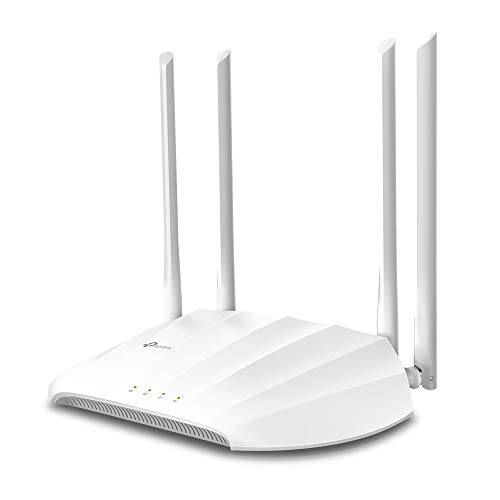
With its dual-band capabilities and MU-MIMO technology, the TP-Link AC1200 Wireless Gigabit Access Point (TL-WA1201) stands out as an ideal choice for small to medium-sized businesses seeking robust connectivity. It delivers speeds up to 1200 Mbps, allowing multiple devices to connect simultaneously without slowing down. You can easily switch between four operation modes, including Client and Range Extender, to meet your specific needs. Installation is a breeze with Passive PoE support, while four external antennas and Beamforming technology enhance coverage. Plus, you’ll enjoy lifetime protection and 24/7 technical support for peace of mind.
Best For: Small to medium-sized businesses seeking reliable and high-speed wireless connectivity.
Pros:
- High-speed performance: Delivers dual-band Wi-Fi speeds up to 1200 Mbps for multiple device connections.
- Versatile operation modes: Offers four modes including Client and Range Extender for various applications.
- Easy installation: Features Passive PoE support for flexible deployment options.
Cons:
- Limited to indoor use: Primarily designed for indoor environments, may not be ideal for outdoor applications.
- Dependent on power supply: Requires a power source for operation, limiting placement options if PoE is not available.
- Potential interference: Dual-band performance may be affected by interference from other wireless devices in congested areas.
Ubiquiti Networks UniFi 7 Pro WiFi 7 Access Point (U7-Pro-US)

The Ubiquiti Networks UniFi 7 Pro WiFi 7 Access Point (U7-Pro-US) offers an impressive six spatial streams and 6 GHz support, making it an ideal choice for large-scale environments that demand reliable, high-speed connectivity. With dimensions of 8.1 x 8.1 x 1.8 inches and a lightweight design at 1.5 pounds, it’s easy to install on ceilings. Rated 4.6 out of 5 stars from 519 reviews, this access point ranks #2 in Computer Networking Wireless Access Points. Keep in mind that a PoE+ adapter isn’t included, but you’ll benefit from robust performance and a warranty for peace of mind.
Best For: The Ubiquiti Networks UniFi 7 Pro WiFi 7 Access Point is best for large-scale environments that require high-speed, reliable WiFi connectivity.
Pros:
- Impressive performance with six spatial streams and 6 GHz support for reduced interference.
- Lightweight and compact design, making it easy to install on ceilings.
- High customer satisfaction, with a rating of 4.6 out of 5 stars from 519 reviews.
Cons:
- PoE+ adapter not included, which may require additional purchase for installation.
- Ceiling-mounted design may not suit all environments or preferences.
- Higher price point compared to basic access points, which may not be necessary for smaller setups.
HPE Networking Instant On Access Point AP32 (3 Pack)

Designed for high-demand environments, the HPE Networking Instant On Access Point AP32 (3 Pack) is perfect for eGaming centers, corporate offices, and smart homes equipped with the latest technology. With support for Wi-Fi 6 and speeds up to 3.6Gbps, it easily handles multiple devices, including VR headsets and flagship smartphones. Setup is a breeze using the Instant On app or web portal, allowing you to manage your network without subscriptions. Plus, Smart Mesh technology extends coverage effortlessly. Power it with PoE or a local adapter for flexibility. Get ready to elevate your network performance with this powerful access point!
Best For: The HPE Networking Instant On AP32 (3 Pack) is best for eGaming centers, corporate offices, and smart homes that require high-speed connectivity for multiple devices.
Pros:
- Easy setup and management through the Instant On app or web portal without any subscriptions.
- Supports Wi-Fi 6 with impressive speeds up to 3.6Gbps, ideal for high-demand environments.
- Smart Mesh technology allows for seamless network coverage extension without additional cabling.
Cons:
- Does not include power sources; requires separate purchase of PoE injector or local power adapter.
- Maximum recommended clients is 75, which may be limiting for larger networks.
- The dual radio configuration may not provide optimal performance in very dense environments compared to single high-capacity units.
TP-Link Omada WiFi 7 Wireless Access Point (EAP773)

For businesses looking to elevate their connectivity, the TP-Link Omada WiFi 7 Wireless Access Point (EAP773) stands out with its impressive dual-band performance, delivering speeds up to 5.0 Gbps. This tri-band access point supports over 250 concurrent clients, ensuring your team stays connected without interruptions. With its Multi-Link Operation and 4K-QAM technology, you’ll experience increased reliability and data capacity. Plus, the free Omada Essential Platform allows for easy management and monitoring. Installation is a breeze with flexible deployment options. Backed by a 5-year warranty, you can trust that the EAP773 will meet your business’s networking needs.
Best For: Businesses seeking high-performance, reliable wireless connectivity for a large number of concurrent users.
Pros:
- Supports speeds up to 5.0 Gbps, ensuring fast and efficient internet access.
- Capable of handling over 250 concurrent clients, making it ideal for busy work environments.
- Easy installation and management through the free Omada Essential Platform, enhancing user experience.
Cons:
- Requires PoE or DC power supply, which may necessitate additional infrastructure.
- Higher upfront cost compared to basic access points, potentially impacting budget-conscious businesses.
- Some advanced features may require technical knowledge to fully utilize.
TP-Link WiFi 7 Wireless Access Point (EAP723)

Businesses requiring high-speed connectivity will find the TP-Link WiFi 7 Wireless Access Point (EAP723) an excellent choice. With dual-band speeds of up to 4324 Mbps on 5 GHz and 688 Mbps on 2.4 GHz, it’s perfect for tasks like 4K streaming and real-time gaming. The EAP723 features seamless roaming and centralized management, ensuring uninterrupted connectivity across your space. Setup is easy, and it supports advanced Multi-RU technology for multiple simultaneous transmissions. Weighing just 14.4 ounces, this sleek access point is designed for efficiency. Plus, with a 5-year warranty, you can invest confidently in your network’s future.
Best For: Businesses and users who need high-speed, reliable Wi-Fi for bandwidth-intensive tasks like 4K streaming and real-time gaming.
Pros:
- High dual-band speeds of up to 4324 Mbps on 5 GHz, suitable for demanding applications.
- Seamless roaming and centralized management for uninterrupted connectivity across large areas.
- Easy setup and support for advanced Multi-RU technology, allowing multiple simultaneous transmissions.
Cons:
- Requires a 2.5G Ethernet port for optimal performance, which may not be available on all devices.
- The sleek design may not blend well with all office aesthetics.
- Higher initial investment compared to basic access points.
ASUS ExpertWiFi EBA63 AX3000 Dual-Band WiFi 6 Access Point

The ASUS ExpertWiFi EBA63 AX3000 Dual-Band WiFi 6 Access Point stands out as an ideal choice for environments that require robust connectivity and device management. With WiFi 6 speeds reaching up to 3000 Mbps, it supports up to 100 active devices, ensuring reliable performance for your team. You can easily configure self-defined networks and manage up to 5 SSIDs with VLAN support for device segregation. Its flexible installation options include Power over Ethernet (PoE) and wall or ceiling mounting. Compliant with safety standards, this model blends performance with reliability, making it a top pick for evolving business needs.
Best For: Businesses and organizations that require high-speed, reliable WiFi for multiple devices in various environments.
Pros:
- High Performance: Offers WiFi 6 speeds up to 3000 Mbps, providing fast and reliable connectivity.
- Device Support: Capable of supporting up to 100 active devices, making it suitable for busy environments.
- Flexible Installation: Supports Power over Ethernet (PoE) and can be mounted on ceilings or walls, adapting to different setups.
Cons:
- Weight: At 14.4 ounces, it may be heavier than some competing models, which could affect certain installations.
- Limited SSID Support: Only supports up to 5 SSIDs, which may not be sufficient for larger networks with diverse requirements.
- Customer Reviews: Although rated 4.3 out of 5 stars, the total number of reviews is relatively low, which may not provide a comprehensive view of user satisfaction.
Factors to Consider When Choosing a Business Wifi Access Point
When choosing a business WiFi access point, you should prioritize speed and performance to guarantee seamless connectivity. Consider the coverage area and device capacity to accommodate your team’s needs. Don’t overlook security features and management options, as they play a critical role in maintaining a reliable network.
Speed and Performance
Choosing the right WiFi access point hinges on understanding speed and performance. Look for models supporting the latest Wi-Fi standards, particularly Wi-Fi 6 (802.11ax), which offers faster speeds and improved efficiency, especially in crowded environments. Aim for access points with dual-band capabilities that can deliver speeds up to 1800 Mbps or more by utilizing both 2.4 GHz and 5 GHz frequencies. It’s essential to evaluate how many simultaneous connections an access point can handle, as busy business settings require higher capacity. Additionally, consider features like MU-MIMO technology, allowing multiple devices to communicate simultaneously, enhancing overall performance. By prioritizing these factors, you’ll guarantee a robust and efficient network for your business needs.
Coverage Area
Finding the right coverage area for your business WiFi access point is essential for ensuring reliable connectivity throughout your space. The coverage area directly impacts the quality of your network, as access points can serve different spaces based on their specifications, ranging from 600 sq. ft. to larger environments. Keep in mind that obstacles like walls and furniture, as well as interference from electronic devices, can affect performance. Look for access points with advanced features, like Smart Mesh technology, which can adapt to eliminate dead zones. Finally, consider how many concurrent users each access point can handle; this will influence both coverage and overall performance in your business setting. Make informed choices to optimize your network.
Device Capacity
Once you’ve secured adequate coverage for your space, the next factor to take into account is device capacity. This refers to how many simultaneous connections an access point can support, which is essential in environments with many users and devices. Business-grade access points, especially those with WiFi 6 technology, can handle 64 or more devices, making them ideal for high-demand situations. It’s important to select an access point that meets your current needs while allowing for future growth as your device count increases. Remember, factors like the layout of your area and the applications in use can affect effective device capacity. Evaluating device capacity alongside performance specs guarantees peak network performance and user experience.
Security Features
Security features are essential when selecting a business WiFi access point, especially in today’s digital landscape. You should look for WPA3 encryption to protect sensitive data and guarantee secure connections. Advanced security protocols, like VLAN support, enhance user access control and minimize potential breaches. Built-in filtering mechanisms can also help reduce interference from external sources that may compromise your network’s integrity. Make sure the access point supports regular firmware updates and remote management capabilities to quickly address vulnerabilities. Additionally, support for VPN clients and remote syslog features can provide extra layers of security, enabling secure remote access and thorough monitoring of network activity. Prioritizing these features will help safeguard your business’s digital environment.
Management Options
When choosing a business WiFi access point, evaluating management options is vital for guaranteeing an efficient and responsive network. Look for access points that offer both local GUI management and cloud-based management to give you flexibility and ease of use. Features like remote access and monitoring can streamline your network management and reduce the need for on-site IT support. It’s essential to verify the access point supports centralized management platforms, allowing you to configure and monitor multiple devices from a single interface. User-friendly management software with functionalities like VLAN configuration, bandwidth management, and real-time analytics can make your job easier. Finally, check for multi-admin access options, enabling collaborative management among your team members.
Installation Flexibility
Choosing the right installation flexibility for your business WiFi access points can greatly impact network performance and coverage. Look for access points that support Power over Ethernet (PoE); this simplifies installation and minimizes the need for extra power outlets. Opt for designs that allow wall and ceiling mounting, giving you more options to optimize coverage and signal strength. Pay attention to the size and weight to guarantee they fit seamlessly into your space without being obtrusive. Consider features like Smart Mesh technology, which can extend coverage without additional cabling. Finally, verify the setup process is user-friendly, ideally with a management interface or app that simplifies configuration and monitoring during installation.