
The best compact stage monitors deliver focused, reliable sound without taking over a small stage, rehearsal room, desk, or worship setup. This roundup compares powered wedges, personal monitors, and compact PA speakers for different performance needs.
We considered output, connectivity, portability, feedback control, and overall flexibility so you can choose a monitor that fits your setup rather than simply buying the loudest option.
Best 10 Compact Stage Monitors Picks for 2026
Best Compact Studio Monitor Value

- Bluetooth, USB, RCA, AUX, and balanced TRS inputs
- 3.5-inch driver with 0.75-inch silk-dome tweeter
- Front headphone output and flat-response tuning
Best For: Compact home studios and flexible desktop monitoring
Best Compact Vocal Monitor
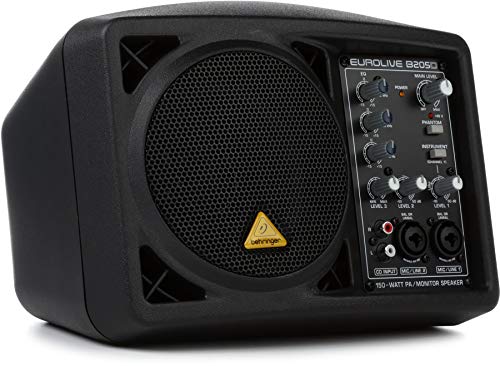
- 150-watt powered monitor with Class-D amplification
- Three-channel mixer with three-band EQ
- Two phantom-powered mic preamps and instrument input
Best For: Vocalists, keyboard players, presenters, and home studios
Best Compact PA Monitor

- 350 watts of bi-amplified Class-D power
- 8-inch woofer with 1-inch titanium HF driver
- Bluetooth, two-channel mixer, and mix output
Best For: Small gigs, DJs, presentations, and stage monitoring
Best High-Power Compact Monitor
Samson RSXM10A Active Stage Monitor

- 800 watts of Class-D output
- 10-inch woofer and 1-inch tweeter in a coaxial design
- Combo input, link output, and FOH/Monitor selector
Best For: Live performers, DJs, and sound engineers needing high output
High-Output Choice

- 250-watt powered 12-inch monitor
- Adjustable feedback filter and limiter
- XLR, 1/4-inch, RCA, and Speakon connections
Best For: Live setups needing strong output and flexible wired connectivity
Personal Monitoring Pick

- Lightweight four-pound passive monitor
- Two 5-inch drivers with 200-watt rating
- Volume control and stand adaptor included
Best For: Portable close-range monitoring and personal performance setups
Flexible Small-Venue Option

- Powered 10-inch two-way wedge monitor
- 300-watt amplifier with three-band EQ
- XLR daisy-chain output and multiple inputs
Best For: Small venues, rehearsals, bars, and churches
Ultra-Compact Pick

- 25-watt output with a 3-inch ceramic driver
- Includes wall/stand mount kit and rubber feet
- 150Hz–17kHz response in a compact enclosure
Best For: Personal monitoring in tight spaces and mounted installations
Talkback Specialist
Phenyx Pro PS-M1 Compact Talkback Monitor

- 65-watt powered personal monitor output
- MIC IN, LINE IN, and MIC DIRECT OUT connections
- Compact, stand-mountable enclosure with tone controls
Best For: Talkback, cue monitoring, rehearsals, live shows, and production communication
Most Versatile Features
Behringer EUROLIVE B105D Monitor Speaker

- 50-watt output with a 5-inch driver
- Built-in MP3 player and Bluetooth streaming
- Three-channel mixer with 3-band EQ
Best For: Monitoring, multimedia playback, presentations, and home recording
Best Compact Studio Monitor Value – Ortizan C7 Powered Monitors
The Ortizan C7 is a practical choice for compact stage monitors and small music-production setups. This powered pair combines Bluetooth 5.3, USB audio through a built-in 24-bit DAC, RCA, AUX, and balanced 6.35mm TRS connectivity in a space-conscious design.
Best For: Home studios, content creators, gaming, and musicians who need flexible nearfield monitoring in a compact space.
Pros:
- Multiple inputs include Bluetooth 5.3, USB, RCA, AUX, and balanced TRS.
- 3.5-inch carbon-fiber mid-bass driver and 0.75-inch silk-dome tweeter support detailed playback.
- Front headphone output makes switching to private monitoring convenient.
- Factory tuning targets a balanced, flat response for audio monitoring.
Cons:
- The 3.5-inch drivers are better suited to compact setups than large-room reinforcement.
- These speakers are corded and not waterproof.
The C7 stands out when connectivity and desk-friendly size matter most. Its balanced input and flat-response tuning make it more adaptable for creative work than a typical casual bookshelf speaker.
Best Compact Vocal Monitor – Behringer Eurolive B205D
The Behringer Eurolive B205D is a compact powered monitor designed for vocals, keyboards, presentations, and small recording setups. Its 150-watt Class-D amplifier, built-in mixer, and lightweight 5.25-inch full-range driver make it a versatile option when space is limited.
Best For: Vocal monitoring, keyboard players, home recording, press conferences, and multimedia use.
Pros:
- Compact 8.66 x 11.42 x 7.28-inch design weighs 7.05 pounds.
- 150-watt Class-D amplification provides substantial output for its size.
- Three-channel mixer includes three-band EQ and low-noise operation.
- Two microphone preamps offer phantom power, plus an instrument-ready input.
Cons:
- Its single 5.25-inch driver provides less low-frequency reach than larger stage monitors.
- It is a single speaker rather than a stereo pair.
The B205D is a strong fit for performers and presenters who need a small monitor with useful mixing controls. Its integrated mic inputs and phantom power reduce the need for additional equipment.
Best Compact PA Monitor – ALTO TX408 Powered PA Speaker
The ALTO TX408 brings 350 watts of bi-amplified power to a relatively compact 8-inch powered speaker. Built for compact stage monitors, small gigs, DJs, home studios, and presentations, it adds Bluetooth streaming, a two-channel mixer, and a wedge-monitor configuration.
Best For: Live bands, DJs, fitness spaces, presentations, and small venues needing higher output from a portable monitor.
Pros:
- 350 watts of Class-D amplification with 250 watts for low frequencies and 100 watts for highs.
- 8-inch woofer, 1-inch titanium compression driver, and 90° x 60° dispersion horn.
- Bluetooth supports streaming and True Wireless Stereo pairing.
- Built-in mixer includes microphone, line-level, and Bluetooth inputs, plus mix output.
Cons:
- At 5.9 kg and 16.61 inches tall, it is less desk-friendly than smaller monitors.
- Bluetooth range is listed at 75 feet, which may not suit every venue layout.
- It is not water resistant.
The TX408 is the better choice when compactness must be balanced against stage volume. Its wedge shape, pole socket, mixer, and linking output give it useful flexibility for live and mobile applications.
Best High-Power Compact Monitor – Samson RSXM10A Active Stage Monitor
The Samson RSXM10A is a high-output coaxial monitor for live performance, DJ booths, and sound engineering. Its 800-watt Class-D design pairs a 10-inch low-frequency driver with a 1-inch tweeter, while the angled cabinet supports practical stage placement.
Best For: Performers and DJs who need powerful, focused monitoring in a compact coaxial stage-monitor format.
Pros:
- 800 watts of output provides substantial headroom for live applications.
- Coaxial two-way design combines a 10-inch low-frequency driver with a 1-inch tweeter.
- XLR/1/4-inch combo input accommodates common professional connections.
- XLR link output and FOH/Monitor selector improve system integration.
Cons:
- At 30 pounds, it is heavier than the smaller monitors in this roundup.
- The 10-inch cabinet is less suitable for desktop or very space-limited setups.
- It does not include Bluetooth connectivity.
The RSXM10A is the performance-focused pick here. Its coaxial layout, selectable FOH/Monitor operation, and link output make it particularly suitable when stage monitoring demands more power than ultra-compact designs can provide.
High-Output Choice – Behringer F1220D
The Behringer F1220D is a powered 12-inch wedge monitor built for performers who need substantial output in a relatively portable package. Its Class-D amplification, feedback filter, and integrated limiter make it a practical option when comparing compact stage monitors for live performances, rehearsals, and multipurpose setups.
Best For: Performers and small live setups that need a powered 12-inch monitor with feedback control and flexible wired inputs.
Pros:
- 250-watt bi-amped design with a 12-inch woofer and 3-inch tweeter.
- Adjustable feedback filter and integrated limiter help with system control and speaker protection.
- Supports XLR, 1/4-inch TRS/TS, RCA, and Speakon connectivity.
- Class-D amplifier technology keeps the powered design relatively lightweight at 23.6 pounds.
Cons:
- Its 12-inch enclosure is larger than smaller personal-monitor designs.
- It is corded, wired, and not water resistant.
- The listed frequency response begins at 45 Hz, but the supplied notes do not specify the upper limit.
Choose the F1220D when output, broad wired connectivity, and feedback management matter more than having the smallest possible footprint. Its 18-by-18-by-12.25-inch enclosure is still manageable for stage use, though it is best suited to buyers comfortable with a full-size wedge monitor.
Personal Monitoring Pick – Galaxy Audio HS7
The Galaxy Audio HS7 Hot Spot is a compact passive personal monitor designed for close-range monitoring rather than filling a large venue. With two 5-inch drivers, a volume control, and a four-pound cabinet, it stands out among compact stage monitors for performers who prioritize portability and straightforward personal-level sound.
Best For: Individual performers, presenters, and small monitoring stations that need a lightweight passive cabinet with local volume control.
Pros:
- Compact 5-inch two-driver design weighs only 4 pounds.
- 200-watt continuous power rating provides useful headroom for a personal monitor.
- Includes a volume control and an MSA-1 stand adaptor.
- Offers a stated frequency range of 150 Hz to 18 kHz.
Cons:
- The 150 Hz lower frequency specification indicates less low-end reach than larger monitors.
- It is a passive 16-ohm cabinet, so it requires suitable external amplification.
- The supplied details list auxiliary and Bluetooth compatibility, but the cabinet is primarily described as a passive monitor.
The HS7 makes the most sense when compact dimensions and easy positioning are more important than deep bass or high venue-wide output. Its light weight and included mounting accessories are particularly useful for personal monitoring stations and portable setups.
Flexible Small-Venue Option – Sound Town METIS-10MPW
The Sound Town METIS-10MPW is a powered 10-inch wedge monitor that balances stage-friendly size with useful control options. For shoppers comparing compact stage monitors, its integrated 300-watt amplifier, three-band EQ, daisy-chain output, and durable carpet-covered enclosure make it well suited to rehearsals, small venues, bars, and churches.
Best For: Small-venue performers and mobile setups needing powered monitoring with onboard tone controls and multiple source inputs.
Pros:
- Powered two-way design combines a 10-inch woofer with a 1-inch titanium compression driver.
- Integrated 300-watt amplifier supports stage monitoring and rehearsal use.
- Includes XLR input and output, 1/4-inch auxiliary input, and 1/8-inch MP3 input.
- Onboard bass, mid, and treble controls allow quick tonal adjustments.
Cons:
- It is corded and not water resistant.
- The carpet-covered enclosure may require more care than a molded cabinet during wet or dirty load-ins.
- The supplied specifications list a 600-watt maximum output but do not provide a frequency-response range.
The METIS-10MPW is a practical middle ground: smaller than a 12-inch monitor while offering more stage-oriented output and control than a basic personal monitor. Its recessed handle, metal grille, and reinforced corners also support repeated transport and setup.
Ultra-Compact Pick – Galaxy Audio NSPA Nano Spot
The Galaxy Audio NSPA Nano Spot is a space-saving choice for anyone comparing compact stage monitors. Its 25-watt output, 3-inch ceramic driver, and included stand/wall-mount hardware make it suitable for close-range monitoring where desk or stage space is limited.
Best For: Personal vocal monitoring, small setups, and permanent or semi-permanent wall or stand placement.
Pros:
- Very compact 3-inch monitor design
- Includes stand/wall-mount bracket kit and rubber feet
- 150Hz–17kHz frequency response
- Three-year limited warranty
Cons:
- 25-watt output is modest compared with larger powered monitors
- 3-inch driver and 150Hz lower response may not suit bass-heavy monitoring
- Wired, corded-electric operation requires nearby power
The NSPA stands out when minimal size and flexible mounting matter most. It is a practical near-field monitor, but performers needing substantial low end or higher stage volume should consider a more powerful model.
Talkback Specialist – Phenyx Pro PS-M1 Compact Talkback Monitor
The Phenyx Pro PS-M1 is a compact stage monitor built around communication as well as playback. It combines a 65-watt powered 3-inch full-range driver with microphone input, line input, direct microphone output, and front-panel tone controls for rehearsals, recording, live shows, and talkback duties.
Best For: Engineers, performers, hosts, worship teams, and production crews that need monitoring plus two-way communication.
Pros:
- 65-watt maximum output in a compact 1.6 kg enclosure
- Dedicated MIC IN, LINE IN, and MIC DIRECT OUT routing
- Front-panel gain, treble, bass, and main controls
- Stand-mountable design with 100Hz–20kHz response
Cons:
- Designed primarily for near-field voice and cue monitoring rather than deep bass
- Only a one-year manufacturer warranty is listed
- Requires a power adapter for operation
The PS-M1 is the most specialized option here. Its extra routing makes it particularly useful when clear cues and talkback are central requirements, while its small footprint helps it fit beside mixers or in crowded stage corners.
Most Versatile Features – Behringer EUROLIVE B105D Monitor Speaker
The Behringer EUROLIVE B105D adds broad playback and mixing features to the compact stage monitor category. Its 50-watt output, 5-inch speaker, three-channel mixer, 3-band EQ, MP3 player, and Bluetooth streaming make it useful for monitoring and general-purpose audio playback.
Best For: Vocal or keyboard monitoring, multimedia use, press conferences, and home recording setups that benefit from built-in playback options.
Pros:
- 50-watt output with a larger 5-inch driver
- Built-in USB MP3 player and Bluetooth audio streaming
- Three-channel mixer with 3-band EQ
- Class-D amplification keeps the speaker relatively lightweight for its output
Cons:
- At 8.2 pounds, it is less portable than the smaller personal monitors listed
- Tabletop mounting may be less flexible for stage placement
- Not water resistant
The B105D is a strong choice when versatility matters more than the smallest possible footprint. Its built-in media and mixer functions reduce the need for extra playback equipment, though its tabletop form and heavier enclosure may be less convenient for highly mobile setups.
How We Picked the Best Compact Stage Monitors
We evaluated these Compact Stage Monitors by looking at the features that matter most during rehearsals and live performances: usable volume, vocal clarity, speaker size, portability, input options, controls, and feedback management. We also separated traditional floor wedges from personal monitors and smaller PA-style speakers, since each design solves a different monitoring problem.
Powered models are especially convenient because they combine the amplifier and speaker in one enclosure. That reduces setup time and avoids matching a passive monitor with a separate power amplifier. For desktop or personal use, Bluetooth and simple volume controls may be more valuable than maximum output; for bands and venues, headroom, coverage, and rugged construction usually matter more.
Quick Comparison
- Best for desktop or casual monitoring: Ortizan C7 Powered Studio Monitors Pair
- Best for compact vocal monitoring: Behringer Eurolive B205D
- Best for small PA setups: ALTO TX408
- Best for higher-output stage use: Samson RSXM10A
- Best for a traditional 12-inch wedge: Behringer EUROLIVE F1220D
- Best for personal performer monitoring: Galaxy Audio HS7 Hot Spot
- Best for DJ and small live-sound setups: Sound Town METIS-10MPW
- Best for an ultra-small personal monitor: Galaxy Audio NSPA Nano Spot
- Best for talkback applications: Phenyx Pro PS-M1
- Best for basic portable playback: Behringer EUROLIVE B105D
Key Buying Factors for Compact Stage Monitors
Output and Headroom
Choose enough power for the room, performers, and stage volume. A small personal monitor may be ideal for one vocalist or speaker, while a larger powered wedge is better when competing with drums, guitar amplifiers, or a full PA.
Speaker Size and Coverage
Eight- to 12-inch speakers generally provide more low-end authority and volume than ultra-compact personal monitors. Smaller units are easier to place close to the performer and can be more practical where stage space is limited.
Inputs, Outputs, and Wireless Features
Check whether the monitor accepts a microphone, line-level source, instrument feed, or mixer output. Bluetooth is useful for playback and practice, but it should not be treated as a substitute for the wired connections needed for dependable live monitoring.
Feedback Control and Placement
Feedback filters, tone controls, and careful placement can make a major difference. Aim the monitor toward the performer’s ears while keeping its microphone outside the speaker’s strongest output path.
Portability and Durability
Consider weight, enclosure design, handles, grille protection, and cable access. A monitor that is easy to carry and position is more useful than a heavier model with capabilities your setup does not require.
Who Should Buy Which Compact Stage Monitors?
Solo performers, presenters, and worship leaders who need close-range vocal monitoring should consider a personal monitor such as the Galaxy Audio HS7, NSPA Nano Spot, or Phenyx Pro PS-M1. Small bands and venues will generally benefit from a powered wedge such as the Behringer B205D, ALTO TX408, Samson RSXM10A, or Behringer F1220D.
DJs and mobile entertainers may prefer the Sound Town METIS-10MPW or ALTO TX408 for broader PA flexibility. The Behringer B105D is a practical choice when low weight, basic playback, and a compact footprint matter most. For home practice or desktop listening, the Ortizan C7 pair makes more sense than a conventional floor wedge.