
Choosing among DMX controllers for small venues is easier when you focus on control style, fixture compatibility, and setup speed rather than channel count alone. The right console should match your lighting workflow, venue size, and operator experience.
This roundup compares 10 compact and venue-friendly options, including standalone consoles, wireless systems, app-based controllers, and budget 192-channel boards.
Best 10 Dmx Controllers for Small Venues Picks for 2026
Best All-Around Standalone Pick

- Four-universe control with 1,024 listed channels
- Touchscreen, buttons, BPM sync, and automation
- Decksaver cover included for transport protection
Best For: Mobile DJs, churches, events, and small clubs
Best for DJ Software Integration

- Two DMX universes with thru support
- Tactile touch strip, encoders, and RGB pads
- BPM detection for DJ, DAW, and live audio sources
Best For: SoundSwitch users and compatible DJ setups
Best Budget Manual Controller

- 512-channel wired and 2.4G wireless control
- Six banks with eight programmable scenes
- Compact design with manual and auto modes
Best For: Bars, parties, weddings, and basic stage lighting
Best App-Based Option

- 256-channel iPad or Android tablet control
- 15,000-plus fixture library and preset effects
- Wi-Fi or USB connectivity with included mounting brackets
Best For: Tablet-based control and quick preset-driven shows
Best Wireless Option
384-Channel Wireless DMX Controller

- Offers 384-channel control for up to 12 fixtures.
- Combines 2.4G wireless and 3-pin wired DMX.
- Adds MIDI, sound activation, blackout, and scene storage.
Best For: Small venues needing wireless and wired flexibility
Best Beginner Pick
192-Channel DMX Stage Controller

- Controls 12 fixtures across 192 channels.
- Stores up to 240 scenes with six programmable chases.
- Uses a beginner-friendly layout with manual faders.
Best For: First-time users and simple wired lighting setups
Best Compact Pick

- Controls up to 12 DMX512 channels
- Portable aluminum design with smooth faders
- Best suited to fixtures with 12 channels or fewer
Best For: Small stages and simple portable dimming setups
Best Programmable Value
192-Channel DMX Lighting Console
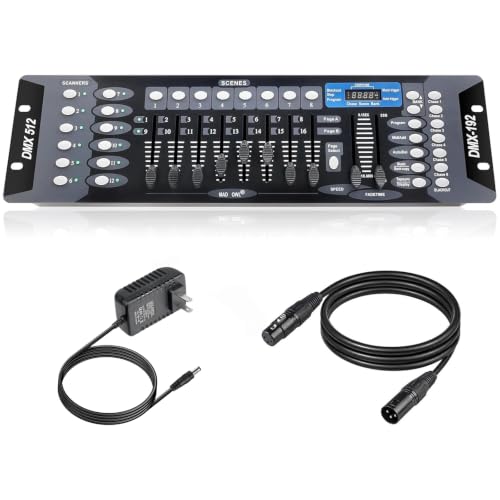
- Controls up to 12 fixtures
- Stores scenes and programmable chases
- Includes a 6.6-foot DMX cable
Best For: Small venues needing repeatable scenes and chase effects
Best for Voice Control
192-Channel Stage Lighting Console

- Controls up to 12 fixtures and 240 scenes
- Offers voice-controlled scene changes
- Programs up to 40 steps per scene
Best For: Events and performances needing flexible scene control
Best All-Around Standalone Pick – ADJ WMX1 MK2 WolfMix Bundle
For small venues that need capable dmx controllers for small venues without relying on a laptop, the ADJ WMX1 MK2 offers touchscreen control, onboard automation, and broad fixture support. This bundle also includes a Decksaver cover for transport and storage.
Best For: Mobile DJs, churches, event technicians, and small bars or clubs that want a standalone controller with room to grow.
Pros:
- Controls up to 680 fixtures across four DMX universes, with 1,024 channels listed in the specifications.
- 4.3-inch touchscreen, 37 backlit buttons, BPM detection, and manual or automated show control.
- Includes a protective Decksaver cover and offers a compact, road-ready steel design.
Cons:
- Its extensive features may be more than a very basic venue setup requires.
- Additional fixture profiles beyond the built-in library require the WTOOLS app.
The WMX1 MK2 is the most capable option here for venues that want standalone operation, hands-on control, and expansion potential in a compact footprint.
Best for DJ Software Integration – SoundSwitch Control One
The SoundSwitch Control One is a strong choice among dmx controllers for small venues that already use compatible DJ software or Engine DJ hardware. Its tactile controls are designed for making lighting adjustments and effects during a performance.
Best For: DJs and small venues using SoundSwitch, compatible Denon DJ or Numark Engine DJ devices, or supported AlphaTheta setups.
Pros:
- Provides two DMX universes with input, output, and thru options for installations.
- Touch strip, encoders, and RGB performance pads offer hands-on control of lighting parameters.
- Supports live audio BPM detection and works with external audio sources, DAWs, and DJ software.
Cons:
- Its primary function is 1:1 control for SoundSwitch software rather than fully standalone operation.
- Some AlphaTheta PRO DJ LINK Bridge configurations require a laptop running SoundSwitch.
Choose the Control One when your lighting workflow is software-centered and you want responsive physical controls for real-time changes during DJ sets.
Best Budget Manual Controller – Wireless Mini DMX512 Console
For straightforward lighting setups, this compact console is one of the simpler dmx controllers for small venues. It combines standard DMX512 with 2.4G wireless transmission, manual dimming, and programmable scenes for parties, bars, and small events.
Best For: Small clubs, bars, weddings, parties, and basic stage-lighting projects that need simple scene playback.
Pros:
- Supports 512 channels and both standard DMX512 and 2.4G wireless transmission.
- Offers six banks with eight programmable scenes, one-key recording, blackout, and clear functions.
- Compact, lightweight design with smooth 0–100% master dimming and automatic scene looping.
Cons:
- Requires an external 9V–12V DC adapter; it does not have a built-in battery.
- Its feature set is oriented toward basic manual and scene control rather than advanced show programming.
This is a practical pick when portability and simple scene management matter more than deep fixture programming or extensive automation.
Best App-Based Option – ADJ MyDMX Go
The ADJ MyDMX Go takes a tablet-based approach to dmx controllers for small venues. Its 256-channel app provides wireless or USB-connected control, presets, and automated effects without requiring users to program every fixture from scratch.
Best For: Small venues and mobile operators that prefer iPad or Android tablet control with quick setup and preset-driven lighting.
Pros:
- Offers 256-channel control through an iPad or Android tablet using Wi-Fi or USB.
- Includes a library of more than 15,000 fixtures, plus 50 user presets and 21 automatic effects.
- Supports manual displays and effect adjustments such as speed, color palette, size, shift, and fan control.
Cons:
- Requires a compatible iPad or Android tablet for app-based operation.
- It is limited to 256 channels, fewer than the higher-capacity controllers in this roundup.
- Additional upgrades are available separately through DMXsoft.
MyDMX Go is appealing for operators who want a lightweight, approachable interface and a large fixture library rather than a traditional hardware console.
Best Overall – MINGJIE 192-Channel DMX512 Controller
For small venues seeking practical dmx controllers for small venues, the MINGJIE offers 192-channel control for up to 12 intelligent fixtures. Its scene storage, programmable chases, sound activation, and clearly divided controls make it suitable for both straightforward setups and more involved shows.
Best For: Small stages, clubs, mobile DJs, weddings, and users who want a traditional wired console with room to program scenes.
Pros:
- Controls up to 12 fixtures across 192 DMX channels.
- Stores 240 scenes in 30 banks and supports six programmable chases.
- Includes sound-activated operation, a 3-pin DMX cable, and a rugged alloy chassis.
Cons:
- Uses wired DMX connectivity rather than the wireless option found on some competing controllers.
- Its larger console layout may be more than needed for very simple lighting rigs.
The MINGJIE is a well-rounded choice when a small venue needs hands-on control and repeatable programmed looks. Its 100–240V input and included cable also make it convenient to put into service quickly.
Best Wireless Option – 384-Channel Wireless DMX Controller
This 384-channel console stands out among dmx controllers for small venues because it combines traditional 3-pin wired operation with 2.4G wireless transmission. It also adds sound activation, MIDI support, and programmable scene storage for venues that need flexible setup options.
Best For: Weddings, bars, banquet halls, churches, and indoor stages where wireless fixture placement or MIDI control is useful.
Pros:
- Provides 384-channel DMX512 control for up to 12 intelligent lights.
- Supports both 2.4G wireless and conventional 3-pin wired connections.
- Offers sound-activated, automatic, manual, and MIDI control modes.
- Stores 240 scenes in 30 banks and includes one-key blackout.
Cons:
- The wireless feature may require compatible wireless equipment in the lighting system.
- Requires a 9V battery according to the listed specifications.
Choose this model if installation flexibility matters as much as channel capacity. The dual-mode design can reduce cable constraints, while the programmable banks and multiple control modes support repeatable event lighting.
Best Beginner Pick – 192-Channel DMX Stage Controller
For beginners comparing dmx controllers for small venues, this 192-channel console keeps the core controls straightforward while supporting up to 12 smart devices. It includes manual faders, programmable scenes and chases, automatic operation, and a 3-pin cable for common stage fixtures.
Best For: Small gatherings, parties, music shows, and first-time users building a basic wired DMX lighting system.
Pros:
- Controls 12 fixtures with 16 channels each, for 192 total channels.
- Supports up to 240 scenes, 23 banks, and six programmable chases.
- Includes eight manual channel sliders and a 3-pin cable.
- The seven-section layout is designed for easier learning and operation.
Cons:
- It has fewer total channels than the 384-channel alternative.
- The supplied notes list a 90-day manufacturer warranty, while also mentioning 360-day repair support.
This controller is a sensible entry point for modest lighting rigs that do not require wireless operation. Its familiar layout and scene programming provide useful control without making the setup unnecessarily complex.
Best Compact Pick – MAD OWL 12-Channel DMX Dimmer
For small venues that use straightforward DMX512 fixtures, the MAD OWL 12-channel controller keeps operation simple. Its compact aluminum body, six sub-control faders, and master fader make it a practical choice when you need basic dimming control without a full-size console.
Best For: Small stages and portable setups using fixtures with 12 DMX channels or fewer.
Pros:
- Controls up to 12 DMX512 channels.
- Compact, lightweight design suited to travel and quick installation.
- Standard 3-pin XLR DMX output for compatible equipment.
- Simple one-key blackout function and smooth faders.
Cons:
- Not compatible with lighting equipment requiring more than 12 channels.
- Provides basic dimming control rather than extensive scene programming.
This is a focused option for operators who value portability and uncomplicated manual control. Choose a larger console if your venue uses intelligent fixtures or needs programmable chases.
Best Programmable Value – 192-Channel DMX Lighting Console
For small venues that need more than manual dimming, this 192-channel DMX controller adds programmable scenes and chases. It can control up to 12 fixtures with 16 channels or fewer and includes a 6.6-foot DMX cable for connecting compatible lighting equipment.
Best For: DJs, stages, clubs, and performance spaces that need programmable lighting sequences.
Pros:
- 192 channels support up to 12 fixtures with 16 channels or fewer.
- Stores 23 banks of eight programmable scenes.
- Supports 240-step scenes across six programmable chases.
- Faders and buttons allow real-time adjustments.
Cons:
- The larger rack-mount design is less portable than a mini controller.
- Its channel capacity is limited to fixtures using 16 channels or fewer.
This console offers a useful middle ground for small venues moving into programmed lighting. It is a stronger fit than a basic dimmer when repeatable scenes and chase effects are part of the show.
Best for Voice Control – 192-Channel Stage Lighting Console
This 192-channel console is designed for small venues that want hands-on programming plus voice-controlled scene changes. It supports up to 12 intelligent lights with 16 channels each, offers adjustable scene timing, and uses a 3-pin XLR DMX output for compatible fixtures.
Best For: DJs, weddings, churches, gatherings, and small performances needing flexible scene control.
Pros:
- Controls up to 12 fixtures and up to 240 scenes.
- Voice control enables hands-free lighting-scene changes.
- Supports up to 40 steps per scene with adjustable timing.
- Organized controls and upgraded buttons are designed for easier operation.
Cons:
- Fixture support is limited to units using 16 channels or fewer.
- Voice control may not be necessary for venues that prefer fully manual operation.
Among these dmx controllers for small venues, this model stands out when voice operation and detailed scene timing matter. Its 192-channel layout provides room for more complex shows while retaining controls aimed at approachable operation.
How We Picked the Best Dmx Controllers for Small Venues
We selected models that suit small stages, mobile DJs, churches, event spaces, and similar installations. Our comparison considers channel capacity, wired and wireless connectivity, programming flexibility, portability, control methods, and ease of use. We also looked for practical differences between standalone hardware and software-driven systems, since each approach serves a different type of operator.
Channel count is only a starting point. A controller with 192 channels may be sufficient for a modest rig, while a 512-channel model provides more room for moving heads, LED fixtures, dimmers, and future expansion. Preset access, scene storage, sound activation, MIDI support, and app integration can matter more than raw capacity for live operation.
Quick Comparison
- Best for advanced standalone control: ADJ WMX1 MK2 Wolfmix bundle.
- Best for software-based lighting: SoundSwitch Control One or ADJ myDMX GO.
- Best for wireless flexibility: the 2.4G wireless 512- and 384-channel controllers.
- Best for simple budget setups: compact 192-channel DMX consoles.
- Best for basic dimming: the MAD OWL 12-channel controller.
Key Buying Factors for Dmx Controllers for Small Venues
Fixture Compatibility and Channel Capacity
Check the DMX personality and channel requirements of every fixture before buying. Add the channels together, then leave capacity for additional lights. Also confirm whether the controller supports the functions you need, such as pan and tilt, color mixing, dimmer curves, strobe effects, and fixture-specific controls.
Programming and Live Operation
Standalone consoles can work without a computer and are useful when reliability and quick access matter. App-based controllers may offer easier fixture libraries, visual programming, and updates, but they depend on a compatible device and software workflow. Look for dedicated buttons, faders, or shortcut controls if you need to make changes during a performance.
Connectivity and Portability
Wired DMX is familiar and dependable, while wireless DMX can reduce cable runs and speed up temporary setups. Verify wireless range, receiver requirements, and interference considerations. For mobile use, prioritize a manageable footprint, protective case or cover, and simple power requirements.
Automation and Expansion
Sound activation, MIDI, scene playback, and automatic modes can reduce operator workload. If the venue may add fixtures later, choose a controller with extra channels and flexible fixture support rather than selecting solely on today’s equipment.
Who Should Buy Which Dmx Controllers for Small Venues?
Choose a Wolfmix-style standalone controller if you want powerful hardware control without relying on a laptop. Pick SoundSwitch Control One when lighting needs to follow DJ software and music playback. An app-based system such as myDMX GO is a good fit for users who prefer visual setup and wireless operation.
For occasional events and uncomplicated rigs, a 192-channel console can provide essential scene and fixture control at a lower cost. Select a 384- or 512-channel wireless controller when you need more capacity or flexible placement. Finally, the 12-channel dimming controller is best reserved for basic dimmer-based lighting rather than complex modern fixtures.