
The right lighting controller can make a band’s live setup look more polished without adding unnecessary complexity. These DMX options cover compact dimmers, traditional 192-channel consoles, and wireless systems for stage, DJ, and event use.
Below, compare the most useful features for programming scenes, controlling moving heads and PAR lights, and building a dependable lighting rig around your performance style.
Best 10 Dmx Controllers for Bands Picks for 2026
Flexible Scene Control
CO-Z 192-Channel DMX Controller

- Controls up to 12 fixtures
- Stores up to 240 scenes
- Supports three-pin lighting and fog machines
Best For: Programmable band shows with multiple fixtures
Cable-Free Stage Links

- Includes one transmitter and two receivers
- Offers seven group IDs
- Uses 2.4G frequency hopping and includes power adapters
Best For: Wireless fixture links and faster mobile setups
Beat-Synced Show Builder

- Controls up to 12 smart lights
- Stores 240 scenarios and six chase sets
- Includes microphone, MIDI, and tap sync modes
Best For: Sound-reactive band and DJ lighting shows
Portable Wireless Fader Control

- Built-in wireless DMX transmitter
- Offers 24-channel control with eight sliders
- Adds fade, strobe, blackout, and memory features
Best For: Compact, portable band lighting rigs
Best Wireless Pick
Lixada DMX 512 Wireless Controller

- Wireless transmission reduces cable runs
- 126 channels and 16 ID groups
- Four selectable output power levels
Best For: Bands needing flexible wireless DMX control
Best Programmable Console

- Controls 12 fixtures with 16 channels each
- Stores up to 240 programmable scenes
- Includes sound-activated and manual modes
Best For: Bands creating repeatable, beat-synced light shows
Best Compact Option

- Portable aluminum design for travel
- Six sub-faders plus a master fader
- Supports DMX512 fixtures up to 12 channels
Best For: Small-stage bands with modest lighting rigs
Beginner-Friendly Pick
192-Channel Stage Lighting Controller

- Controls 12 fixtures with up to 16 channels each
- 23 banks, six chases, and eight manual sliders
- Includes 3-pin cable and power adapter
Best For: Small bands and beginner lighting operators
Cable-Included Workhorse
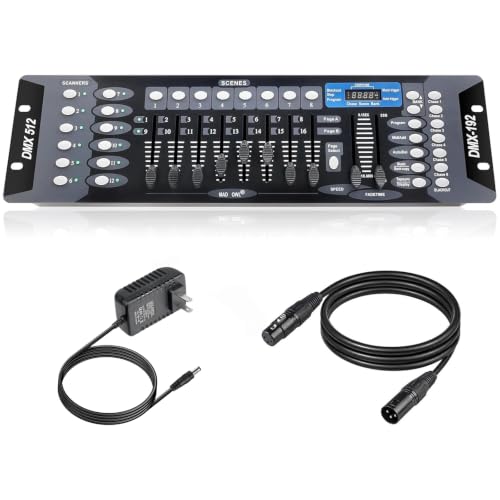
- Controls 12 fixtures with up to 16 channels
- Stores 23 banks and six programmable chases
- Includes a 6.6-foot DMX cable
Best For: Club, stage, and venue performances
Flexible Scene Control – CO-Z 192-Channel DMX Controller
For bands building more involved lighting cues, this 192-channel console is one of the more capable DMX controllers for bands. It can address up to 12 intelligent lights with up to 16 channels each, while storing up to 240 scenes.
Best For: Bands, DJs, churches, weddings, and small venues that need programmable scenes and control for multiple fixtures.
Pros:
- Controls up to 12 fixtures and 240 scenes.
- Works with fog machines, moving or oscillating beam lights, PARs, strobes, and other three-pin fixtures.
- Includes dedicated areas for light selection, scenes, channels, speed, timing, and functions.
- Voice control and upgraded buttons and control sticks add convenience.
Cons:
- The corded design requires a nearby power source.
- Its 19.1-inch width may be less convenient for compact setups.
This is a practical choice when your band needs more than simple manual dimming. Its scene capacity and fixture support suit programmed shows, although the larger console layout may take more space than a portable controller.
Cable-Free Stage Links – JERRAY Wireless DMX Set
This wireless kit is a useful add-on for dmx controllers for bands when the main challenge is getting the signal to fixtures without long XLR runs. It includes one transmitter, two receivers, and power adapters, with a stated range of up to 1,000 feet.
Best For: Mobile bands, DJs, weddings, and venues where quick setup and reduced cable clutter matter.
Pros:
- Wireless DMX512 transmission avoids a cable run between compatible equipment.
- 2.4G ISM operation uses 126-channel frequency hopping for interference resistance.
- Seven group IDs allow separate lighting rigs to be controlled independently.
- Includes power adapters for the transmitter and both receivers.
Cons:
- This is a wireless transmitter-and-receiver set, not a standalone lighting console.
- The units are not battery-powered and require power adapters while operating.
Consider this kit when your existing controller and lights support wireless DMX and you want a cleaner stage setup. Its multiple groups can help separate rigs, but the need for continuous power should be planned into the setup.
Beat-Synced Show Builder – 192-Channel DMX Controller
Bands wanting lighting that follows the performance may appreciate this 192-channel console. Among dmx controllers for bands, it stands out for its built-in microphone, MIDI beat activation, tap synchronization, automatic operation, chases, and scene storage.
Best For: Bands, DJs, clubs, bars, and party setups that want sound-reactive or programmed lighting control.
Pros:
- Controls up to 12 smart lights using up to 16 channels per light.
- Stores 240 scenarios across 23 groups and provides six sets of chases.
- Supports simultaneous chase playback.
- Offers built-in microphone, MIDI beat activation, tap sync, and automatic operation.
Cons:
- It uses three-pin DMX cabling, so it does not provide wireless fixture control.
- The range of features may require programming time for first-time users.
This console is a strong fit for performances where lighting needs to react to music or run through prepared sequences. It gives you substantial scene and chase capacity, provided your fixtures use compatible three-pin DMX connections.
Portable Wireless Fader Control – 24-Channel DMX Console
For smaller rigs, this compact console offers a straightforward alternative among dmx controllers for bands. Its built-in wireless DMX transmitter, 24-channel control, adjustable speed and fade, strobe, blackout, and power-failure memory support live manipulation without a large desk.
Best For: Small bands, DJs, pubs, clubs, parties, and portable setups using compatible wireless DMX lights.
Pros:
- Built-in wireless DMX transmitter reduces cable clutter with compatible lights.
- Provides 24 channels through eight physical sliders and page controls.
- Includes speed, fade, strobe, blackout, and master output controls.
- Portable design measures about 9.1 by 6.2 by 2.6 inches and weighs 2.65 pounds.
Cons:
- Its 24-channel capacity is more limited than 192-channel consoles.
- Wireless operation depends on compatible wireless DMX fixtures.
This is a sensible option when portability and quick hands-on control matter more than extensive scene capacity. It suits compact band rigs, while larger productions may outgrow its 24-channel layout.
Best Wireless Pick – Lixada DMX 512 Wireless Controller
For bands that want to reduce cable runs, the Lixada DMX 512 Controller is a wireless option for transmitting standard DMX512 data between a console and lighting fixtures. It offers 126 frequency channels, 16 ID groups, and four selectable output power levels for configuring a dependable setup.
Best For: Bands and DJs that prioritize wireless control for disco, party, recording, or stage lighting.
Pros:
- Wireless DMX512 transmission eliminates the need for a direct cable connection between compatible devices.
- 126 frequency channels and 16 ID groups provide setup flexibility in busy environments.
- Four selectable power levels and stated anti-jamming capability support reliable signal transmission.
Cons:
- It is a wireless transmitter/receiver system rather than a conventional console with physical faders.
- Its compact display-based design may be less suitable for performers who want hands-on channel control.
The Lixada is a practical choice among DMX controllers for bands when wireless flexibility matters more than onboard scene programming. Confirm that your lighting equipment supports the required DMX512 connection and wireless setup.
Best Programmable Console – 192-Channel DMX Controller
For bands building repeatable light shows, this 192-channel DMX controller combines physical faders with programmable scenes and sound activation. It controls up to 12 fixtures with 16 channels each and can store as many as 240 scenes for more structured performances.
Best For: Bands, DJs, clubs, churches, and mobile setups that need programmable scenes plus beat-synchronized lighting.
Pros:
- Controls up to 12 fixtures with 16 channels per fixture through standard 3-pin XLR output.
- Stores up to 240 programmable scenes for organizing complex light shows.
- Built-in microphone supports sound-activated operation, alongside auto and manual modes.
- Includes a DMX cable, power cord, manual, and a stated two-year manufacturer warranty.
Cons:
- The larger 18.9-inch console requires more transport and setup space than a mini controller.
- Programming 240 scenes may take more preparation than a simple plug-and-play control setup.
With its organized control sections, responsive sliders, and multiple operating modes, this is one of the more versatile DMX controllers for bands that want hands-on control during live shows and saved looks between songs.
Best Compact Option – MAD OWL 12-Channel DMX Dimmer
The MAD OWL 12-channel DMX dimming controller is a compact choice for bands using smaller lighting rigs. Its six sub-control faders, master fader, and one-key blackout function provide straightforward control for DMX512 fixtures with no more than 12 channels.
Best For: Small-stage bands and traveling performers who need a lightweight, simple DMX dimmer.
Pros:
- Compact aluminum design measures approximately 7.09 by 3.94 by 1.38 inches for easier transport.
- Six sub-control faders and a master fader offer direct adjustment of supported channels.
- Standard 3-pin DMX output connects readily to compatible DMX512 lighting equipment.
- One-key blackout provides a quick way to shut down the controlled lighting output.
Cons:
- It cannot be used with stage lighting equipment requiring more than 12 channels.
- It is a dimming controller, so it offers fewer programming features than a larger scene-based console.
The MAD OWL makes sense when portability and uncomplicated fader control are the priorities. It is best matched with a modest rig and should be avoided if your fixtures exceed the stated 12-channel limit.
Beginner-Friendly Pick – 192-Channel Stage Lighting Controller
For bands seeking dmx controllers for bands, this compact 192-channel console offers straightforward control for small shows, rehearsals, parties, and stage setups. It supports up to 12 fixtures with 16 channels each, plus programmable scenes and chases.
Best For: Small bands and beginner operators needing accessible control for stage lights, moving heads, fog machines, and other 3-pin DMX equipment.
Pros:
- Controls up to 192 channels across 12 fixtures.
- Offers 23 banks of programmable scenes and six chases.
- Includes eight sliders for manual channel adjustments.
- Includes a 3-pin cable and a power adapter.
Cons:
- Its feature set is aimed more at small gatherings than highly complex productions.
- The supplied notes list different warranty durations, so buyers should confirm coverage.
This is a practical entry-level choice when ease of operation and a compact control layout matter more than advanced show-control features.
Cable-Included Workhorse – 192-Channel DMX Board
This 192-channel console is a useful option for bands comparing dmx controllers for bands that can handle multiple fixtures and programmed lighting sequences. Its faders and buttons support real-time adjustments, while the included 6.6-foot DMX cable simplifies connection to compatible equipment.
Best For: Bands playing clubs, stages, and performance venues that want programmable scenes, chase effects, and a bundled DMX cable.
Pros:
- Controls 12 fixtures with up to 16 channels each.
- Provides 23 banks of eight programmable scenes.
- Supports 240-step scenes across six programmable chases.
- Includes a 6.6-foot DMX cable.
Cons:
- Its programming-oriented interface may take practice for first-time users.
- The product is designed for corded operation rather than portable, battery-powered use.
With broad scene capacity and a supplied cable, this console is a solid fit for bands building repeatable lighting looks for recurring performances.
Portable Programming Choice – Compact 192CH DMX Console
For touring groups researching dmx controllers for bands, this compact 192-channel console focuses on portable programming without dropping core scene and chase functions. A backlit LCD, numeric keypad, and eight real-time sliders support setup and live adjustments.
Best For: Bands and lighting technicians who need a smaller controller for programming multi-cue shows and transporting between venues.
Pros:
- Controls up to 12 fixtures with 16 channels or fewer each.
- Includes a backlit LCD display and numeric keypad.
- Offers 23 banks of eight scenes and six programmable chases.
- Compact design is easier to carry than a full-size console.
Cons:
- The supplied notes do not mention included cables or a power adapter.
- Its 192-channel architecture may be more than needed for very small lighting rigs.
This model stands out when portability and structured programming are priorities, especially for bands moving a lighting controller from one show to the next.
How We Picked the Best Dmx Controllers for Bands
We focused on the practical needs of performing groups: channel capacity, compatibility with common DMX512 fixtures, programming controls, portability, connection options, and setup flexibility. The selection includes conventional console-style controllers, compact units for smaller stages, and wireless transmitter-and-receiver systems that can reduce cable runs.
Because band lighting setups vary widely, we did not treat the highest channel count as an automatic advantage. A simple controller may be easier to operate during a show, while a larger console can better support several fixtures, programmed scenes, and moving-head effects.
Quick Comparison
- Best for straightforward setups: A 192-channel console offers familiar faders and scene controls for PAR cans, washes, and basic fixtures.
- Best for wireless flexibility: A 2.4GHz DMX transmitter and receiver kit can help when long signal cables are inconvenient.
- Best for small stages: A compact 12-channel dimmer is suitable for limited lighting rigs with simpler control requirements.
- Best for expanding rigs: Choose a controller with enough channels and programmable banks to accommodate future fixtures.
Key Buying Factors for Dmx Controllers for Bands
Channel Count and Fixture Type
Count the DMX channels required by every fixture, not just the number of lights. A basic PAR may use a few channels, while moving heads, pixel fixtures, and effects can use many more. Leave spare capacity for future additions.
Programming and Live Control
Look for faders, scene or chase memory, blackout controls, and accessible speed or dimmer adjustments. If one person will operate lights while performing, straightforward controls are generally more valuable than an overloaded interface.
Wired Versus Wireless DMX
Wired DMX is usually the simplest choice for dependable permanent or semi-permanent installations. Wireless systems can speed up setup and keep walkways clear, but verify receiver compatibility, operating range, power requirements, and backup options before relying on them for a major show.
Portability and Durability
Mobile bands should consider weight, physical controls, cable storage, and protection during transport. A compact board may fit a small case more easily, while a larger console can provide better hands-on control but require more space.
Who Should Buy Which Dmx Controllers for Bands?
Choose a 192-channel controller if your band uses several conventional DMX fixtures and wants a familiar console for scenes, chases, and manual adjustments. These models are a practical middle ground for clubs, rehearsal spaces, and mobile performances.
Choose a wireless DMX system if cable management is a major concern or fixtures are positioned far from the control area. Confirm that the system supports your fixture configuration and keep a wired fallback for critical events.
Choose a compact 12-channel controller if you operate a small rig with limited fixtures and prioritize quick setup over advanced programming. For larger or more effect-heavy productions, select a higher-capacity console instead.
Before buying, match the controller’s channel layout to your fixtures, confirm the required connectors and power arrangements, and decide whether someone can actively run lighting during performances. The best Dmx Controllers for Bands are the ones that fit both the equipment and the people operating them.