
The right DMX controller can make a lighting rig easier to program, faster to operate, and more reliable during a live show. This roundup compares 10 options ranging from compact app-based systems to traditional 192- and 384-channel consoles.
Use the guide below to match your fixtures, control style, and performance needs with a controller that offers the right balance of hands-on access, automation, and expandability.
Best 10 Dmx Controllers Picks for 2026
Programmable 192-Channel Pick
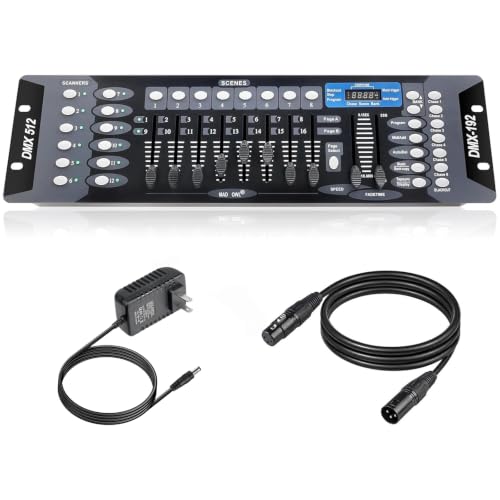
- Controls up to 12 fixtures at 16 channels or fewer
- Stores 23 banks and six programmable chases
- Includes a 6.6-foot DMX cable
Best For: Small to midsize stage and DJ lighting setups
Compact Multi-Universe Pick

- Supports up to four DMX universes
- Provides four output sockets
- Uses 37 backlit buttons and four rotary encoders
Best For: Compact setups needing expanded DMX output
High-Capacity Scene Pick

- Provides 384 DMX channels
- Controls up to 12 lights with up to 32 channels each
- Stores 240 scenes across six chases
Best For: Multi-fixture stage and event lighting
Voice-Controlled Value Pick

- Controls up to 12 fixtures at 16 channels each
- Stores up to 240 scenes with 40 steps per scene
- Adds voice control and a 3-pin DMX output
Best For: Beginner-friendly DJ, event, and small venue lighting
Best Programmable Choice

- Controls 192 DMX channels
- Stores up to 240 scenes
- Adds chases, fog, strobe, and MIDI control
Best For: Complex multi-fixture lighting setups
Best for DJ Software Integration

- Supports two DMX universes
- Works with select Engine DJ hardware
- Offers tactile pads, encoders, and touch control
Best For: Software-connected DJ lighting performances
Best Budget-Style Manual Console

- Controls up to 12 fixtures
- Stores up to 240 scenes
- Includes voice control and fog-machine support
Best For: Amateur users and event lighting
Best App-Based Pick

- Tablet-based control for up to 256 channels
- 15,000+ fixture library and no-programming operation
- 50 presets, 21 effects, USB and 3-pin XLR support
Best For: Tablet-based control and quick lighting setup
Best Budget Console

- Controls 12 devices across 192 channels
- Programmable scenes, banks, and six chases
- Physical sliders and beginner-friendly layout
Best For: Small events and entry-level hands-on control
Best Wireless Flexibility

- 384 channels with support for up to 12 lights
- 2.4G wireless and 3-pin XLR wired modes
- Sound, MIDI, auto, and manual control options
Best For: Mobile DJs, weddings, bars, and live stages
Programmable 192-Channel Pick – WK-192 DMX Controller
For buyers comparing DMX controllers for stage, DJ, or venue lighting, the WK-192 offers hands-on control across 192 channels. Its programming capacity and included 6.6-foot DMX cable make it a practical choice for building repeatable lighting scenes and chase effects.
Best For: Stages, clubs, and performance venues using up to 12 fixtures with 16 channels or fewer.
Pros:
- Controls up to 12 lighting fixtures with 16 channels or fewer.
- Provides 23 banks of eight programmable scenes.
- Supports 240-step scenes across six programmable chases.
- Includes a 6.6-foot DMX cable.
Cons:
- Its 192-channel capacity is less suited to larger, more complex rigs.
- The rack-mount design and 22.44-inch width may require dedicated space.
The WK-192 emphasizes straightforward physical control and substantial scene storage. It is a sensible fit when you want programmable DMX operation without moving to a larger multi-universe system.
Compact Multi-Universe Pick – ADJ WMX1 Mk2 Controller
The ADJ WMX1 Mk2 stands out among DMX controllers for its compact footprint and expanded output design. With four universes, four output sockets, backlit buttons, and rotary encoders, it is built for users who need a more capable standalone control surface.
Best For: Users seeking a compact standalone controller with up to four DMX universes.
Pros:
- Supports up to four universes.
- Offers four output sockets for connectivity.
- Uses 37 backlit silicone buttons for visible control.
- Includes four rotary encoders for adjustment.
Cons:
- The supplied notes do not specify scene or chase storage capacity.
- Its feature set may be more than needed for a simple single-universe setup.
With its four-universe architecture and compact 10-by-9.25-inch body, the WMX1 Mk2 is aimed at more flexible installations than basic 192-channel boards. Consider it when output expansion matters more than extensive published programming details.
High-Capacity Scene Pick – CHAUVET DJ Obey 70
The CHAUVET DJ Obey 70 is one of the more substantial DMX controllers in this group, combining 384 channels with generous scene and chase programming. It is designed for users who need control over multiple intelligent lights and want timing details stored within each programmed step.
Best For: Larger stage or event rigs using up to 12 intelligent lights with as many as 32 channels each.
Pros:
- Offers 384 DMX channels of control.
- Controls up to 12 intelligent lights with up to 32 channels each.
- Stores 30 banks of eight scenes, or 240 scenes total.
- Supports six chases and lets users program fade and speed time into each step.
Cons:
- At 6.9 pounds, it is heavier than the compact ADJ controller listed here.
- The 230-volt power specification may require compatibility checking for the intended setup.
The Obey 70 is a strong choice when channel count and scene organization are priorities. Its rack-mount form and chase programming suit repeatable productions, while the 12-fixture limit keeps the intended scale clear.
Voice-Controlled Value Pick – 192-Channel Stage Console
For buyers wanting accessible DMX controllers with extra convenience features, this 192-channel stage console combines organized physical controls with voice control. It can manage up to 12 intelligent lights, store up to 240 scenes, and connect through a 3-pin DMX512 output.
Best For: DJs, gatherings, weddings, churches, and small venue setups that value voice control and simple operation.
Pros:
- Controls up to 12 intelligent lights with up to 16 channels each.
- Supports up to 240 scenes and 40 steps per scene.
- Includes voice control for switching lighting scenes.
- Provides a 3-pin XLR DMX512 output and includes a 3-pin cable.
Cons:
- The 192-channel design is intended for smaller systems than higher-capacity consoles.
- The plastic shade material may feel less robust than metal-bodied alternatives.
This console is especially appealing when ease of use is important. Its clearly divided controls, adjustable timing, voice operation, and included cable give beginners and casual event operators several ways to manage compatible lighting equipment.
Best Programmable Choice – CHAUVET DJ OBEY40
For demanding lighting rigs, the CHAUVET DJ OBEY40 is one of the more capable DMX controllers in this roundup. It manages up to 12 fixtures with 16 channels each, giving operators room to build organized, repeatable shows.
Best For: DJs, venues, and performers managing multiple intelligent lights with programmed scenes and chases.
Pros:
- Controls up to 192 DMX channels across 12 fixtures.
- Stores up to 240 scenes in 30 banks.
- Offers six chase sets, plus fog and strobe controls.
- Includes MIDI compatibility and reversible sliders.
Cons:
- Its extensive programming capacity may be more than needed for simple setups.
- At 6.7 pounds, it is less lightweight than some compact controllers.
The OBEY40 is a practical pick when scalability and scene storage matter more than a minimal control surface. Its broad fixture capacity makes it well suited to more complex DMX lighting systems.
Best for DJ Software Integration – SoundSwitch Control One
The SoundSwitch Control One is a modern option among DMX controllers, designed for hands-on control alongside SoundSwitch software. Its tactile interface, dual DMX universes, and DJ-focused connections make it especially useful for performance-based lighting.
Best For: DJs and performers using SoundSwitch, Engine DJ devices, or supported AlphaTheta setups.
Pros:
- Provides two DMX universe inputs and outputs with a Thru option.
- Works directly with compatible Denon DJ and Numark Engine DJ hardware without a computer.
- Offers a touch strip, encoders, and customizable RGB performance pads.
- Supports live audio BPM detection and on-the-fly lighting effects.
Cons:
- Some compatibility options require SoundSwitch software and a computer.
- Its feature set is most useful within supported DJ software ecosystems.
Choose the Control One if you want responsive physical controls for modifying lighting during a DJ set. It combines software integration with practical controls for intensity, color, strobe, moving heads, and gobos.
Best Budget-Style Manual Console – CO-Z 192 DMX Controller
The CO-Z 192 DMX 512 controller offers a straightforward way to operate multiple stage fixtures. With 192 channel groups, scene storage, dedicated control sections, and voice control, it is aimed at users who want practical DMX controllers for events and small-to-medium lighting setups.
Best For: Amateur DJs, parties, weddings, churches, clubs, and other event-based lighting applications.
Pros:
- Controls up to 12 intelligent lights with up to 16 channels each.
- Supports up to 240 scenes for more involved shows.
- Includes a three-pin cable for compatible fog machines and fixtures.
- Provides voice control and a clearly divided seven-section interface.
Cons:
- The plastic construction may feel less substantial than metal-bodied alternatives.
- Its manual console layout may require some learning for first-time users.
The CO-Z is a sensible choice for users who need broad channel and scene support without moving to a software-centered system. Its dedicated controls and voice feature add flexibility for parties and live events.
Best App-Based Pick – MyDMX Go Wireless Controller
For tablet-first control, the ADJ MyDMX Go is one of the more approachable DMX controllers. Its app-based design, broad fixture library, and wireless or USB connectivity make it a practical option for users who want quick setup without traditional programming.
Best For: Tablet-based lighting control, mobile DJs, small stages, and users who prioritize simple operation.
Pros:
- Controls up to 256 DMX channels through an iPad or Android tablet.
- Supports more than 15,000 fixtures, helping it work with many lighting brands.
- Offers 50 user presets and 21 automatic effects without requiring programming.
- Includes mounting brackets and supports USB or standard 3-pin XLR connections.
Cons:
- Requires a compatible iPad or Android tablet for app-based operation.
- Its two-universe capability may be limiting for larger lighting systems.
The MyDMX Go stands out for convenience rather than hands-on console control. Choose it if a visual tablet interface and quick access to effects matter more than physical faders.
Best Budget Console – 192-Channel Stage Controller
This 192-channel unit is a straightforward choice among DMX controllers for small gatherings and entry-level stage setups. Its physical sliders, programmable scenes, and support for up to 12 devices provide familiar hands-on control without relying on an app.
Best For: Beginners, small parties, compact stage systems, and users who want physical controls for basic lighting scenes.
Pros:
- Controls up to 12 devices with 16 channels each, for 192 total channels.
- Provides 23 programmable banks, six programmable chases, and up to 240 scenes.
- Eight sliders allow manual channel control, with speed and fade controls for automatic programs.
- Includes a 3-pin cable and supports common stage fixtures such as moving heads, fog machines, and par lights.
Cons:
- Offers fewer channels than the other controllers in this roundup.
- Its physical, segmented layout may feel less flexible than an app-based interface.
- Warranty information varies in the supplied listing details, so buyers should verify coverage.
With dedicated buttons and sliders, this console favors predictable, hands-on operation. It is a sensible fit when your setup is modest and you want an inexpensive way to build scenes and chases.
Best Wireless Flexibility – 384-Channel DMX512 Controller
The DMX-384 combines a higher channel count with both wired and 2.4G wireless operation, making it one of the more flexible DMX controllers for mobile event setups. It also adds sound activation, MIDI support, and programmable scene storage for more involved shows.
Best For: DJs, weddings, bars, live stages, and indoor setups that need wireless or wired fixture connections.
Pros:
- Provides 384 DMX512 channels and supports up to 12 intelligent lights.
- Offers both 2.4G wireless transmission and traditional 3-pin XLR wired connection.
- Includes sound-activated, automatic, manual, and MIDI control modes.
- Stores 30 banks and 240 preset static scenes with scene copy, insert, and delete functions.
Cons:
- The supplied notes do not specify wireless receiver or fixture compatibility details.
- Requires a 9V battery according to the product details.
- Its feature set may be more than needed for very small, simple lighting systems.
This controller is the strongest choice here for connectivity flexibility and show-building capacity. Its wireless option and rhythm-based modes are particularly useful when a conventional cable-only setup would be inconvenient.
How We Picked These Dmx Controllers
We focused on controllers that cover the most common lighting setups, including DJ rigs, small stages, event spaces, and mobile entertainment. The selection includes traditional fader consoles, software- and app-based systems, wireless-capable models, and controllers with features for sound activation or MIDI integration.
We also considered channel capacity, fixture compatibility, programming flexibility, portability, ease of operation, and the kind of workflow each controller supports. A higher channel count is not automatically better; the best choice depends on how many fixtures and DMX channels your setup actually uses.
Quick Comparison
| Controller type | Best suited for | Main advantage |
|---|---|---|
| 192-channel console | Basic DJ and party lighting | Simple hands-on control and affordable setup |
| 384-channel controller | Larger or expanding rigs | More room for fixtures and complex programming |
| Standalone advanced console | Regular performers and venues | Deeper scene, chase, and show control |
| App or software controller | Modern mobile and computer-based workflows | Flexible programming and visual control |
| Wireless-capable controller | Fast event setups | Less cable routing between controller and fixtures |
Key Buying Factors for Dmx Controllers
Channel Capacity and Fixture Compatibility
Check the DMX channel requirements for every fixture, not just the number of lights. A moving head, pixel fixture, or multi-effect light may use far more channels than a simple PAR. Leave extra capacity for future additions when possible.
Programming and Live Operation
Faders and dedicated buttons are useful for quick manual adjustments, while scenes and chases help automate repeating looks. If you perform regularly, prioritize a layout you can operate confidently in low light and under time pressure.
Connectivity
Confirm whether the controller uses standard DMX output, wireless DMX, USB, MIDI, or an app connection. Wireless control can simplify installation, but wired DMX remains a dependable choice for permanent or demanding setups. Also verify the connector format and whether adapters or terminators are needed.
Sound Activation and Automation
Sound-active modes are convenient for parties and unattended lighting, but they offer less precision than manually programmed scenes. MIDI support and software integration may be more valuable for performers who synchronize lighting with music or other show equipment.
Portability and Power
Mobile DJs should consider dimensions, weight, mounting options, cable storage, and power requirements. A compact controller that is quick to deploy may be more practical than a larger console with features you rarely use.
Who Should Buy Which Dmx Controllers?
For Beginners and Occasional DJs
A straightforward 192-channel controller is often the easiest starting point. It provides physical controls without requiring a computer and works well for basic PAR cans, wash lights, and simple effect fixtures.
For Mobile Entertainers
Look for compact construction, quick scene selection, sound activation, and wireless options. These features can reduce setup time while keeping enough control for weddings, parties, and small events.
For Venues and Growing Lighting Rigs
Choose a higher-capacity or more programmable controller with room for additional fixtures. Advanced standalone consoles and software-based systems are better suited to repeatable show files, multiple lighting zones, and more complex cue structures.
For Music-Driven Performances
Controllers with MIDI, software integration, or reliable beat and sound-triggered modes are the strongest fit when lighting needs to follow a DJ set, live performance, or programmed show.