
The right amplifier can make passive speakers easier to place, simpler to connect, and more enjoyable to use. This roundup compares 10 power amplifiers for home use across compact stereo systems, Bluetooth listening, karaoke, home theater, and higher-output setups.
We focus on practical differences that matter at home, including connectivity, channel count, speaker compatibility, controls, size, and the kind of listening each amplifier suits best.
Best 10 Power Amplifiers for Home Use Picks for 2026
Compact Power Pick

- 300 watts per channel
- Bass and treble controls
- Compact Class D design
Best For: Passive-speaker systems, bass shakers, and desktop audio
Versatile Stereo Receiver

- 100 watts per channel
- Bluetooth and phono input
- A/B speaker switching
Best For: Turntable, streaming, and multi-speaker stereo setups
Pro Audio Powerhouse
- 800 watts RMS
- XLR, 1/4-inch, and RCA inputs
- Stereo and bridged modes
Best For: DJ rigs, events, studios, and professional speaker systems
Wireless Upgrade Choice
- 300 watts per channel
- Bluetooth 5.0 connectivity
- Replaceable op-amps
Best For: Wireless passive-speaker systems with tone customization
Versatile Karaoke Receiver
Pyle PDA77BU Home Stereo Amplifier

- 800-watt peak output
- Bluetooth, USB, SD, FM, AUX, and RCA inputs
- Dual microphone inputs with independent controls
Best For: Home karaoke and multi-source entertainment systems
Hi-Fi Bluetooth Powerhouse
Fosi Audio BT20A MAX Stereo Amplifier
- 180W rated and 300W peak per channel
- Bluetooth 6.0 with LDAC and aptX Lossless
- Dedicated subwoofer output and 2.1 support
Best For: High-output stereo and 2.1-channel hi-fi systems
Compact Karaoke All-Rounder
Romicta AK50 Bluetooth Amplifier

- 50W+50W rated and 400W+400W peak output
- Supports passive speakers and active subwoofers
- Bluetooth, FM, USB, SD, and microphone features
Best For: Small-room karaoke and flexible home entertainment setups
Best Multi-Input Pick
Donner MAMP5 4-Channel Bluetooth Amplifier

- 440W peak output with four independently controlled channels
- Bluetooth 5.0, USB, SD, RCA, AUX, FM, and dual mic inputs
- Supports four groups of passive 4–16-ohm speakers
Best For: Flexible multi-speaker home audio and karaoke setups
Best for Karaoke and Announcements
Pyle PTA44BT 4-Channel Amplifier

- 500W peak power for 4–8-ohm multi-speaker systems
- Bluetooth, USB, microSD, AUX, FM, and subwoofer output
- Dual mic inputs with echo, talk-over, and volume controls
Best For: Karaoke, paging, and microphone-focused home audio
Best Compact Stereo Pick
Pyle PDA29BU.5 200W Bluetooth Amplifier

- 200W peak and 100W RMS continuous stereo output
- Compact two-channel design for two speakers
- Bluetooth, RCA, USB, SD, FM, AUX, and mic input
Best For: Desktop audio and compact two-speaker home systems
Compact Power Pick – Fosi Audio TB10D
The Fosi Audio TB10D is a compact choice among power amplifiers for home use, delivering substantial two-channel output through its Class D design. Its RCA input, passive-speaker connection, and tone controls make it practical for desktop systems, living rooms, game rooms, and personal studios.
Best For: Users who want a small, high-output amplifier for passive speakers, bass shakers, or straightforward home audio setups.
Pros:
- Rated at 300 watts per channel with the TPA3255 chip.
- Bass and treble controls allow simple sound adjustment.
- Compact design with built-in protection circuits and broad device compatibility.
Cons:
- Requires passive speakers and does not include wireless connectivity in the supplied specifications.
- Its high power rating may be more than needed for modest desktop systems.
The TB10D is a focused, space-saving amplifier for buyers who already have passive speakers and want strong output without a full-size receiver.
Versatile Stereo Receiver – Sony STRDH190
The Sony STRDH190 combines amplification and source flexibility, making it a practical option among power amplifiers for home use. It provides 100 watts per channel, Bluetooth streaming, a phono input, multiple RCA inputs, and A/B speaker switching in a low-profile receiver.
Best For: Home listeners who want one stereo receiver for turntables, Bluetooth devices, wired sources, and flexible speaker placement.
Pros:
- 100 watts per channel into 8-ohm speakers.
- Includes Bluetooth, a phono input, four stereo RCA inputs, and a 3.5 mm input.
- Supports up to four speakers with A/B switching and includes FM radio.
Cons:
- Designed for stereo operation rather than surround sound.
- Supports speakers rated from 6 to 16 ohms, limiting some speaker pairings.
The STRDH190 is a strong all-around pick when connectivity and everyday convenience matter as much as amplification.
Pro Audio Powerhouse – Rockville RPA9
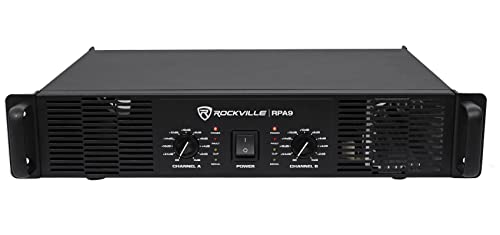
The Rockville RPA9 is a rack-mount professional amplifier for buyers seeking power amplifiers for home use in larger or more demanding audio environments. It offers 800 watts RMS, 3000 watts peak output, pro-grade connections, stereo and bridged modes, and cooling designed for extended operation.
Best For: DJs, event setups, studios, and home systems that use professional mixers and speakers.
Pros:
- 800 watts RMS and 3000 watts peak output provide substantial headroom.
- Accepts XLR, 1/4-inch, and RCA inputs.
- Offers speakON and banana outputs, dual fans, LED indicators, and a 2U rack-mount chassis.
Cons:
- Its professional rack-mount design may be excessive for a typical living-room system.
- The supplied specifications do not mention Bluetooth or a phono input.
The RPA9 makes the most sense when high output, pro connectivity, and durable rack-based installation take priority over compact convenience.
Wireless Upgrade Choice – Fosi Audio BT20A Pro
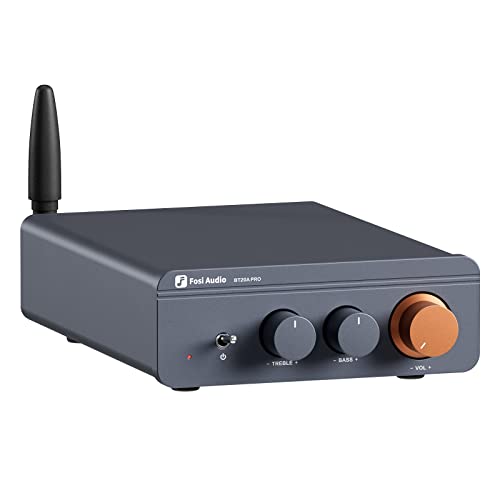
The Fosi Audio BT20A Pro is a compact Bluetooth amplifier suited to home listeners who want wireless convenience without giving up substantial output. As one of the more flexible power amplifiers for home use, it combines Bluetooth 5.0, 300 watts per channel, bass and treble controls, and replaceable op-amps.
Best For: Home or outdoor stereo users who want wireless streaming, adjustable tone, and the option to experiment with op-amp sound changes.
Pros:
- Rated at 300 watts per channel using the TPA3255 chip.
- Bluetooth 5.0 includes memory for easier pairing.
- Replaceable op-amps, bass and treble controls, and stated SNR of at least 108 dB.
Cons:
- Designed for passive speakers and does not list a phono input in the supplied notes.
- Op-amp customization may be unnecessary for listeners seeking a simple plug-and-play setup.
The BT20A Pro is a compelling compact option when wireless playback and customization are more important than the source variety of a traditional receiver.
Versatile Karaoke Receiver – Pyle PDA77BU Home Stereo Amplifier
For shoppers comparing power amplifiers for home use, the Pyle PDA77BU is a feature-rich receiver designed for music, movies, gaming, and karaoke. It combines Bluetooth 5.0 streaming with USB, SD-card, FM-radio, RCA, AUX, and microphone connectivity in one compact unit.
Best For: Home karaoke, multi-source audio setups, and users who want flexible front-panel controls.
Pros:
- 800-watt peak output for dynamic home audio playback.
- Bluetooth 5.0 supports wireless streaming from phones, tablets, and laptops up to 30 feet away.
- Dual 1/4-inch microphone inputs include independent controls for karaoke and presentations.
- Supports USB, SD card, FM radio, AUX, RCA, and other connected sources.
Cons:
- The listed 800-watt figure is peak output, while the product details also list 500 watts of wattage.
- Its karaoke-focused controls may be more than needed for a simple stereo system.
The PDA77BU stands out when input variety and microphone support matter as much as amplification. It is a practical choice for an entertainment-centered room, though buyers seeking a minimalist music amplifier may prefer a simpler design.
Hi-Fi Bluetooth Powerhouse – Fosi Audio BT20A MAX Stereo Amplifier
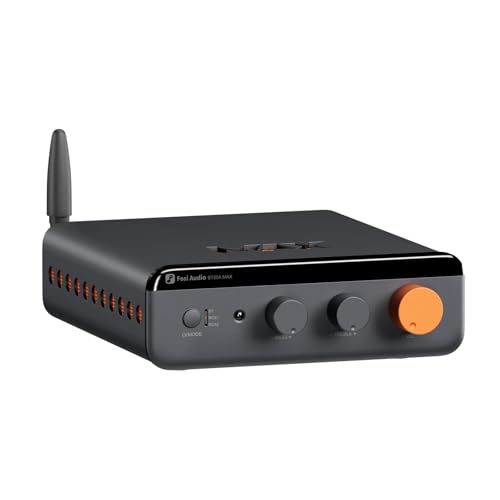
Among power amplifiers for home use, the Fosi Audio BT20A MAX targets listeners who prioritize clean, high-output stereo sound and modern wireless playback. Its PFFB design, dual independent power supplies, advanced Bluetooth codecs, and dedicated subwoofer output support a capable 2.1-channel setup.
Best For: High-fidelity stereo systems, bookshelf speakers, and 2.1-channel home audio builds.
Pros:
- Delivers 180 watts rated power and 300 watts peak power per channel.
- PFFB technology and dual power supplies are designed for low distortion and reduced noise.
- Bluetooth 6.0 supports LDAC, aptX Lossless, aptX HD, and other codecs.
- Includes a dedicated subwoofer output, 12V trigger, remote, and bass/treble controls.
Cons:
- The built-in cooling fan can speed up and become more noticeable during extended peak-power use.
- With dual RCA inputs and a subwoofer output, it is less suited to users needing numerous legacy inputs.
The BT20A MAX is the most specification-focused option in this group, pairing substantial per-channel output with high-resolution Bluetooth and 2.1 support. It makes particular sense for a dedicated stereo listening setup where clean amplification and system expansion are priorities.
Compact Karaoke All-Rounder – Romicta AK50 Bluetooth Amplifier
The Romicta AK50 is a practical choice for shoppers seeking power amplifiers for home use in smaller rooms or flexible entertainment spaces. It combines 400W+400W peak output with Bluetooth 5.0, FM, USB, SD, microphone controls, and support for passive speakers plus an active subwoofer.
Best For: Small-room karaoke, bookshelf systems, home theaters, and setups that include an active subwoofer.
Pros:
- Offers 50W+50W rated power and 400W+400W peak power.
- Supports 4–16-inch passive speakers and active subwoofers.
- Includes microphone input and output with an independent echo control.
- Provides Bluetooth 5.0, USB and SD MP3 playback, FM radio, remote control, and tone controls.
Cons:
- The 400W+400W figure is peak output; rated power is 50W+50W.
- Its numerous karaoke and media features may be unnecessary for straightforward stereo listening.
The AK50 offers broad connectivity in a compact format, making it especially adaptable for bedrooms, apartments, offices, and garages. Its active-subwoofer support and microphone features give it an advantage for casual entertainment systems and karaoke-focused use.
Best Multi-Input Pick – Donner MAMP5 4-Channel Bluetooth Amplifier
For shoppers comparing power amplifiers for home use, the Donner MAMP5 stands out for its four independently controlled channels, Bluetooth 5.0, and broad selection of wired and media inputs. Its 440-watt peak rating supports four groups of passive speakers with 4–16-ohm impedance, making it a flexible choice for larger home audio setups.
Best For: Multi-room audio, karaoke, presentations, and home theater systems that need several inputs and independently managed speaker groups.
Pros:
- Four independently controlled channels with 440 watts of peak power
- Bluetooth 5.0 supports wireless playback from current mobile and computer devices
- Includes USB, SD, RCA, AUX, FM, and two microphone inputs
- Offers treble, bass, microphone-volume, LED-display, and remote-control functions
Cons:
- Requires passive speakers to produce audio
- Remote control is limited to MP3, Bluetooth, and FM volume adjustment
- Some wind noise may occur when no speaker is connected
The MAMP5 is a versatile option when connectivity and zone-style control matter more than a minimalist design. Confirm your speaker wiring and impedance requirements before buying.
Best for Karaoke and Announcements – Pyle PTA44BT 4-Channel Amplifier
The Pyle PTA44BT is a practical choice among power amplifiers for home use when karaoke, paging, or home theater flexibility is the priority. It combines 500 watts of peak power with Bluetooth, multiple media inputs, dual microphone connections, and a dedicated talk-over function.
Best For: Karaoke nights, home theater audio, announcements, and users who want microphone controls with music playback.
Pros:
- 500 watts of peak power for multi-speaker systems using 4–8-ohm speakers
- Bluetooth supports wireless streaming from smartphones, tablets, laptops, and computers
- Provides USB, microSD, AUX, FM, audio input, recording, and subwoofer-output connections
- Dual microphone inputs include echo, volume, and talk-over controls
Cons:
- The supplied notes describe peak power but do not specify continuous RMS output
- Its four-channel design may be more capability than a basic two-speaker setup needs
- Packaging may vary
Choose this model if microphone functionality and source variety are central to your setup. The subwoofer output and talk-over control add useful flexibility for entertainment and spoken announcements.
Best Compact Stereo Pick – Pyle PDA29BU.5 200W Bluetooth Amplifier
For smaller systems, the Pyle PDA29BU.5 is one of the more compact power amplifiers for home use. This two-channel receiver delivers 200 watts of peak power and 100 watts RMS continuous power for two stereo speakers, while providing Bluetooth, RCA, USB, SD, FM, AUX, and microphone connectivity.
Best For: Desktop audio, compact home theater systems, karaoke, and two-speaker setups that need a small receiver with varied source options.
Pros:
- Compact two-channel design supports two stereo speakers
- Provides 200 watts peak and 100 watts RMS continuous power
- Includes Bluetooth, RCA, USB, SD, FM, and AUX inputs
- Dedicated controls adjust microphone volume, bass, treble, and master volume
Cons:
- Two-channel output is less suitable for multi-zone or multi-speaker installations
- The supplied notes do not specify supported speaker impedance
- Only one RCA audio input is listed
The PDA29BU.5 is a sensible fit when space and straightforward stereo operation matter. Its lower output and two-channel layout make it better suited to focused listening areas than larger distributed-audio systems.
How We Picked These Power Amplifiers for Home Use
We selected models that cover the main ways people build or upgrade a home audio system. The lineup includes compact Class D amplifiers, traditional stereo receivers, Bluetooth-focused units, multichannel receivers, and rack-mount equipment. We considered advertised power, input options, wireless connectivity, speaker-channel flexibility, ease of use, and useful extras such as phono, USB, FM radio, microphone inputs, and karaoke controls.
Because amplifier specifications can vary by impedance, distortion level, and measurement method, advertised wattage should be treated as a comparison point rather than a guarantee of real-world performance. Your speakers and room size are just as important.
Quick Comparison
- Best for compact stereo setups: Fosi Audio TB10D, BT20A Pro, or BT20A MAX.
- Best for vinyl and everyday listening: Sony STR-DH190, thanks to its phono input and conventional receiver design.
- Best for karaoke and multiple sources: Pyle, Romicta, and Donner receivers with microphone inputs.
- Best for rack-based systems: Rockville RPA9, with a professional amplifier format.
- Best for simple budget flexibility: Pyle’s two-channel Bluetooth receiver with USB, SD, FM, and microphone connectivity.
Key Buying Factors for Power Amplifiers for Home Use
Power and Speaker Compatibility
Check your speakers’ nominal impedance and recommended amplifier range before buying. A higher wattage number is not automatically better; clean power with suitable impedance matching is more useful than maximum output alone. Leave some headroom, but avoid pushing a small amplifier into clipping.
Inputs and Everyday Convenience
Bluetooth is useful for phones and tablets, while RCA inputs suit CD players, streamers, and other wired sources. Vinyl listeners should look for a phono input or plan to add a separate phono preamp. USB, SD, FM, and microphone inputs are valuable for karaoke or casual all-in-one systems, but may be unnecessary for a focused two-channel setup.
Channels, Size, and Cooling
Two-channel amplifiers are usually the simplest choice for left-and-right bookshelf or floorstanding speakers. Four-channel models offer more flexibility for distributed audio or multiple speaker pairs, but require careful setup. Compact Class D units save space, while rack-mount amplifiers may provide more installation flexibility and cooling requirements.
Who Should Buy Which Power Amplifiers for Home Use?
Choose a compact Fosi Audio model if you want a small, modern amplifier for passive speakers and mostly stream from a phone. Pick the Sony receiver if vinyl, conventional stereo controls, and dependable home listening matter most. Consider Pyle, Romicta, or Donner if microphones, radio, USB playback, or karaoke are central to your setup. The Rockville is better suited to users building a rack or DJ-style system rather than a minimalist living-room setup.
Before ordering, confirm the speaker impedance, available space, required inputs, and whether the stated power rating matches your intended listening level. Those checks will narrow the field more effectively than wattage alone.