
If your photo library keeps growing, a good RAID enclosure can make storage faster, safer, and easier to manage. The right setup helps protect your images while keeping large RAW and edited files readily accessible.
This roundup highlights options for different budgets, drive counts, and connection types so you can choose a reliable fit for your workflow.
Best 10 Raid Enclosures for Photo Storage Picks for 2026
Compact 2-Bay RAID
TERRAMASTER D2-320 USB RAID Enclosure 2-Bay

- USB 3.2 Gen 2 with up to 10Gbps transfer speed
- Supports RAID 0, RAID 1, JBOD, and SINGLE
- Tool-free trays and push-lock drive design
Best For: Direct-attached photo storage with simple RAID 1 backup
High-Speed Thunderbolt RAID
OWC ThunderBay 4 8TB Thunderbolt 40Gb/s RAID Storage Solution

- Four-bay Thunderbolt RAID enclosure with up to 1074MB/s
- RAID 0/1/4/5/1+0 support with SoftRAID Premium included
- Works with 3.5-inch or 2.5-inch drives
Best For: Fast, advanced photo storage and editing on Thunderbolt systems
Budget 4-Bay RAID
CENMATE Aluminum 4 Bay Hard Drive RAID Enclosure

- Four bays with up to 80TB capacity
- Supports RAID 0/1/3/5/10 plus CLONE and LARGE modes
- USB 3.0 plus eSATA connectivity for direct attach
Best For: Large local photo backups on a value-focused four-bay enclosure
Premium Thunderbolt RAID
OWC ThunderBay 4 Thunderbolt 40Gb/s Four-Bay SATA Enclosure
- Thunderbolt 3 enclosure with up to 1527MB/s sustained performance
- RAID 0/1/4/5/1+0 and JBOD support
- SoftRAID Premium included for management and monitoring
Best For: Professional photo libraries that need fast, reliable desktop RAID
Large-Capacity RAID Archive Pick
ORICO 4-Bay RAID Enclosure for 3.5-inch HDDs

- 8 RAID modes, including mirror and parity options
- Up to 88TB total capacity with 22TB drive support
- Aluminum body with 80mm fan and lockable trays
Best For: desktop photo archives and backup-heavy workflows
High-Capacity Cooling-Focused RAID Box
MAIWO 4-Bay 3.5-inch SATA RAID Enclosure

- Supports Normal, RAID 0/1/3/5/10, Clone, and JBOD
- Up to 96TB total capacity with 24TB-drive support
- Dual cooling fans and USB-A/C cable bundle
Best For: desktop backup stations and large photo libraries
5-Bay RAID Workhorse
Yottamaster 5 Bay RAID Enclosure for Photo Storage
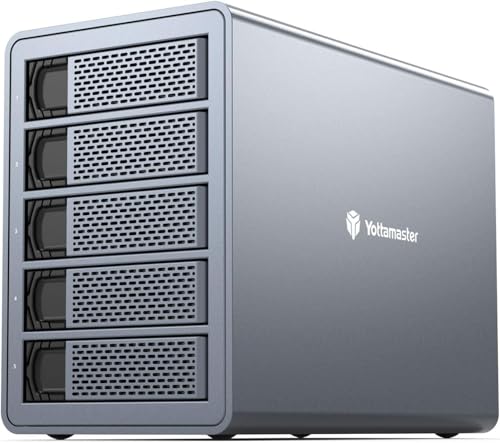
- Holds up to 120TB across 5 drives
- RAID 0/1/5/10, JBOD, and CLONE support
- Aluminum body with built-in 80mm fan
Best For: Large photo archives and creators who need maximum capacity
8-Bay Capacity Pick

- Up to 160TB total capacity
- Eight RAID modes including RAID 5 and RAID 50
- Aluminum chassis with two fans
Best For: Large photo libraries and users planning for future expansion
Dual-Bay Starter

- Compact 2-bay design for simpler setups
- RAID 0, RAID 1, Normal, and JBOD modes
- Supports up to 40TB total capacity
Best For: Compact photo backup and mirrored storage setups
Compact 2-Bay RAID – TERRAMASTER D2-320 USB RAID Enclosure 2-Bay
If you want a simple, fast RAID enclosure for photo storage, the TERRAMASTER D2-320 is built around USB 3.2 Gen 2 and supports hardware RAID 0, RAID 1, JBOD, and SINGLE. It’s a DAS rather than a NAS, so it plugs directly into your computer for straightforward local storage and backup.
Best For: Photographers who want a compact, direct-attached RAID enclosure with mirror backup options and easy tray access.
Pros:
- USB 3.2 Gen 2 connection supports up to 10Gbps transfer speeds.
- RAID 1 mirror backup helps protect stored files if one drive fails.
- Supports both 3.5-inch and 2.5-inch SATA HDDs, plus 2.5-inch SATA SSDs.
- Tool-free trays and push-lock design make drive swaps easier.
Cons:
- Only two bays, so capacity is limited versus larger enclosures.
- As a DAS, it is designed for direct connection rather than network sharing.
The D2-320 makes sense if you want a practical RAID setup for photo storage without moving to a full network storage system. Its mix of speed, RAID 1 protection, and simple installation fits a straightforward desktop workflow.
High-Speed Thunderbolt RAID – OWC ThunderBay 4 8TB Thunderbolt 40Gb/s RAID Storage Solution
For photo storage workflows that need more speed and more drive flexibility, the OWC ThunderBay 4 is a Thunderbolt RAID enclosure with four drive bays and sustained performance up to 1074MB/s. It supports multiple RAID modes and includes SoftRAID Premium for creating, monitoring, and managing arrays.
Best For: Photographers and creatives who want a fast Thunderbolt RAID enclosure for large local photo libraries and editing workflows.
Pros:
- Dual Thunderbolt 3 ports and real-world sustained performance up to 1074MB/s.
- Supports RAID 0/1/4/5/1+0 (10) for flexible storage setups.
- Works with both 3.5-inch and 2.5-inch drives without an adapter.
- Includes SoftRAID Premium with a 3-year subscription.
Cons:
- Thunderbolt-based, so it depends on compatible Mac or Windows systems.
- Larger four-bay design may be more than casual users need.
This is a strong choice when photo storage demands speed, capacity, and more advanced RAID management. It’s better suited to users who regularly move large image files and want a more capable desktop array.
Budget 4-Bay RAID – CENMATE Aluminum 4 Bay Hard Drive RAID Enclosure
If you want a larger RAID enclosure for photo storage without jumping to a network system, the CENMATE 4-bay model offers up to 80TB of capacity and multiple RAID modes. It uses USB 3.0 with eSATA support and is designed as a DAS for direct connection.
Best For: Users who want a spacious four-bay external RAID enclosure for local photo backups and mixed storage needs.
Pros:
- Four bays support up to 80TB total capacity.
- Compatible with 2.5-inch and 3.5-inch HDDs and SSDs.
- Offers RAID 0/1/3/5/10 plus CLONE, LARGE, and NORMAL modes.
- Aluminum build and built-in fans are designed for cooling.
Cons:
- USB 3.0 tops out at 5Gbps, which is slower than newer 10Gbps or Thunderbolt options.
- Fan noise is listed around 40–50 decibels.
- Switching RAID modes requires careful setup and may cause data loss.
The CENMATE makes sense if capacity matters more than top-end speed. It gives you a broad RAID feature set and plenty of room for growing photo libraries, but it is best for users comfortable managing RAID changes carefully.
Premium Thunderbolt RAID – OWC ThunderBay 4 Thunderbolt 40Gb/s Four-Bay SATA Enclosure
The OWC ThunderBay 4 is a high-performance RAID enclosure for photo storage when you want strong sustained speed and flexible drive management. With four bays, Thunderbolt 3 connectivity, and SoftRAID Premium included, it is built for demanding desktop workflows.
Best For: Photographers who need a fast, professional-grade RAID enclosure for large image libraries and active editing.
Pros:
- Up to 1527MB/s sustained performance with Thunderbolt 3.
- Supports RAID 0/1/4/5/1+0 (10) and JBOD.
- Works with 3.5-inch or 2.5-inch drives without an adapter.
- SoftRAID Premium is included for RAID creation and monitoring.
Cons:
- Requires Thunderbolt-compatible Mac or PC systems.
- Premium feature set may be more than basic backup users need.
If your photo storage setup needs speed first and storage second, this enclosure is one of the strongest options in the group. It’s a serious desktop solution for users who want high throughput and advanced RAID control.
Large-Capacity RAID Archive Pick – ORICO 4-Bay RAID Enclosure for 3.5-inch HDDs
If you need raid enclosures for photo storage that prioritize capacity and control, this ORICO 4-bay model is built for large libraries, backups, and shared working sets. It supports multiple RAID options, includes a locked trayless design, and is aimed at users who want centralized storage with strong cooling and straightforward expansion.
Best For: Photographers and creators managing large 3.5-inch drive libraries, backup sets, and desktop DAS storage.
Pros:
- Supports 8 RAID modes, including RAID 0, 1, 3, 5, 10, JBOD, CLONE, and CLEAR
- Up to 88TB total capacity with support for 22TB per 3.5-inch SATA drive
- USB 3.0 with up to 235 MB/s transfer rate for backup and file movement
- Aluminum chassis, 80mm silent fan, and front/rear vents for cooling
Cons:
- Only works with 3.5-inch SATA drives, not 2.5-inch drives or SSD-focused setups
- USB 3.0 performance is solid, but not as fast as newer 10Gbps options
- Best suited to desktop use rather than portable field storage
Overall, this is a strong fit if your photo workflow centers on high-capacity local storage and you want RAID flexibility plus simple physical drive access. It is especially practical for users who value data protection, cooling, and a large pooled archive over portability.
High-Capacity Cooling-Focused RAID Box – MAIWO 4-Bay 3.5-inch SATA RAID Enclosure
For raid enclosures for photo storage that need a balance of capacity, cooling, and simple connectivity, the MAIWO 4-bay enclosure is a practical desktop DAS option. It supports a broad set of RAID modes, comes with both USB-A and USB-C cables, and is designed for users who want dependable storage for large photo libraries and backups.
Best For: Photographers, studios, and power users who want a roomy 3.5-inch SATA RAID enclosure with active cooling.
Pros:
- Supports multiple RAID setups: Normal, 0, 3, 5, 1/10, Clone, and Large (JBOD)
- Up to 96TB capacity with support for four 24TB drives
- Two built-in cooling fans help maintain operating temperatures during heavy use
- Includes USB-A to USB-C and USB-C to USB-C cables for flexible setup
Cons:
- Designed for 3.5-inch SATA drives only
- 5Gbps USB interface is fine for backups, but not the fastest option available
- Best suited to stationary workflows rather than on-the-go photo ingest
This enclosure stands out if you want a straightforward RAID box with generous capacity and stronger cooling than a basic single-fan design. It makes sense for users building a reliable photo archive or backup station around large SATA drives.
Portable All-Flash Field Storage – ORICO 2.5-inch All-Flash 4-Bay RAID Enclosure
If your raid enclosures for photo storage need to travel with you, this ORICO all-flash model is built around 2.5-inch drives and a compact, shock-resistant design. It is aimed at photographers and editors who want fast handling of project files, card backups, and mobile storage without the bulk of a traditional 3.5-inch enclosure.
Best For: On-site photographers and video editors who want a portable all-flash storage enclosure with RAID options.
Pros:
- Supports seven RAID modes, including RAID 0, 1, 3, 5, 10, JBOD, and CLEAR
- USB 3.2 Gen 2 delivers up to 10Gbps with compatible PSSD connections
- Includes two 10Gbps USB ports plus SD and TF card slots for workflow expansion
- Compact 2.5-inch design is lighter and more shock-resistant than traditional HDD enclosures
Cons:
- Uses 2.5-inch drives only; it does not support 3.5-inch drives
- Total capacity tops out at 40TB across the bays
- Best performance depends on compatible high-speed drives and connections
This is the most travel-friendly option in the group, especially if you prioritize quick ingest, portability, and a smaller footprint for field work. It is less about maximum raw HDD capacity and more about fast, flexible handling of photo and video files.
5-Bay RAID Workhorse – Yottamaster 5 Bay RAID Enclosure for Photo Storage
If you need raid enclosures for photo storage that can also handle large video or archive libraries, the Yottamaster FS5RU3 is built for bigger workloads. It supports up to 120TB across five drives, offers RAID 0/1/5/10 plus JBOD and CLONE modes, and uses an aluminum body with a built-in 80mm fan to help keep drives cool during longer runs.
Best For: Photographers and creators who want a high-capacity RAID box for backups, archives, and multi-drive photo libraries.
Pros:
- Up to 120TB capacity with support for 5 drives
- RAID 0/1/5/10, JBOD, CLONE, and Normal modes
- Works with 2.5-inch and 3.5-inch SATA HDDs/SSDs
- Aluminum enclosure with built-in fan for heat management
Cons:
- USB 3.0 speed tops out at 5Gbps
- Best suited to users comfortable managing RAID modes
This is the strongest option here if your priority is capacity and flexible RAID choices for photo storage. It’s a practical pick when you want one enclosure to cover active projects, backups, and long-term archives.
8-Bay Capacity Pick – CENMATE 8 Bay RAID Enclosure
For raid enclosures for photo storage where capacity matters more than compact size, the CENMATE 8-bay unit gives you a lot of headroom. It supports 2.5-inch and 3.5-inch SATA HDDs/SSDs up to 160TB total, includes eight RAID modes, and uses an aluminum design with two fans for cooling during heavy use.
Best For: Users who want a high-capacity RAID enclosure for large photo libraries, backups, and mixed media storage.
Pros:
- Supports up to 160TB total capacity
- Eight RAID modes, including RAID 0, RAID 5, and RAID 50
- Works with 2.5-inch and 3.5-inch HDDs and SSDs
- Aluminum build with two fans for heat control
Cons:
- Noise is listed around 40–50 dB
- RAID mode changes require careful steps and can cause data loss
- Instruction notes mention drive insertion requirements for proper use
This is the most expansion-friendly enclosure in the group, but it’s also the one that asks for the most setup care. If you need room to grow your photo storage, the capacity and RAID flexibility are strong advantages.
Dual-Bay Starter – CENMATE 2 Bay RAID Enclosure
If you want a simpler entry point into raid enclosures for photo storage, the CENMATE 2-bay model keeps the setup compact while still giving you RAID options. It supports up to 40TB total, works with 2.5-inch and 3.5-inch SATA HDDs/SSDs, and includes RAID 0, RAID 1, Normal, and JBOD modes for basic redundancy or speed.
Best For: Photographers who want a compact two-drive enclosure for photo backups, mirrored storage, or a straightforward RAID setup.
Pros:
- Compact 2-bay design for smaller desks or workstations
- Supports RAID 0, RAID 1, Normal, and JBOD
- Compatible with 2.5-inch and 3.5-inch SATA HDDs/SSDs
- Aluminum housing with a built-in fan
Cons:
- Lower total capacity than 5- and 8-bay options
- Fan noise is listed around 40–50 dB
- MAC OS no raid software is noted in the product details
This is the most straightforward choice here if you only need two drives and prefer a smaller footprint. It won’t match the capacity of the larger enclosures, but it covers the basics well for photo backup and simple RAID mirroring.
How We Picked the Best Raid Enclosures for Photo Storage
We focused on Raid Enclosures for Photo Storage that offer a practical balance of capacity, transfer speed, cooling, and redundancy options. We also looked for models that support common SATA drives, provide enough bays for expanding libraries, and use connection standards that make sense for modern photo workflows.
For photographers, the best choice is usually the one that fits your editing habits, backup strategy, and amount of data you expect to store over the next few years.
Quick Comparison
Two-bay enclosures are a good starting point for mirrored storage or a simple high-speed external volume. Four-bay models offer more flexibility for RAID 5, larger combined capacity, and better room to grow. Five- and eight-bay options are better for heavy archivists, studios, and anyone managing very large RAW catalogs or multiple shoots at once.
Thunderbolt models generally deliver the best performance for editing directly from the array, while USB-based enclosures are often better value for storage-first setups.
Key Buying Factors for Raid Enclosures for Photo Storage
RAID Mode Support
Look for RAID 1 if your priority is redundancy, RAID 5 if you want a mix of protection and usable capacity, and RAID 0 only if speed matters more than data safety. Some enclosures also support JBOD or individual disks, which can be useful for flexible photo archiving.
Drive Compatibility and Capacity
Check whether the enclosure supports 2.5-inch SSDs, 3.5-inch HDDs, or both. If you work with large archives, confirm the maximum per-drive size and total enclosure capacity before buying.
Connection Type and Workflow
Thunderbolt is ideal for high-speed editing, especially with large RAW files or 4K/8K media. USB 3.x is sufficient for backups, transfers, and general photo storage, especially if you are not editing directly from the enclosure.
Cooling and Noise
Photo libraries tend to grow over time, so cooling matters. A fan and aluminum construction can help maintain drive health, especially in multi-bay units that run for long periods.
Ease of Setup
Tool-free trays, clear RAID controls, and straightforward software can save time. That matters if you plan to swap drives, expand storage, or rebuild arrays later.
Who Should Buy Which Raid Enclosures for Photo Storage?
If you want a compact backup solution for a smaller portfolio, a 2-bay enclosure is often enough. If you manage a serious archive or want room for future growth, a 4-bay model is usually the sweet spot for Raid Enclosures for Photo Storage.
Choose a 5-bay or 8-bay enclosure if you are running a studio, storing years of client work, or planning a large mirrored or parity-based array. For the fastest editing experience, prioritize Thunderbolt. For affordable long-term storage, a USB enclosure with good cooling is usually the smarter buy.