
Choosing the right storage can make a big difference in editing speed, project organization, and backup safety. A good RAID enclosure helps you keep footage accessible when timelines get heavy and files get large.
Below, we focus on practical options for creators who need dependable performance, flexible drive support, and the right connection for modern editing workflows.
Best 10 Raid Enclosure for Video Editing Picks for 2026
4-Bay Flex Storage
ORICO 4 Bay RAID Hard Drive Enclosure

- 4-bay enclosure with RAID 0/1/5/10, JBOD, and Normal
- Up to 104TB total capacity with 26TB per drive support
- USB 3.2 Gen 2x2 and USB4 can deliver 20Gbps
Best For: Editors who need flexible RAID modes in a 4-bay chassis
Thunderbolt Pro Box
OWC ThunderBay 4 Thunderbolt Enclosure

- Dual Thunderbolt 3 ports with up to 1527MB/s sustained speed
- Supports RAID 0/1/4/5 and 1+0 (10)
- Includes SoftRAID Premium with a 3-year subscription
Best For: Mac and Windows editors who want Thunderbolt speed and RAID software
High-Capacity 5-Bay
ORICO 5 Bay RAID Hard Drive Enclosure
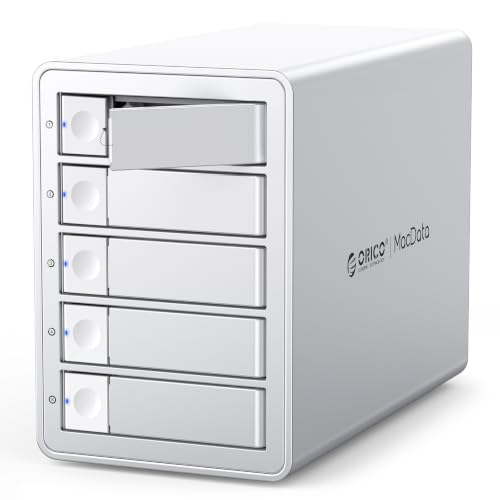
- Five bays with up to 130TB total capacity
- RAID 0/1/5/10, JBOD, and Normal modes
- USB 3.2 Gen 2x2 supports 20Gbps on USB4
Best For: Editors who need more bay count and higher capacity
Eight-Bay Studio Vault
OWC ThunderBay 8 External Storage

- Eight drive bays for 2.5-inch or 3.5-inch SATA drives
- Up to 2586MB/s transfer rate with Thunderbolt
- Daisy-chain support for up to six units
Best For: Studios and editors who need a large Thunderbolt storage hub
Compact RAID pick
TerraMaster D2-320 2-Bay USB 3.2 Gen2

- 10Gbps USB 3.2 Gen 2 connection
- RAID 0, RAID 1, JBOD, and Single modes
- Tool-free trays with temperature-controlled fan
Best For: Editors who need fast, compact DAS storage with simple RAID options
Hybrid pro choice
ACASIS 4-Bay USB4 Hybrid RAID Enclosure

- 2 HDD bays plus 2 NVMe bays
- USB4 40Gbps with Thunderbolt support
- Active cooling and 96W power supply
Best For: Pro editors who want one enclosure for fast NVMe work and HDD archiving
High-capacity budget pick
MAIWO 4-Bay 3.5-inch RAID Enclosure

- Multiple RAID modes including 0, 5, 1/10, and JBOD
- Up to 96TB capacity with 3.5-inch SATA drives
- Dual fans for cooling during heavy use
Best For: Editors needing maximum SATA capacity and many RAID options at 5Gbps
Studio-Grade 5-Bay Powerhouse
ORICO 5-Bay RAID External Hard Drive Enclosure

- 5-bay hardware RAID with multiple modes
- Built-in 150W supply for stable multi-drive use
- Aluminum body with 80mm fan for cooling
Best For: Editors needing flexible RAID and high-capacity desktop storage
Budget 4-Bay RAID Workhorse
CENMATE Aluminum 4 Bay RAID Enclosure

- 4-bay enclosure with 8 RAID modes
- USB 3.0, USB-C, and eSATA connectivity
- Aluminum build with built-in cooling fan
Best For: Small studios wanting a compact RAID enclosure with flexible ports
High-Capacity Editing Dock
Yottamaster 5-Bay RAID Hard Drive Enclosure
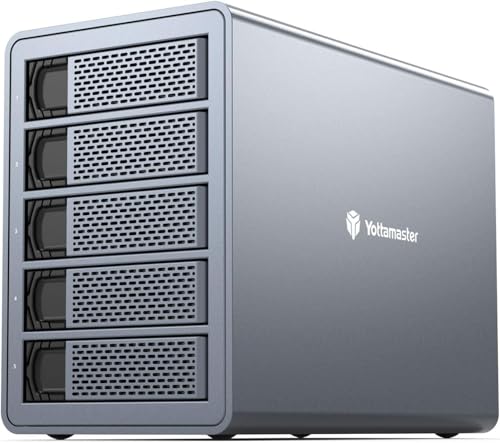
- Five-bay DAS with up to 120TB capacity
- Hardware RAID modes for editing workflows
- Aluminum shell with low-noise 80mm fan
Best For: Large video libraries and studio editing storage
4-Bay Flex Storage – ORICO 4 Bay RAID Hard Drive Enclosure
If you’re looking for a raid enclosure for video editing, this ORICO 4-bay model is built around fast transfers, flexible RAID options, and high total capacity. It pairs a JMS591 chip with USB 3.2 Gen 2×2 for up to 20Gbps over USB4, and it supports RAID 0, 1, 5, 10, JBOD, and Normal modes for different editing and backup workflows.
Best For: Editors who want a compact 4-bay RAID enclosure with multiple RAID modes and room for large media libraries.
Pros:
- Supports six RAID modes, including RAID 0, 1, 5, 10, JBOD, and Normal
- Up to 104TB total capacity with support for 26TB drives per bay
- USB 3.2 Gen 2×2 connection can reach full 20Gbps on USB4
- Built-in 45dB fan, aluminum alloy body, and hot-swapping support
Cons:
- Thunderbolt connections are limited to around 10Gbps for storage devices
- Changing RAID modes erases drive contents, so backups are required
This is a practical choice for creators who need strong capacity and configurable RAID behavior without moving up to a larger chassis. Its cooling, power supply, and compatibility across Windows, macOS, and Linux make it a solid fit for everyday editing storage.
Thunderbolt Pro Box – OWC ThunderBay 4 Thunderbolt Enclosure
This raid enclosure for video editing is aimed at users who want Thunderbolt performance and pro-grade RAID software in a 4-bay setup. The OWC ThunderBay 4 uses dual Thunderbolt 3 ports, supports 3.5-inch or 2.5-inch drives without adapters, and is rated for sustained performance up to 1527MB/s.
Best For: Mac and Windows editors who want a Thunderbolt 3 enclosure with included RAID management software.
Pros:
- Dual Thunderbolt 3 ports with up to 1527MB/s sustained performance
- Supports RAID 0, 1, 4, 5, and 1+0 (10)
- Includes SoftRAID Premium with a 3-year subscription
- Works with 3.5-inch or 2.5-inch drives without an adapter
Cons:
- Only four drive bays, so expansion is limited compared with larger units
- Built around Thunderbolt 3, not USB-centric workflows
For editors already invested in Thunderbolt, this enclosure balances speed, flexibility, and included software in a polished package. It makes the most sense when you want straightforward RAID setup and monitoring rather than a bigger multi-bay storage tower.
High-Capacity 5-Bay – ORICO 5 Bay RAID Hard Drive Enclosure
If you need a raid enclosure for video editing with more room for active projects and archives, this ORICO 5-bay model adds capacity without giving up flexible RAID support. It uses the JMS591 chip, USB 3.2 Gen 2×2 connectivity, and the same six RAID modes found on the smaller version, while increasing total storage potential to 130TB.
Best For: Editors who want a 5-bay RAID enclosure for larger project libraries and higher total capacity.
Pros:
- Five bays and up to 130TB total capacity with 26TB drives
- Supports RAID 0, 1, 5, 10, JBOD, and Normal
- USB 3.2 Gen 2×2 offers up to 20Gbps, with full speed on USB4
- Built-in 45dB fan, aluminum alloy construction, and hot-swapping
Cons:
- Thunderbolt connections will not reach the full 20Gbps storage bandwidth
- RAID changes erase drive contents, so setup requires caution
This model is a better fit when a 4-bay unit feels cramped and your editing workload needs more headroom. The added bay makes it easier to build larger arrays while keeping the same practical cooling and compatibility profile.
Eight-Bay Studio Vault – OWC ThunderBay 8 External Storage
For a raid enclosure for video editing that feels closer to a personal data center, the OWC ThunderBay 8 brings eight drive bays, Thunderbolt connectivity, and high sustained throughput. It supports 2.5-inch or 3.5-inch SSDs and HDDs, includes dual Thunderbolt 3 ports, and is designed for quick drive swaps with thumb screw release trays.
Best For: Editors and studios that need a large Thunderbolt RAID enclosure with eight bays and daisy-chain expansion.
Pros:
- Eight universal drive bays for 2.5-inch or 3.5-inch SATA drives
- Up to 2586MB/s data transfer rate for pro-grade performance
- Dual Thunderbolt 3 ports with daisy-chain support for more devices
- Plug-and-play setup with included Thunderbolt 3 cable
Cons:
- Larger and heavier than smaller four- or five-bay options
- Its scale may be more than solo editors need
This enclosure is the strongest fit when your workflow demands both capacity and expansion room. With eight bays and daisy-chain capability, it works well as the center of a larger editing storage setup.
Compact RAID pick – TerraMaster D2-320 2-Bay USB 3.2 Gen2
If you need a straightforward raid enclosure for video editing, the TerraMaster D2-320 is built around speed, simplicity, and flexible RAID modes. It uses USB 3.2 Gen 2 for up to 10Gbps connectivity and supports RAID 0, RAID 1, JBOD, and Single, making it a practical DAS for working storage or mirrored backup.
Best For: Editors who want a compact 2-bay DAS for fast project storage, RAID 1 protection, or a simple RAID 0 speed boost.
Pros:
- USB 3.2 Gen 2 connection rated up to 10Gbps
- Supports RAID 0, RAID 1, JBOD, and Single
- Tool-free tray design with push-lock drive retention
- Intelligent temperature-controlled fan for quieter cooling
Cons:
- Only two drive bays, so capacity is more limited than 4-bay units
- As a DAS, it is not a NAS for network access
The D2-320 makes sense if you want a small, direct-attached RAID enclosure that balances speed and backup options without adding complexity. For many editing setups, that combination is easier to live with than a larger, higher-cost storage tower.
Hybrid pro choice – ACASIS 4-Bay USB4 Hybrid RAID Enclosure
This raid enclosure for video editing is aimed at users who want both fast active-project storage and larger archive space in one box. The ACASIS hybrid design combines dual HDD bays and dual NVMe bays, supports USB4 40Gbps, and is built for Thunderbolt 3/4/5 and USB4 systems.
Best For: Editors who want a single high-speed enclosure for active NVMe projects plus HDD-based archiving and mirroring.
Pros:
- Hybrid design with 2 HDD bays and 2 NVMe bays
- USB4 40Gbps interface for fast transfer performance
- Supports hardware RAID 1 on HDDs and software RAID 0 on NVMe
- Active cooling, aluminum chassis, and included 96W power supply
Cons:
- Full 40Gbps speed requires compatible Thunderbolt 3/4/5 or USB4 ports
- RAID and capacity behavior depends on the drive type and mode chosen
For a more advanced editing setup, this ACASIS enclosure offers impressive flexibility by separating speed-focused SSD work from high-capacity HDD storage. It is the strongest fit here if you want a premium all-in-one solution and have the host connection to use it properly.
High-capacity budget pick – MAIWO 4-Bay 3.5-inch RAID Enclosure
If your priority is lots of storage with multiple RAID choices, this raid enclosure for video editing is a strong budget-friendly DAS option. The MAIWO 4-bay unit supports RAID Normal, 0, 3, 5, 1/10, Clone, and Large (JBOD), while offering USB-C transfer speeds up to 5Gbps for SATA drives.
Best For: Editors and power users who need a high-capacity 4-bay SATA enclosure with broad RAID flexibility.
Pros:
- Supports a wide range of RAID modes, including 0, 5, 1/10, and JBOD
- Up to 96TB maximum capacity with four 24TB drives
- Dual cooling fans help maintain drive temperatures
- USB-A to USB-C and USB-C to USB-C cables are included
Cons:
- USB 3.1 speeds top out at 5Gbps, which is slower than higher-end alternatives
- Designed for 3.5-inch SATA drives, so it is not the most flexible option for SSD-heavy workflows
The MAIWO enclosure is best when you value capacity and RAID variety over raw interface speed. For large media libraries, backups, and less speed-sensitive editing storage, it offers a practical balance of features.
Studio-Grade 5-Bay Powerhouse – ORICO 5-Bay RAID External Hard Drive Enclosure
If you need a RAID enclosure for video editing that can handle large projects and active media libraries, this ORICO 5-bay DAS gives you a lot of flexibility. Its hardware RAID controller supports multiple modes, so you can prioritize speed, redundancy, or simple single-disk use depending on the workflow.
Best For: Editors who want a high-capacity desktop RAID enclosure with flexible hardware RAID modes and stable multi-drive power.
Pros:
- Supports RAID 0, 1, 3, 5, 10, JBOD, Clone, and Clear modes.
- Built-in 150W power supply helps keep five drives running stably.
- Aluminum shell and 80mm fan are designed for 24/7 cooling.
- Up to 110TB capacity with 2.5″ and 3.5″ SATA HDDs/SSDs.
Cons:
- USB 3.0 speed is listed at up to 230MB/s, which is lower than some higher-end workflows may want.
- Hardware RAID setup requires using the enclosure switches rather than software control.
- Large 5-bay desktop footprint may be more than casual users need.
Overall, this is a practical pick for editors who want a roomy, hardware-based storage box with broad RAID flexibility and strong cooling for long sessions.
Budget 4-Bay RAID Workhorse – CENMATE Aluminum 4 Bay RAID Enclosure
This raid enclosure for video editing is a straightforward 4-bay option for users who want RAID support without moving up to a larger desktop system. It works with 2.5/3.5-inch HDDs and SSDs, includes USB A/C 3.0 plus eSATA connectivity, and keeps the focus on dependable external storage.
Best For: Editors and small studios looking for a compact 4-bay RAID enclosure with USB and eSATA support.
Pros:
- Supports 8 RAID modes including RAID 0, 1, 3, 5, 10, CLONE, LARGE, and NORMAL.
- USB 3.0 and eSATA outputs offer flexible connection options.
- Aluminum body and built-in fan help with heat management.
- Up to 80TB capacity with 2.5/3.5-inch HDDs and SSDs.
Cons:
- Fan noise is listed around 40–50 decibels.
- Switching RAID modes requires a specific manual process and may cause data loss.
- Speed is listed up to 5Gbps, which may not satisfy heavier throughput needs.
For buyers who want a practical, no-frills RAID enclosure, this CENMATE model offers broad mode support and useful connection flexibility in a compact 4-bay design.
High-Capacity Editing Dock – Yottamaster 5-Bay RAID Hard Drive Enclosure
The Yottamaster FS5RU3 is built for users who need a raid enclosure for video editing with serious capacity and classic hardware RAID control. With support for 2.5-inch and 3.5-inch SATA drives, it is aimed at managing large media sets, backups, and on-location footage in one desktop unit.
Best For: Editors who need a 5-bay RAID enclosure for large media libraries, studio storage, and backup workflows.
Pros:
- Supports RAID 0, 1, 5, 10, JBOD, CLONE, and Normal modes.
- Up to 120TB capacity across five drives.
- Aluminum enclosure and 80mm low-noise fan help with cooling.
- USB 3.0 Type-B interface with up to 5Gbps transfer speed.
Cons:
- Designed as DAS storage, not NAS.
- Only the listed RAID modes are available, so it may not suit users wanting software-level customization.
- Capacity depends on using 5 drives and compatible SATA media.
This is a strong fit if you want a high-capacity, hardware RAID storage box that can stay in the studio and handle large editing libraries without overcomplicating setup.
How We Picked the Best Raid Enclosure for Video Editing
For this roundup, we prioritized models that make sense for a Raid Enclosure for Video Editing: strong interface speed, multiple drive bays, sensible cooling, and RAID support that fits real-world production use. We also favored enclosures that can scale with larger libraries and deliver stable performance for working on footage directly from external storage.
Quick Comparison
In general, 2-bay units are best for smaller projects or portable editing setups, while 4-bay and 5-bay models offer a better balance of speed, capacity, and redundancy for serious creators. 8-bay enclosures are the strongest choice for studios, high-volume shooters, and editors managing multiple active projects at once.
Key Buying Factors for Raid Enclosure for Video Editing
Connection Speed
USB 3.2 Gen 2×2 and Thunderbolt enclosures are the most attractive choices for high-bitrate footage. Faster connections help reduce bottlenecks when scrubbing, caching, or transferring large media files.
RAID Mode and Capacity
Choose RAID 0 for speed, RAID 5 for a balance of protection and usable space, or RAID 1 if redundancy matters more than capacity. If your projects are growing quickly, look for higher maximum capacity and support for larger modern drives.
Drive Bays and Expansion
Four-bay models are often the sweet spot for creators, while five- and eight-bay options suit users who need more headroom for archives, proxies, and multiple clients. If you work with mixed media, check whether the enclosure supports both 2.5-inch and 3.5-inch SATA drives.
Cooling and Noise
Long editing sessions generate heat, so active cooling matters. Look for fans, aluminum construction, and layouts that help keep drives stable under sustained loads without adding excessive noise to your workspace.
Who Should Buy Which Raid Enclosure for Video Editing?
If you are a solo editor or content creator, a 2-bay or compact 4-bay enclosure is usually enough. Event shooters, wedding editors, and YouTube teams should look at 4-bay and 5-bay models for better flexibility. Post-production studios, documentary teams, and anyone building a shared working library should consider an 8-bay enclosure for maximum capacity and smoother long-term growth.
For most buyers, the best choice is the enclosure that matches your interface, your current storage needs, and how much redundancy you want built into your workflow.