
Setting up dozens of flash drives for classrooms, testing labs, or staff training can waste hours if you copy them one by one. The right duplicator makes that work faster, more consistent, and easier to manage.
This roundup of USB duplicators for schools focuses on capacity, speed, ease of use, and data safety so you can choose a model that fits your campus workflow.
Best 10 USB Duplicators for Schools Picks for 2026
Compact 1-to-2 School Duplicator
StarTech 1:2 Standalone USB Duplicator/Eraser

- No-computer 1-to-2 USB cloning and erasing
- LCD controls with compare and error scan
- Supports quick erase and multi-pass overwrite
Best For: Small school IT jobs and secure USB wiping
Multi-Drive School Volume Copier
U-Reach UB910S 1-to-9 USB Duplicator

- Duplicates one source to up to nine targets
- Standalone operation with erase options
- Modular ports help simplify maintenance
Best For: Districts and labs making many USB copies
Portable Two-Target School Copier
BestDuplicator UB300 1:2 USB Duplicator

- Lightweight standalone 1-to-2 cloning
- Quick copy, whole-media copy, and erase tools
- Includes capacity and speed testing
Best For: Mobile school IT use and small flash-drive batches
High-Volume School USB Bank
Systor 1-to-15 USB Duplicator & Sanitizer

- Duplicates one source to up to 15 drives
- Standalone copy with synchronous and asynchronous modes
- Includes sanitizer functions for reuse
Best For: Bulk school deployment and large lab runs
Portable 4-Bay Standalone
EZ Dupe 1-to-4 Mini USB Plus MK II
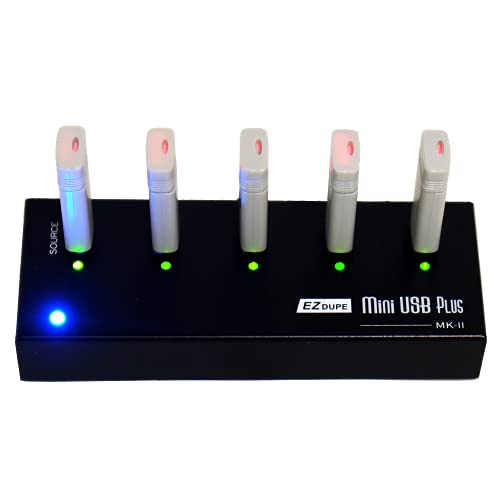
- Standalone operation with no computer required
- Copies up to 4 USB drives at once
- Updated model claims faster speed and better compatibility
Best For: Small school batches and portable drive duplication
Large-Batch PC System
Nexcopy SSUSB160PC 16-Target USB Duplicator

- Duplicates up to 16 target drives
- PC-based with Nexcopy Drive Manager software
- USB 3.0 design for max flash-drive transfer speeds
Best For: High-volume school duplication from a workstation
Touchscreen All-in-One
EZ Dupe SOHO Touch 1-to-10 USB Duplicator
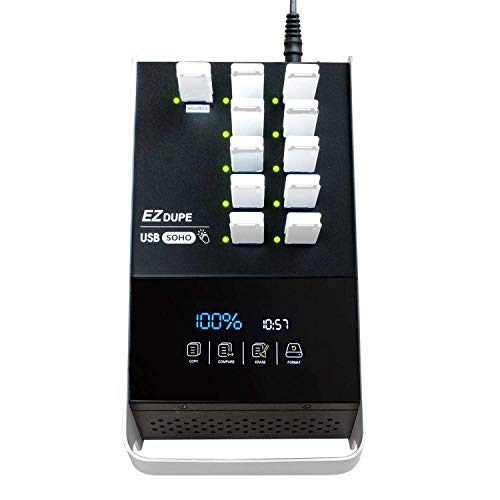
- Touchscreen controls for copy, compare, format, and erase
- Duplicates up to 10 USB drives at once
- Works with USB 2.0/3.0/3.1 flash drives
Best For: Schools needing easy drive copying plus erase/format tools
High-Capacity Stand-Alone Choice
DupliM 1:23 USB Flash Drive Duplicator

- Copies 1 source to up to 23 targets
- Stand-alone operation with 3-step workflow
- Supports bootable flash drives and some USB SSDs
Best For: School IT teams doing medium to larger batch USB distributions
Largest Batch Stand-Alone Copier

- Copies and erases up to 31 drives at once
- Asynchronous duplication supports independent targets
- Standalone unit with Smart Copy, Raw Mode, and secure erase
Best For: Large school IT departments needing high-volume copying and erasure
Compact Computer-Connected Option
DupliM Mini 1 to 10 USB Duplicator

- Duplicates up to 10 USB drives simultaneously
- Works with Windows and Mac computers
- Copies from image files, drives, or folders
Best For: Smaller school labs or IT staff wanting a flexible software-based workflow
Compact 1-to-2 School Duplicator – StarTech 1:2 Standalone USB Duplicator/Eraser
If you need usb duplicators for schools to make a small batch of boot drives, learning media, or sanitized flash drives, this standalone StarTech unit keeps the process simple. It clones or erases USB media without a computer, and the LCD plus button controls make it practical for lab or IT desk use.
Best For: School IT teams that need a compact 1-to-2 copier with erase options and basic verification.
Pros:
- Standalone 1-to-2 duplication and erase functions with no computer required
- Supports system/file copy, sector-by-sector copy, and multiple erase modes
- LCD menu with copy-and-compare verification and drive error scanning
- Asynchronous copy mode lets you swap in new drives without stopping the job
Cons:
- Only copies to two target drives at a time, so it is not built for large batches
- Asynchronous mode requires source content under 64 MB
- Best suited to USB flash media and supported external USB storage, not broader storage workflows
This is a practical fit when a school needs a straightforward duplicator for routine flash-drive prep and secure wipe tasks. The tradeoff is speed and scale: it is efficient for small jobs, but not a high-volume production unit.
Multi-Drive School Volume Copier – U-Reach UB910S 1-to-9 USB Duplicator
For schools that need usb duplicators for schools in larger quantities, the U-Reach UB910S is built for standalone multi-drive copying. It handles up to nine targets at once, supports bit-by-bit duplication, and includes erase functions for cleaner drive management.
Best For: School labs, districts, or media teams that need to duplicate one source drive to several targets at once.
Pros:
- Copies to 1-9 drives without a computer or software
- Supports USB 2.0/3.0/3.1, plus external USB-powered HDDs
- Bit-by-bit copy works with Linux, Mac, NTFS, FAT16/32/64, and more
- Modular sockets make port replacement easier and can reduce downtime
Cons:
- Heavier and less portable than small two-port units
- Best suited for teams that regularly need multiple targets, not occasional one-off copying
- Optional eUSB adapters are mentioned, so some workflows may require extra accessories
This model makes sense when copying speed matters less than the ability to push one source to many drives in a single run. Its modular design is also helpful for schools that want easier maintenance over time.
Portable Two-Target School Copier – BestDuplicator UB300 1:2 USB Duplicator
If you want usb duplicators for schools that are simple to move between classrooms or offices, the BestDuplicator UB300 keeps things compact and practical. It duplicates one USB flash drive to two targets without a computer and adds basic test and erase tools for everyday deployment work.
Best For: School technicians who need a lightweight standalone copier for flash drives and occasional media checks.
Pros:
- Standalone 1-to-2 duplication with no Windows or Mac software needed
- Quick copy and whole-media copy modes support different deployment needs
- Includes capacity check, device info, speed test, and erase functions
- Compact design and LCD navigation make it easy to use in the field
Cons:
- Designed for USB 1.1 and USB 2.0 media, so it is not the newest interface class
- Best performance depends on using source and target media of similar capacity
- Card duplication needs a compatible USB card reader sold separately
Overall, this is a good fit for school teams that value portability and straightforward operation over high-volume throughput. The added testing tools are useful when you want to verify drives before handing them out.
High-Volume School USB Bank – Systor 1-to-15 USB Duplicator & Sanitizer
When schools need usb duplicators for schools at larger scale, the Systor SYS-USBD-15 is built to handle a much bigger run in one standalone unit. It copies one source drive to as many as 15 targets, supports synchronous and asynchronous modes, and includes sanitizer functions for drive cleanup.
Best For: School IT departments that need to duplicate many USB drives from one source without using a computer.
Pros:
- Copies to up to 15 drives at once with no computer or software required
- Bit-by-bit copy mode and synchronous/asynchronous copy options
- Transfer rate stays up to 2GB per minute even as the load increases
- Includes sanitizer capabilities for drive wiping and reuse
Cons:
- Bigger format and 15-port capacity make it less portable than smaller duplicators
- More machine than a small lab needs if you only copy a few drives at a time
- Details provided focus on USB 2.0, so it is not positioned as a broad modern-media workstation
This is the strongest fit in the group for high-output school workflows where one source needs to become many matching drives. If your use case is regular bulk prep, the higher port count is the main advantage.
Portable 4-Bay Standalone – EZ Dupe 1-to-4 Mini USB Plus MK II
If you need usb duplicators for schools to quickly prepare flash drives without tying up a computer, this standalone 1-to-4 unit is a practical fit. It copies up to four USB flash drives at once, supports USB 1.0/2.0/3.0 media, and is designed for plug-and-use operation. The updated version also advertises faster copy speed and better USB flash memory compatibility.
Best For: School IT teams or staff who want a compact, standalone copier for small batches of lesson or handout drives.
Pros:
- Standalone design means no computer is needed.
- Copies up to 4 USB flash drives simultaneously.
- Updated version claims 25% faster copy speed than the original.
- Supports USB 1.0, 2.0, and 3.0 flash media, plus external USB storage with its own power source.
Cons:
- Only duplicates up to 4 drives per run, which may be small for larger school deployments.
- External USB devices must have their own power source.
This is a strong choice for simple, portable duplication tasks where ease of use matters more than high-volume throughput. Its compact size and standalone workflow make it convenient for school environments with recurring but moderate copying needs.
Large-Batch PC System – Nexcopy SSUSB160PC 16-Target USB Duplicator
For schools that need usb duplicators for schools in larger quantities, this PC-based 16-target system is built for bigger duplication jobs. It uses USB 3.0 technology, includes Nexcopy Drive Manager software, and is designed to copy flash drives at their maximum transfer speeds. Because it is PC based, it fits workflows where a dedicated workstation is available.
Best For: School technology departments that need to duplicate many USB drives from one workstation.
Pros:
- Supports 16 target USB drives for larger batch jobs.
- Uses USB 3.0 technology and can copy at maximum flash drive transfer speeds.
- Includes Nexcopy Drive Manager software.
- PC-based setup can suit a dedicated lab or office workflow.
Cons:
- Requires a computer, so it is not standalone.
- Larger and heavier than compact portable duplicators.
This model makes the most sense when volume matters more than portability. If your school regularly prepares many identical drives, the 16-target capacity is the key advantage.
Touchscreen All-in-One – EZ Dupe SOHO Touch 1-to-10 USB Duplicator
This touchscreen model is a versatile option for usb duplicators for schools that also need formatting and erasing tools. It supports 1-to-10 duplication, works with USB 2.0/3.0/3.1 thumb drives, and includes a touch panel for simple Copy, Compare, Format, and Erase functions. The lightweight but heavy-duty build is aimed at daily operation.
Best For: School staff who want an easy-to-use duplicator with copy, compare, format, and erase functions.
Pros:
- Touchscreen interface simplifies operation.
- Supports copy, compare, format, and one-touch erase functions.
- Duplicates up to 10 USB drives at once.
- Works with USB-compatible devices on Windows, Linux, or macOS.
Cons:
- Not as high-capacity as 16-target systems for very large jobs.
- Best suited to thumb drives and USB flash media rather than broader storage workflows.
For schools that want a balance of capacity and usability, this unit stands out. The touchscreen and maintenance features can save time when you need to manage drives as well as duplicate them.
High-Capacity Stand-Alone Choice – DupliM 1:23 USB Flash Drive Duplicator
DupliM 1:23 USB Flash Drive Duplicator Stand-Alone Burner Cloner Copier (1 to 23)
Check Price On AmazonIf you need usb duplicators for schools that can handle larger classroom rollouts without tying up a computer, this DupliM stand-alone unit is built for the job. It copies up to 23 USB drives at once, supports bootable flash drives, and works with USB 2.0/3.0 flash drives plus some external 2.5-inch USB hard drives or SSDs.
Best For: School IT teams that need a stand-alone duplicator for medium to larger batch distributions.
Pros:
- Copies 1 source drive to up to 23 targets at once
- Stand-alone operation with simple 3-step copying
- Supports bootable flash drives
- Handles USB flash drives and some external 2.5-inch drives/SSDs
Cons:
- Designed around USB media, not a general-purpose PC tool
- Maximum HDD capacity is listed at under 2TB
- Heavier, 7-pound unit is less portable than mini duplicators
This model is a strong fit when your priority is straightforward, offline duplication at scale. The 256MB buffer memory and stand-alone workflow make it practical for recurring school deployments where speed and simplicity matter more than software features.
Largest Batch Stand-Alone Copier – Vinpower USBDupeBoxES 1 to 31
For schools that need usb duplicators for schools with the biggest output, this Vinpower Digital model is built to copy and erase at scale without requiring a PC. It supports standalone operation, asynchronous duplication, Smart Copy and Raw Mode, plus secure erase for USB flash drives and external USB HDD/SSD devices.
Best For: Large school IT departments that need high-volume copying and secure drive erasure.
Pros:
- Duplicates up to 31 drives at once
- Asynchronous duplication helps targets finish independently
- Includes Smart Copy, Raw Mode, and secure erase
- Standalone design with PC export utility for logs
Cons:
- At 25 pounds, it is the heaviest unit in this roundup
- Higher-capacity, more specialized machine than smaller school labs may need
- USB 1.1 interface detail suggests it is centered on duplication workflows, not general connectivity
This is the most feature-rich option here when you need both scale and control. The 600-watt power supply and asynchronous workflow make it especially suited to large, repeated school imaging or distribution jobs.
Compact Computer-Connected Option – DupliM Mini 1 to 10 USB Duplicator
If you want usb duplicators for schools that are easier to move between rooms or labs, this DupliM Mini is the most compact option here. It duplicates up to 10 USB 2.0/3.0 drives, works from a Windows or Mac computer, and can copy from image files, flash drives, or selected folders on a hard drive.
Best For: Smaller school labs or IT staff who prefer a computer-connected duplicator with flexible source options.
Pros:
- Compact computer-connected design for Windows and Mac
- Duplicates up to 10 drives simultaneously
- Can copy from image files, flash drives, or folders
- Includes USB 3.0 cable, power adapter, and software suite
Cons:
- Requires a compatible computer to operate
- Lower target count than the larger stand-alone models
- Best suited to flash media rather than broader device types
This model makes sense when flexibility matters more than maximum capacity. Its software-driven workflow and smaller footprint are a good match for schools that duplicate drives in smaller batches or across mixed PC and Mac environments.
How We Picked the Best USB Duplicators for Schools
We focused on models that make school deployment practical: enough target ports for common batch sizes, dependable standalone operation or stable PC-based control, and useful verify/erase features for repeatable results. We also considered throughput, portability, and how well each unit fits administrative, classroom, lab, and media-prep use cases.
Quick Comparison
The main tradeoff is target count versus speed and simplicity. Smaller standalone units are usually best for teachers or department-level jobs, while higher-port models suit IT teams preparing many drives at once. PC-based duplicators can offer more control and scaling, but they also add setup steps and require a computer during operation.
Key Buying Factors for USB Duplicators for Schools
Target Count
Choose a port count based on your typical batch size, not the largest one you might someday need. A 1:2 or 1:4 unit works well for small classroom kits, while 1:10, 1:15, or higher is better for district-wide imaging, events, or onboarding.
Speed and Media Support
Faster duplication matters most when you copy large lesson files, installers, videos, or OS images. Check whether the unit supports USB 2.0, USB 3.0, or mixed media, since schools often need compatibility across older and newer flash drives.
Verify, Erase, and Sanitize Features
For USB Duplicators for Schools, built-in verification helps confirm that every drive copied correctly. Erase and sanitizing functions are useful when reusing drives between classes, departments, or students, especially when data privacy is a concern.
Standalone Vs. PC-Based
Standalone units are easier for non-technical staff because they do not need a computer to run. PC-based systems can be a better fit when you want more flexible workflows, larger-scale management, or integration with existing IT procedures.
Physical Design and Workflow
Look for clear status indicators, a readable display, and a compact footprint if the device will sit in a media center, IT closet, or shared office. For busy school environments, simple menus and durable construction can save time and reduce mistakes.
Who Should Buy Which USB Duplicators for Schools?
Elementary and classroom teams usually do best with compact standalone duplicators that are easy to operate. Secondary schools and department heads may prefer mid-range models with more ports and faster performance for recurring projects. District IT teams and technology coordinators should look at higher-capacity or PC-based systems when they need to prepare large batches reliably and often.
If your priority is convenience, choose the simplest standalone model with enough ports for your everyday workload. If your priority is scale, choose a higher-capacity unit with verify and erase tools that can keep pace with frequent school-wide distribution.