
Live streaming setups often need to send one camera or switcher feed to several destinations at once, including monitors, recorders, confidence displays, and capture systems. The right distribution amplifier keeps those signals stable without forcing you to rebuild your workflow.
These 10 picks cover SDI, HDMI-over-CAT, composite video, and specialized 4K distribution needs. Use the guide below to match output count, signal type, resolution, and installation requirements to your production setup.
Best 10 Video Distribution Amplifiers for Live Streaming Picks for 2026
Long-Run SDI Reliability
AVMATRIX SD1141 1×4 SDI Splitter

- Auto-detects SD, HD, and 3G-SDI
- Four reclocked outputs for reliable distribution
- Supports long cable runs up to 400m for SD
Best For: SDI live streaming and broadcast setups with extended cable runs
Multi-Display HDMI Distribution

- Sends one HDMI source to eight displays
- Supports 1080p at 60Hz over CAT cable
- Includes HDMI loop out and IR pass-back
Best For: HDMI events, meeting rooms, and multi-display streaming setups
Eight-Output Broadcast Flexibility
Blackmagic Mini Converter SDI Distribution

- Eight reclocked SDI outputs
- Auto-switches SD, HD, and 3G-SDI
- Supports embedded audio, ASI, and ancillary data
Best For: Broadcast and live-event SDI distribution
Simple Analog Video Splitting
AuviPal AU-41BC 1×4 BNC Distributor
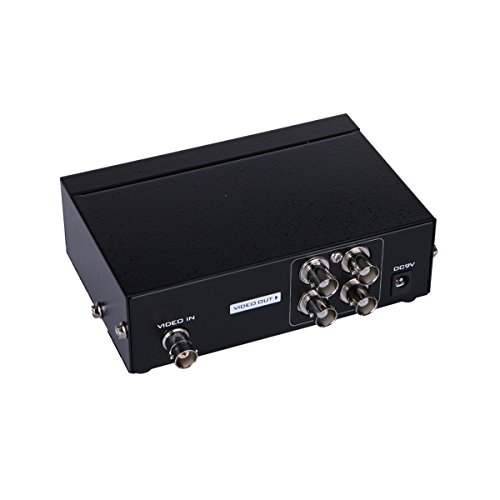
- Splits one BNC input to four outputs
- Supports PAL, NTSC, and SECAM analog video
- Plug-and-play metal-housed design
Best For: CCTV and composite analog monitoring systems
Compact HD-SDI Hub

- Four separately buffered HD-SDI/SDI outputs
- Auto equalization and multi-standard support
- Compact, portable Mini-Converter design
Best For: Small SDI live production and streaming rigs
Eight-Way RCA Video Splitter

- One RCA A/V input to eight outputs
- Active signal booster for longer connections
- Metal housing and included 9V adapter
Best For: Composite RCA monitoring and distribution systems
4K 12G-SDI Distributor

- Handles SDI data rates up to 12G
- One input feeds four identical outputs
- Equalizes and re-clocks signals
Best For: 4K broadcast and live-streaming SDI workflows
Best RCA Choice
DTECH 4-Way Composite AV Splitter

- Splits one 3RCA signal to four outputs
- Amplifies video and stereo audio signals
- Includes 9V adapter and metal housing
Best For: Composite AV distribution to multiple displays or speakers
Best VGA Distribution
ConnectPRO VSE-105 5-Port Splitter

- Duplicates one VGA source to five outputs
- Supports VGA, SVGA, and Multi-Sync monitors
- Transmission distance up to 210 feet
Best For: Multi-monitor VGA installations and cascaded display systems
Best Compact BNC Unit

- Distributes one BNC video input to four outputs
- Compact plastic enclosure
- Designed for straightforward video-only distribution
Best For: Compact BNC video distribution installations
Long-Run SDI Reliability – AVMATRIX SD1141 1×4 SDI Splitter
For live streaming systems built around SDI cameras and equipment, the AVMATRIX SD1141 is a practical choice among video distribution amplifiers for live streaming. It accepts auto-detected SD, HD, and 3G-SDI signals, provides four outputs, and reclocks each output for more dependable transmission over longer cable runs.
Best For: SDI-based live streaming, broadcast, and production setups that need four outputs and extended cable distances.
Pros:
- Supports SD, HD, and 3G-SDI signals up to 1080p at 60Hz.
- Reclocked outputs help maintain signal transmission over distance.
- Transmission distances are listed up to 400m for SD, 200m for HD, and 120m for 3G-SDI.
- Includes a detachable wall-mounting bracket and three-year warranty.
Cons:
- Provides four outputs rather than the eight outputs offered by some alternatives.
- Uses SDI connections, so it is not intended for HDMI or analog CVBS systems.
The SD1141 is especially useful when reliable SDI distribution and long cable runs matter more than a large output count. Its compact design, reclocking, and mounting flexibility suit permanent or portable production installations.
Multi-Display HDMI Distribution – OREI 1×8 CAT6/7 HDMI Extender
The OREI HD18-EX165-K is a strong option for HDMI-based video distribution amplifiers for live streaming when one source must reach several remote displays. It sends a signal to eight receivers over CAT6, CAT6a, or CAT7 cable and adds a local HDMI loop output for a nearby monitor.
Best For: HDMI live streaming, presentations, conferences, and installations distributing one source to eight remote displays.
Pros:
- Distributes one HDMI source to eight displays over network cable.
- Includes a local HDMI loop output for an additional nearby display.
- Supports up to 1080p at 60Hz and includes IR pass-back for remote source control.
- Plug-and-play design includes eight receivers and Power Over LAN.
Cons:
- 4K support is listed at up to 30Hz and up to 165 feet.
- Remote distribution requires CAT6, CAT6a, or CAT7 cabling and the included receivers.
- Its eight-receiver design may be more equipment than a small setup requires.
Choose this OREI system when HDMI compatibility, multiple display endpoints, and remote control are priorities. The included transmitter, receivers, IR accessories, and loop output make it a complete distribution package for larger rooms or venues.
Eight-Output Broadcast Flexibility – Blackmagic Mini Converter SDI Distribution
For production teams using SDI gear, the Blackmagic Design Mini Converter offers eight reclocked outputs from a single SD, HD, or 3G-SDI input. Its automatic format switching, embedded audio support, and ASI handling make it a versatile entry in the video distribution amplifiers for live streaming category.
Best For: Broadcast and live-event systems that need eight SDI outputs with automatic format handling and embedded data support.
Pros:
- Provides eight reclocked SDI outputs from one input.
- Automatically switches among SD, HD, and 3G-SDI formats.
- Supports ASI, ancillary data, and embedded audio.
- Includes a redundant SDI input for mission-critical applications.
Cons:
- Designed for SDI workflows rather than HDMI or analog video systems.
- The supplied notes identify the main unit but do not list mounting hardware or accessories.
This Mini Converter is a good fit when output count and broadcast-oriented signal handling are important. Automatic switching and reclocking simplify mixed-format live production, while the redundant input adds value for critical events.
Simple Analog Video Splitting – AuviPal AU-41BC 1×4 BNC Distributor
The AuviPal AU-41BC is a straightforward choice for analog camera and monitoring systems. Among video distribution amplifiers for live streaming, it suits workflows using composite BNC video, splitting one input to four outputs without software or configuration.
Best For: CCTV, analog monitoring, and studio systems using PAL, NTSC, or SECAM composite video.
Pros:
- Splits one BNC video input to four BNC outputs.
- Supports up to 1080p at 60Hz according to the supplied specifications.
- Plug-and-play installation requires no additional configuration.
- Metal housing is designed for stability, heat resistance, and continuous operation.
Cons:
- Not compatible with SDI or digital signals.
- Sources must be set to CVBS mode for compatible analog output.
- It is intended for analog video rather than modern HDMI or SDI streaming chains.
This distributor makes sense for existing analog surveillance or monitoring infrastructure. Its compact metal construction and simple BNC connectivity keep installation uncomplicated, but digital streaming systems should use a compatible SDI or HDMI distribution device instead.
Compact HD-SDI Hub – AJA HD5DA
For live streaming setups built around HD-SDI or SDI, the AJA HD5DA is a compact distribution amplifier that sends one input to four separately buffered outputs. Auto equalization and multi-standard support make it a practical choice when you need a portable signal repeater for monitors, cameras, or other SDI equipment.
Best For: Compact HD-SDI/SDI live production rigs needing four reliable outputs.
Pros:
- Provides four separately buffered HD-SDI/SDI outputs.
- Includes automatic equalization and supports multiple standards.
- Compact design fits behind monitors, in racks, or on camera rigs.
- Locking power connector helps prevent accidental disconnection.
Cons:
- Designed for HD-SDI/SDI rather than RCA composite video.
- The supplied notes describe four outputs, so it may be limiting for larger distribution requirements.
The HD5DA is a focused, portable option for SDI workflows. Its buffered outputs, signal equalization, and flexible placement make it well suited to smaller broadcast and live-streaming systems.
Eight-Way RCA Video Splitter – MT-VIKI 108AV
The MT-VIKI 108AV is an active composite video and stereo audio distribution amplifier for live streaming or monitoring setups that use RCA connections. It mirrors one three-RCA input across eight outputs, while its powered design helps distribute the signal over longer connections.
Best For: RCA-based systems that need one composite video and audio source sent to eight destinations.
Pros:
- Duplicates one set of RCA audio and video inputs to eight outputs.
- Active signal boosting supports longer-distance connections.
- Durable metal housing with anti-skid feet aids placement and heat dissipation.
- Small footprint and included 9V DC power adapter suit rack or monitor installation.
Cons:
- Supports composite RCA connections rather than SDI or HDMI distribution.
- It mirrors one source to eight outputs and is not an 8-to-1 switcher.
This splitter is a straightforward choice when a legacy or composite workflow needs many mirrored feeds. Confirm that your sources and displays use RCA before choosing it for a streaming installation.
4K 12G-SDI Distributor – Kramer VM-4UX
For higher-bandwidth live streaming and broadcast workflows, the Kramer VM-4UX distributes one SDI source to four identical outputs at data rates up to 12G. It automatically adapts to the input rate, equalizes the signal, and re-clocks it to help extend transmission reach.
Best For: Broadcast-grade 4K SDI systems requiring four synchronized distribution outputs.
Pros:
- Supports standard broadcast-grade SDI signals up to 12G.
- Distributes one input to four identical SDI outputs.
- Auto-adapts to the input data rate.
- Equalizes and re-clocks the signal to improve transmitted reach.
Cons:
- Provides four outputs, which may not be enough for larger installations.
- Its SDI-focused design is not intended for RCA composite distribution.
The VM-4UX is the strongest fit here for demanding 4K SDI environments. Its automatic rate adaptation, equalization, and re-clocking make it a practical choice when signal integrity and transmission distance matter.
Best RCA Choice – DTECH 4-Way Composite AV Splitter
For basic analog setups, this DTECH unit is one of the more flexible video distribution amplifiers for live streaming when your source uses composite RCA connections. It takes one video-and-stereo-audio signal and sends it to four displays or powered speakers.
Best For: Distributing composite video and left/right audio to multiple TVs, monitors, speakers, or recording setups.
Pros:
- One RCA input feeds four RCA outputs for simultaneous viewing or audio distribution.
- Built-in signal amplification is designed to support clear video and reliable audio over longer connections.
- Metal housing, anti-skid feet, LED status indicator, and color-coded RCA jacks support practical installation.
- Includes a 9V AC power adapter and requires no extra software.
Cons:
- Uses analog composite RCA connections rather than VGA, HDMI, or other digital formats.
- Its four-way layout is intended for fixed distribution and has no switching function.
Choose this model when your streaming or monitoring chain is built around 3RCA composite connections and you need both video and stereo-audio duplication in one compact box.
Best VGA Distribution – ConnectPRO VSE-105 5-Port Splitter
The ConnectPRO VSE-105 is a straightforward option among video distribution amplifiers for live streaming when your equipment uses VGA. It duplicates one VGA source across five outputs and supports extended transmission distances for compatible monitor installations.
Best For: Sending one VGA, SVGA, or Multi-Sync source to several monitors in a distributed display system.
Pros:
- Duplicates one VGA input to multiple outputs, with five ports available.
- Supports VGA, SVGA, and Multi-Sync monitors.
- Rated for an effective transmission distance of up to 65 meters or 210 feet.
- Supports cascading and includes an optimized port for DDC-compatible output.
Cons:
- VGA-only connectivity limits compatibility with newer digital video equipment.
- The supplied notes do not indicate audio distribution.
This is a practical choice for legacy VGA workflows where one computer or video source must feed several displays, particularly across a longer cable run or through cascaded units.
Best Compact BNC Unit – Speco VIDDIST 1×4 Amplifier
Speco VIDDIST 1 in/4 Out Video Distribution Amplifier 1 Input to 4 Output Video Bnc Splitter
Check Price On AmazonThe Speco VIDDIST is a compact choice among video distribution amplifiers for live streaming setups that use BNC video cabling. Its 1-input, 4-output design provides a simple way to distribute one video feed across multiple destinations.
Best For: Basic BNC-based video distribution where a single source needs to reach up to four outputs.
Pros:
- Provides one video input and four video outputs.
- Uses BNC connectors for compatible video equipment.
- Compact plastic housing measures approximately 4.5 inches wide, 1 inch high, and 3.5 inches deep.
- Lightweight design weighs about 13.4 ounces.
Cons:
- The supplied notes do not specify audio distribution.
- Plastic construction may be less robust than a metal distribution box.
- Compatibility is centered on BNC video connections.
Consider the VIDDIST when your installation already uses BNC cabling and you want a small, uncomplicated 1-to-4 video distribution amplifier without extra audio features.
How We Picked the Best Video Distribution Amplifiers for Live Streaming
We focused on signal compatibility, output capacity, supported resolutions, connection type, and practical installation needs. The selection includes SDI distribution amplifiers for broadcast-style rigs, HDMI and CAT-based systems for longer cable runs, and composite units for legacy cameras, monitors, gaming, and surveillance equipment.
We also considered features that affect day-to-day reliability, including EDID management, loop-through connections, powered operation, rack or desktop suitability, and whether a unit is designed for professional production or simpler monitoring systems. A distributor is only useful when its inputs and outputs match the rest of your chain, so connector format and signal standard matter as much as the advertised output count.
Quick Comparison
| Best For | Recommended Signal Type | What to Prioritize |
|---|---|---|
| Broadcast and studio streaming | SDI | Supported SDI standards, reclocking, cable distance, and BNC build quality |
| Consumer cameras and displays | HDMI | Resolution, refresh rate, HDCP or EDID behavior, and cable length |
| Long HDMI-style runs | HDMI over CAT | Transmitter and receiver compatibility, network-style cabling, and latency |
| Legacy video equipment | Composite RCA or BNC | Video format, audio routing, power supply, and noise control |
| Surveillance or monitoring | Coaxial BNC | Camera compatibility, output count, and continuous-duty reliability |
Key Buying Factors for Video Distribution Amplifiers for Live Streaming
Match the Signal Standard
Choose SDI for durable, long-distance professional video connections, HDMI for common cameras and displays, or composite when working with older equipment. A splitter cannot convert an incompatible signal unless conversion is specifically built in.
Check Resolution and Refresh-Rate Support
Confirm that the amplifier supports the exact format produced by your camera, switcher, or encoder. Pay attention to 4K frame rates, 3G or 12G-SDI ratings, 1080p support, and whether every output can carry the same format simultaneously.
Count Outputs and Plan for Expansion
Four outputs may be enough for a basic stream, while an eight-way unit is more practical for studios with several monitors, recorders, or overflow feeds. Leave room for future additions if your production setup is growing.
Consider Cable Distance and Signal Management
Long runs can require SDI, active HDMI extension, or HDMI-over-CAT hardware. EDID management can help HDMI sources and displays negotiate correctly, while SDI reclocking can improve reliability across a distribution chain.
Verify Power and Installation Requirements
Check whether the unit needs an external adapter, uses a standard rack format, or is intended for desktop placement. For live events and continuous operation, prioritize secure connectors, ventilation, and dependable power.
Who Should Buy Which Video Distribution Amplifiers for Live Streaming?
Choose an SDI model if you use professional cameras, switchers, or field production equipment. SDI is usually the strongest choice for reliable broadcast-style cabling and longer runs.
Choose an HDMI or HDMI-over-CAT model for consumer and prosumer cameras, streaming PCs, and modern displays. CAT-based extension is especially useful when the destination is far from the source.
Choose a composite RCA or BNC model for legacy cameras, older monitors, gaming systems, or surveillance installations. These products are economical when your equipment already uses analog video, but they are not substitutes for modern HDMI or SDI distribution.
Before buying, write down the source connector, output connector, maximum resolution, required cable distance, number of destinations, and whether audio must be distributed. Those five checks will eliminate most compatibility problems and help you select the right amplifier for your live streaming workflow.