
Sending one 4K HDMI source to multiple displays can be straightforward—until cable distance, HDCP compatibility, HDR, or audio support creates signal problems. The right distribution amplifier keeps video stable while matching your displays, source devices, and installation layout.
We selected 10 options ranging from compact 1×2 splitters to 1×8 systems and HDMI-over-CAT extenders. Use the guide below to compare port counts, signal formats, distance requirements, and installation priorities before choosing.
Best 10 4K Video Distribution Amplifiers Picks for 2026
Professional 4K Distribution

- 18Gbps 1x2 HDMI distribution
- Cascadable for more outputs and distance
- Downscaling and audio extraction on output 2
Best For: Stable 4K installations with legacy-display support
Long-Run 4K Extension

- Distributes one source to eight displays
- 4K@30Hz up to 165 feet
- Loop-out and IR pass-back included
Best For: Multi-display installations using CAT6/7 cabling
Next-Gen HDMI 2.1 Distribution

- 48Gbps HDMI 2.1b distribution
- Custom EDID Blend and four-block EDID support
- Extracts up to 7.1 digital or 2-channel analog audio
Best For: High-bandwidth gaming and HDMI 2.1 systems
Simple 4K Mirrored Splitting

- Mirrors one HDMI source to four displays
- Supports 4K@30Hz and 1080p@60Hz
- Powered metal design with cascade support
Best For: Basic four-screen mirror installations
Best Compact Choice

- 1x2 HDMI distribution for two displays
- Supports 4K/HDR signals
- Includes EDID management
Best For: Simple residential or commercial two-display installations
Best for Flexible Sources

- Two HDMI inputs and four outputs
- Built-in automatically adjusting amplifier
- Supports 4K video and HD audio formats
Best For: Multi-source setups feeding up to four displays
Best for Large Display Systems

- Feeds up to eight HDMI displays
- Supports 4K UHD and 1080p at 60Hz
- HDCP 2.2 and HD audio support
Best For: Large single-source, multi-display AV installations
Compact 4K Splitter

- Splits one HDMI source to two displays
- Supports 4K@30Hz and 3D video
- Includes 48-bit Deep Color and HD audio support
Best For: Two-display home theater and small HDMI installations
Long-Run HDMI Repeater
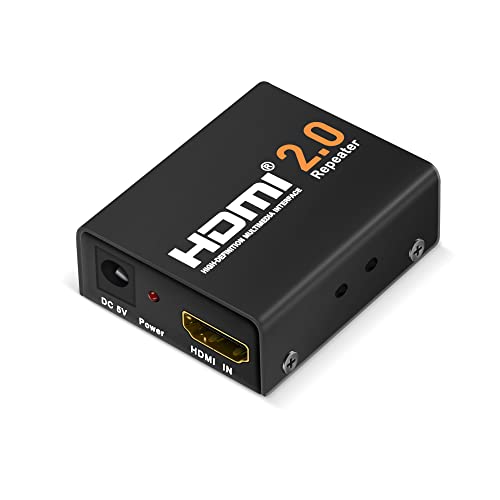
- Supports 18Gbps HDMI 2.0 bandwidth
- Handles 4K at 60Hz and HDCP 2.2
- Extends transmission up to 60m/200ft
Best For: Long HDMI runs in offices, classrooms, and presentation spaces
Eight-Display Distributor

- Sends one HDMI source to eight displays
- Supports 4K@30Hz, Full HD, and 3D
- Includes a 5V AC adapter and metal enclosure
Best For: Large multi-display HDMI distribution systems
Professional 4K Distribution – AVPro Edge AC-DA12-AUHD-GEN2
For dependable 4k video distribution amplifiers, the AVPro Edge AC-DA12-AUHD-GEN2 is a practical 1×2 option built around 18Gbps distribution. It can be cascaded for additional outputs and longer distribution paths, while its second HDMI output adds downscaling for legacy displays.
Best For: Installations that need stable 4K distribution, audio extraction, and compatibility with older displays.
Pros:
- 18Gbps bandwidth for 4K distribution applications.
- Supports cascading for expanded output capacity and distance.
- Output 2 includes audio extraction and downscaling for legacy equipment.
- Includes a 10-year warranty.
Cons:
- Provides two channels, so larger systems may require cascading or a higher-output model.
- The downscaler is specified on HDMI output 2 rather than both outputs.
This is a strong fit when reliability and mixed-display compatibility matter more than having many outputs in a single chassis.
Long-Run 4K Extension – OREI 1×8 HDMI Over CAT6/7
The OREI HD18-EX165-K combines HDMI distribution with CAT6/6a/7 extension for systems that need to reach multiple displays. It sends one source to eight receivers, supports a local loop-out display, and includes IR pass-back for remote source control.
Best For: Meeting rooms, bars, exhibitions, conferences, and other installations requiring eight remote displays over network cable.
Pros:
- Distributes one source to eight displays simultaneously.
- Supports 4K@30Hz up to 165 feet and 1080p@60Hz up to 230 feet.
- Includes a local HDMI loop-out and IR pass-back.
- Receivers receive power over LAN, reducing receiver-side adapters.
Cons:
- 4K support is limited to 30Hz.
- Setup requires the included transmitter and eight receivers.
- Warranty coverage is one year.
Choose this model when output count and cable distance are priorities, particularly where CAT6/7 cabling is easier to run than long HDMI cables.
Next-Gen HDMI 2.1 Distribution – AVPro Edge AC-DA14-AUHD-GEN2
For newer 4k video distribution amplifiers and HDMI 2.1 systems, the AVPro Edge AC-DA14-AUHD-GEN2 provides four outputs with 48Gbps bandwidth. Its EDID tools and extracted-audio support are designed for demanding displays and flexible AV installations.
Best For: HDMI 2.1b, gaming-focused, and high-bandwidth systems distributing one source to four displays.
Pros:
- 48Gbps bandwidth with Fixed Rate Link 6 support.
- Supports HDMI 2.1b gaming-focused features.
- Custom EDID Blend combines EDIDs from different devices.
- Extracts up to 7.1 digital or 2-channel analog audio.
Cons:
- Provides four outputs, which may not suit larger distribution systems without expansion.
- Advanced EDID features may require more configuration than a basic splitter.
This is the most forward-looking option in the group for high-bandwidth HDMI 2.1 environments where display negotiation and audio flexibility are important.
Simple 4K Mirrored Splitting – MT-VIKI 1×4 HDMI Splitter
The MT-VIKI MT-SP104-M is a straightforward powered 1×4 splitter for sending identical content to four HDMI displays. It supports 4K@30Hz, 1080p@60Hz, 3D video, and cascading, making it a practical choice for home theaters, classrooms, conference rooms, and retail displays.
Best For: Mirror-only installations that need four local HDMI outputs with powered signal stability.
Pros:
- Splits one HDMI source to four displays simultaneously.
- Supports 4K@30Hz, 1080p@60Hz, 3D, and HDCP 1.4.
- Powered operation helps reduce flickering and signal drops.
- Metal housing provides heat dissipation and EMI protection.
Cons:
- Supports mirror mode only and cannot extend separate desktop images.
- Does not include a remote or built-in speaker.
- 4K support is limited to 30Hz.
Its simple design suits users who only need the same source on four screens and do not require switching, independent content, or newer HDMI 2.1 features.
Best Compact Choice – Atlona Rondo 442
The Atlona Rondo 442 is a compact 1×2 option for distributing one HDMI source to two displays. It supports 4K/HDR applications, manages EDID communications, and is designed for straightforward installation in residential or commercial AV systems.
Best For: Buyers who need dependable two-display 4K/HDR distribution from a single HDMI source.
Pros:
- Supports 4K/HDR HDMI signal distribution.
- EDID management helps coordinate supported audio formats and video resolutions.
- Suitable for commercial and residential installations.
Cons:
- Provides only two output connections.
- Does not offer source switching between multiple inputs.
As 4K video distribution amplifiers go, the Rondo 442 is best suited to simple, reliable installations where one source must feed two displays without extra switching features.
Best for Flexible Sources – Monoprice Blackbird 2×4
The Monoprice Blackbird combines 2×4 HDMI switching and splitting, letting you select between two source devices and distribute the chosen signal to four displays. Its built-in automatically adjusting amplifier supports longer-than-normal HDMI cable runs, while the unit handles 4K video and several surround-sound formats.
Best For: Home entertainment or presentation setups that need two HDMI sources and up to four connected displays.
Pros:
- Switches between two HDMI inputs and distributes to four outputs.
- Built-in amplifier is designed to support longer HDMI cable runs.
- Supports Dolby Vision, Dolby TrueHD, DTS-HD Master Audio, and LPCM stereo.
Cons:
- Supplied notes specify video support up to 4K at 30Hz.
- No warranty is listed in the supplied product details.
This Blackbird is a practical pick among 4K video distribution amplifiers when input flexibility matters as much as display count, though buyers wanting 4K at 60Hz should verify compatibility before purchasing.
Best for Large Display Systems – KanexPro 1×8 4K UHD
The KanexPro HDSP184K distributes one HDMI source to as many as eight displays, making it a strong fit for larger AV installations. It supports 4K UHD, 1080p at 60Hz, HDCP 2.2, and common Dolby and DTS audio formats.
Best For: Installations that need one 4K HDMI source shared across up to eight televisions or other displays.
Pros:
- Distributes HDMI video and audio to up to eight displays.
- Supports 4K UHD and Full HD 1080p at 60Hz.
- HDCP 2.2 compliant with Dolby Digital, DTS-HD, and Dolby TrueHD support.
Cons:
- Offers one input, so it does not switch among multiple sources.
- Its eight-output design may be more than needed for smaller systems.
For buyers comparing 4K video distribution amplifiers for a multi-screen deployment, the KanexPro stands out primarily for its eight-output capacity and broad video and audio compatibility.
Compact 4K Splitter – Monoprice Blackbird 1×2
Monoprice Blackbird 4K 1x2 HDMI Amplifier Splitter - 48-bit Deep Color, 3D Video Support, Black
Check Price On AmazonFor basic 4k video distribution amplifiers setups, the Monoprice Blackbird sends one HDMI source to two displays. It supports 4K at 30Hz, 3D video, 48-bit Deep Color, and a broad selection of digital audio formats.
Best For: Home theaters or small installations that need to feed two HDMI displays from one source.
Pros:
- Splits one HDMI input to two HDMI sink devices.
- Supports 4K@30Hz, 1080p@120Hz, and 3D-1080p@60Hz.
- Handles 48-bit Deep Color and formats including DTS-HD, Dolby TrueHD, and 7.1-channel LPCM.
- HDCP 1.4 compliant with support for 297MHz TMDS clock rates.
Cons:
- Maximum listed 4K refresh rate is 30Hz.
- Uses HDCP 1.4 rather than a newer HDCP version.
This is a straightforward two-output distributor for compatible HDMI systems. Choose it when two displays are enough and your source and displays do not require 4K at 60Hz.
Long-Run HDMI Repeater – Flashmen 4K2K Booster
The Flashmen HDMI Booster is a repeater rather than a multi-output splitter, making it useful in 4k video distribution amplifiers systems where cable distance is the main concern. It supports HDMI 2.0 features, 18Gbps bandwidth, 4K at 60Hz, and transmission distances up to 60m/200ft.
Best For: Extending an HDMI connection between a source and display in conference rooms, offices, classrooms, or showrooms.
Pros:
- Supports 4K/2K at 60Hz, 4K at 30Hz, 1080p, and 720p.
- Provides an 18Gbps transmission rate and HDCP 2.2 support.
- Designed for distances up to 60m/200ft between HDMI devices.
- Compact, plug-and-play metal housing requires no extra power supply in typical use.
Cons:
- Does not split one source across multiple displays.
- High-power devices may require the included backup power cord.
With its compact design and high-bandwidth HDMI 2.0 support, this model fits installations that need signal reinforcement over a longer cable run. It is not the right choice if you need several simultaneous outputs.
Eight-Display Distributor – HDSUNWSTD 1×8 HDMI Splitter
For larger 4k video distribution amplifiers installations, this powered HDMI splitter distributes one source signal to eight outputs. It supports 4K at 30Hz, Full HD, 3D, and a range of common sources such as game consoles, Blu-ray players, streaming devices, DVRs, and PCs.
Best For: Multi-display installations in homes, classrooms, offices, retail spaces, or presentation environments.
Pros:
- Distributes one HDMI input to eight identical HDMI outputs.
- Supports 4Kx2K@30Hz, 1080p, 1080i, 720p, and Full HD 3D formats.
- Compatible with sources including PS3, PS4, Xbox, Blu-ray players, Fire TV, Roku, and PCs.
- Heavy-duty metal enclosure helps with heat absorption and dissipation.
Cons:
- Listed 4K support is limited to 30Hz.
- Requires the included 5V AC adapter for operation.
This splitter is the strongest fit when one HDMI source must reach many displays at once. Its eight outputs offer considerably more distribution capacity than a compact 1×2 model, while the 4K specification remains geared toward 30Hz content.
How We Picked the Best 4K Video Distribution Amplifiers
We focused on the features that affect real-world HDMI distribution: supported resolution and refresh rates, bandwidth, HDCP compatibility, HDR and 3D support, EDID management, output count, signal distance, audio handling, build quality, and installation flexibility. The list includes basic powered splitters for simple setups, higher-bandwidth distribution amplifiers for 4K HDR systems, and extender-based designs for longer cable runs.
Because equipment needs vary, no single model is ideal for every installation. A compact 1×2 unit may be the best choice for a television and projector, while a commercial display system may require eight outputs, rack-friendly hardware, or transmission over CAT 6 or CAT 7 cable.
Quick Comparison
| Need | Best configuration to consider | Important features |
|---|---|---|
| Two nearby displays | 1×2 distribution amplifier | 4K support, HDCP compatibility, compact powered design |
| Four displays | 1×4 splitter | Reliable EDID handling and consistent output behavior |
| Eight displays | 1×8 distribution amplifier | Output stability, bandwidth, cooling, and power supply quality |
| Long-distance displays | HDMI-over-CAT extender | CAT 6/7 transmission distance, receiver requirements, and latency |
| Multiple source devices | 2×4 splitter or switch | Input switching, audio support, and source compatibility |
Key Buying Factors for 4K Video Distribution Amplifiers
Resolution, Bandwidth, and Refresh Rate
Confirm whether you need standard 4K at 30Hz or 4K at 60Hz with full 18Gbps bandwidth. Gaming, sports, desktop use, and smooth camera feeds generally benefit from 4K/60 support. Also check compatibility with HDR formats, Dolby Vision, 3D, and deep color if those features matter in your system.
HDCP and EDID Management
HDCP version support affects protected content from streaming devices, Blu-ray players, and set-top boxes. EDID management helps the source negotiate a usable format when connected displays have different capabilities. This is particularly important when mixing 4K and 1080p screens.
Output Count and Cable Distance
Choose more outputs than you currently need if expansion is likely, but remember that every additional display increases installation and troubleshooting complexity. For longer runs, ordinary HDMI cables may not be enough; an extender system using properly rated CAT 6 or CAT 7 cable can provide greater reach.
Power, Audio, and Physical Design
Powered units are generally more dependable than passive splitters. Look for a stable power adapter, clear status indicators, secure connectors, and a metal enclosure when the device will run continuously. Verify whether the amplifier passes the audio format your receivers, soundbars, or displays require.
Who Should Buy Which 4K Video Distribution Amplifiers?
Choose a 1×2 model for a simple home theater, office presentation system, or television-and-projector arrangement. A 1×4 unit suits classrooms, conference rooms, and small signage installations. Select a 1×8 amplifier when one source must feed many displays, provided its bandwidth and HDCP support match the source and screens.
For long cable runs between rooms or floors, prioritize an HDMI-over-CAT extender rather than relying on oversized HDMI cables. If you need to connect multiple sources as well as distribute them, a switch-and-splitter combination such as a 2×4 design can reduce extra equipment. Before ordering, map every source, display, cable length, resolution, refresh rate, and audio requirement so the selected unit will work consistently across the entire system.