
Gigabit Intel 82576 Dual NIC review is best for buyers who want a simple dual-port Ethernet add-in card with broad OS support.
If you need a practical wired networking upgrade rather than a flashy feature set, this one is easy to evaluate.
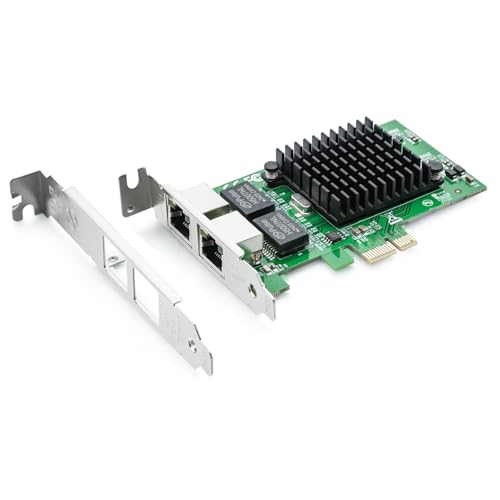
Intel 82576 Dual NIC Review Summary
The Gigabit Intel 82576 Dual NIC makes sense for anyone who needs two RJ45 ports, straightforward PCIe installation, and wide operating-system compatibility in a low-profile format.
It is not trying to be a premium enthusiast product; it is aimed at stable, utilitarian networking for desktops, slim systems, and servers.
For the right buyer, that is the point.
The listing centers on the original Intel 82576 controller, dual 10/100/1000Mbps ports, support for common PCIe slot sizes, and compatibility across Windows, Windows Server, Linux, and virtualization-oriented environments.
That combination makes it attractive for practical upgrades where reliability and compatibility matter more than aesthetics.
Review Scorecard
| Category | Score | Why it matters |
|---|---|---|
| Network flexibility | 9/10 | Two RJ45 ports give more routing, segmentation, or spare-port options than a single-port card. |
| Compatibility | 9/10 | The listed support for Windows, Windows Server, Linux, FreeBSD, and VMware ESXi is broad. |
| Installation ease | 8/10 | Low-profile and full-height brackets help it fit standard and slim cases. |
| Performance fit | 8/10 | Gigabit speeds and an Intel controller suit steady wired networking duties well. |
| System versatility | 8/10 | PCIe x1 support and multiple slot compatibility make it easy to deploy in mixed systems. |
| Buyer confidence | 7/10 | The warranty, return window, and tech support are positive, but the listing is still utility-first. |
Key Features and Specifications of Intel 82576 Dual NIC
The core appeal is straightforward: this is a dual-port gigabit Ethernet card built around an Intel 82576 controller.
Each port supports 10/100/1000Mbps data rates, and the listing says the card works with Cat5e cable for distances up to 100 meters.
The interface is PCI Express 2.0 with an x1 lane design, and the listing says it is compatible with PCIe x1, x4, x8, and x16 slots.
That matters because the card is meant to drop into a wide range of desktops and servers without requiring a special slot layout.
Other useful facts from the listing:
- Dual RJ45 ports for separate network connections or redundancy planning
- Low-profile and full-height brackets included
- Support listed for Windows 7/8/10/11
- Support listed for Windows Server 2008/2012/2016/2019
- Support listed for CentOS/RHEL, Ubuntu, Debian, FreeBSD, and VMware ESXi versions
- Not listed as supporting VMware ESXi 7.0, Mac OS, or bypass mode
- QR-code or Intel driver download guidance is referenced in the listing
- 24/7 customer service, 30-day free returns, 3-year warranty, and lifetime technical support are stated
For buyers comparing listings, the most important specification is not the Ethernet speed alone.
It is the combination of dual ports, Intel controller branding, and broad system support.
Pros and Cons of Intel 82576 Dual NIC
Pros
- Two RJ45 ports increase flexibility for multi-network setups
- Intel 82576 controller suggests a more serious networking foundation than generic no-name alternatives
- Broad support list is helpful for Windows, Linux, server, and virtualization use cases
- Included low-profile bracket improves fit in compact cases
- PCIe x1 design keeps installation simple
Cons
- It is a utility card, so there is no premium hardware feature set beyond core networking
- The listing excludes Mac OS and VMware ESXi 7.0
- Buyers who only need one port may be paying for capacity they will never use
- Success depends on whether the specific OS and environment match the listed support
Who Should Buy Intel 82576 Dual NIC?
This card is a good fit for home lab builders, small-office IT setups, server refresh projects, and users who want a spare dual-port NIC for a Windows or Linux machine.
It is also appealing if you are building in a slim chassis and need the included low-profile bracket.
It is especially relevant for buyers who care about predictable wired networking and want two physical ports without moving to a more complex adapter class.
If your use case involves separate internal and external networks, a spare failover path, or a machine that benefits from two wired interfaces, the design is sensible.
You should probably skip it if you need Mac support, VMware ESXi 7.0 compatibility, or advanced networking features that are not mentioned in the listing.
It is also unnecessary if your machine only needs one Ethernet port and already has stable onboard networking.
Intel 82576 Dual NIC Compatibility and Use Cases
Desktop and Slim-Case Installation
The included low-profile bracket is important because it expands where the card can go.
A small workstation, a rack shelf server, or a compact office PC can all benefit from a card that is not locked to one case style.
Server and Lab Networking
The listing support for Windows Server and Linux distros makes the card relevant for lab environments and service boxes.
Dual ports are useful when a machine needs more than one network role, even if the actual configuration is simple.
Virtualization and Multi-NIC Planning
Because the listing names VMware ESXi support up to certain versions, the card is clearly positioned for virtualization-minded buyers.
Even outside ESXi, dual ports can help with virtual switch layouts, testing, and separating traffic in a lab.
Driver and Setup Practicality
The product page points buyers toward Intel drivers or the QR code on the card.
That is a practical sign that setup is expected to follow standard driver installation rather than proprietary software complexity.
Alternatives to Intel 82576 Dual NIC
If you want a comparable dual-port Intel option, look at the Intel I350-T2 for a more established dual-port server NIC line.
If you want a similar general-purpose network adapter, the TP-Link 2.5Gb PCIe network card may be worth comparing for newer desktops.
For buyers focused on server-grade flexibility, the Intel X520 dual port NIC is another common Amazon search path.
For most shoppers, the right comparison is not just port count.
It is whether you need this card’s broad legacy OS support or whether a newer adapter better matches your current platform.
Is Intel 82576 Dual NIC Worth It?
Yes, if you want a practical dual-port Intel-based PCIe network card with broad compatibility and simple installation.
The value here is in the combination of dual RJ45 ports, included brackets, and support for a wide range of operating systems and server environments.
If you need Mac support, VMware ESXi 7.0, or advanced extras beyond wired networking, look elsewhere.
But for a straightforward dual-NIC upgrade on Windows, Linux, or server hardware, this is a sensible, utilitarian buy.