
Choosing the right printer for tabletop minis is mostly about detail, consistency, and how much setup you want to handle. The best 3D printers for miniatures can capture sharp edges, clean facial features, and fine weapons without wasting resin or time.
In this roundup, we focus on models that balance print quality, workflow, and value for hobbyists, beginners, and more advanced makers.
Best 10 3d Printers for Miniatures Picks for 2026
Beginner-Friendly Detail Pick
Phrozen Sonic Mini 8K S for Miniatures

- 22µm XY resolution and 8K mono LCD
- Compact build for models and miniatures
- Works with Lychee, Chitubox, and Tango
Best For: Beginners who want sharp resin detail in a compact printer
Large-Format Detail Pick
ELEGOO Saturn 3 12K Resin Printer

- 10-inch 12K mono LCD for fine detail
- Large build volume for bigger projects
- Compatible with CHITUBOX and Lychee
Best For: Users who want miniature detail plus extra build space
Compact Precision Value
ANYCUBIC Photon Mono 4 for Miniatures

- 7-inch 10K LCD with 17 × 17 µm pixels
- Easy 4-point leveling for beginners
- Laser-engraved plate helps adhesion
Best For: Miniature makers who want high resolution in a compact printer
Beginner FDM Starter Kit
Bambu Lab A1 mini with LED Lamp Kit

- Automatic calibration and simple setup
- Quiet, compact printer for home use
- Includes an LED Lamp Kit for projects
Best For: Beginners who want easy creative printing with added lamp-kit fun
Miniature Resin Pick
TGM-7 3D Wargaming Resin for Tabletop Miniatures

- High-resolution resin for detailed tabletop miniatures
- Durable with a bit of flex for handling and shipping
- Hard, non-sticky post-cured surface for painting
Best For: Hobbyists and small sellers printing detailed tabletop minis
Detail-Focused Resin Printer

- 16K resin printer focused on smooth surfaces and fine detail
- Auto-leveling and plug-and-play setup reduce hassle
- Tank heating and AI monitoring help improve print reliability
Best For: Miniature makers who want automated high-detail resin printing
Fast FDM Option

- Automatic bed leveling for easy first layers
- CoreXY system reaches up to 600mm/s travel speed
- App monitoring and quick nozzle swaps improve convenience
Best For: Makers who want fast, easy FDM printing for larger hobby projects
Fast-Setup Detail Pick
ELEGOO Mars 5 Resin 3D Printer
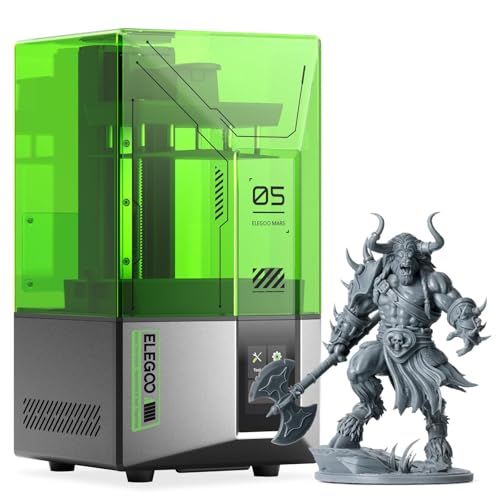
- One-click automatic leveling
- 4K mono LCD for fine details
- Smart sensors and self-checks reduce errors
Best For: Beginners who want detailed resin miniatures with simpler setup
High-Detail Stability Pick
ANYCUBIC Photon P1 14K 3D Printer

- 14K display and sharp detail optics
- Ball screws and guide rails boost stability
- AI checks and leveling assist with reliability
Best For: Detail-focused miniature makers who want a stable, automated resin printer
Beginner-Friendly Compact Pick
Creality HALOT R6 Fully Assembled

- Built-in boot guide for easy setup
- Compact 4.25kg body saves space
- Uniform integral light source supports smooth prints
Best For: New resin users who want a compact, easy-to-learn miniature printer
Beginner-Friendly Detail Pick – Phrozen Sonic Mini 8K S for Miniatures
If you want one of the more approachable 3d printers for miniatures, the Phrozen Sonic Mini 8K S is built around high-detail resin output with a 22µm XY resolution and an 8K monochrome LCD. Its compact footprint and open compatibility with slicers like Lychee, Chitubox, and Tango make it a practical starting point for modelers who want sharp results without a complicated setup.
Best For: Beginners who want a compact resin printer focused on miniature detail and straightforward software compatibility.
Pros:
- 22µm XY resolution and 8K mono LCD for fine miniature detail
- Compact printing volume suited to models, miniatures, and action figures
- Supports open-source software and popular slicers like Lychee and Chitubox
- Precise Z-axis calibration helps support accurate printing
Cons:
- Smaller build volume than larger resin printers
- Resin workflow may still be less convenient than filament printing
The Sonic Mini 8K S stands out when detail matters most and you want a beginner-friendly resin machine. For hobbyists focused on small figures and crisp surface definition, it offers a strong balance of precision, size, and ease of use.
Large-Format Detail Pick – ELEGOO Saturn 3 12K Resin Printer
The ELEGOO Saturn 3 is a strong option in 3d printers for miniatures when you want room to grow without giving up fine detail. Its 10-inch 12K mono LCD, 19 × 24 µm XY resolution, and Fresnel collimating light source are aimed at producing highly detailed, consistent prints, while the larger build volume gives you more flexibility for bigger projects too.
Best For: Hobbyists who want a high-detail resin printer with a larger build area for miniatures and ambitious models.
Pros:
- 10-inch 12K mono LCD with 19 × 24 µm XY resolution
- Uniform light source designed for accurate, consistent prints
- Generous build volume for larger models and batch flexibility
- Compatible with third-party slicers like CHITUBOX and Lychee Slicer
Cons:
- Larger and heavier than compact tabletop resin printers
- May be more printer than needed for very small-only workflows
Saturn 3 is best if you want miniature-level detail but also want the option to print larger terrain or display pieces. It combines resolution, build space, and software flexibility in a well-rounded resin package.
Compact Precision Value – ANYCUBIC Photon Mono 4 for Miniatures
The ANYCUBIC Photon Mono 4 is a compact resin option to consider if you’re comparing 3d printers for miniatures and want strong precision in a small footprint. Its 7-inch 10K LCD, 17 × 17 µm pixel size, and LighTurbo matrix light source are designed to improve detail and surface smoothness, while the beginner-friendly leveling approach keeps setup simple.
Best For: Miniature makers who want a small resin printer with high resolution and easy setup.
Pros:
- 7-inch 10K screen with 17 × 17 µm pixel size
- Uniform LighTurbo light source for smooth surface detail
- 4-point leveling is simple for beginners
- Laser-engraved platform improves adhesion and helps reduce warping
Cons:
- Smaller build volume than larger resin printers
- Anycubic app service is not supported for this model
Photon Mono 4 is a smart pick if you care about precision more than size. It offers beginner-friendly touches and strong detail output, making it a practical miniatures-focused resin printer.
Beginner FDM Starter Kit – Bambu Lab A1 mini with LED Lamp Kit
The Bambu Lab A1 mini is a beginner-friendly choice if you want one of the more convenient 3d printers for miniatures-style creative projects, especially when you also want room to explore decorative prints. It offers automatic calibration, simple setup, and quiet operation, and the included LED Lamp Kit adds a creative path for functional light projects and gifts.
Best For: Beginners who want an easy-to-use printer for creative projects, décor, and printed accessories.
Pros:
- Automatic calibration and simple setup
- Quiet operation for home, studio, or workspace use
- Includes an LED Lamp Kit for decorative light projects
- Access to MakerWorld models and Bambu Handy app support
Cons:
- Not a resin printer, so it is less specialized for ultra-fine miniature surface detail
- Best suited to creative everyday printing rather than maximum micro-detail
A1 mini is less about resin-style miniature fine detail and more about easy, reliable creativity. If you want a smooth first printer with a broad project range, this bundle makes a lot of sense.
Miniature Resin Pick – TGM-7 3D Wargaming Resin for Tabletop Miniatures
If you already have one of the best 3d printers for miniatures and want a resin tuned for clean detail, TGM-7 is aimed squarely at tabletop models. It’s designed for high-resolution output with a low-odor formula, plus a harder post-cured surface that helps finished minis hold up during painting and play.
Best For: Hobbyists and small sellers who want durable, high-detail miniature prints with easy-to-paint surfaces.
Pros:
- High-resolution resin made for professional-quality miniatures
- Durable with a bit of flex to help reduce breakage during shipping and gaming
- Hard, non-sticky surface after short post-curing for easier painting
- Low-odor formula suited to tabletop miniature workflows
Cons:
- Resin requires a compatible LCD/DLP/SLA printer
- Needs post-curing to reach the advertised hard surface
TGM-7 is a sensible choice if your priority is crisp miniature detail with practical durability, rather than a general-purpose resin. The included support promise may also appeal to buyers who want help dialing in consistent results.
Detail-Focused Resin Printer – ELEGOO Saturn 4 Ultra 16K
For buyers comparing the best 3d printers for miniatures, the ELEGOO Saturn 4 Ultra 16K stands out for ultra-high resolution and print-management features built around consistency. Its tank heating, auto-leveling, and AI camera are all aimed at reducing common resin-printing failures while preserving fine model detail.
Best For: Miniature makers who want a high-detail resin printer with automated setup and monitoring.
Pros:
- 16K resolution designed to capture fine details and smooth surfaces
- Smart tank heating keeps resin at 30°C for better fluidity and layer adhesion
- Auto-leveling and plug-and-play operation simplify setup
- AI camera and alerts help monitor prints and catch issues early
Cons:
- Resin printing still requires post-processing and cleanup
- Larger, heavier machine than a compact starter printer
This model makes the most sense if you value precision and convenience over simplicity alone. Between the heating system, auto-leveling, and print monitoring, it’s built to make high-detail miniature printing more reliable.
Fast FDM Option – FLASHFORGE Adventurer 5M
If you’re shopping for 3d printers for miniatures and prefer an FDM machine, the FLASHFORGE Adventurer 5M is built for speed, easy setup, and consistent first layers. It won’t match resin detail for tiny figures, but its automatic leveling, high-speed CoreXY motion, and fast nozzle changes make it a practical printer for prototypes and larger hobby projects.
Best For: Makers who want a fast, easy-to-use FDM printer for prototypes and larger creative prints.
Pros:
- Fully automatic bed leveling for consistent first layers
- Very fast CoreXY printing with up to 600mm/s travel speed
- Quick 3-second nozzle changes and fast warm-up
- Dual-fan cooling, vibration compensation, and app monitoring add convenience
Cons:
- FDM printing is generally less suited to ultra-fine miniature detail than resin
- Standard 0.4mm nozzle may not be ideal for the smallest figures
The Adventurer 5M is best viewed as a speed-focused general printer with some mini-friendly flexibility, not a dedicated resin-style miniature machine. If you want quick turnaround and low-fuss operation, it’s a strong fit.
Fast-Setup Detail Pick – ELEGOO Mars 5 Resin 3D Printer
If you want 3d printers for miniatures that make setup easier without giving up fine detail, the ELEGOO Mars 5 is built around convenience and precision. Its one-click automatic leveling, quick self-check, and 4K mono LCD are aimed at getting you from unboxing to clean prints with less trial and error.
Best For: Beginners and hobbyists who want an easy-to-run resin printer with detailed output for miniatures.
Pros:
- One-click automatic leveling simplifies setup
- 4K mono LCD with COB light source for detailed models
- Smart sensor adds residue detection and resin shortage alerts
- Overheat protection and cooling system improve safety
Cons:
- Resin printing still requires cleanup and post-processing
- Best suited to users who are comfortable working with resin
For miniature makers who value smoother setup and reliable detail, the Mars 5 focuses on reducing common print failures while preserving crisp results. It is a practical pick if you want a more guided resin printing experience.
High-Detail Stability Pick – ANYCUBIC Photon P1 14K 3D Printer
Among 3d printers for miniatures, the ANYCUBIC Photon P1 is positioned for users who want strong detail and a more controlled print process. Its 14K-class display, stable ball-screw structure, and AI-assisted checks are designed to support precise miniature work with fewer avoidable failures.
Best For: Miniature hobbyists who want high-detail resin printing with stability-focused hardware and automated checks.
Pros:
- Industrial-grade ball screws and guide rails improve stability
- 14K printing system with sharp detail-focused optics
- Wave release technology helps reduce release force
- AI detection and self-checks help catch common print issues
Cons:
- More advanced feature set may be more than casual users need
- Larger, heavier machine than compact beginner-oriented options
If your priority is crisp miniature output and dependable layer formation, the Photon P1 leans into precision-oriented hardware. It is a strong option for users who want automation and stability supporting detail-heavy resin prints.
Beginner-Friendly Compact Pick – Creality HALOT R6 Fully Assembled
If you are shopping 3d printers for miniatures and want something approachable, the Creality HALOT R6 is designed for zero-basic newbies. Its built-in boot guide, compact body, and integrated light source make it a friendly entry point for small resin projects and miniatures.
Best For: First-time resin users, kids, and beginners who want a compact printer that is easy to start.
Pros:
- Built-in boot guide helps with setup and networking
- Compact, lightweight body saves space
- Integral light source supports uniform curing
- Orange cover helps shield UV rays for safer use
Cons:
- 2K 6.08-inch LCD is smaller and less detailed than higher-end models
- Compact size may limit users who want a larger build area
The HALOT R6 is a sensible choice if you want a simpler, smaller resin printer that is easier to place and learn. For miniature printing, it stands out most as a beginner-friendly machine focused on ease of use and reliable basics.
How We Picked These 3d Printers for Miniatures
We prioritized printers that are well suited to small, highly detailed models rather than general-purpose large-format printing. That means strong XY resolution, stable motion systems, reliable leveling, and enough build volume for batches of infantry, characters, or scenic parts. We also considered ease of use, because miniature makers often want repeatable results more than maximum speed.
Quick Comparison
In simple terms, resin printers are usually the best choice for miniatures when fine detail matters most. They excel at crisp edges, shallow texture, and small parts. FDM printers can still work for larger terrain pieces or beginner-friendly experimentation, but they are generally less suited to highly detailed figures unless you accept visible layer lines.
Key Buying Factors for 3d Printers for Miniatures
Resolution and Detail
Look for a low XY pixel size, high-resolution monochrome LCDs, and stable light sources if you want sharp faces, armor trim, and weapon details. Resolution matters more for miniatures than raw build size.
Build Volume
A smaller build plate is fine for single models, while a larger one helps if you batch-print squads or multiple character options at once. Just remember that bigger printers can also take more resin and space.
Ease of Setup
Auto-leveling, preassembled frames, and guided calibration are useful if you want to spend more time painting than troubleshooting. This is especially important for first-time users.
Workflow and Maintenance
For resin printing, consider the cleanup process, odor control, and how easy it is to replace consumables like FEP films or LCD screens. A smoother workflow often matters as much as pure print quality.
Speed and Reliability
Fast printers are helpful, but consistent exposure control, sturdy mechanics, and dependable slicing support are more important for producing repeatable miniature parts.
Who Should Buy Which 3d Printers for Miniatures?
If you want the finest detail for tabletop heroes, monsters, and character busts, a resin machine is usually the best fit. If you are new to the hobby and want the simplest start, look for beginner-friendly models with auto-leveling and straightforward controls. Makers who want terrain, larger accessories, or a lower-maintenance path may prefer a fast FDM option, while advanced users and batch printers should focus on higher-resolution resin systems with larger build plates.
For most shoppers, the best choice comes down to your priorities: maximum detail, easiest setup, or broader printing versatility. Matching the printer to your workflow will save time, reduce failed prints, and give you better miniatures right out of the box.