
Multi-camera productions are easier to monitor when video can reach several displays without running long HDMI cables through the room. The right wireless receiver system can simplify studio monitoring, live events, classrooms, security viewing, and home entertainment installations.
This roundup compares 10 wireless HDMI options based on receiver capacity, claimed range, resolution support, latency, connectivity, and setup flexibility. Use the buying guide below to narrow the choices for your cameras, displays, and workflow.
Best 10 Wireless Video Receivers for Multi Camera Setups Picks for 2026
Best All-in-One Hub
7-Inch Multi-Viewer Wireless HDMI Kit
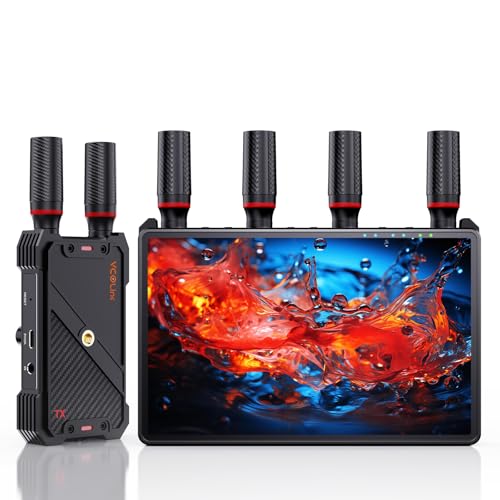
- Built-in 7-inch HD monitoring screen
- Supports up to five receivers
- HDMI loop-out and flexible power options
Best For: Film crews and live productions needing shared wireless monitoring
Best Multi-TV Expansion
G9R Pro 1TX/2RX Wireless HDMI Kit

- Feeds two displays simultaneously out of the box
- Expandable to up to six screens
- Plug-and-play dual-band operation
Best For: Distributing one HDMI source to multiple TVs or monitors
Best for Quiet Shoots
SYNCO XVision Wireless HD System

- Fanless 2W operation for quieter recording
- Claims 40ms latency and 300m range
- Supports up to nine monitor-only endpoints
Best For: Sound-sensitive shoots and mobile production rigs
Best Adapter Bundle
G58 Dual-Receiver Wireless HDMI Kit

- Includes two receivers and expands to six
- Bundles USB-C, Micro HDMI, and Mini HDMI adapters
- Supports dual-band transmission up to 165 feet
Best For: Mixed-device multi-screen setups in homes and venues
Long-Range Monitoring Pick
Vrriis 1300FT Wireless HDMI System

- Up to 1300 feet in open-field conditions
- 1080p/60Hz with about 0.05-second latency
- Loop-out, dual HDMI output, and flexible power
Best For: Long-distance camera and display monitoring
Multi-Screen Expansion Pick
4-Receiver Wireless HDMI Extender

- Includes four receivers and supports up to eight
- 165-foot claimed range with dual-band transmission
- 4K decoding with 1080p output
Best For: Synchronized video across multiple displays
Flexible Display Pick

- Supports up to eight receivers or mobile devices
- 656-foot open-environment range claim
- 4K decoding, 1080p/60Hz output, and 0.1-second delay
Best For: Multi-display installations with mobile viewing
Best Long-Range Pick
WELUSOPU 656FT Wireless HDMI Kit
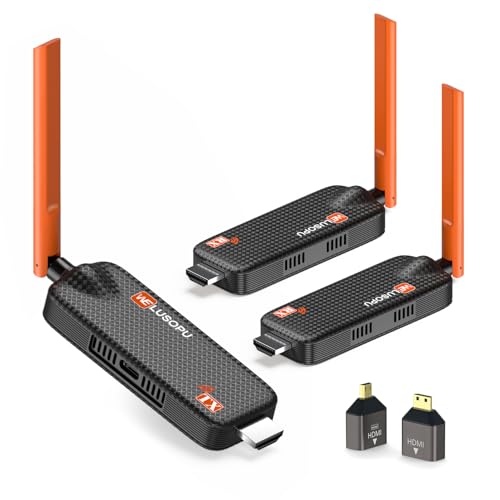
- Includes two receivers and supports expanded multi-display casting
- Claims 656-foot open-area range with dual-band transmission
- Accepts 4K input and outputs 1080p at 60Hz
Best For: Large venues and synchronized multi-room monitoring
Best Compact Option
WELUSOPU 165FT Multi-Display HDMI Kit

- Supports up to six receivers simultaneously
- Uses dual-band transmission with auto frequency hopping
- Handles 4K input and 1080p output at up to 60Hz
Best For: Nearby multi-screen installations in offices and entertainment spaces
Best Multi-Receiver Bundle
AIMIBO 4-Receiver Wireless HDMI Kit

- Includes four receivers and supports expansion to eight screens
- Arrives pre-paired for plug-and-play installation
- Claims 656-foot open-area range with 4K decoding and 1080p output
Best For: Large multi-screen installations needing several receivers upfront
Best All-in-One Hub – 7-Inch Multi-Viewer Wireless HDMI Kit
For buyers comparing wireless video receivers for multi camera setups, this kit stands out as a monitoring-focused system with a built-in 7-inch display, HDMI output, and support for up to five receivers. It is designed for crews that need both private on-set viewing and larger client or production monitors.
Best For: Film crews, studios, and live events that need multi-viewer monitoring with flexible display options.
Pros:
- Built-in 7-inch HD receiver monitor reduces the need for an extra screen.
- One transmitter can connect with up to five receivers for collaborative monitoring.
- Supports 1080p at 60Hz, up to 1,312 feet line of sight, with claimed latency below 0.05 seconds.
- Offers HDMI loop-out, IR remote control, headphone monitoring, and NP-F, power-bank, or USB-C power options.
Cons:
- The advertised long range is specified for line-of-sight use.
- An HDMI cable is not included for the receiver’s external HDMI output.
- A Type-C-to-HDMI cable is required for smartphone or tablet compatibility.
This is a strong choice when a multi-camera team values built-in monitoring and scalable receiver coverage more than a minimal, single-screen setup. Its mounting and power flexibility also make it practical for mobile productions.
Best Multi-TV Expansion – G9R Pro 1TX/2RX Wireless HDMI Kit
Among wireless video receivers for multi camera setups, the G9R Pro is geared toward sending one HDMI source to multiple displays. Its included transmitter and two receivers can feed two TVs or monitors simultaneously, with expansion available for up to six screens using additional receivers.
Best For: Presentations, church services, sports viewing, and other setups that distribute one HDMI source across several displays.
Pros:
- Includes one transmitter and two receivers for simultaneous two-screen output.
- Supports up to 165 feet in open areas and uses 2.4GHz/5.8GHz dual-band transmission.
- Delivers 1080p at 60Hz with claimed ultra-low 0.1-second latency.
- Pre-paired, plug-and-play operation requires no app, drivers, Wi-Fi, or Bluetooth.
Cons:
- The transmitter must connect to an HDMI-output source, not directly to a TV.
- Transmission through walls is listed at about 50 feet.
- The transmitter supports 1080p output only, despite receiver support for 4K decoding input.
This kit is a practical multi-display solution when the goal is to replicate one source rather than independently route several camera feeds. Confirm your source device has HDMI output and can be configured for 1080p.
Best for Quiet Shoots – SYNCO XVision Wireless HD System
For wireless video receivers for multi camera setups used in sound-sensitive productions, the SYNCO XVision emphasizes quiet operation, low power use, and responsive monitoring. The fanless transmitter is paired with a receiver and supports additional real-time monitoring endpoints for team collaboration.
Best For: Weddings, interviews, live music, drone work, and productions where fan noise could affect audio capture.
Pros:
- Fanless 2W design helps minimize operating noise during recording.
- Claims 40ms latency and 1080p/60fps transmission for responsive monitoring.
- Transmission range is listed at up to 300 meters or 984 feet, including strong penetration claims.
- Receiver supports up to nine real-time monitor-only endpoints, while the transmitter provides HD loop-out.
Cons:
- NP-F batteries are not included.
- The supplied configuration includes one transmitter and one receiver, so additional endpoints may require separate equipment.
- The product notes describe an HD-port system, so buyers should verify compatibility with their specific camera and monitor connections.
The XVision is especially compelling when silent operation and low latency matter more than having a built-in receiver screen. Its compact 119g design and USB-C power input also suit mobile camera rigs.
Best Adapter Bundle – G58 Dual-Receiver Wireless HDMI Kit
This G58 kit is a flexible option for buyers seeking wireless video receivers for multi camera setups across cameras, laptops, consoles, and mobile devices. It includes two receivers, supports up to six receivers total, and bundles adapters for USB-C, Micro HDMI, and Mini HDMI connections.
Best For: Home theaters, conference rooms, classrooms, churches, bars, and multi-screen installations using varied source devices.
Pros:
- Includes one transmitter and two receivers, with expansion up to six screens.
- Provides USB-C-to-HDMI, Micro HDMI, and Mini HDMI adapters for broader source compatibility.
- Supports up to 165 feet in open environments with 2.4GHz/5.8GHz dual-band transmission.
- Plug-and-play design works with laptops, cameras, consoles, set-top boxes, projectors, and monitors.
Cons:
- Range may drop to about 50 feet when transmitting through walls.
- It cannot transmit from one TV to another.
- The included phone/tablet app does not currently control laptops or the transmitter.
This is a well-rounded choice for mixed-device environments where adapter convenience matters. It is best suited to distributing a source to multiple displays, so verify that your cameras or other sources provide the required HDMI output.
Long-Range Monitoring Pick – Vrriis 1300FT Wireless HDMI System
For shoppers comparing wireless video receivers for multi camera setups, the Vrriis system stands out when long-range point-to-point transmission and local monitoring matter. It supports 1080p at 60Hz, includes loop-out functionality, and can send one source to as many as five receivers, although added receivers may reduce range.
Best For: Long-distance 1080p monitoring from cameras, laptops, or set-top boxes where flexible power options are useful.
Pros:
- Claims up to 1300 feet of open-field transmission with dual antennas and 2.4/5G connectivity.
- Supports 1080p at 60Hz with approximately 0.05-second latency.
- Transmitter loop-out and dual HDMI output on the receiver support multiple viewing positions.
- Works with NP-F batteries, USB-C power, adapters, or portable power banks.
Cons:
- Walls, metal, brick, and glass can significantly reduce coverage.
- Additional receivers can shorten the transmission distance.
- Batteries are not included.
This is a practical choice for users who prioritize range, low delay, and monitoring flexibility over a compact single-screen setup. Its real-world performance will depend heavily on obstacles and receiver count.
Multi-Screen Expansion Pick – 4-Receiver Wireless HDMI Extender
This upgraded wireless HDMI kit is designed for multi-screen distribution, making it a strong candidate among wireless video receivers for multi camera setups that need several displays. One transmitter can coordinate four included receivers and may support up to eight receivers, with 165 feet of claimed range and 1080p output.
Best For: Presentations, camera feeds, classrooms, conference rooms, and other installations requiring synchronized video on multiple screens.
Pros:
- Includes four receivers and supports expansion to up to eight receivers.
- Uses 2.4G and 5G dual-band transmission with a claimed range of 165 feet.
- Decodes up to 4K while outputting 1080p high-definition video.
- Plug-and-play design requires no Wi-Fi, app, or Bluetooth setup.
Cons:
- Output is limited to 1080p despite 4K decoding support.
- Stable 5V/1A power is required for the transmitter and receivers.
- Antennas must be connected before use for stable operation.
Its included receiver count makes this one of the more straightforward options for distributing a single HDMI source across several displays. Check the 165-foot range against your room layout, especially where walls or interference are present.
Flexible Display Pick – AIMIBO 5.8G Wireless HDMI Kit
The AIMIBO kit combines multi-display support with the ability to cast an HDMI source to phones and tablets. For buyers seeking wireless video receivers for multi camera setups, it offers up to eight receiver or mobile-device connections, 1080p viewing, and a claimed 656-foot open-environment range.
Best For: Homes, classrooms, restaurants, churches, and meeting spaces that need multiple displays or supplemental mobile viewing.
Pros:
- Supports up to eight receivers or phones/tablets for simultaneous viewing.
- Claims up to 656 feet in an open environment using a 5.8GHz connection.
- Provides 4K decoding and 1080p output at 60Hz with about 0.1-second delay.
- Factory-paired plug-and-play setup includes micro-HDMI and mini-HDMI adapters.
Cons:
- Through-wall range may fall to about 32 feet.
- Phone and tablet viewing requires the RScreen app.
- Operating a laptop from a phone is not supported.
AIMIBO is appealing when a deployment needs more than traditional HDMI displays, particularly mobile viewing in larger rooms. Its range claims are for open conditions, so plan conservatively when walls separate the transmitter and receivers.
Best Long-Range Pick – WELUSOPU 656FT Wireless HDMI Kit
If you need wireless video receivers for multi camera setups across a large venue, this WELUSOPU kit stands out for its included two receivers, expandable multi-display support, and claimed 656-foot open-area range. It accepts 4K input and outputs 1080p at 60Hz, making it better suited to synchronized monitoring than native 4K display output.
Best For: Large rooms, churches, sports bars, classrooms, conference spaces, and security-monitoring installations that need synchronized screens over long distances.
Pros:
- Includes one transmitter and two receivers, with support for up to six displays according to the supplied notes.
- Claims up to 656 feet of range in open areas with dual-band 2.4G/5.8G transmission.
- Supports 4K source input, 1080p at 60Hz output, and claimed 0.1-second latency.
- Plug-and-play operation requires no app, Bluetooth, or Wi-Fi password for HDMI screen sharing.
Cons:
- Output is limited to 1080p, despite accepting 4K input.
- The 656-foot range is an open-area claim and may be reduced by walls or interference.
- The smartphone and tablet monitoring function requires the Tutuplay app.
This is the strongest choice here when range and multi-room synchronization matter most. Its included receivers reduce the need for immediate expansion, while the 1080p output specification is important to confirm before buying for a native-4K workflow.
Best Compact Option – WELUSOPU 165FT Multi-Display HDMI Kit
For wireless video receivers for multi camera setups in smaller spaces, this WELUSOPU system offers a more moderate 165-foot open-area range and support for up to six receivers. Its dual-band transmission, 4K input handling, and 1080p output make it a practical option for offices, classrooms, entertainment areas, and nearby monitoring screens.
Best For: Home theaters, conference rooms, classrooms, restaurants, bars, and installations where displays are within roughly 165 feet in open conditions.
Pros:
- Can mirror audio and video to up to six receivers simultaneously.
- Uses 2.4G/5.8G dual-band transmission with auto frequency hopping.
- Supports 4K input and 1080p HD output with 60Hz support.
- Plug-and-play setup does not require Bluetooth, Wi-Fi, or an app for basic screen sharing.
Cons:
- Its stated 165-foot range is substantially shorter than the long-range kits in this roundup.
- It does not provide native 4K output; the listed output is 1080p.
- Phone and tablet viewing is mirroring-only and requires the companion app.
This kit makes sense when you need several synchronized displays but do not need a 656-foot transmission distance. It balances multi-receiver support and straightforward installation, provided your camera or source devices are HDMI-compatible and 1080p output is sufficient.
Best Multi-Receiver Bundle – AIMIBO 4-Receiver Wireless HDMI Kit
Among wireless video receivers for multi camera setups, the AIMIBO bundle is notable for including four receivers and supporting expansion to as many as eight screens. It arrives pre-paired, supports 4K decoding with 1080p at 60Hz viewing, and includes several cables, making it a convenient starting point for multi-screen camera, presentation, surveillance, or event systems.
Best For: Conference rooms, stores, bars, RVs, surveillance setups, and buyers who want multiple receiver units included from the start.
Pros:
- Includes one transmitter and four receivers, with support for up to eight receivers or touchscreens.
- Pre-paired plug-and-play setup requires no Wi-Fi, Bluetooth, or configuration for initial use.
- Claims up to 656 feet in open areas and includes dual-band 2.4G/5.8GHz transmission.
- Includes HDMI, Micro/Mini HDMI, and USB-C cables, plus 12 months of product care and 24/7 support.
Cons:
- The 656-foot range can decrease when adding receivers or transmitting through solid walls.
- Despite 4K decoding, the listed resolution is 1080p at 60Hz.
- Phone and tablet viewing supports mirroring only, without reverse touchscreen operation.
The AIMIBO is the most expansion-ready package of the three, especially if you need several receiver endpoints immediately. Its pre-paired setup and included accessories simplify deployment, but plan around the stated 1080p resolution and possible range loss through walls.
How We Picked the Best Wireless Video Receivers for Multi Camera Setups
We focused on systems designed to send one HDMI source to multiple receivers or displays, since that is the core requirement in multi-camera monitoring. We compared the advertised receiver count, transmission range, supported formats, stated delay, loop-out capability, frequency bands, and installation requirements.
Specifications vary by environment. Walls, interference, crowded 2.4GHz or 5.8GHz networks, antenna placement, and line of sight can reduce real-world range. A receiver system that looks ideal on paper still needs to match the source output and every connected display.
Quick Comparison
- Best for many displays: Systems supporting four, five, or up to six receivers are useful for distributing one camera feed across a larger venue.
- Best for simpler installations: A one-transmitter, one-receiver kit generally has fewer pairing and placement considerations.
- Best for monitoring: Models advertising low latency and 1080p at 60Hz are better suited to live camera viewing.
- Best for flexible routing: Loop-out models can feed a local monitor while transmitting wirelessly to other screens.
- Best for compact setups: Plug-and-play systems can reduce configuration time when advanced control features are unnecessary.
Key Buying Factors for Wireless Video Receivers for Multi-Camera Setups
Receiver Capacity and Expansion
Count the displays you need today, then allow room for expansion. Some systems include one or two receivers, while others are designed to support four, five, or six. Confirm whether the advertised maximum requires optional receivers and whether all receivers can display the same source simultaneously.
Range and Interference
Advertised distances are usually measured in open conditions. For cameras used across rooms, choose a system with a comfortable range margin and check whether it operates on 2.4GHz, 5.8GHz, or both. Dual-band designs may offer more flexibility, but they do not eliminate interference or obstructions.
Resolution, Refresh Rate, and Latency
Match the transmitter to your camera or switcher output. A system that decodes 4K may still transmit at 1080p, so check the actual wireless resolution and refresh rate. For live production, presentations, and camera operation, lower delay matters more than a higher headline resolution.
Ports and Compatibility
Look for HDMI input and output compatibility, HDCP requirements, loop-out connections, power needs, and support for your cable lengths. Wireless transmission does not convert incompatible signals, so verify that the source and displays share a supported format.
Who Should Buy Which Wireless Video Receivers for Multi Camera Setups?
Choose a high-capacity multi-receiver kit for events, classrooms, houses of worship, and production spaces with several viewing positions. Pick a one-to-two-receiver system for a small studio or living-room installation. If you need a local preview plus remote displays, prioritize loop-out. For occasional use, a plug-and-play kit is usually the simplest choice; for demanding live workflows, prioritize stable connectivity, low latency, and format compatibility over maximum advertised distance.