
A camera slider with motor can add repeatable movement, smoother transitions, and automated time-lapse capability to a video setup. The right model depends on your preferred travel length, camera load, control method, and portability needs.
We selected 10 motorized sliders ranging from compact 2-axis designs to longer carbon-fiber rails built for professional production. Use the guide below to compare their practical differences before choosing one.
Best 10 Camera Slider with Motor Picks for 2026
Long-Track Workhorse
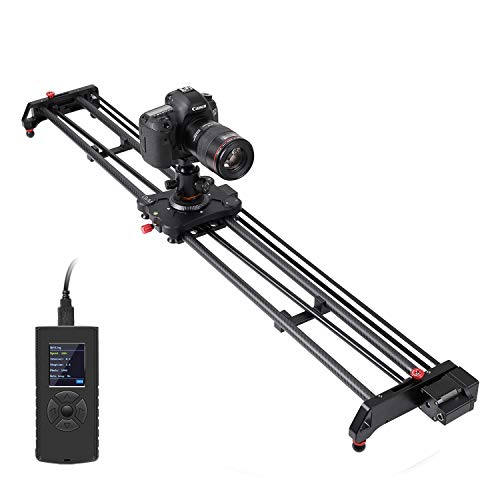
- 48-inch carbon-fiber rail
- Adjustable automated motion and time-lapse controls
- Includes battery, remote, cables, and bag
Best For: Long tracking shots and panoramic time-lapse setups
Compact Creator Pick
IFOOTAGE Shark Slider Pico Pro

- Portable 15.7-inch motorized slider
- Works with phones, action cameras, and DJI Pocket cameras
- Supports cameras up to 2.4 pounds
Best For: Lightweight mobile video rigs and social content
App-Controlled All-Rounder

- App and remote-control support
- 11-pound horizontal maximum load
- Silent motor with included 4400mAh battery
Best For: Product videos, time-lapse, and versatile tripod setups
Advanced Motion System

- 360-degree rotary axis and multi-point paths
- AI face and object tracking
- IPS touchscreen with app control
Best For: Cinematic multi-axis shots and complex tracking sequences
Best App-Controlled Pick
NEEWER DL400 Motorized Camera Dolly

- Quiet dual-motor operation below 30 dB
- App control with manual, video, and time-lapse modes
- Included NP-F750 battery with up to 5 hours of runtime
Best For: Portable, wireless camera movement controlled from a phone
Best Versatile 27-Inch Slider
GVM 27-Inch Motorized Camera Slider

- Supports video, time-lapse, and round-trip shooting
- Works horizontally, vertically, and at 45 degrees
- Multiple mounting holes and adjustable non-slip feet
Best For: Flexible DSLR, cellphone, and video shooting setups
Best Long-Travel Professional Pick
GVM 48-Inch Carbon Fiber Slider
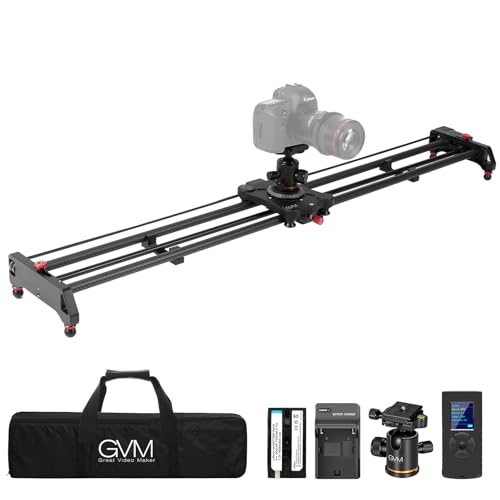
- 48-inch rail for extended tracking movement
- Remote control with detailed motion and time-lapse settings
- Includes six shutter cables and an extension cable
Best For: Programmable tracking, panoramic, and time-lapse productions
Best Compact Battery-Powered Pick
NEEWER ER1-80 Motorized Camera Slider

- 31.5-inch carbon-fiber rail with app control
- Quiet motor and 4400mAh battery included
- Supports horizontal and 45-degree tilted shooting
Best For: Portable outdoor video and time-lapse work
Best Long-Rail Option
GVM 48-Inch Motorized Camera Slider

- 48-inch carbon-fiber rail for expansive moves
- Six shooting modes with detailed app controls
- Multiple mounts and adjustable legs for varied setups
Best For: Long tracking shots and programmed production work
Best Mid-Size Value
GVM 31-Inch Wireless Motorized Slider

- 31-inch carbon-fiber rail with wireless app control
- Includes tracking, panoramic, video, and time-lapse modes
- Adjustable legs and carry bag aid setup and transport
Best For: App-controlled studio and location content creation
Long-Track Workhorse – GVM 48-Inch Motorized Slider
If you need a camera slider with motor for longer tracking shots, the GVM GP-120QD offers a 48-inch carbon-fiber rail, automatic round trips, and adjustable motion settings. It supports both manual and motorized operation, with multiple mounting ports for tripod setups.
Best For: Longer tracking shots, time-lapse work, panoramic moves, and creators who want an out-of-the-box kit with a battery and carrying bag.
Pros:
- 48-inch carbon-fiber rail supports extended camera movements.
- Adjustable speed, interval, stop time, photo count, torque, and start/end points.
- Supports tracking, time-lapse, panoramic, manual, and electric shooting modes.
- Includes battery, charger, remote, shutter cables, extension cable, and carrying bag.
Cons:
- At 11.8 pounds, it is less convenient to transport than shorter sliders.
- Not water resistant.
The GVM is a practical choice when rail length and included accessories matter more than portability. Its 5 kg maximum recommended load and adjustable feet also make it suitable for stable tripod-based setups.
Compact Creator Pick – IFOOTAGE Shark Slider Pico Pro
The IFOOTAGE Shark Slider Pico Pro is a compact camera slider with motor designed for smaller rigs. Its 15.7-inch format works with smartphones, DJI Osmo Pocket 3/4, action cameras, and cameras weighing up to 2.4 pounds, making it a convenient option for lightweight cinematic movement.
Best For: Smartphone creators, action-camera users, DJI Pocket shooters, and portable video setups that need smoother motion than handheld shooting.
Pros:
- Compact 15.7-inch design is easier to fit into portable kits.
- Compatible with smartphones, DJI Osmo Pocket 3/4, action cameras, and cameras.
- Supports a payload of up to 2.4 pounds.
- Built-in image stabilization is listed for smoother video capture.
Cons:
- Shorter rail limits the length of tracking moves.
- Lower payload capacity is not intended for heavier camera setups.
This slider is best viewed as a lightweight movement tool rather than a full-size production rail. It is a strong fit for creators who value portability and compatibility with compact cameras.
App-Controlled All-Rounder – NEEWER ER1 31.5-Inch Slider
The NEEWER ER1 is a versatile camera slider with motor that combines app control with manual operation and time-lapse functions. Its 31.5-inch carbon-fiber rail supports up to 11 pounds horizontally, while the silent stepper motor and included 4400mAh battery suit extended shooting sessions.
Best For: Product videos, time-lapse photography, content creators, and shooters who want app-based control with a relatively high horizontal payload.
Pros:
- App control supports manual, video, and time-lapse modes with adjustable speed and interval.
- Supports up to 11 pounds horizontally and 5.5 pounds on a 45-degree tilt.
- Silent motor and included 4400mAh NP-F750 battery support quiet, extended operation.
- Carbon-fiber construction, four roller bearings, and 1/4-inch and 3/8-inch mounting holes add versatility.
Cons:
- A 2.4G remote is supported but not included.
- A minor shake may occur during macro photography.
- The USB-C portable charger is not included.
The ER1 balances rail length, payload, and control options well. It is especially useful when you want automated movement without giving up the ability to use a phone app or mount the slider on a tripod.
Advanced Motion System – IFOOTAGE Shark Nano II
The IFOOTAGE Shark Nano II is a camera slider with motor aimed at advanced cinematic control. Its 34-inch rail combines a 360-degree rotary axis, multi-point path programming, AI target tracking, an IPS touchscreen, and app control for complex tracking, panorama, macro, and time-lapse moves.
Best For: Filmmakers, product demonstrators, interviews, and production setups that need multi-axis movement, programmable paths, and subject tracking.
Pros:
- Supports up to eight customizable motion points with individual parameters.
- AI face and object tracking helps keep selected subjects centered.
- Brushless motor and stabilization algorithms target quiet, steady movement.
- Offers five listed modes: time-lapse, stop-motion, video, macro, and panorama.
Cons:
- Its advanced feature set may be more than casual users need.
- Some multi-axis functionality depends on compatible DJI gimbals and the included RS Adapter.
- The supplied notes do not specify a maximum payload.
The Nano II stands out for programmable and multi-axis shooting rather than simple linear slides. The built-in touchscreen, Moco app support, memory function, and USB-C PD 3.0 power option make it a capable choice for demanding workflows.
Best App-Controlled Pick – NEEWER DL400 Motorized Camera Dolly
The NEEWER DL400 is a compact camera slider with motor designed for quiet, wireless movement. Its app control, rechargeable battery, and adjustable speeds make it practical for tabletop video, time-lapse work, and mobile production setups.
Best For: Creators who want app-controlled motion in a portable dolly-style slider.
Pros:
- Quiet dual-motor operation below 30 dB
- App control supports manual, live video, and time-lapse modes
- Included NP-F750 battery provides up to 5 hours of runtime
- Ball head offers 360-degree rotation and 90-degree tilt
Cons:
- Time-lapse photography requires a separately purchased shutter cable
- Maximum load is 6.6 pounds
- High-speed uphill starts may cause shaking
The DL400 stands out when quiet operation and phone-based control matter most. Its compact design and included battery add convenience, though users should plan around the shutter-cable requirement for time-lapse photography.
Best Versatile 27-Inch Slider – GVM 27-Inch Motorized Camera Slider
The GVM 27-inch camera slider with motor is a versatile aluminum-alloy rail for stable video and photography. It supports time-lapse, video, and automatic round-trip shooting, with mounting options for cameras, phones, tripods, and ball heads.
Best For: DSLR, cellphone, and video shooters who need multiple mounting and shooting options.
Pros:
- Supports time-lapse, video, and automatic round-trip shooting
- Works horizontally, vertically, and at 45-degree angles
- Adjustable non-slip feet help balance the slider
- Multiple 1/4-inch and 3/8-inch screw holes support tripod mounting
Cons:
- Maximum recommended load is 2.5 kg
- At 26.8 inches, it offers less travel than the 48-inch GVM model
- It is not water resistant
This model is a strong fit for buyers who value flexibility over specialized remote controls. Its adjustable feet and broad mounting compatibility make it adaptable, while the 2.5 kg load recommendation should guide camera and accessory selection.
Best Long-Travel Professional Pick – GVM 48-Inch Carbon Fiber Slider
The GVM 48-inch camera slider with motor is built for longer tracking moves and advanced programmed shots. Its remote control handles start and end points, speed, dwell time, pauses, shot counts, and looping, while dedicated modes support tracking, horizontal, time-lapse, and 120-degree panoramic shooting.
Best For: Professional-style tracking, panoramic, and programmable time-lapse productions.
Pros:
- 48-inch carbon-fiber rail provides long travel
- Supports tracking, horizontal, time-lapse, video, and 120-degree panoramic modes
- Remote control offers detailed motion and time-lapse settings
- Includes six shutter cables and an extension cable
Cons:
- Its 120 cm folded size and 5.42 kg weight reduce portability
- The supplied notes do not specify a maximum camera load
- It is not water resistant
This is the most feature-focused option for controlled, repeatable camera movement and extended rail travel. It is better suited to a dedicated production setup than casual travel, especially given its full-size dimensions and weight.
Best Compact Battery-Powered Pick – NEEWER ER1-80 Motorized Camera Slider
The NEEWER ER1-80 is a practical camera slider with motor for creators who want automated movement without a complicated setup. Its 31.5-inch carbon-fiber rail offers app control, optional 2.4G remote compatibility, video and time-lapse modes, and a built-in 4400mAh F750 battery.
Best For: Outdoor shooters and creators who need a portable, quiet slider with flexible camera movement.
Pros:
- Supports app control, manual movement, video mode, and time-lapse shooting.
- Silent stepper motor provides smooth, precise motion.
- Supports horizontal loads up to 11 pounds and 45-degree tilted loads up to 5.5 pounds.
- Carbon-fiber construction, multiple threaded mounts, and a 4400mAh battery improve portability.
Cons:
- Battery charger is not included.
- The 2.4G RT-08 remote is optional rather than included.
- It is not water resistant.
The ER1-80 balances useful automation, quiet operation, and a manageable 31.5-inch rail. It is a strong fit for mobile setups, though buyers should budget for charging accessories if they do not already have compatible equipment.
Best Long-Rail Option – GVM 48-Inch Motorized Camera Slider
The GVM 48-inch camera slider with motor is designed for larger, more expansive camera moves. Its 120cm carbon-fiber rail supports tracking, panoramic, time-lapse, and video modes, while app controls let you adjust motion settings and define start and end points.
Best For: Filmmakers who want a long travel distance and advanced automated shooting modes.
Pros:
- Long 48-inch rail provides more room for sweeping camera moves.
- Offers six shooting functions, including tracking, panoramic, time lapse, and video capture.
- App control allows adjustments for speed, interval, stop time, torque, and looping.
- Multiple 1/4-inch and 3/8-inch ports support horizontal, vertical, and 45-degree setups.
Cons:
- Its 120cm length and 4kg weight make it less portable than shorter sliders.
- Battery life is listed at approximately two hours.
- It is not water resistant.
This GVM model stands out when a longer rail and detailed motion programming matter more than compactness. The included carry bag and adjustable legs help with transport and leveling, but the larger format is best suited to deliberate production setups.
Best Mid-Size Value – GVM 31-Inch Wireless Motorized Slider
The GVM 31-inch wireless camera slider with motor delivers automated tracking, panoramic, video, and time-lapse movement in a more compact format than the brand’s 48-inch model. Its iOS and Android app provides control over speed, dwell time, sliding distance, pause time, and photo count.
Best For: Content creators who want app-controlled motion in a relatively compact carbon-fiber slider.
Pros:
- Wireless app control works with iOS and Android devices.
- Supports tracking, panoramic, time-lapse, and video shooting modes.
- Adjustable legs help with leveling, while the included carry bag supports transport.
- Multiple 1/4-inch and 3/8-inch ports allow horizontal, vertical, and 45-degree mounting.
Cons:
- Its maximum recommended load is 4.5kg, lower than the larger GVM model’s listed 20-pound capacity.
- At 4.5kg, it is not especially lightweight for a 31-inch slider.
- It is not water resistant.
The GVM 31-inch model is a flexible middle-ground choice for app-based camera movement. It offers many of the programming features found on larger motorized sliders while taking up less rail space, making it suitable for studio and controlled location work.
How We Picked the Best Camera Slider with Motor
We compared these models by looking at the features that most affect real-world shooting: rail length, motorized movement, camera-support capacity, control options, power design, portability, and specialized functions such as time-lapse, panoramic movement, and round-trip operation. We also considered whether each slider suits tabletop work, travel, studio production, or heavier camera rigs.
Because specifications and included accessories can vary by configuration, confirm the current package contents, supported payload, battery, charger, and mounting hardware before ordering.
Quick Comparison
| Slider type | Best suited to | What to prioritize |
|---|---|---|
| Compact mini slider | Travel, tabletop, and product video | Low weight, short travel, 2-axis control |
| 31.5-inch slider | General video and interviews | Balanced reach, app control, battery life |
| 34-inch slider | Creative camera movement | Rotary-axis capability and smooth automation |
| 48-inch slider | Studio and cinematic production | Long travel, rigidity, payload support |
Key Buying Factors for a Camera Slider with Motor
Travel Length and Portability
Longer rails create more visible movement and are useful for establishing shots, interviews, and controlled reveals, but they take more room to transport and support. A 27- to 34-inch model is often easier for small studios and travel kits, while a 48-inch slider is better when maximum motion is the priority.
Payload and Stability
Check the manufacturer’s stated load rating for both horizontal and angled use. A mirrorless camera may be easy to support, but a cinema camera, large lens, follow-focus system, or fluid head adds weight quickly. Solid mounting points and a stable tripod or support system matter as much as the motor.
Control and Shooting Modes
App control is convenient for setting speed, direction, repeatable routes, and time-lapse intervals. Remote controls can be faster on set, while round-trip and programmed motion help create consistent takes. If you need pans as well as linear travel, consider models with a rotary or 2-axis system.
Power and Operating Setup
Review battery type, charging method, expected runtime, and whether the slider can operate while connected to external power. A removable or higher-capacity battery may be valuable for long production days, while a compact integrated system is simpler for occasional use.
Who Should Buy Which Camera Slider with Motor?
Traveling creators and product shooters: Choose a compact mini slider when portability and quick setup matter more than long camera travel.
General videographers: A 31.5- or 34-inch app-controlled slider offers a practical balance of reach, automation, and manageable transport.
Filmmakers and studio teams: Select a 48-inch carbon-fiber model if you regularly need longer cinematic moves, repeatable time-lapse paths, or support for a more substantial rig.