
The best camera sliders make controlled movement easier, whether you are filming product videos, interviews, time-lapses, or cinematic B-roll. The right model balances travel length, load capacity, motion control, and setup speed.
This roundup compares 10 options ranging from compact manual rails to app-controlled motorized systems, helping you choose a slider that matches your camera kit and shooting style.
Best 10 Camera Sliders Picks for 2026
Best Portable Manual Slider
Zecti 24-Inch Carbon Fiber Slider

- Lightweight 24-inch manual design
- Adjustable legs and multiple mounting points
- Compatible with small cameras, phones, and action cameras
Best For: Travel creators seeking a flexible manual slider
Best Compact Motorized Slider

- Motorized movement for smooth footage
- 15.7-inch compact format
- Supports phones, action cameras, and cameras up to 2.4 pounds
Best For: Mobile creators wanting automated camera moves
Best Tabletop Dolly
NEEWER SD001 Four-Wheeled Camera Dolly

- Linear and circular movement options
- Compact 220-gram aluminum-alloy design
- Includes ball head and rotatable phone clamp
Best For: Tabletop shots with phones and compact cameras
Best Long Motorized Slider
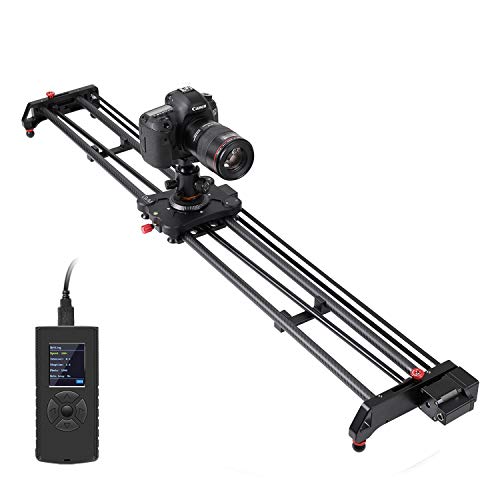
- 48-inch motorized carbon-fiber track
- Programmable tracking, time-lapse, and panoramic modes
- Includes battery, controller, cables, and carrying bag
Best For: Studio productions needing long repeatable camera moves
Best Portable Pick
NEEWER CS1M Carbon Fiber Camera Slider

- Lightweight 16-inch carbon-fiber slider
- Adjustable legs and bubble level
- Includes phone and action-camera accessories
Best For: Traveling creators and compact camera setups
Best Motorized Value
NEEWER ER1 31.5-Inch Motorized Camera Slider

- 31.5-inch motorized carbon-fiber rail
- App-controlled video and time-lapse modes
- Supports up to 11 pounds horizontally
Best For: Product videos and repeatable automated motion
Best Advanced Control
IFOOTAGE Shark Nano II Motorized Camera Slider

- Programmable paths with up to eight motion points
- AI face and object tracking
- Built-in touchscreen and quiet brushless motor
Best For: Advanced cinematic, product, and tracking shots
App-Controlled Pro
GVM 48-Inch Motorized Carbon Fiber Slider

- App-controlled motion with multiple shooting modes
- Includes six shutter cables and an extension cable
- Adjustable legs and multiple tripod-mounting ports
Best For: Creators needing programmable tracking, time-lapse, and panoramic shots
Lightweight Long-Run Pick
NEEWER ER1 47.2-Inch Motorized Slider

- 2.5kg carbon-fiber design for easier transport
- Includes a 4400mAh NP-F750 battery
- Quiet motor with app control and versatile shooting angles
Best For: Outdoor and product-video creators prioritizing portability
Remote-Controlled Workflow
GVM 48-Inch Carbon Fiber Slider
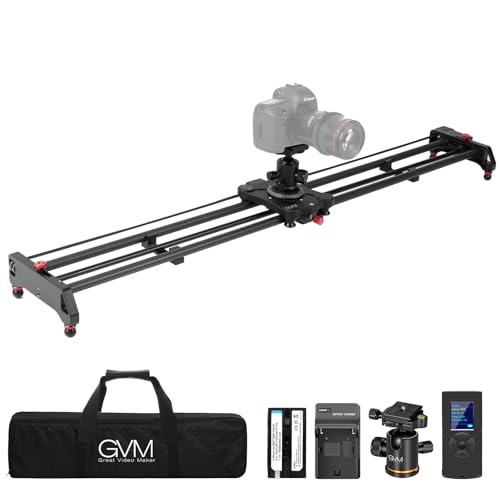
- Remote adjusts motion, timing, shot counts, and loops
- Supports video, time-lapse, tracking, and panorama modes
- Includes six shutter cables and versatile tripod ports
Best For: Controlled studio setups and repeatable automated sequences
Best Portable Manual Slider – Zecti 24-Inch Carbon Fiber Slider
For creators who want portable camera sliders without adding a motor or complicated controls, the Zecti 24-inch slider offers a lightweight manual setup. Its carbon-fiber rail system, adjustable legs, bubble level, and multiple mounting holes support horizontal, vertical, diagonal, and sideways moves.
Best For: Travel filmmakers and photographers using small cameras, phones, action cameras, or compact camcorders.
Pros:
- Portable 24-inch design weighs about 1.4 pounds and includes a carrying bag.
- Four precision bearings and dual interior carbon-fiber rails are designed for smooth, quiet movement.
- Adjustable legs, non-skid feet, and a bubble level help with setup on different surfaces.
- Multiple 1/4-inch and 3/8-inch mounting points support varied configurations.
Cons:
- Manual operation requires you to control the camera movement yourself.
- Some users may need to slightly loosen the screws if the slider feels noisy or does not move smoothly.
- The maximum recommended load is 4.4 pounds.
The Zecti is a practical choice when portability and flexible positioning matter more than automated moves. Its adjustable hardware is useful, but careful setup may be needed to get the smoothest travel.
Best Compact Motorized Slider – IFOOTAGE Shark Slider Pico
The IFOOTAGE Shark Slider Pico is one of the more compact camera sliders for creators who want automated movement in a small rig. Its motorized design is aimed at producing smooth footage with smartphones, action cameras, DJI Osmo Pocket models, and cameras up to 2.4 pounds.
Best For: Mobile filmmakers and vloggers who want motorized camera movement from a compact setup.
Pros:
- Motorized operation helps create consistent, smooth camera moves.
- Works with smartphones, action cameras, DJI Osmo Pocket 3/4, and compatible cameras.
- Compact 15.7-inch format is suited to smaller shooting setups.
Cons:
- The 2.4-pound payload limits use with heavier camera and lens combinations.
- The shorter 15.7-inch travel length provides less movement than a full-size slider.
This slider makes the most sense for creators prioritizing convenience and repeatable movement over long travel. It is particularly well matched with phones, pocket cameras, and action cameras.
Best Tabletop Dolly – NEEWER SD001 Four-Wheeled Camera Dolly
The NEEWER SD001 is a pocket-size alternative to traditional camera sliders. Rather than using a long rail, this manual dolly rolls in straight lines or circles, making it useful for tabletop product shots, panoramic moves, and compact phone or camera rigs.
Best For: Tabletop filmmakers and creators making circular or short tracking shots with compact cameras and phones.
Pros:
- Four-wheeled design supports both linear and circular movement.
- Adjustable wheel angles help control the panoramic shooting area.
- Soft rubber wheel rings are designed for smooth, quiet movement on floors, tables, and sliders.
- Includes an angle-adjustable ball head and a rotatable phone clamp with a cold shoe.
Cons:
- It is not suitable for telephoto lenses.
- The compact dolly is intended for shorter movements rather than long rail-style tracking.
- Action-camera adapters may need to be purchased separately.
The SD001 is best viewed as a highly portable tabletop dolly rather than a conventional camera slider. Its circular movement and phone-friendly accessories make it useful for small-scale creative shots.
Best Long Motorized Slider – GVM 48-Inch Automatic Slider
For longer automated camera moves, the GVM 48-inch motorized slider provides a substantial track with programmable movement options. It supports automatic round trips, time-lapse, tracking, and panoramic shooting, while also allowing manual operation when you want direct control.
Best For: Studio and production setups needing long, repeatable camera movements for video or time-lapse work.
Pros:
- 48-inch carbon-fiber track provides extended travel for wide camera moves.
- Programmable start and end points, speed, interval, stop time, photo count, and looping.
- Supports tracking, time-lapse, and panoramic shooting modes.
- Includes a battery, charger, controller, shutter cables, extension cable, and carrying bag.
Cons:
- At about 11.8 pounds, it is substantially less portable than compact camera sliders.
- Its 48-inch folded size requires considerable storage and transport space.
- The product is listed with a maximum recommended load of 5 kilograms and is not water resistant.
The GVM is a strong fit when travel size is secondary to track length and programmable control. Its included accessories and multiple shooting modes make it suited to planned studio or location productions.
Best Portable Pick – NEEWER CS1M Carbon Fiber Camera Slider
If you want a lightweight option for camera sliders, the NEEWER CS1M combines a 16-inch carbon-fiber rail with adjustable legs, a ball head, phone clamp, and action-camera mount. Its four bearings are designed for smooth, quiet movement, while the bubble level helps with setup on uneven surfaces.
Best For: Travelers, mobile creators, and shooters using cameras, phones, GoPros, or other action cameras.
Pros:
- Lightweight 615g design includes a carrying bag.
- Adjustable legs support flexible positioning from 2 to 5cm.
- Includes a 360-degree ball head, phone clamp, and action-camera adapter.
- Supports horizontal, vertical, and 45-degree tilted shooting.
Cons:
- Maximum capacity is 4.4 pounds horizontally and lower when tilted or vertical.
- The 16-inch rail provides less travel than longer sliders.
- It is not water resistant.
The CS1M is a practical entry point for portable camera sliders, especially when versatility and low carry weight matter more than long travel or heavy-camera capacity.
Best Motorized Value – NEEWER ER1 31.5-Inch Motorized Camera Slider
The NEEWER ER1 adds automated movement to camera sliders with an 80cm rail, app control, and manual, video, and time-lapse modes. Its carbon-fiber construction, four roller bearings, and included 4400mAh battery make it suitable for repeatable motion in studio or outdoor shoots.
Best For: Product videos, time-lapse photography, and creators who need programmable camera movement with a higher load capacity.
Pros:
- Long 31.5-inch travel provides more movement than compact sliders.
- Supports app control and optional 2.4G remote control.
- Handles up to 11 pounds horizontally and 5.5 pounds at a 45-degree tilt.
- Includes a 4400mAh NP-F750 battery for extended operation.
Cons:
- The 2.4G remote is not included.
- A charger is not included according to the product highlight.
- Minor shake may occur during macro photography.
Choose the ER1 when automated, repeatable motion and greater payload support are priorities. It is a more substantial option than a basic manual slider, though the remote and charging setup require extra attention.
Best Advanced Control – IFOOTAGE Shark Nano II Motorized Camera Slider
For filmmakers seeking advanced camera sliders, the IFOOTAGE Shark Nano II combines a 26-inch motorized rail with multi-axis control, programmable paths, and AI-powered subject tracking. Its touchscreen and Moco app support detailed motion design, while the brushless motor and stabilization system target quiet, steady footage.
Best For: Professional-style tracking shots, product demonstrations, time-lapses, macro work, and DJI gimbal users.
Pros:
- Supports up to eight customizable motion points in one path.
- Offers face and object tracking through the Moco app.
- Includes five shooting modes: time-lapse, stop-motion, video, macro, and panorama.
- Provides standalone control through a built-in IPS touchscreen.
Cons:
- Its 26-inch rail is shorter than the NEEWER ER1’s 31.5-inch rail.
- The advanced feature set may be more than casual users need.
- Some accessories or compatibility details may require checking before purchase, including the DJI gimbal setup.
The Nano II is the feature-rich choice for complex, repeatable camera movement. Its multi-point programming, tracking, and stabilization make it compelling for demanding productions, while the shorter rail favors controlled shots over maximum travel.
App-Controlled Pro – GVM 48-Inch Motorized Carbon Fiber Slider
For creators who want flexible camera sliders with automated movement, the GVM 48-inch model combines a carbon-fiber rail with app control and several programmable shooting modes. Its 120cm length and multiple mounting points make it suitable for horizontal, vertical, and 45-degree setups.
Best For: App-controlled tracking shots, time-lapse work, panoramic movement, and creators who need broad camera compatibility.
Pros:
- Supports tracking, panoramic, time-lapse, and video shooting modes.
- App control works with iOS and Android devices.
- Includes six shutter-release cables and an extension cable.
- Carbon-fiber construction, adjustable legs, and a carry bag support mobile production.
Cons:
- Battery life is listed at approximately two hours.
- At 4kg, it is less travel-friendly than lighter slider options.
- It is not water resistant.
This is a feature-rich choice among camera sliders, especially if app-based control and programmable movement matter more than minimizing weight.
Lightweight Long-Run Pick – NEEWER ER1 47.2-Inch Motorized Slider
The NEEWER ER1 is one of the more portable camera sliders in this group, weighing 2.5kg while offering a 120cm carbon-fiber rail. It adds app control, a quiet stepper motor, and an included 4400mAh NP-F750 battery for extended shooting sessions.
Best For: Outdoor creators, product-video shooters, and photographers seeking quiet automated movement with app control and a relatively lightweight design.
Pros:
- Supports manual, video, and time-lapse modes.
- Offers app control and compatibility with an optional 2.4G remote.
- Includes a 4400mAh NP-F750 battery and uses a quiet stepper motor.
- Supports horizontal, 45-degree tilt, tracking, and 120-degree panoramic shooting.
Cons:
- The charger is not included.
- The optional 2.4G remote is not included.
- Minor shake may occur during macro photography.
With its lower listed weight and included high-capacity battery, the ER1 is a practical camera slider for mobile setups, though buyers should budget for the missing charger and optional remote.
Remote-Controlled Workflow – GVM 48-Inch Carbon Fiber Slider
This GVM model is designed for hands-off operation, using a remote control to configure movement, timing, shot counts, and automatic loops. Its 120cm rail supports horizontal, tracking, time-lapse, and 120-degree panoramic shooting for repeatable camera motion.
Best For: Studio production, repeatable time-lapse sequences, and filmmakers who prefer dedicated remote control over smartphone operation.
Pros:
- Remote control adjusts speed, start and end points, dwell time, shot count, and looping.
- Supports video and time-lapse modes with automatic back-and-forth movement.
- Offers tracking, horizontal, and 120-degree panoramic shooting.
- Includes multiple 1/4-inch and 3/8-inch mounting ports plus six shutter cables.
Cons:
- Its listed weight is 5.42kg, making it the heaviest option here.
- No battery or charger details are supplied in the notes.
- It is not water resistant.
Among these camera sliders, this version stands out for detailed remote programming and repeatable sequences. Its heavier construction may be better suited to controlled setups than frequent travel.
How We Picked the Best Camera Sliders
We focused on the features that most affect real-world shooting: rail length, portability, drive system, motion smoothness, control options, mounting flexibility, and compatibility with common cameras and accessories. The selection includes manual and motorized models, compact sliders for travel, and longer rails suited to cinematic tracking shots or studio work.
Motorized options were evaluated for useful automation features such as time-lapse programming, repeatable movement, app or remote control, panoramic functions, and follow modes. We also considered whether each slider supports phones, action cameras, mirrorless bodies, or heavier DSLR setups.
Quick Comparison
| Type | Best For | Main Advantage | Potential Trade-Off |
|---|---|---|---|
| Compact manual | Travel and quick B-roll | Lightweight, simple setup | Limited automation |
| Long manual | Studio tracking shots | Greater travel distance | Needs more room and support |
| Motorized mini | Portable time-lapse work | Repeatable motion in a small package | Shorter movement range |
| Motorized 31.5–48 inch | Professional video and time-lapse | Programmable movement and longer travel | More weight, setup, and battery management |
Key Buying Factors for Camera Sliders
Slider Length and Travel
A 15- to 16-inch slider is convenient for desks, small products, and travel. Rails around 24 to 32 inches provide a more noticeable camera move without becoming difficult to transport. A 47- to 48-inch model creates broader cinematic movement, but it requires a larger shooting area and more stable support.
Manual or Motorized Operation
Manual sliders are fast to deploy and usually easier to maintain. They are ideal when you want direct control over speed. Motorized sliders are better for repeatable moves, hands-free operation, time-lapse sequences, and precise starts and stops. Check whether controls are built in, remote-operated, or managed through a phone app.
Payload, Mounting, and Smoothness
Verify the slider’s rated load against your camera, lens, battery, cage, and fluid head—not just the camera body. A rigid rail, quality bearings, and a secure carriage help prevent vibration. Multiple mounting points are useful when working from a tripod, while a ball head or phone clamp improves out-of-the-box flexibility.
Power and Portability
Motorized models vary in battery type, charging method, and runtime. A built-in or included battery can simplify field work, but confirm replacement and charging options before buying. For frequent travel, compare total packed size and weight rather than rail length alone.
Who Should Buy Which Camera Sliders?
Choose a compact manual slider if you prioritize portability, simple operation, and quick product or B-roll shots. These are a practical fit for creators who do not need programmed movement.
Choose a motorized mini slider if you shoot time-lapses, tabletop content, or repeatable moves in limited spaces. Its smaller travel range is offset by easy transport and automation.
Choose a 31.5-inch motorized model for a versatile middle ground that works well in home studios, interviews, and general video production.
Choose a 47- or 48-inch motorized slider when you need long, cinematic camera moves, panoramic shooting, or advanced time-lapse control. Make sure your tripod support, battery plan, and available floor space are adequate before committing.