
The best lightweight camera sliders make camera movement smoother without turning a portable video kit into a heavy production rig. The options in this roundup cover manual rails, skater dollies, compact phone sliders, and app-controlled motorized systems.
Use the comparison and buying advice below to match slider length, load capacity, drive system, and portability to your camera, lens, and shooting style.
Best 10 Lightweight Camera Sliders Picks for 2026
Best Lightweight Pick
Zecti 24-inch Carbon Fiber Slider

- 654-gram portable carbon fiber design
- Adjustable legs and multiple mounting threads
- Works horizontally, vertically, or diagonally
Best For: Travel shooters using compact cameras and phones
Best Motorized Option
NEEWER ER1 31.5-inch App Slider

- App-controlled video and time-lapse modes
- 11-pound horizontal load capacity
- Includes a 4,400mAh battery
Best For: Programmable product videos and time-lapse shoots
Best Heavy-Duty Dolly
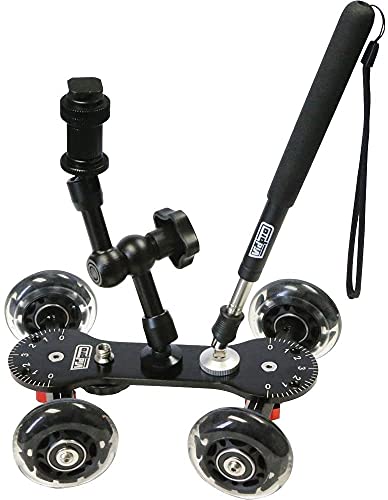
- 25-pound maximum capacity
- Adjustable wheels for curves and 360-degree pans
- Includes handle, magic arm, and seven mounting points
Best For: Low-angle tracking with heavier camera rigs
Best Compact Smart Slider

- 1.9-pound body fits in a 20L backpack
- Seven-hour battery and quiet brushless motor
- Programmable motion with app, Bluetooth, and NFC
Best For: Mobile creators using phones and compact cameras
Best Tabletop Dolly
Neewer Scaled Camera Table Dolly

- Supports up to 22 pounds
- Adjustable straight, curved, and circular paths
- Smooth rubber wheels with fluid bearings
Best For: Tabletop tracking shots and product videos
Best Portable Rail Slider
NEEWER CS1M Carbon Fiber Camera Slider

- Weighs 21.7 ounces with carrying bag
- 16-inch rail with four precision bearings
- Includes ball head, phone clamp, and action mount
Best For: Travel video with compact cameras and phones
Best Lightweight Rail Slider
Andoer 30cm Aluminum Camera Slider

- Four precision bearings deliver smooth, quiet movement.
- Supports up to 11 pounds with aluminum-alloy construction.
- Multiple mounting threads support cameras and accessories.
Best For: Portable manual camera movements and compact accessory setups
Best Motorized Lightweight Slider
NEEWER ER1-80 Carbon Fiber Slider

- App-controlled motorized movement with optional remote support.
- Includes video, manual, and time-lapse shooting modes.
- Supports up to 11 pounds horizontally with a 4400mAh battery.
Best For: Automated tracking and time-lapse production
Best Versatile Motorized Slider

- Motorized time-lapse, video, and round-trip shooting modes.
- Adjustable feet support stable leveling on surfaces.
- Handles horizontal, vertical, and 45-degree shooting.
Best For: Flexible DSLR, cellphone, and video-camera setups
Best Lightweight Pick – Zecti 24-inch Carbon Fiber Slider
For creators comparing lightweight camera sliders, the Zecti 24-inch model offers a portable manual setup with carbon fiber rails, adjustable legs, and multiple mounting points. Its listed 654-gram weight makes it particularly travel-friendly, while the four precision bearings are designed for smooth, quiet movement. If the carriage feels noisy or stiff, the supplied notes indicate that slightly loosening the screws may help.
Best For: Travel videographers and photographers using compact cameras, phones, action cameras, or small camcorders.
Pros:
- Lightweight 654-gram design with a carrying bag.
- Supports horizontal, vertical, diagonal, and sideways operation.
- Multiple 1/4-inch and 3/8-inch mounting holes, adjustable legs, rubber feet, and a bubble level.
- Compatible with a range of small cameras, smartphones, and action cameras.
Cons:
- Manual operation does not provide automated repeatable moves.
- It has a maximum recommended load of 4.4 pounds.
- Movement may become noisy or less smooth if the screws are overtightened.
The Zecti is a sensible choice when low carry weight and flexible placement matter more than motorized control or heavy payload capacity. Its included bag and adjustable feet add practical value for mobile shooting.
Best Motorized Option – NEEWER ER1 31.5-inch App Slider
The NEEWER ER1 adds motorized movement and app control to the lightweight camera sliders category. Its carbon fiber construction, silent stepper motor, and included 4,400mAh battery are suited to repeatable video, product, and time-lapse work. Despite its portable construction, the slider is listed at 8.7 pounds, so it is better suited to planned shoots than ultralight backpacking.
Best For: Creators who need programmable motion, time-lapse control, and higher payload capacity.
Pros:
- App control with manual, video, and time-lapse modes.
- Supports up to 11 pounds horizontally and 5.5 pounds at a 45-degree tilt.
- Silent motor, four roller bearings, and 45-degree tilt capability.
- Included 4,400mAh battery supports extended shooting.
Cons:
- At 8.7 pounds, it is considerably heavier than simpler portable sliders.
- The 2.4G remote control is not included.
- Minor shake may occur during macro photography.
The ER1 is the stronger pick for controlled, repeatable camera moves and heavier setups. Choose it when motorized precision is more important than minimizing the weight of your kit.
Best Heavy-Duty Dolly – Vidpro SK-22 Skater Dolly
The Vidpro SK-22 takes a different approach from rail-based lightweight camera sliders: it uses smooth rubber wheels for low-level tracking, panning, and curved moves. Its CNC-machined aluminum chassis, adjustable axles, and 25-pound capacity make it suitable for heavier camera setups, while the compact folded dimensions help with transport.
Best For: Low-angle shooting, broad curves, 360-degree panning, and heavier DSLRs or camcorders.
Pros:
- Supports up to 25 pounds.
- Rubber wheels with stainless steel ball bearings provide rolling movement.
- Adjustable axles allow straight lines, broad curves, and full 360-degree circles.
- Includes seven mounting points, a 27-inch extendable handle, and an articulated magic arm.
Cons:
- It is a wheeled dolly rather than a conventional fixed rail slider.
- Rolling performance depends on having a suitable smooth surface.
- Its 2-pound weight is light, but the accessories and larger folded package may add bulk.
The SK-22 is compelling when movement variety and payload capacity matter more than rail-style linear travel. It is especially useful for low-level shots and curved camera paths that conventional sliders may not handle as naturally.
Best Compact Smart Slider – iFootage Shark Slider PICO
For creators seeking compact, connected lightweight camera sliders, the iFootage Shark Slider PICO combines a 15.8-inch motorized platform with app, Bluetooth, NFC, and onboard controls. Its 1.9-pound aluminum-alloy body fits in a 20-liter backpack, while programmable points and multiple shooting modes support repeatable motion with small cameras, action cameras, and smartphones.
Best For: Mobile creators using DJI Pocket cameras, action cameras, or smartphones for automated creative shots.
Pros:
- Lightweight 1.9-pound design with a seven-hour battery.
- Supports video, time-lapse, stop-motion, panorama, and multi-target modes.
- Quick-mark system and app support for up to eight programmable points.
- Compatible with DJI Pocket 3/4, Action 5/6, and smartphones.
Cons:
- Its 15.8-inch travel length is shorter than many full-size sliders.
- The listed payload is 2.4 pounds, limiting heavier camera setups.
- Its advanced connected features may be unnecessary for simple manual tracking shots.
The PICO stands out for creators who want automated motion without carrying a full-size slider. Its short track and low payload favor compact gear, but the quiet motor, long battery life, and programmable moves make it highly versatile for mobile production.
Best Tabletop Dolly – Neewer Scaled Camera Table Dolly
For lightweight camera sliders on flat surfaces, this tabletop dolly offers a flexible alternative to a conventional rail. Its adjustable aluminum rods support straight paths, curves, or complete circles, while the scaled disc helps with repeatable positioning.
Best For: Tabletop tracking shots, product videos, and creative camera movements around a subject.
Pros:
- Supports up to 22 pounds for DSLRs, camcorders, and other compatible setups.
- Adjustable rods enable straight, curved, and circular routes.
- Rotatable rubber wheels and fluid roller bearings help create smooth, quiet movement.
- Includes 1/4-inch and 3/8-inch mounting threads plus four 1/4-inch screw holes.
Cons:
- Designed for flat surfaces rather than elevated rail-slider setups.
- Its tabletop dolly format may be less suitable for long, fixed camera moves.
This is a strong choice when route flexibility and higher load capacity matter more than a traditional track. It is especially useful for compact studio or tabletop work, though it is not water resistant.
Best Portable Rail Slider – NEEWER CS1M Carbon Fiber Camera Slider
Among lightweight camera sliders, the NEEWER CS1M stands out for its 615-gram carbon-fiber construction and compact 16-inch rail. Adjustable legs, a bubble level, and multiple mounting threads make it practical for both indoor setups and outdoor shooting.
Best For: Portable DSLR, mirrorless, smartphone, and action-camera video work where easy transport matters.
Pros:
- Lightweight 21.7-ounce design includes a carrying bag.
- Four precision bearings provide smooth, noiseless movement along the 16-inch rail.
- Adjustable legs support balancing on uneven terrain and allow horizontal, vertical, or 45-degree shooting.
- Includes a 360-degree ball head, phone clamp, and action-camera mount.
Cons:
- Horizontal load capacity is limited to 4.4 pounds, with lower limits at an angle or vertically.
- The 16-inch rail provides less travel than longer slider systems.
This slider is a well-rounded travel option for creators who want rail-based movement without much luggage weight. Its included mounting accessories broaden compatibility, while the modest load and travel limits favor smaller camera setups.
Best Motorized Dolly – NEEWER DL100 Wireless Video Camera Dolly
For lightweight camera sliders with automated movement, the NEEWER DL100 adds wireless speed and direction control in a compact 1.1-pound dolly. Its adjustable wheels can create straight or circular routes, while the built-in battery supports extended operation.
Best For: Repeatable product shots, time-based camera moves, and compact setups using cameras, phones, or action cameras.
Pros:
- Wireless remote controls speed, direction, and pausing from up to 19.7 feet away.
- Offers three movement speeds from 1.4 to 3.0 centimeters per second.
- Adjustable wheel angles support straight-line and circular movement.
- Built-in 1,800mAh battery provides up to six hours of service time.
Cons:
- Accessories such as phone holders and action-camera adapters are not included.
- Its maximum recommended load is 6.6 pounds.
- It is not water resistant, so outdoor use requires suitable protection.
The DL100 is the most convenient pick here for motorized, remotely adjusted movement rather than manual rail sliding. Its compact footprint and long battery runtime suit repeatable shots, provided your camera setup stays within the load limit and you supply any needed adapters.
Best Lightweight Rail Slider – Andoer 30cm Aluminum Camera Slider
If portability and straightforward operation matter most, the Andoer is a practical choice among lightweight camera sliders. Its aluminum-alloy rail uses four precision bearings for smooth, quiet movement, while multiple mounting threads support a flexible DSLR or camcorder setup.
Best For: Photographers and videographers who want a compact manual slider for tabletop, tripod, or accessory-heavy setups.
Pros:
- Available in 30cm, 40cm, and 50cm track lengths.
- Lightweight 6.24-ounce aluminum-alloy construction.
- Supports loads up to 11 pounds and includes convertible 1/4-inch and 3/8-inch mounting screws.
- Multiple 1/4-inch and 3/8-inch threads accommodate tripods, lights, monitors, and microphones.
Cons:
- Manual operation does not provide automated time-lapse or motorized movement.
- The supplied notes do not indicate water resistance.
Choose this model if you want a simple, quiet rail slider that is easy to carry and adaptable to a range of camera accessories. Its compact design favors controlled short-distance moves rather than automated shooting.
Best Motorized Lightweight Slider – NEEWER ER1-80 Carbon Fiber Slider
The NEEWER ER1-80 adds app-controlled motorized movement to the lightweight camera sliders category. Its 80cm carbon-fiber rail supports manual, video, and time-lapse modes, with a silent stepper motor and included 4400mAh battery for extended shooting flexibility.
Best For: Creators who need repeatable tracking, time-lapse, or panoramic camera movement with wireless control.
Pros:
- Supports app control and an optional 2.4G RT-08 remote.
- Offers manual, constant-speed video, slow-start/stop, and time-lapse modes.
- Silent motor drive and 4400mAh NP-F750 battery support quiet, extended operation.
- Works horizontally up to 11 pounds and supports 45-degree tilt shooting up to 5.5 pounds.
Cons:
- The charger is not included, and the optional remote is not included.
- At 8.7 pounds, it is considerably heavier than a basic manual slider.
- The notes do not indicate water resistance.
This is the strongest fit when automated movement matters more than minimum carry weight. The carbon-fiber build helps reduce bulk for a motorized unit, but its 8.7-pound weight and 80cm length still call for deliberate transport planning.
Best Versatile Motorized Slider – GVM 27-Inch Camera Slider
The GVM 27-inch slider balances motorized shooting features with a relatively compact aluminum-alloy design. It supports time-lapse, video, and automatic round-trip modes, while adjustable feet and multiple threaded holes make it suitable for floor or tripod-based setups.
Best For: DSLR, cellphone, and video-camera users who want multiple shooting angles and flexible mounting options.
Pros:
- Supports time-lapse, video, and automatic round-trip shooting.
- Adjustable non-slip feet help level the slider on a surface.
- Supports horizontal, vertical, and 45-degree shooting, including slopes up to 70 degrees on a tripod.
- Multiple 1/4-inch and 3/8-inch holes allow floor or tripod mounting.
Cons:
- Its 2.36kg weight is less portable than a simple manual rail.
- Maximum recommended load is 2.5kg, lower than the Andoer and NEEWER models.
- The notes do not indicate water resistance.
The GVM is a useful middle ground for shooters who want motorized movement without moving to the longer NEEWER rail. Its angle flexibility and leveling feet are especially valuable when scenes require more than a basic horizontal slide.
How We Picked These Lightweight Camera Sliders
We selected these 10 Lightweight Camera Sliders based on the features that matter most in real-world shooting: overall portability, usable travel length, supported camera weight, movement control, setup simplicity, and compatibility with cameras, phones, and action cameras. The list includes both manual and motorized designs because each suits a different type of production.
We also considered practical details such as carbon-fiber or aluminum construction, wheel and bearing design, app control, time-lapse support, battery operation, mounting options, and whether a slider is better suited to tabletop, low-angle, studio, or travel use. Always verify the manufacturer’s current specifications before purchase, particularly load ratings and included accessories.
Quick Comparison
| Best For | Recommended Type | What to Prioritize |
|---|---|---|
| Travel and run-and-gun video | Short manual carbon-fiber slider | Low weight, quick setup, rigid track |
| Repeatable movement and time-lapse | Motorized slider | App control, battery life, speed settings |
| Phones and compact cameras | Mini or tabletop slider | Small footprint, clamp compatibility |
| Low-angle product shots | Skater dolly | Wheel quality, surface compatibility, steering |
| Longer cinematic moves | 24- to 31.5-inch slider | Track stiffness, support points, transport size |
Key Buying Factors for Lightweight Camera Sliders
Weight and Packed Size
A slider only improves portability if it fits your bag and can be set up quickly. Short tracks are easier to carry and support, while longer rails provide more dramatic movement but require more room and careful leveling. Carbon fiber can reduce weight, whereas aluminum often offers strong value and rigidity.
Load Capacity and Stability
Check the rated capacity for the complete setup, not just the camera body. Include the lens, cage, microphone, monitor, and any other accessories. A slider operating near its limit may produce uneven movement, especially on longer rails or during motorized operation.
Manual Versus Motorized Movement
Manual sliders are quiet, simple, and usually faster to reposition. Motorized models are better for repeatable moves, interviews, product footage, and time-lapse sequences. They add batteries, controls, and setup considerations, so they are not automatically the better choice for casual shooting.
Mounting and Motion Options
Look for compatible tripod threads, ball heads, phone clamps, action-camera mounts, and adjustable wheels. A slider with multiple mounting points can be supported at both ends or used on a tripod for more flexible positioning.
Who Should Buy Which Lightweight Camera Sliders?
Choose a compact manual model if you prioritize travel, fast setup, and quiet operation. A longer manual rail is a better fit for controlled camera moves when you have room to work. Pick a motorized slider if you need consistent speed, programmed motion, or repeatable time-lapse results. A skater dolly is ideal for low-level tabletop shots and circular or panning movements on a suitable smooth surface.
For phones, action cameras, and lightweight mirrorless bodies, focus on compact sliders with secure clamps and modest load ratings. DSLR or full-frame users with heavier lenses should favor a rigid track, higher capacity, and solid tripod support. In every case, match the slider to the complete camera package and the type of movement you will actually use most.