
When you’re looking to enhance your energy management strategy, choosing the right commercial electrical monitor can make a significant difference. These devices not only track your energy usage but also provide insights that help you identify inefficiencies. With a variety of options available, how do you know which monitor suits your needs best? Let’s explore the top contenders and what they can offer your business.
Emporia Vue 3 Home Energy Monitor
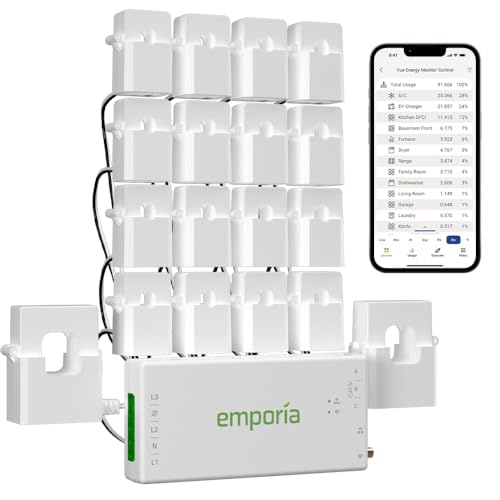
If you’re looking to take control of your energy consumption, the Emporia Vue 3 Home Energy Monitor is an ideal choice for homeowners and small business owners alike. This UL Listed device provides real-time monitoring of your electricity usage, ensuring safety and reliability. Installing it in your circuit panel is simple, and it supports various electrical systems. With the Emporia Energy App, you can automate management, track usage, and receive notifications to help cut costs. The monitor even includes sixteen sensors for precise appliance monitoring. With its accurate data and user-friendly features, you’ll optimize your energy efficiency effortlessly.
Best For: Homeowners and small business owners looking to monitor and optimize their energy consumption.
Pros:
- Real-time monitoring of electricity usage for enhanced energy management.
- Easy installation in various electrical systems with included and optional sensors.
- User-friendly app provides actionable notifications and tracking for cost savings.
Cons:
- Requires a 2.4 GHz Wi-Fi connection for full functionality.
- Additional sensors may be needed for certain systems, increasing initial costs.
- Limited historical data retention in the cloud may not meet all user needs.
Eyedro 3-Phase Commercial & Industrial Energy Meter
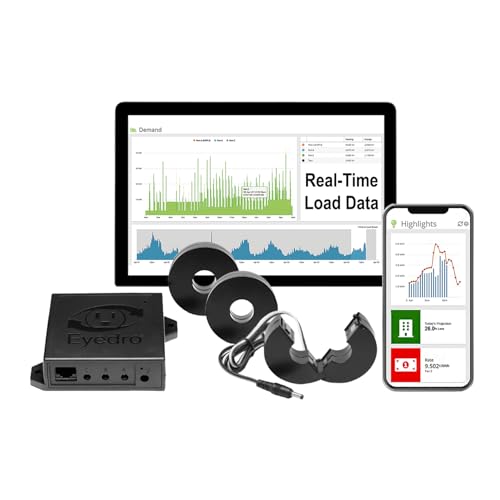
The Eyedro 3-Phase Commercial & Industrial Energy Meter is designed for businesses seeking precise and real-time energy monitoring. With its ability to track energy usage and solar generation, it displays critical data like kWh, Watts, and cost. Installation is a breeze, thanks to non-invasive split-core sensors that require no special tools. You can connect via WiFi or Ethernet and manage everything through the MyEyedro cloud platform. Expect complete 24/7 usage history and detailed cost estimates without extra fees. Plus, Eyedro provides reliable technical support, ensuring you get the most out of your energy management strategy.
Best For: Businesses looking for an efficient and user-friendly solution for real-time energy monitoring and solar generation tracking.
Pros:
- Non-invasive installation with split-core sensors simplifies setup without the need for special tools or wiring changes.
- Comprehensive data management through the MyEyedro platform, providing 24/7 usage history and cost estimates without additional fees.
- Flexible connectivity options allow for easy integration via WiFi or wired Ethernet.
Cons:
- Limited to North American voltage standards, which may not be suitable for international users without additional adapters.
- Weight and dimensions may not be ideal for all installations, especially in space-constrained environments.
- Requires a MyEyedro account for full functionality, which might be a barrier for some users.
Eyedro 3-Phase Commercial & Industrial Energy Meter

Designed for businesses looking to optimize energy usage, the Eyedro 3-Phase Commercial & Industrial Energy Meter offers real-time monitoring of both energy consumption and solar generation. It displays essential metrics like kWh, Watts, and Power Factor, ensuring you have the data you need. With easy installation via WiFi or wired Ethernet, you’ll use non-invasive split-core sensors—no special tools required. Plus, the MyEyedro platform provides detailed graphs and historical data, allowing you to analyze your energy usage effectively. This meter is also solar-ready, making it perfect for businesses with solar installations. Enjoy full access to your data without subscription fees!
Best For: Businesses looking to optimize energy usage and monitor solar generation in real-time.
Pros:
- Real-time monitoring of energy consumption and solar generation provides essential insights for businesses.
- Easy installation with non-invasive split-core sensors and options for WiFi or wired Ethernet connectivity.
- No subscription fees for full access to data, alerts, and reports on the MyEyedro platform.
Cons:
- Requires two Eyedro systems for accurate solar and grid consumption separation, which may increase costs.
- Limited to specific voltage options, potentially restricting use in some commercial setups.
- Technical support may be needed during setup, which could be a barrier for less tech-savvy users.
Upgraded Watt Power Meter Plug for Home Electrical Usage Monitor
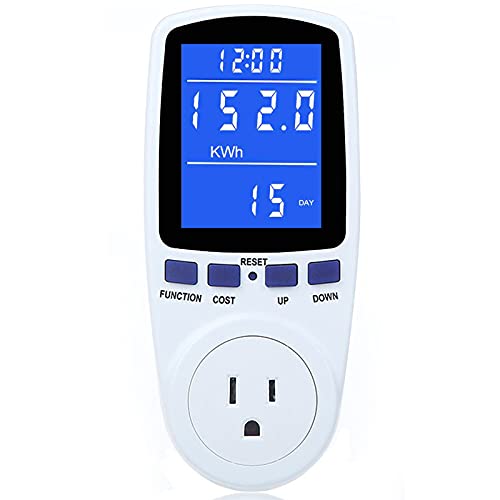
For homeowners seeking to monitor their electricity usage effectively, the upgraded Watt Power Meter Plug stands out with its advanced features. It tracks multiple parameters like power, energy, volts, and even costs, giving you a complete picture of your consumption. With seven display modes and a backlit LCD, reading is easy, day or night. You can adjust the backlight settings to your preference, ensuring visibility when you need it. Plus, its overload protection safeguards your appliances. The data memory function records consumption, allowing you to manage usage and cut down on bills efficiently. This meter is a must-have for energy-conscious households!
Best For: Homeowners looking to monitor and manage their electricity usage efficiently.
Pros:
- Monitors multiple parameters such as power, energy, and cost for comprehensive tracking.
- Adjustable backlight settings provide optimal visibility in any lighting condition.
- Data memory function allows for tracking usage even after disconnection, aiding in energy management.
Cons:
- Overload protection may limit usage for high-wattage appliances if not set appropriately.
- Buttons become non-functional during overload conditions, which can be inconvenient.
- Initial setup may require adjustment of overload settings for optimal use.
Smart Home Energy Monitor with Circuit Sensor and Real-Time Tracking

Looking to take control of your energy consumption? The Smart Home Energy Monitor is your answer. With circuit sensors for real-time tracking, you can monitor energy use 24/7 through the Refoss app. It’s ETL certified and supports various circuit configurations, making installation a breeze. Expect 10%-20% savings on your energy bills thanks to its accurate data and personalized alerts for unusual spikes. Plus, it’s solar-ready, optimizing your system for excess energy use. Enjoy local data storage for privacy and seamless integration with Home Assistant for complete automation. Simplify your energy management today with this powerful monitor.
Best For: Homeowners looking to optimize their energy consumption and reduce utility bills through real-time monitoring and smart automation.
Pros:
- Accurate Monitoring: Provides 98% accuracy in tracking energy usage, helping users make informed decisions.
- Cost Savings: Users can save an average of 10%-20% on energy bills by optimizing their energy consumption patterns.
- Solar Integration: Designed for solar owners, it maximizes the use of excess solar energy, enhancing investment returns.
Cons:
- No Cloud Processing: All data is stored locally, which may limit remote access options for users who prefer cloud-based solutions.
- API Support Not Available: Lack of API integration may restrict advanced users from customizing their energy monitoring experience.
- Firmware Updates Required: Users must update firmware to integrate with Home Assistant, which may be a hurdle for some.
Eyedro 3-Phase Commercial & Industrial Energy Meter
The Eyedro 3-Phase Commercial & Industrial Energy Meter is an excellent choice for businesses seeking precise real-time monitoring of their energy usage and solar generation. It displays essential data like kWh, Watts, and cost, ensuring you stay informed. With connection options through WiFi or wired Ethernet, you can easily access your data. The MyEyedro platform offers 24/7 usage history and real-time graphs, helping you manage costs effectively. Its non-invasive installation requires no special tools, making setup a breeze. Plus, you’ll benefit from reliable technical support without any subscription fees. You’ll have everything you need to optimize your energy management strategy.
Best For: Businesses looking for a reliable and efficient solution to monitor their energy consumption and solar generation in real-time.
Pros:
- Non-invasive installation with no special tools required, making it easy to set up.
- Provides comprehensive data visualization with real-time graphs and 24/7 usage history.
- No subscription fees for cloud software, ensuring full access to features and support.
Cons:
- Requires two Eyedro monitors for accurate separation of grid consumption from solar generation.
- Limited to specific voltage configurations, which may not suit all businesses.
- May require a learning curve for users unfamiliar with energy management software.
SIEMENS Inhab Smart Home Energy Monitor

With real-time electricity monitoring capabilities, the Siemens Inhab Smart Home Energy Monitor is ideal for homeowners seeking to gain deeper insights into their energy consumption. It offers whole home and circuit level monitoring, letting you track usage across 16 branch circuits. With a mobile app, you can access current and historical data 24/7. Advanced energy management functions, including peak demand management and personalized notifications for energy savings, make it user-friendly. Weighing just 4.75 pounds, it’s easy to install and compatible with existing electrical panels. Backed by positive reviews, it’s a smart choice for effective energy management.
Best For: Homeowners looking for comprehensive real-time monitoring and management of their energy consumption.
Pros:
- Whole home and circuit level monitoring for detailed energy usage insights.
- Mobile app access for real-time and historical data, enhancing user experience.
- Advanced energy management features, including personalized notifications for savings.
Cons:
- Limited availability of the mobile app to the USA and Canada only.
- Installation may require some electrical knowledge or professional assistance.
- Customer support and warranty details may vary by region.
20A AC Power Meter with LCD Display

For those managing commercial spaces, the 20A AC Power Meter with LCD Display is an essential tool. This device plugs directly into your outlet, allowing you to monitor voltage, current, and power consumption effortlessly. With a range of 0-125VAC and up to 20A, it’s perfect for various applications, from computers to lighting. The 6.56FT cable lets you position it for easy viewing. Plus, built-in safety features protect against overloads and short circuits. You can even track historical data during outages, ensuring you stay informed about your energy usage. It’s plug-and-play, making it user-friendly and efficient for any environment.
Best For: This power meter is best for commercial space managers looking to efficiently monitor and manage their electrical consumption.
Pros:
- Easy to use: Plug-and-play design requires no installation, making it user-friendly.
- Comprehensive monitoring: Tracks voltage, current, frequency, and power factor, providing a complete overview of energy usage.
- Safety features: Equipped with short-circuit and overload protection to ensure safe operation.
Cons:
- Limited voltage range: Only supports up to 125VAC, which may not be suitable for all applications.
- Data reset feature: Requires a manual button press to reset data, which may be inconvenient for some users.
- Not suitable for high-power devices: Only handles a maximum of 20A, limiting its use with larger industrial appliances.
Emporia Vue 3 Home Energy Monitor

Designed for homeowners seeking efficient energy management, the Emporia Vue 3 Home Energy Monitor offers real-time insights into your power consumption. It’s UL Listed for safety, preventing hazards like overheating and short-circuiting. Installation is a breeze with clamp-on sensors that fit most circuit panels. You can manage real-time consumption via the Emporia Energy App, monitoring solar energy and configuring settings for peak demand. With accurate data retention and the option to add up to sixteen branch sensors for appliances, you’ll have complete control over your energy use, saving money and enhancing efficiency effortlessly.
Best For: Homeowners looking for an efficient way to monitor and manage their energy consumption while ensuring safety and reliability.
Pros:
- UL Listed for safety, preventing hazards like overheating and short-circuiting.
- Real-time data monitoring via the Emporia Energy App for enhanced energy management.
- Expandable with up to sixteen branch sensors for detailed appliance monitoring.
Cons:
- Requires a 2.4 GHz Wi-Fi connection for full functionality, which may limit some users.
- Additional 200A sensors needed for certain electrical systems, increasing initial costs.
- Cloud data export may not be intuitive for all users, requiring a learning curve.
Series 2000 Three Phase Outdoor Energy SubMeter Kit 110-277V MAX 200 Amp

The Series 2000 Three Phase Outdoor Energy SubMeter Kit is an excellent choice for commercial property managers and business owners seeking precise energy monitoring. With a voltage range of 110-277V and a maximum current of 200 Amps, this meter’s durable, weatherproof enclosure guarantees reliable performance outdoors. It accurately measures energy consumption across various configurations, making it versatile for your needs. Weighing just 2.6 pounds and compact in size, it’s easy to install and monitor. Use this submeter to track utility bills and optimize energy efficiency, helping you manage costs effectively while guaranteeing your operations run smoothly.
Best For: The Series 2000 Three Phase Outdoor Energy SubMeter Kit is best for commercial property managers and business owners looking for accurate energy monitoring solutions.
Pros:
- Durable, weatherproof enclosure suitable for outdoor use.
- Accurate measurement of energy consumption helps optimize energy efficiency.
- Compact and lightweight design makes installation and monitoring easy.
Cons:
- Maximum current rating of 200 Amps may not be sufficient for larger industrial applications.
- Limited to certain voltage configurations (110-277V) which may not suit all setups.
- Best Sellers Rank suggests it may not be a top-choice product among competitors.
Factors to Consider When Choosing a Commercial Electrical Monitor
When you’re choosing a commercial electrical monitor, you need to think about several key factors. Accuracy of measurements, installation requirements, and data management features are essential for effective monitoring. Additionally, guarantee compatibility with your existing systems and evaluate the monitoring capabilities to meet your specific needs.
Accuracy of Measurements
Accuracy in electrical measurements plays an essential role in your energy management strategy, as it directly influences how effectively you can monitor and control costs. Most commercial monitors provide energy data within an accuracy range of ±2%, which guarantees that your readings are reliable. High-resolution data is important for spotting consumption patterns, and you’ll want monitors that track minute, hourly, and daily records. This accuracy helps you forecast electricity bills more effectively. If you’re using solar applications, make certain your monitor differentiates between power consumed and generated for better insights into energy efficiency. Finally, pay attention to calibration and testing standards, as they’re critical for maintaining accuracy over time and securing compliance and operational efficiency.
Installation Requirements
Choosing the right commercial electrical monitor involves considering several installation requirements that can impact its effectiveness. First, verify compatibility with your electrical system, whether it’s single-phase or three-phase, and check the wiring configurations. Many monitors use clamp-on sensors for easy, non-invasive installation, so you won’t need special tools or extensive rewiring. However, if your system is a 3-wire or 4-wire setup, additional sensors might be necessary for accurate monitoring. A stable internet connection, either via Wi-Fi or Ethernet, is essential for real-time data transmission. Finally, remember to comply with local electrical codes and safety certifications during installation to prevent hazards and guarantee reliable operation.
Data Management Features
Understanding the data management features of commercial electrical monitors is essential for optimizing energy usage. Look for monitors that maintain a full 24/7 usage history, enabling you to track energy consumption over time effectively. Many models support various rate structures—fixed, tiered, and time-of-use—giving you flexibility in billing estimates and energy management. High-resolution data visualization through real-time graphs can help you analyze hourly, daily, weekly, and monthly consumption patterns. Additionally, some systems allow you to export data for further analysis and integration into other management platforms, which aids in conducting thorough energy audits. Finally, alerts and notifications for unusual energy spikes or abnormal consumption patterns can empower you to address potential issues promptly.
Compatibility With Systems
When managing energy data, compatibility with your existing systems is a key factor in selecting a commercial electrical monitor. First, confirm the monitor supports your system’s voltage configuration, whether it’s 600V Delta, 480V/277V Wye, or 208V/120V. Next, consider the phases your facility uses—single-phase, split-phase, or three-phase—as this will influence your choice. If you’re integrating renewable energy, check for compatibility with solar and net metering to track generation versus consumption effectively. Also, think about the installation method; non-invasive clamp-on sensors may be easier compared to modifications in existing wiring. Finally, verify that the monitor can handle your application’s current rating, especially for systems needing monitoring up to 6000A.
Monitoring Capabilities
How can you guarantee your commercial electrical monitor truly meets your needs? First, make sure it provides real-time monitoring of key metrics like kWh, Watts, Amps, Volts, and Power Factor. This gives you thorough insights into your energy usage. If you’re using solar energy or net metering, choose a monitor that differentiates between consumed and generated power to accurately track your energy flow. Additionally, check for compatibility with various voltage configurations, such as 600V Delta or 480V/277V Wye. Detailed data management capabilities are essential—look for 24/7 usage history and real-time graphs for tracking consumption. Finally, opt for user-friendly cloud platforms that offer easy access to alerts, reports, and bill projections to enhance your energy management strategy.
Real-Time Reporting
Real-time reporting is a critical feature to contemplate when choosing a commercial electrical monitor, as it provides continuous insights into your energy consumption and generation. This capability lets you track energy usage patterns instantly, helping you identify unusual spikes that may require immediate attention. Many monitors also offer data visualization through graphs and charts, making it easy to review hourly, daily, weekly, and monthly metrics. By having access to accurate real-time data, you can optimize your energy management practices, potentially leading to significant cost savings. Additionally, some systems retain historical data, allowing you to analyze trends over time and refine your strategies for enhanced energy efficiency. Make sure to choose a monitor with strong real-time reporting features.
Energy Management Functions
Having access to real-time data sets the stage for effective energy management functions in commercial electrical monitors. These tools enable automated settings for time-of-use, peak demand, and excess solar generation, optimizing your energy consumption and cutting costs. Features like load shedding automatically reduce energy use during peak times, helping you avoid higher rates. Advanced monitors can distinguish between solar generation and grid consumption, enhancing your management of renewable energy sources. Many also offer personalized notifications for unusual energy usage, allowing you to quickly address potential issues. Plus, integration with cloud-based platforms provides real-time data visualization and historical tracking, empowering you to make informed decisions about your energy management strategies.