
Moisture can turn otherwise good filament into a source of popping, stringing, weak layers, and inconsistent extrusion. A compact filament dryer gives you a practical way to condition and protect spools without dedicating a large amount of workspace.
We selected 10 compact filament dryers spanning single-spool boxes, multi-spool systems, high-temperature models, and storage-focused designs. Use the guide below to compare capacity, heat range, controls, and day-to-day convenience before choosing one.
Best 10 Compact Filament Dryers Picks for 2026
Best Adjustable Dryer

- 35–70°C temperature range
- 0–99 hour timer
- Supports three filament diameters
Best For: Flexible drying control and printing from the dryer
Best Fast-Heating Dryer

- Reaches 65°C in 15 minutes
- 360° hot-air circulation
- Fits most 1kg spools
Best For: Quick drying with simple temperature and humidity monitoring
Best Quiet Dryer

- Operating noise below 10dB
- 35–55°C adjustable temperature
- 1–99 hour drying timer
Best For: Quiet home printing and everyday filament drying
Best Two-Spool Dryer
Comgrow SH01 Filament Dryer Box

- Holds two 1kg spools
- Temperature and humidity monitoring
- Sealed filament outlets
Best For: Multi-spool drying and dry storage in one enclosure
High-Capacity Pick

- Dries up to four 1kg spools
- Three fans and 350W PTC heating
- Eight outlets for multi-printer feeding
Best For: Multi-printer setups and batch filament drying
Storage-Focused Pick

- Dries, stores, and prints without breaking the seal
- Built-in hygrometer and desiccant support
- 360-degree airflow for even drying
Best For: Moisture-conscious storage and direct filament feeding
Single-Spool Value Pick

- Fan-assisted drying for one spool
- Two-inch display shows temperature, time, and humidity
- Supports common materials and filament diameters
Best For: Single-spool drying in a compact, straightforward setup
High-Capacity Power Pick

- Four-spool capacity with dual independent heating chambers
- Dries filament at temperatures up to 85°C
- Adds sealed storage and automatic desiccant regeneration
Best For: Multi-material and multi-printer workflows
Balanced Dual-Spool Choice
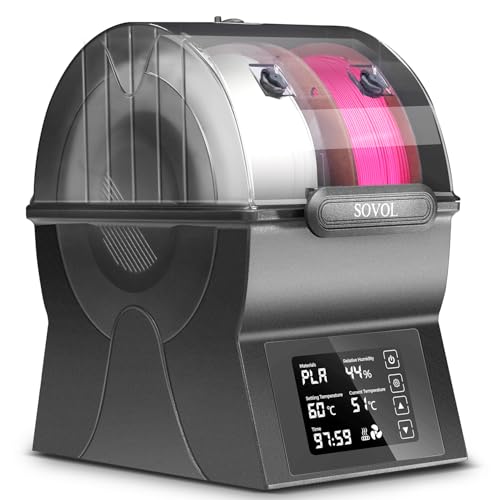
- Dries two 1kg spools at the same time
- Heats from 40°C to 70°C with 150W PTC power
- Includes presets for nine common filament types
Best For: Two-printer setups and easy everyday drying
Simple Single-Spool Solution

- Fan-assisted drying for common printing filaments
- Adjustable 35°C–55°C temperature range
- LCD displays temperature, time, and humidity
Best For: Everyday single-spool filament maintenance
Best Adjustable Dryer – SUNLU Filament Dryer S2
The SUNLU S2 is a versatile choice among compact filament dryers for users who want broad temperature and timing control. It can dry filament while printing, supports several filament diameters, and uses a built-in spindle for more even drying.
Best For: Makers who want flexible settings, a large touchscreen, and support for 1.75mm, 2.85mm, and 3.00mm filament.
Pros:
- Adjustable temperature from 35–70°C and drying time from 0–99 hours.
- Built-in spindle continuously rotates filament for even drying.
- Can function as a spool holder while drying during printing.
- Large translucent lid makes it easy to check the filament.
Cons:
- Its maximum temperature may not suit every high-temperature filament.
- The larger 265 × 274 × 118mm capacity may take more space than smaller dryers.
With broad compatibility and unusually granular controls, the S2 is a practical pick for users who regularly switch between filament types or need long drying cycles.
Best Fast-Heating Dryer – Creality Space Pi SE
The Creality Space Pi SE is one of the more feature-focused compact filament dryers, combining quick PTC heating with a circulating fan and insulation. It reaches 65°C within 15 minutes and provides live humidity and drying-time information.
Best For: Users who want quick heating, straightforward controls, and compatibility with most 1kg spools.
Pros:
- Heats to 65°C within 15 minutes according to the supplied specifications.
- 360-degree hot-air circulation helps heat the chamber evenly.
- Display and knob provide simple operation with real-time humidity monitoring.
- Fits most 1kg spools and supports 1.75mm and 2.85mm filament.
Cons:
- Temperature range is limited to 45–65°C.
- Timer settings max out at 24 hours.
- The supplied warranty description is six months.
The Space Pi SE stands out when speed and simple monitoring matter more than an especially wide temperature range or extended timer.
Best Quiet Dryer – SUNLU S1 Plus Filament Dryer
The SUNLU S1 Plus is a compact filament dryer designed for quiet operation and straightforward everyday use. Its two internal rollers support printing while drying, while the adjustable settings accommodate more than 20 commonly used filament types.
Best For: Home workspaces where low operating noise and a clear LCD display are priorities.
Pros:
- Operates at less than 10dB according to the supplied notes.
- Adjustable temperature range of 35–55°C.
- Manual drying time can be set from 1–99 hours.
- Supports 1.75mm, 2.85mm, and 3mm filament.
Cons:
- Its 55°C maximum is lower than some competing dryers.
- The supplied spool-size specification is presented unclearly as “21085(H) mm.”
The S1 Plus is a sensible option for quieter rooms and routine filament drying, especially if you value long timer settings over high maximum heat.
Best Two-Spool Dryer – Comgrow SH01 Filament Dryer Box
The Comgrow SH01 is a compact filament dryer with room for two 1kg spools, making it useful when you want to store or feed multiple rolls from one enclosure. It also includes sealed outlets, temperature and humidity monitoring, and a silicone-and-Teflon filament outlet design.
Best For: Users who need two-spool capacity and a sealed storage-style box for PLA, ABS, and similar materials.
Pros:
- Internal space accommodates two 1kg spools.
- Provides real-time temperature and humidity monitoring.
- Sealed outlets and a snap-button lid help maintain a dry storage environment.
- Supports 1.75mm and 2.85mm filament.
Cons:
- Maximum temperature is limited to 50°C.
- Drying-time settings are limited to 6–12 hours.
- The moisture outlet must be opened during drying and closed during storage.
The SH01 is best suited to makers who value capacity and storage sealing, but its lower heat ceiling and narrower timer range make it less flexible for specialized drying needs.
High-Capacity Pick – SUNLU S4 Four-Spool Dryer
For makers comparing compact filament dryers, the SUNLU S4 is a higher-capacity option designed to dry up to four 1kg spools while printing. Its 350W PTC heater, three circulation fans, adjustable 35–70°C temperature range, and 0–99-hour timer make it suited to multi-spool workflows, though its large footprint is worth considering.
Best For: Multi-printer setups and users who need to dry several spools at once.
Pros:
- Holds up to four 1kg filament spools.
- Three fans and 360-degree surrounding heating promote more even drying.
- Eight filament exit holes support multiple printers and loading angles.
- Supports common materials and 1.75mm, 2.85mm, and 3.00mm filament sizes.
Cons:
- Its 460 × 220 × 310mm exterior makes it less space-saving than single-spool dryers.
- At 4kg, it is relatively heavy for a filament dryer.
- Some DIY features, such as 3kg-roll conversion, require modification.
The S4 prioritizes capacity and throughput over a truly small form factor. Choose it when four-spool drying and multi-printer feeding matter more than minimizing bench space.
Storage-Focused Pick – Polymaker PolyDryer
The Polymaker PolyDryer stands out among compact filament dryers by combining a drying dock with a storage box. It is designed to dry, store, and feed filament without breaking the seal, while a built-in hygrometer, sealing, and desiccant support help manage moisture between print sessions.
Best For: Print-ready filament storage with integrated drying and direct feeding.
Pros:
- Combines heated drying, sealed storage, and printing in one system.
- Built-in hygrometer helps monitor storage conditions.
- 360-degree airflow supports even drying.
- Works with PA Nylon, PLA, PVB, PETG, ABS, ASA, TPU, and multiple filament diameters.
Cons:
- Its modular dock-and-box design may be less straightforward than a basic dryer.
- The supplied notes do not specify a temperature range or timer range.
- It is intended around a 1kg spool capacity.
PolyDryer is a practical choice when storage is as important as drying. Its sealed, feed-ready design reduces the need to repeatedly expose filament to ambient air.
Single-Spool Value Pick – SUNLU S1 Plus Dryer
The SUNLU S1 Plus is a straightforward choice for shoppers seeking compact filament dryers for one spool at a time. Its fan-assisted design, two-inch LCD display, adjustable 35–55°C temperature range, and drying-while-printing capability address common moisture-related printing problems without the larger footprint of a multi-spool unit.
Best For: Individual makers who need an accessible dryer for common filament materials.
Pros:
- Fan design helps speed moisture discharge.
- LCD displays temperature, time, and humidity.
- Adjustable temperature and drying settings suit different filament conditions.
- Supports 1.75mm, 2.85mm, and 3.00mm PLA, PETG, ABS, TPU, Nylon, and PA filament.
Cons:
- Its 35–55°C range is narrower than the SUNLU S4’s range.
- The listed capacity is for one spool, limiting batch drying.
- It offers fewer filament outlets than multi-spool models.
The S1 Plus keeps the feature set focused and the capacity modest. It makes the most sense for users who typically dry one spool and want visible humidity and temperature information.
High-Capacity Power Pick – Creality Space Pi X4
For makers who need compact filament dryers with serious capacity, the Creality Space Pi X4 stands out with room for four spools and two independently controlled heating chambers. Its 85°C maximum temperature supports a broad range of everyday and engineering-grade filaments.
Best For: Multi-material printing, multi-printer setups, and users who want drying plus long-term sealed storage.
Pros:
- Holds four spools with two independent 200W heating chambers.
- Reaches up to 85°C for PLA, PETG, ABS, TPU, Nylon, PC, PA, and PAHT.
- Offers active dehumidification, automatic desiccant regeneration, and airtight storage.
- Includes quiet 45dB operation, night mode, touchscreen monitoring, and multiple safety protections.
Cons:
- The larger four-spool capacity may be more than needed for a single-printer setup.
- Its advanced dual-chamber design is likely less compact than single-spool dryers.
The Space Pi X4 is a feature-rich choice when flexibility and capacity matter more than having the smallest possible footprint. Its separate chambers and high heat range make it particularly useful for demanding filament workflows.
Balanced Dual-Spool Choice – Sovol SH02 Filament Dryer
The Sovol SH02 is one of the more practical compact filament dryers for users who want to dry two 1kg spools at once. Its 150W PTC heater, circulating fan, improved sealing, and preset filament modes keep the controls straightforward.
Best For: Two-spool drying, shared use with two printers, and users who prefer one-key settings for common materials.
Pros:
- Dries two 1kg spools simultaneously while supporting two filament feed-through holes.
- Reaches 50°C in about seven minutes and up to 70°C in about 25 minutes.
- Provides preset modes for nine filament types, including PLA, TPU, PETG, ABS, PC, PA, and PP.
- Improved sealing helps protect filament even when the unit is powered off.
Cons:
- Desiccant bags are not included.
- The 70°C maximum is lower than the 85°C range offered by some higher-temperature dryers.
With dual-spool capacity and simple material presets, the SH02 offers a useful middle ground between basic single-spool boxes and larger professional-style units. Its safety cutoff and fan alarm add practical reassurance during unattended drying.
Simple Single-Spool Solution – SUNLU S1 Plus Filament Dryer
The SUNLU S1 Plus is a straightforward option among compact filament dryers, combining a fan-assisted design with adjustable temperature and drying time. Its 2-inch LCD displays temperature, time, and humidity, while the spacious chamber accommodates several common filament sizes.
Best For: Single-spool users who want simple controls, visible status information, and broad filament compatibility.
Pros:
- Fan-assisted drying helps discharge excess moisture from filament.
- Adjustable temperature from 35°C to 55°C and customizable drying time.
- Supports 1.75mm, 2.85mm, and 3.00mm filament in materials such as PLA, PETG, ABS, TPU, Nylon, and PA.
- LCD shows temperature, time, and humidity at a glance.
Cons:
- The 55°C maximum is more limited for high-temperature engineering filaments.
- The supplied notes specify a maximum chamber capacity rather than multi-spool support.
The S1 Plus is best suited to routine filament maintenance rather than high-temperature drying. Its low-end temperature range, fan, and clear display make it an accessible choice for common materials and everyday print preparation.
How We Picked These Compact Filament Dryers
We focused on dryers that balance moisture control with a relatively space-efficient footprint. The selection includes single-spool and multi-spool designs, since the right capacity depends on whether you print occasionally, run several materials, or need to dry filament while it feeds directly to a printer.
We also considered temperature adjustability, stated spool compatibility, sensor or timer features, storage capability, and practical usability. These factors matter more than headline wattage alone because filament types require different drying conditions and users need predictable operation.
Quick Comparison
| Type | Best For | What to Check |
|---|---|---|
| Single-spool dryer | Most everyday PLA, PETG, and small-workspace setups | Spool width, temperature range, and feed-through design |
| Multi-spool dryer | Frequent printing or several open spools | Cabinet size, airflow, independent control, and power use |
| High-temperature dryer | Nylon and other moisture-sensitive engineering materials | Maximum temperature, sensor accuracy, and spool clearance |
| Dry-storage box | Keeping conditioned filament ready to print | Seal quality, humidity display, and desiccant support |
Key Buying Factors for Compact Filament Dryers
Capacity and Footprint
Check whether the unit accepts one or several 1 kg spools, and measure the available shelf or desk space before buying. A larger capacity is useful only if it fits comfortably and leaves room for ventilation and cable routing.
Temperature Range and Control
PLA and PETG generally need less heat than nylon, so adjustable temperature control is preferable to a single preset. For technical filaments, confirm that the dryer reaches the manufacturer’s recommended range and can maintain it consistently.
Drying Versus Storage
Some products are designed mainly to heat filament, while others also provide sealed storage and a path for printing directly from the box. If you live in a humid climate or print slowly, storage features can be as valuable as the heating function.
Controls, Sensors, and Safety
Look for readable controls, a timer, temperature monitoring, and automatic shutoff where available. Precision sensors can reduce overheating risk, but you should still follow the filament maker’s temperature and drying-time guidance.
Who Should Buy Which Compact Filament Dryers?
Choose a single-spool SUNLU, Creality, Comgrow, or Sovol-style dryer if you want a straightforward solution for one active spool and have limited space. These designs suit most hobbyists who occasionally need to restore or condition PLA, PETG, or similar materials.
Consider a multi-spool option such as the SUNLU S4 or Creality Space Pi X4 if you regularly switch materials, operate multiple printers, or want to process several spools at once. Their larger footprint makes them better for a dedicated workbench than a crowded desk.
For nylon and other demanding materials, prioritize a model with a higher maximum temperature and clear sensor control, such as a high-temperature Creality or Polymaker-oriented solution. If your main concern is keeping already-dried filament ready to use, favor a sealed storage design with reliable feed-through access and humidity management.