
Moisture can turn otherwise good filament into a source of popping, stringing, inconsistent extrusion, and weak prints. A dedicated dryer helps hobbyists prepare damp spools and keep moisture-sensitive materials in better condition between projects.
We compare 10 filament dryers for hobbyists across capacity, temperature control, heating design, storage features, and everyday usability, so you can choose a model that fits your printer setup and printing habits.
Best 10 Filament Dryers for Hobbyists Picks for 2026
Best High-Capacity Pick

- Holds up to four 1kg spools
- Three fans and 350W PTC heating
- 35–70°C range with 0–99-hour timer
Best For: Multi-spool hobby printing and multiple-printer setups
Best Dual-Chamber Option

- Fits four 1kg or two 2kg spools
- Dual 200W chambers reach 85°C
- Sealed storage helps limit moisture return
Best For: High-volume users and higher-temperature filament
Best Everyday Choice

- 35–70°C temperature range
- 0–99-hour timer and touch controls
- Works as a spool holder during printing
Best For: Single-spool hobby printing and humid environments
Best Simple Storage Dryer
Comgrow SH01 Filament Dryer Box

- Stores two 1kg spools
- 40–50°C adjustable temperature
- LCD temperature and humidity monitoring
Best For: Basic two-spool storage and standard filament materials
Easy-Use Pick

- Fan-assisted drying for moisture-related print issues
- LCD shows temperature, time, and humidity
- Supports common filament sizes and materials
Best For: Hobbyists drying one spool with simple controls
Integrated Storage Pick

- Dries, stores, and prints without breaking the seal
- Built-in hygrometer supports moisture monitoring
- Works with multiple materials and filament diameters
Best For: Hobbyists wanting an all-in-one moisture-control workflow
Dual-Spool Pick
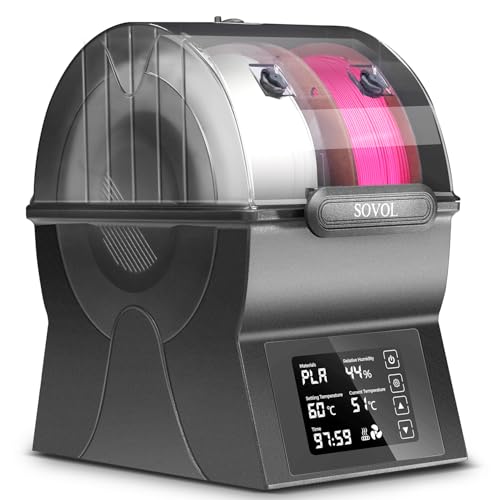
- Dries two 1 kg rolls at the same time
- 150W PTC heater with 40°C–70°C adjustment
- Preset settings for nine filament types
Best For: Hobbyists preparing filament for two printers or larger jobs
Best Multi-Spool Control
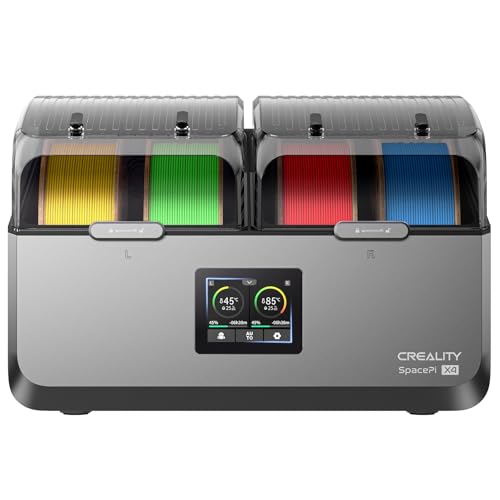
- Dries and feeds up to four spools
- Independent chambers and temperatures
- Reaches up to 85°C
Best For: Multi-printer users and engineering filaments
Best Easy-Setup Dryer

- 360° fan-assisted heating
- Presets for up to 12 materials
- 0–48-hour timer with setting memory
Best For: Everyday single-spool hobby printing
Best Large-Capacity Storage

- Holds four 1kg or two 2kg spools
- Dual 200W independent chambers
- Sealed enclosure helps limit moisture return
Best For: High-volume users needing drying and storage
Best High-Capacity Pick – SUNLU S4 Filament Dryer
For hobbyists who print with several materials or run multiple printers, the SUNLU S4 is a filament dryer for hobbyists built around high capacity. It holds up to four 1kg spools, supports drying while printing, and offers adjustable temperature and timer settings.
Best For: Multi-spool workflows, multiple printers, and hobbyists who need broad material compatibility.
Pros:
- Holds up to four 1kg spools and includes eight filament exit holes.
- Three circulation fans and 360-degree surround heating promote more even drying.
- Supports 35–70°C settings, 0–99-hour timers, and materials including PLA, PETG, ABS, TPU, PA, PC, and Nylon.
- Can be modified for 3kg rolls or use as a shoe dryer, according to the supplied instructions.
Cons:
- Its 460 × 220 × 310mm external size requires substantial workspace.
- At 4kg, it is less convenient to move than smaller dryers.
The S4 is a strong choice when capacity and flexibility matter more than a compact footprint. Its 350W PTC heater, three fans, and multiple outlets suit demanding hobby setups.
Best Dual-Chamber Option – Creality Space Pi X4 Dryer
The Creality Space Pi X4 is a filament dryer for hobbyists who want high capacity plus active storage. Its dual heating chambers hold four standard 1kg spools or two 2kg spools, while the sealed enclosure is designed to limit moisture re-absorption during pauses.
Best For: High-volume hobbyists drying or storing several spools and working with higher-temperature materials.
Pros:
- Holds four standard 1kg spools or two large 2kg spools.
- Dual independent 200W heating chambers reach up to 85°C.
- Touch controls and a real-time display support temperature customization.
- Silicone-sealed storage helps maintain humidity control during printing pauses.
Cons:
- Its larger capacity may be more than needed for occasional, single-spool printing.
- The supplied notes do not specify a timer range or exact external dimensions.
Choose the Space Pi X4 if you want one enclosure for both drying and storage. Its 85°C maximum also gives hobbyists more flexibility for materials such as ABS, PC, ASA, PA, and PAHT.
Best Everyday Choice – SUNLU S2 Filament Dryer
The SUNLU S2 is a practical filament dryer for hobbyists who typically work with one spool at a time. It combines adjustable drying with a spool-holder design, so filament can remain dry while feeding to the printer.
Best For: Everyday hobby printing, humid workspaces, and users who want straightforward touch-screen controls.
Pros:
- Adjustable temperature from 35–70°C and drying time from 0–99 hours.
- Built-in spindle keeps the filament rotating for more even drying.
- Supports 1.75mm, 2.85mm, and 3.00mm filament diameters.
- Translucent lid allows monitoring without opening the enclosure.
Cons:
- The supplied notes do not state a multi-spool capacity.
- Its 265 × 274 × 118mm interior is less suited to oversized rolls.
The S2 balances useful controls and in-print drying without the footprint of a four-spool unit. It is a sensible starting point for hobbyists who need to revive or protect filament regularly.
Best Simple Storage Dryer – Comgrow SH01 Filament Dryer Box
The Comgrow SH01 is a filament dryer for hobbyists who want a sealed box for drying and feeding filament during printing. It stores two 1kg spools, includes temperature and humidity monitoring, and uses a silicone-sealed outlet with a Teflon tube.
Best For: Budget-conscious hobbyists who need two-spool storage and basic moisture control.
Pros:
- Stores two 1kg spools and supports 1.75mm and 2.85mm filament.
- Provides real-time temperature and humidity monitoring on a 2-inch LCD.
- Sealed outlet design includes a silicone cable sheath and Teflon tube.
- Can maintain a dry storage environment while filament is being printed.
Cons:
- Temperature adjustment is limited to 40–50°C.
- Drying time settings are limited to 6–12 hours.
- The drying vent must be opened while operating and closed for storage.
The SH01 is best suited to standard PLA, PETG, and ABS workflows that do not require high-temperature drying. Its monitoring and sealing features make it a straightforward option for keeping a small filament supply ready to print.
Easy-Use Pick – SUNLU S1 Plus Filament Dryer
For hobbyists comparing filament dryers for hobbyists, the SUNLU S1 Plus is a straightforward single-spool option with fan-assisted drying, a visible LCD readout, and adjustable settings for common materials.
Best For: Hobbyists who want simple drying and storage support for one spool at a time.
Pros:
- Fan design helps discharge excess moisture and address moisture-related stringing, clogging, and adhesion issues.
- Two-inch LCD displays temperature, time, and humidity.
- Adjustable temperature range of 35°C–55°C and support for 1.75, 2.85, and 3.00 mm filament.
- Supports PLA, PETG, ABS, TPU, Nylon, and PA filament.
Cons:
- Its listed maximum capacity is one spool measuring up to 210 × 89 mm.
- The 35°C–55°C range is narrower than the range offered by some higher-temperature dryers.
The S1 Plus makes a practical choice when you value clear controls and broad filament compatibility without needing dual-spool capacity. Its fan and drying-while-printing design add useful flexibility for routine hobby printing.
Integrated Storage Pick – Polymaker PolyDryer
Among filament dryers for hobbyists, the Polymaker PolyDryer stands out as an integrated dry, store, and print setup. Its dock, storage box, hygrometer, sealing, and desiccant support are designed to reduce moisture exposure between print sessions.
Best For: Hobbyists who want one system for drying, sealed storage, monitoring, and direct feeding.
Pros:
- Combines heated drying, storage protection, and direct printing without breaking the seal.
- Built-in hygrometer helps monitor storage conditions.
- Supports PA Nylon, PLA, PVB, PETG, ABS, ASA, and TPU in 1.75, 2.85, and 3.00 mm sizes.
- Modular design provides a Dry Dock, storage box, 360° airflow, and sealing support.
Cons:
- The combined dock-and-box design may be more involved than a basic dryer.
- The supplied notes do not specify an adjustable temperature range or drying time.
The PolyDryer is a strong fit for hobbyists who want moisture management to continue after drying is complete. Its sealed workflow is especially useful when filament may sit between projects.
Dual-Spool Pick – Sovol SH02 Filament Dryer
For hobbyists seeking filament dryers for hobbyists with more capacity, the Sovol SH02 can dry two 1 kg rolls at once. Its 150W PTC heater, 360° airflow, improved sealing, and preset material modes target efficient, convenient multi-spool drying.
Best For: Hobbyists running two printers or preparing two filament rolls in one drying cycle.
Pros:
- Dual-spool design holds two 1 kg filament rolls simultaneously.
- 150W PTC heating reaches 50°C in about seven minutes and 70°C in about 25 minutes, according to the supplied notes.
- Adjustable 40°C–70°C range and one-key settings for nine filament types.
- Improved sealing helps protect filament when the unit is powered off; safety features monitor overheating and fan operation.
Cons:
- Desiccant bags are not included.
- Its larger dual-spool design may be unnecessary if you normally dry only one roll.
The SH02 is the most capacity-focused option in this group. Preset material settings reduce guesswork, while the dual feed holes and two-roll capacity make it convenient for multi-printer hobby setups.
Best Multi-Spool Control – Space Pi X4
For hobbyists comparing filament dryers for hobbyists, the Creality Space Pi X4 stands out when you need to dry and feed multiple spools at once. Its two independently controlled chambers can run different filament types and support temperatures up to 85°C.
Best For: Multi-printer setups and hobbyists working with engineering filaments such as PA, PAHT, PC, and flexible materials.
Pros:
- Dries and prints with up to four spools simultaneously.
- Dual chambers provide independent temperature control for two filament types.
- Dual 200W PTC heaters reach up to 85°C for demanding materials.
- Single-chamber mode can reduce energy use by up to 40%.
Cons:
- The note recommends using Creality RFID filament with heat-resistant plastic trays.
- Its four-spool capacity may be more than needed for occasional single-spool printing.
The Space Pi X4 is a strong choice when throughput and material flexibility matter more than a compact footprint. Independent chambers make it especially useful for hobbyists who regularly switch between materials with different drying needs.
Best Easy-Setup Dryer – Space Pi Filament Dryer
The Creality Space Pi is a practical entry point for hobbyists shopping for filament dryers for hobbyists. Its 360° hot-air circulation, touchscreen controls, material presets, and flexible 0–48-hour timer simplify routine filament drying.
Best For: Hobbyists who want straightforward drying for common 1.75mm or 2.85mm PLA, PETG, TPU, ABS, and composite filaments.
Pros:
- 360° fan-assisted hot-air circulation promotes uniform heating.
- 3.7-inch LCD touchscreen supports Celsius and Fahrenheit settings.
- One-key presets cover up to 12 filament types, including PLA-CF, PA-CF, and ASA.
- Timer runs from 0 to 48 hours, with power-off memory for prior settings.
Cons:
- The adjustable temperature range is 45°C to 70°C, below the higher maximum of some dryers.
- It is designed for one spool rather than multi-spool drying.
With accessible controls and broad diameter compatibility, the Space Pi is well suited to everyday hobby printing. Choose it if simple operation and material presets are more important than high-capacity drying.
Best Large-Capacity Storage – Space Pi X4L
The Creality Space Pi X4L is aimed at hobbyists who need more than a basic dryer. It combines four-spool storage with dual heating chambers, temperature control, and a sealed enclosure designed to help keep filament dry during printing pauses.
Best For: High-volume hobbyists who use several spools or want active drying and humidity-conscious storage in one unit.
Pros:
- Holds four standard 1kg spools or two large 2kg spools.
- Dual independent 200W heating chambers support separate drying control.
- Supports common and advanced materials, including PLA, PETG, ABS, PC, ASA, PA, and PAHT.
- Silicone-sealed enclosure helps limit moisture re-absorption during pauses.
Cons:
- The listed maximum temperature is 75°C, lower than the 85°C maximum of some Space Pi models.
- Its larger capacity may be unnecessary for users who typically print from one spool.
The X4L makes the most sense when organized storage is as important as drying performance. Its capacity and sealed design can reduce the need to move spools between drying and printing, while the dual chambers add flexibility for mixed materials.
How We Picked the Best Filament Dryers for Hobbyists
We focused on practical features that matter in a home workshop: usable temperature ranges, spool capacity, chamber layout, heating consistency, drying controls, filament outlet design, and sealed storage. We also considered whether each unit is better suited to occasional PLA maintenance, larger multi-spool workflows, or moisture-sensitive materials such as nylon and PETG.
The selection includes compact single- and dual-spool dryers, larger four-spool machines, and models that emphasize storage after drying. Since product specifications and included accessories can vary by seller or revision, check the current listing before ordering.
Quick Comparison
| Best For | Look For | Shortlist Options |
|---|---|---|
| Several active spools | Four-spool capacity and independent heating | SUNLU S4, Creality Space Pi X4/X4L |
| Small workspaces | Compact footprint and simple controls | SUNLU S2, SUNLU S1 Plus |
| General-purpose drying | Adjustable heat, fan circulation, and filament feed-throughs | Comgrow SH01, Sovol SH02 |
| Advanced material support | Higher temperatures and moisture-conscious storage | Polydryer, selected Creality Space Pi models |
Key Buying Factors for Filament Dryers for Hobbyists
Capacity and Footprint
Choose capacity based on how many spools you actually print from. A four-spool dryer is useful for multi-material projects and busy workflows, but it occupies more bench space and may consume more power. A compact dryer is often the better value for one printer and occasional use.
Temperature Range and Control
PLA generally needs gentler treatment than nylon, while PETG and other materials may benefit from longer, controlled drying. Look for clear temperature and timer settings rather than assuming a higher maximum temperature is automatically better. Always follow the filament manufacturer’s drying recommendations.
Heating and Airflow
PTC heating, fans, and 360-degree or circulating airflow can help distribute heat more evenly. Dual independent chambers are particularly useful when drying different materials or quantities at the same time.
Storage and Feeding
If you print directly from the dryer, inspect the outlet design, seal quality, roller support, and compatibility with your spool sizes. A good storage box can slow reabsorption after drying, but it is not a substitute for proper drying when filament is already wet.
Who Should Buy Which Filament Dryers for Hobbyists?
Choose SUNLU S4 or Creality Space Pi X4/X4L if you regularly run multiple spools or use a multi-material setup. Their larger capacity is most valuable when throughput matters more than compactness.
Choose SUNLU S2, S1 Plus, Comgrow SH01, or Sovol SH02 for everyday hobby printing with one or two spools. These types of dryers balance simpler operation, smaller footprints, and broad material compatibility.
Choose Polymaker Polydryer if integrated storage and material-focused handling are priorities, particularly for users who work with moisture-sensitive engineering filaments.
Choose a Creality Space Pi model if you want features such as higher heat settings, independent chambers, or more active airflow. Match the model’s capacity to your available space and spool count.