
Moisture can turn a dependable 3D printer into a source of stringing, popping, weak layers, and inconsistent results. For schools, a capable filament dryer also helps protect shared supplies between classes and projects.
We selected 10 filament dryers ranging from compact single-spool units to large multi-roll systems, focusing on capacity, temperature control, storage practicality, and ease of use in busy educational settings.
Best 10 Filament Dryers for Schools Picks for 2026
High-Capacity Classroom Pick

- Dries up to four 1kg spools
- Eight outlets support multiple printers
- 35–70°C control with three fans
Best For: Busy school makerspaces with multiple printers
Organized Lab Storage
Creality Space Pi X4 4-Spool Dryer

- Fits four 1kg or two 2kg spools
- Dual 200W chambers reach 85°C
- Sealed storage helps prevent re-absorption
Best For: High-volume labs needing drying and storage
Easy-Use Classroom Option

- Dries while feeding a printer
- Simple touch-screen controls
- Supports several filament diameters
Best For: Small classes and single-printer setups
Dry-and-Store Specialist

- Dries, stores, and prints sealed
- Includes hygrometer and desiccant support
- Broad material and diameter compatibility
Best For: Schools focused on controlled filament storage
Best All-Around Pick

- Fan-assisted drying for more consistent prints
- LCD shows temperature, time, and humidity
- Supports multiple filament sizes and materials
Best For: Classrooms needing compact, one-spool filament drying
Best for Bulk Storage
Creality Multi-Roll Filament Dryer
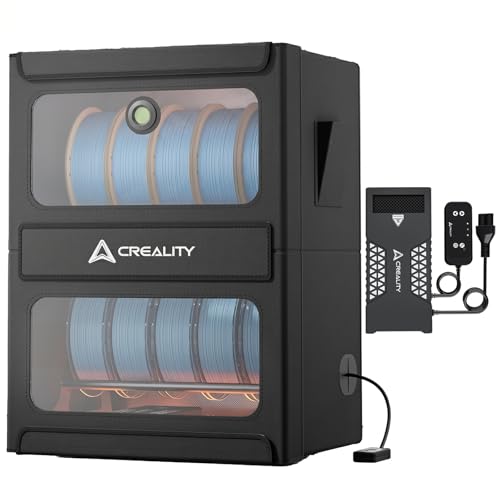
- Dries and stores multiple spools simultaneously
- Supports up to 10 kg of filament
- Reaches 70°C with timed drying up to 48 hours
Best For: Large school makerspaces with multiple printers and spools
Best for Multi-Material Workflows

- Two independent chambers hold four 1 kg spools
- 45°C–85°C range suits varied materials
- Automatic humidity-based drying and safety monitoring
Best For: Advanced school labs running multiple filament types
Fast, Flexible Drying

- Heats to 65°C in about 15 minutes
- Adjustable 45–65°C temperature and 0–24 hour timer
- Supports 1 kg spools and common filament types
Best For: Classrooms drying one standard spool at a time
Dual-Spool Classroom Storage

- Stores two 1 kg spools in its inner compartment
- Monitors temperature and humidity on an LCD screen
- Sealed outlet supports dry feeding during printing
Best For: Makerspaces needing two-spool storage and moderate-temperature drying
High-Capacity Batch Drying

- Holds four 1 kg or two 2 kg spools
- Dual independent 200 W heating chambers
- Supports common and advanced filament materials
Best For: High-volume school makerspaces running multiple printers
High-Capacity Classroom Pick – SUNLU S4 4-Spool Dryer
For schools running several printers, the SUNLU S4 is a practical choice among filament dryers for schools because it can dry up to four 1kg spools at once while supporting printing. Its three fans, 350W PTC heater, and adjustable 35–70°C temperature range are suited to shared labs and varied materials.
Best For: School makerspaces that need high capacity and support for multiple printers.
Pros:
- Holds up to four 1kg spools and offers eight filament exit holes.
- Three circulation fans and 360-degree surround heating promote even drying.
- Supports common materials including PLA, PETG, ABS, TPU, PA, PC, and Nylon.
- Temperature and timer settings can be adjusted for different filament needs.
Cons:
- Its 460 × 220 × 310mm exterior requires substantial bench space.
- At 4kg, it is less convenient to move between classrooms.
- The 350W heater may be more capacity than a small instructional lab needs.
The S4 stands out when throughput matters. Its large footprint is easier to justify in a dedicated makerspace than in a compact classroom, but the four-spool capacity can reduce waiting between student print projects.
Organized Lab Storage – Creality Space Pi X4 4-Spool Dryer
The Creality Space Pi X4 combines drying and storage in a four-spool enclosure, making it a useful option among filament dryers for schools. Dual independent 200W heating chambers can reach 85°C, while the sealed enclosure helps limit moisture re-absorption during pauses and printing.
Best For: High-volume school labs that want drying plus ongoing filament storage.
Pros:
- Holds four standard 1kg spools or two large 2kg spools.
- Dual heating chambers provide separate 200W heating and up to 85°C.
- Sealed storage helps maintain humidity control between printing sessions.
- Supports 1.75mm and 2.85mm filament and a broad range of materials.
Cons:
- The dual-chamber design may be more than a small class requires.
- The supplied notes do not specify a timer range or detailed dimensions.
- Higher-temperature operation requires careful material-specific settings.
This model is particularly appealing for schools that need to keep several spools ready across multiple lessons. Its storage-focused design can help reduce repeated setup, while the two chambers add flexibility for different filament conditions.
Easy-Use Classroom Option – SUNLU S2 Single-Spool Dryer
The SUNLU S2 is a straightforward choice for schools that need a compact way to revive damp filament and feed it directly to a printer. Its touch controls, translucent lid, and adjustable 35–70°C temperature and 0–99-hour timer make routine classroom operation simple.
Best For: Smaller classrooms or school labs that typically prepare one spool at a time.
Pros:
- Can dry filament while it serves as a spool holder during printing.
- Large touch screen simplifies temperature and time adjustments.
- Supports 1.75mm, 2.85mm, and 3.00mm filament diameters.
- Translucent lid allows visual checks without opening the dryer.
Cons:
- Its listed capacity is smaller than the four-spool alternatives.
- Temperature tops out at 70°C, limiting higher-temperature drying needs.
- A single-spool workflow may slow a busy multi-printer lab.
The S2 favors ease of use over throughput. For introductory programs, occasional printing, or a classroom with one primary printer, its simple interface and compact listed dimensions can be more practical than a larger shared dryer.
Dry-and-Store Specialist – Polymaker PolyDryer
The Polymaker PolyDryer takes a connected approach to filament care, combining a heated Dry Dock with a sealed storage box. For schools comparing filament dryers for schools, its ability to dry, store, and print without breaking the seal can simplify material management between student projects.
Best For: Programs that prioritize sealed storage and moisture monitoring alongside drying.
Pros:
- Supports a dry, store, and print workflow without breaking the seal.
- Built-in hygrometer helps staff monitor storage conditions.
- Combines heated drying, sealing, desiccant support, and 360-degree airflow.
- Works with PA Nylon, PLA, PVB, PETG, ABS, ASA, TPU, and multiple diameters.
Cons:
- The supplied notes do not specify temperature settings or drying times.
- Its storage-box design is less suited to high-volume, multi-spool drying.
- The setup is centered on one 1kg spool.
PolyDryer is a strong fit when filament organization and moisture protection matter as much as active drying. It may be less suitable for a large lab processing several spools simultaneously, but its sealed workflow can reduce handling between classes.
Best All-Around Pick – SUNLU S1 Plus Filament Dryer
For schools seeking practical filament dryers for schools, the SUNLU S1 Plus offers straightforward drying, storage, and monitoring for common classroom 3D-printing materials. Its fan-assisted design and adjustable controls are useful for improving consistency without taking up much space.
Best For: Classrooms that need a compact dryer for one spool and a range of filament types.
Pros:
- Fan-assisted drying helps address stringing, clogging, and poor adhesion caused by damp filament.
- 2-inch LCD displays temperature, time, and humidity.
- Adjustable temperature from 35°C to 55°C and support for 1.75 mm, 2.85 mm, and 3.00 mm filament.
- Can dry filament while printing and includes a one-year warranty.
Cons:
- Its stated capacity is limited to one spool-sized compartment.
- The maximum temperature may be less suitable for materials needing higher-temperature drying.
The S1 Plus is a sensible choice when ease of use, broad filament compatibility, and a small footprint matter more than multi-spool capacity or high-temperature operation.
Best for Bulk Storage – Creality Multi-Roll Filament Dryer
For schools managing several printers or shared filament supplies, the Creality Multi-Roll Filament Dryer combines drying and long-term storage in one large-capacity setup. Its enclosed design and timed heating can help organize a busy makerspace while reducing moisture-related printing problems.
Best For: School makerspaces that need to dry and store multiple spools together.
Pros:
- Stores and dries multiple filament spools, with capacity for up to 10 kg.
- 400W PTC hot-air heating reaches up to 70°C and supports one- to 48-hour timed drying.
- Power-off temperature memory helps simplify repeated use.
- Fire-retardant interior and an Oxford-fabric exterior designed to remain below 50°C during operation.
Cons:
- Its 13-pound weight and larger multi-roll format may be excessive for a small classroom.
- The supplied notes do not specify a display for humidity or temperature monitoring.
This model is most compelling for schools prioritizing capacity and organized filament storage. The detachable heating module and foldable cover also support flexible installation when space or workflow changes.
Best for Multi-Material Workflows – Comgrow SH03 Filament Dryer
The Comgrow SH03 is designed for schools that regularly use different filament materials and need separate control over drying cycles. Its dual chambers, automatic humidity-based mode, and extensive monitoring features make it suited to more demanding classroom or makerspace workflows.
Best For: Advanced school labs drying up to four spools and multiple filament types at once.
Pros:
- Dual independent chambers hold up to four 1 kg spools and allow separate temperature and power control.
- Adjustable 45°C–85°C range supports materials including PLA, ABS, PETG, TPU, ASA, PA, and PC.
- Automatic mode responds to humidity and can enter energy-saving storage mode after drying.
- 360° hot-air circulation, touchscreen controls, and four protection and monitoring systems support controlled operation.
Cons:
- Its advanced controls may be more complexity than a basic classroom setup requires.
- Dual 200W heating modules may demand more power than a single-spool dryer.
The SH03 offers the most control of these options for schools with varied materials and heavier printing schedules. Independent chambers are especially useful when different spools require different drying settings.
Fast, Flexible Drying – Creality Space Pi SE
For schools seeking filament dryers for schools, the Creality Space Pi SE is a practical single-spool option with quick heating, adjustable settings, and compatibility with common classroom filaments. Its controls and humidity display also make routine operation easier for students and staff.
Best For: Classrooms that need straightforward drying for one standard 1 kg spool at a time.
Pros:
- Heats to 65°C within 15 minutes using circulated hot air and insulation.
- Adjustable temperature from 45°C to 65°C and drying time from 0 to 24 hours.
- Supports 1 kg spools and 1.75 mm or 2.85 mm filament, including PLA, PETG, ABS, ASA, and TPU.
- Display and knob provide humidity monitoring and countdown timing.
Cons:
- Holds only one standard 1 kg spool.
- Filament should be moved to a vacuum bag after drying for longer-term storage.
The Space Pi SE suits schools that prioritize simple controls and broad filament support over high-volume batch drying. Its 24-hour timer and adjustable heat give instructors useful flexibility across different materials.
Dual-Spool Classroom Storage – Comgrow SH01 Filament Dryer
The Comgrow SH01 is a useful choice among filament dryers for schools when a classroom needs to hold two spools in a sealed enclosure. It combines drying and in-printer storage, with temperature and humidity monitoring on a compact LCD screen.
Best For: School makerspaces that want larger storage capacity and continued moisture protection during printing.
Pros:
- Inner compartment stores two 1 kg spools.
- Works with standard 1.75 mm and 2.85 mm filament diameters.
- Sealed cover, silicone outlet, and Teflon tube help maintain a dry feeding path.
- LCD screen provides real-time temperature and humidity information.
Cons:
- Temperature range is limited to 40°C–50°C.
- Drying time settings are limited to 6–12 hours.
- The sealing hole must be opened while drying and closed when storing.
This model is especially practical where teachers need two rolls ready for use without repeatedly opening the box. Its lower maximum temperature makes it less suitable for materials requiring more aggressive drying conditions.
High-Capacity Batch Drying – Creality Space Pi X4L
For busy school labs, the Creality Space Pi X4L offers the capacity of a four-spool filament dryer with dual independent heating chambers. It is designed for classrooms that run multiple printers and use both everyday and higher-temperature materials.
Best For: High-volume school makerspaces that need to dry or store several spools at once.
Pros:
- Holds four standard 1 kg spools or two large 2 kg spools.
- Dual independent 200 W chambers provide separate heating areas.
- Supports temperatures from common 50°C–60°C settings up to 70°C–75°C for advanced filaments.
- Silicone-sealed storage helps limit moisture reabsorption during pauses.
Cons:
- Larger and heavier than single- or dual-spool dryers.
- The supplied notes list a maximum temperature inconsistently as 75°C and 85°C.
- Its greater capacity may be more than a small classroom needs.
The Space Pi X4L is the strongest fit for a shared school print lab where throughput and material range matter. Its multi-spool design can reduce repeated drying cycles, while the sealed enclosure helps keep prepared filament ready between print jobs.
How We Picked These Filament Dryers for Schools
We focused on practical classroom needs rather than maximum specifications alone. The selection includes compact dryers for individual printers, larger units for makerspaces, and models that can both dry and store filament during ongoing projects. We considered spool capacity, advertised temperature range, heating design, sensor and control features, enclosure practicality, and how easily students or staff can monitor a drying cycle.
Because filament types vary, temperature flexibility matters. PLA, PETG, TPU, and nylon do not all need the same treatment, so a useful dryer should offer appropriate settings instead of relying on a single high-heat mode. Product names and specifications can vary by seller or revision, so confirm the current manual and operating limits before purchasing.
Quick Comparison
| School need | Best fit among these options | What to prioritize |
|---|---|---|
| One printer or small class | Compact single- or dual-spool dryer | Simple controls, quiet operation, and a small footprint |
| Shared makerspace | Four-spool dryer | Capacity, independent control, and reliable heat circulation |
| High-throughput lab | Large multi-roll system | Roll capacity, safe organization, and easy access |
| Nylon and other moisture-sensitive materials | Higher-temperature model | Accurate temperature control and longer drying support |
Key Buying Factors for Filament Dryers for Schools
Capacity and Workflow
Match capacity to actual usage. A single-spool dryer may be easier to manage in a classroom, while four-spool or larger units reduce waiting in a busy lab. Independent chambers are useful when different materials require different settings.
Temperature Control
Look for adjustable settings, clear controls, and a stated operating range that covers the filaments your school uses. Higher maximum temperature is not automatically better; accuracy and appropriate presets are more important for routine PLA and PETG work.
Storage and Feeding
A dryer that lets students print while filament remains enclosed can reduce reabsorption of moisture. Check whether the design supports your spool sizes, has practical outlet paths, and leaves enough room for loading without tangles.
Safety and Supervision
Choose a stable enclosure with clear status information and sensible heat management. Place the unit on a nonflammable, ventilated surface, follow the manufacturer’s instructions, and use staff-approved procedures for unattended operation.
Who Should Buy Which Filament Dryers for Schools?
Choose a compact SUNLU or Comgrow model when space, simplicity, and one- or two-spool operation matter most. These are suitable for individual classrooms or a teacher’s prep area.
Choose a four-spool Creality or Comgrow dryer for a makerspace that regularly rotates materials. The extra capacity can reduce queues, especially when several printers share one drying station.
Choose a larger Creality multi-roll model when the lab has high material turnover and needs centralized storage. For nylon or advanced engineering filaments, prioritize a model with a suitable temperature range, precise sensing, and clear manufacturer guidance rather than capacity alone.