
The best compact power amplifiers deliver useful power without taking over your listening space. Whether you need a desktop stereo amp, a Bluetooth upgrade, or a small PA solution, the right model balances output, connectivity, speaker compatibility, and heat management.
We compared 10 compact options across Class-D stereo designs, multi-channel automotive amplifiers, Bluetooth receivers, and public-address models to help you choose the right fit for your system.
Best 10 Compact Power Amplifiers Picks for 2026
High-Power Desktop Pick

- Up to 300W per channel
- Bass and treble controls
- RCA input for passive speakers
Best For: High-output desktop, home-theater, and bass-shaker setups
Compact Car Installation Pick

- Four Class-D channels
- 45W per channel at 4 ohms
- High- and low-level inputs
Best For: Space-limited four-channel vehicle audio installations
Precision Hi-Fi Pick

- 140W per channel at 4 ohms
- Balanced TRS and RCA inputs
- TRIG auto-power synchronization
Best For: Compact Hi-Fi and studio-monitoring systems
Wireless Upgrade Pick
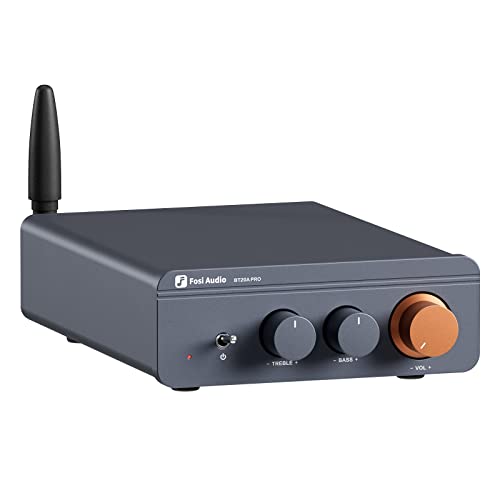
- Bluetooth 5.0 streaming
- Up to 300W per channel
- Replaceable op-amps and tone controls
Best For: Wireless home or outdoor passive-speaker systems
Versatile PA Control

- 60W output with 4/8/16-ohm, 25V, and 70V speaker options
- Two microphone inputs with MIC 1 auto talkover
- AUX, paging, telephony, and music-on-hold connections
Best For: Small commercial PA and paging installations
High-Power Mini Hi-Fi

- TPA3255 Class D design with claimed 300W x 2 capability
- Drives 2- to 8-ohm passive bookshelf speakers
- AUX pre-out supports active speakers or a powered subwoofer
Best For: Compact high-output desktop and bookshelf-speaker systems
Simple Desktop Value
Fosi Audio V1.0G Mini Stereo Amp

- Two-channel Class D output rated at 50W x 2
- TPA3116D2 chip with speaker protection circuitry
- Includes power adapter, AC cord, and manual
Best For: Basic desktop and small-room passive-speaker systems
Best Feature-Rich Option
Pyle PDA29BU.5 Stereo Amplifier

- 100W RMS and 200W peak power
- Bluetooth, FM, USB, SD, RCA, and AUX
- Adds microphone inputs and remote control
Best For: Home audio, computer audio, and karaoke
High-Power Desktop Pick – Fosi Audio TB10D
For shoppers comparing compact power amplifiers, the Fosi Audio TB10D is a flexible two-channel option for passive speakers and bass-shaker setups. Its TPA3255-based design provides up to 300 watts per channel, while bass and treble controls make quick sound adjustments simple.
Best For: Desktop, living-room, home-theater, and gaming systems using passive speakers or a bass shaker.
Pros:
- Up to 300 watts per channel for 2–8-ohm passive speakers.
- RCA input and passive-speaker output support common audio sources.
- Includes bass, treble, power controls, and built-in protection circuits.
Cons:
- Provides RCA connectivity rather than the broader input options found on some models.
- Its high output may be more than needed for modest desktop speaker systems.
The TB10D is a practical choice when you want substantial power in a small enclosure and prefer straightforward wired connectivity with basic tone shaping.
Compact Car Installation Pick – Sony XMS400D
Among compact power amplifiers, the Sony XMS400D stands out for car audio installations that need four channels without taking up much space. Its Class-D design delivers 45 watts per channel at 4 ohms and includes filtering and protection features for a practical installation.
Best For: Vehicle audio systems needing a small four-channel amplifier with flexible input and filter options.
Pros:
- Four-channel configuration in a compact 1.8-pound design.
- Supports both high-level and low-level input connections.
- Includes low-pass and high-pass filters, protection circuitry, and high-level sensing power-on.
Cons:
- Continuous output is 45 watts per channel at 4 ohms, lower than the power ratings of several two-channel alternatives.
- It is designed around vehicle audio rather than home stereo use.
The XMS400D is best viewed as a space-conscious car amplifier for expanding a vehicle system across four channels while retaining installation flexibility.
Precision Hi-Fi Pick – TOPPING Mini300
The TOPPING Mini300 is one of the more measurement-focused compact power amplifiers in this group. Its fully balanced Class-D architecture, 140 watts per channel at 4 ohms, and support for balanced TRS and unbalanced RCA inputs make it a strong fit for detailed desktop, Hi-Fi, and studio-monitoring systems.
Best For: Users building compact Hi-Fi or studio-monitoring systems around DACs, preamps, or audio interfaces.
Pros:
- Fully balanced design with listed THD+N below 0.0004% at 8 ohms and 5 watts.
- Accepts both balanced TRS and unbalanced RCA inputs.
- TRIG auto-power synchronization and overheat/overcurrent protection add convenience and safety.
Cons:
- Requires a compatible source or preamp for a complete system.
- Its 12-volt DC power design may require more setup consideration than a conventional integrated receiver.
Choose the Mini300 when clean specifications, balanced connectivity, and automated system control matter more than built-in source features or tone controls.
Wireless Upgrade Pick – Fosi Audio BT20A Pro
For buyers who want compact power amplifiers with wireless convenience, the Fosi Audio BT20A Pro combines Bluetooth 5.0 with up to 300 watts per channel for passive speakers. It also adds bass and treble controls and replaceable op-amps for listeners interested in customizing the system.
Best For: Home or outdoor stereo setups that need Bluetooth streaming, high output, and optional op-amp experimentation.
Pros:
- Bluetooth 5.0 provides wireless source connectivity with pairing memory.
- Up to 300 watts per channel from the TPA3255-based Class-D design.
- Replaceable op-amps and bass/treble controls support sound customization.
Cons:
- Bluetooth pairing is the primary convenience feature; wired source details are limited in the supplied information.
- Its high power can exceed the needs of smaller passive-speaker systems.
The BT20A Pro is a compelling match for listeners who want a small, powerful amplifier with wireless streaming and more tuning potential than a basic plug-and-play unit.
Versatile PA Control – Compact 60W Pyle PCM30A
The Pyle PCM30A is one of the more practical compact power amplifiers for paging, background music, and small public-address installations. Its 60-watt output, multiple speaker impedance options, microphone inputs, and 25V/70V support make it better suited to distributed audio than a typical desktop stereo amp.
Best For: Offices, shops, small venues, paging systems, and installations needing microphone and music-on-hold connections.
Pros:
- Supports COM, 4-, 8-, and 16-ohm speakers plus 25V and 70V outputs.
- Offers five input functions, including AUX RCA, two microphone terminals, paging, and telephony connections.
- Includes independent input volume controls, bass and treble adjustment, and MIC 1 talkover.
- Compact chassis measures about 10.7 by 8.9 by 3.46 inches.
Cons:
- Its feature set is focused on PA and installed audio rather than high-fidelity home stereo use.
- The 60-watt output is less powerful than larger commercial amplifiers.
- It uses wired terminals and RCA connections rather than modern wireless streaming.
The PCM30A stands out when you need flexible speaker distribution and microphone control in a compact enclosure. Choose it over a mini hi-fi amp when paging, talkover, or commercial speaker outputs are central requirements.
High-Power Mini Hi-Fi – AIYIMA A07 TPA3255 Amplifier
The AIYIMA A07 is a compact power amplifier aimed at passive bookshelf speakers and desktop hi-fi systems. Its Class D TPA3255 platform, two-channel design, and AUX pre-out provide a small footprint with substantial claimed power and a straightforward path to adding powered equipment.
Best For: Audiophile-oriented desktop systems, passive bookshelf speakers, and compact 2.1 setups with a powered subwoofer or active speakers.
Pros:
- Uses a TI TPA3255 Class D amplifier chip and NE5532 dual op-amp.
- Designed to drive 2- to 8-ohm passive speakers.
- 3.5mm AUX pre-out can feed active speakers, a powered subwoofer, or another amplifier.
- Full-metal housing, upgraded cooling, and swappable op-amp support add flexibility.
Cons:
- It does not support Wi-Fi.
- The included 32V/5A adapter may not deliver the maximum claimed 300W-per-channel output.
- It is a basic integrated amp without the input variety of a full-size receiver.
The A07 is a strong fit for listeners who want high output from a very small, two-channel enclosure. Its pre-out and replaceable op-amp make it more expandable than many entry-level mini amplifiers, though the power claims depend on the power supply used.
Simple Desktop Value – Fosi Audio V1.0G Mini Stereo Amp
The Fosi Audio V1.0G is a straightforward choice among compact power amplifiers for small home speaker systems. Its two-channel TPA3116D2 Class D design delivers up to 50 watts per channel, while the aluminum chassis and included power supply keep the setup simple.
Best For: Desktop listening, small home stereo systems, passive bookshelf speakers, and users who want a compact plug-and-play amplifier.
Pros:
- Provides two-channel output rated at 50 watts per channel.
- Uses the efficient TI TPA3116D2 Class D amplifier chip.
- Includes speaker protection circuitry and is designed for quiet, cool operation.
- Package includes the amplifier, power adapter, AC cord, and user manual.
Cons:
- Its input and control options are more limited than those of a PA or full-size receiver.
- It is intended for basic stereo amplification rather than microphone or distributed-audio applications.
- The supplied specifications list a maximum output of 100 watts total, so it is not aimed at demanding large-room systems.
The V1.0G makes sense when you need clean, uncomplicated amplification in a very small enclosure. It offers less connectivity and output headroom than the other options here, but its included accessories and efficient Class D design suit everyday desktop or small-room use.
Best Desktop Pick – Facmogu F900S Mini Bluetooth Amplifier
The Facmogu F900S is one of the more versatile compact power amplifiers for desktop audio, workshops, RVs, and other space-limited setups. It delivers 50W per channel and supports Bluetooth 5.0, USB, and 3.5mm AUX sources for passive speakers.
Best For: Desktop systems, racing simulators, RVs, workshops, and garages that need a small stereo amplifier with multiple inputs.
Pros:
- 50W x 2 stereo output from a compact enclosure
- Bluetooth 5.0, USB, and AUX input options
- Includes a 12V power adapter and useful connection cables
- Small footprint fits easily under a monitor or in tight spaces
Cons:
- Designed for passive speakers and is not compatible with Amazon Echo or Alexa
- Power-on sound cannot be changed, and mode switching includes a voice announcement
The F900S stands out when you want strong two-channel output without sacrificing desk or installation space. Its practical input selection and included accessories make it a convenient choice for straightforward passive-speaker setups.
Best Feature-Rich Option – Pyle PDA29BU.5 Stereo Amplifier
The Pyle PDA29BU.5 is a feature-rich choice among compact power amplifiers, combining 100W RMS output with Bluetooth, FM radio, USB, SD, RCA, AUX, and microphone inputs. Its controls and display are suited to flexible home audio and karaoke-style use.
Best For: Home audio, computer systems, karaoke, and users who want numerous source inputs plus microphone support.
Pros:
- 100W RMS continuous output and 200W peak power
- Wide source selection, including Bluetooth, FM, USB, SD, RCA, and AUX
- Two 1/4-inch microphone inputs for karaoke or announcements
- Includes LED display, remote control, and FM antenna
Cons:
- More feature-packed than necessary for a simple stereo setup
- Its 7 x 6.2 x 2.4-inch size is less miniature than the smallest desktop amps
Choose the PDA29BU.5 when input flexibility matters more than minimalist design. It provides substantially more connectivity and control than a basic Bluetooth amplifier while remaining relatively compact for an indoor receiver.
Best Ultra-Compact Choice – Nobsound Mini Bluetooth Amplifier
The Nobsound Mini is a hand-sized option for shoppers seeking compact power amplifiers with simple connectivity and a clean desktop footprint. Its upgraded design provides 50W per channel, while Bluetooth 5.0, USB, and AUX inputs cover common computer and home audio sources.
Best For: Desktop, office, and home audio systems where minimal size, included accessories, and straightforward setup are priorities.
Pros:
- 50W x 2 output in a compact aluminum enclosure
- Bluetooth 5.0, USB, and AUX input support
- USB playback works without a driver and can provide lossless computer playback
- Includes power supply, AUX, USB, and RCA cables
Cons:
- It is a basic two-channel amplifier without the broader controls or inputs found on larger receivers
- Supplied product information references both a 19V power supply and other voltage specifications, so buyers should verify the included power adapter
The Nobsound is a strong fit when you want a very small amplifier that is ready for a computer or desktop system. Its aluminum body, multiple everyday inputs, and included cables keep installation simple without taking up much space.
How We Picked These Compact Power Amplifiers
We focused on amplifiers that offer a small footprint while still providing practical performance for their intended use. The selection includes two-channel home audio models, four-channel automotive amplification, Bluetooth-enabled units, and PA-oriented designs with microphone and distributed-audio connections.
Our comparison emphasizes stated power ratings, supported speaker loads, input and output options, wireless features, amplifier topology, controls, and likely installation requirements. Because wattage claims can vary by impedance, power supply, and measurement conditions, treat headline figures as a starting point rather than a direct guarantee of real-world loudness.
Quick Comparison
- Best for compact home stereo: Look for a two-channel Class-D amplifier with a dedicated power supply and straightforward RCA, AUX, or Bluetooth inputs.
- Best for high-output passive speakers: Models using platforms such as the TPA3255 generally offer more headroom, provided the power supply and speaker impedance are appropriate.
- Best for flexible wireless listening: Bluetooth-equipped amplifiers are convenient for phones, tablets, and computers, but wired inputs remain valuable for consistent source quality.
- Best for multiple zones or microphones: PA-style models with microphone inputs and 25V/70V outputs suit announcements and distributed audio better than ordinary home stereo amps.
- Best for vehicle installations: A dedicated multi-channel car amplifier is designed around automotive power and wiring requirements rather than household AC operation.
Key Buying Factors for Compact Power Amplifiers
Power, Impedance, and Headroom
Check both the amplifier’s output rating and your speakers’ impedance. An amp rated at a particular wattage may reach that figure only at a specific load or distortion level. Choose enough clean headroom for your room and listening habits, but avoid pairing an amplifier with speakers it cannot safely drive.
Inputs and Everyday Connectivity
Bluetooth is useful for casual streaming, while RCA and AUX inputs support streamers, turntables with a suitable preamp, televisions, and computers. USB or SD playback can be convenient, but confirm which file formats are supported. Microphone inputs and FM tuners are specialized features rather than universal advantages.
Cooling, Power Supply, and Installation
Compact Class-D designs are efficient, but they still need ventilation. Leave space around the chassis and avoid enclosing it in a sealed cabinet. Also verify whether the included power supply provides the advertised performance; replacing it with an incompatible adapter can cause noise, instability, or damage.
Controls and Speaker Connections
Front-panel volume and tone controls are convenient for simple systems. Confirm whether the amplifier uses binding posts, spring terminals, banana-compatible terminals, or bare-wire connections, and check that the included cables match your installation.
Who Should Buy Which Compact Power Amplifiers?
Choose a simple two-channel mini amplifier if you are powering bookshelf speakers, a desktop pair, or a small passive stereo system. Select a higher-output TPA3255-based design when you need more volume and dynamic headroom. A Bluetooth model is ideal for casual wireless streaming, while a USB- or SD-equipped unit suits listeners who play files directly from storage.
For announcements, background music, or multiple speakers over longer cable runs, choose a PA amplifier with microphone support and compatible 25V or 70V outputs. For a car, use the dedicated automotive four-channel option and follow its installation and fuse requirements. Finally, remember that the smallest amplifier is not automatically the best choice: match its power, inputs, and electrical design to the speakers and source equipment you already own.