
The right case does more than complete a gaming build. It determines how easily you can install components, manage cables, control temperatures, and upgrade later.
We selected 10 computer cases for gaming PCs with practical differences in airflow, included fans, radiator support, motherboard compatibility, and front-panel connectivity, so you can match the case to your hardware and budget.
Best 10 Computer Cases for Gaming PCs Picks for 2026
Best Panoramic Cooling Value

- Seven pre-installed PWM ARGB fans
- 270° dual-tempered-glass view
- Supports 400 mm GPUs and 360 mm radiators
Best For: Showcase ATX builds needing extensive included cooling
Best High-Clearance Build

- Fits GPUs up to 420 mm
- Supports 360 mm top radiators
- Includes four PWM ARGB fans
Best For: Large-component ATX and back-connect builds
Best Airflow-Focused Upgrade Base

- Mesh front panel for airflow
- Supports up to eight 120 mm fans
- Fits 360 mm front radiators
Best For: Custom cooling setups and practical ATX builds
Best Airflow Pick

- Mesh front with four included 120mm ARGB fans
- Supports 340mm GPUs and 360mm radiators
- Tempered glass, dust filter, and seven PCIe slots
Best For: ATX builders prioritizing airflow and included lighting
Best High-Capacity Design

- Fits GPUs up to 420mm
- Supports up to ten fans or a 360mm AIO
- Adds USB Type-C and a GPU support bracket
Best For: ATX builds with large graphics cards and expansive cooling plans
Best Budget-Friendly Pick
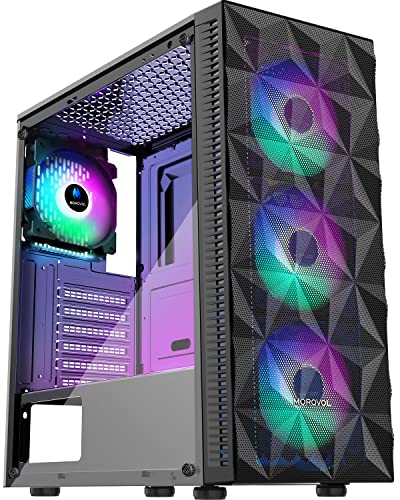
- Four pre-installed 120mm RGB fans
- Supports ATX, Micro-ATX, and Mini-ITX
- Diamond-mesh front and tempered-glass side panel
Best For: Budget builds using standard-size components and fixed RGB lighting
Best Showpiece White Case
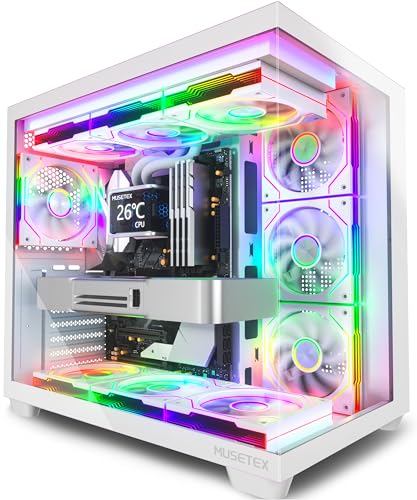
- Seven pre-installed Infinity Mirror ARGB fans
- 270° tempered-glass viewing
- Supports GPUs up to 410mm and 360mm radiators
Best For: Showcase-style white gaming builds
Best High-Capacity Airflow Case

- Eight pre-installed PWM ARGB fans
- Supports 420mm radiator configurations
- Dual-chamber layout with room for E-ATX builds
Best For: Large, heavily cooled enthusiast systems
Best Easy-Access Mid-Tower

- Six pre-installed PWM ARGB fans
- Opening tempered-glass side panel
- Flexible storage and 280mm top-radiator support
Best For: Upgradeable builds needing convenient maintenance access
Best Panoramic Cooling Value – MUSETEX K2 ATX Gaming Case
For builders comparing computer cases for gaming pcs, the MUSETEX K2 combines a broad dual-tempered-glass view with substantial included cooling. Its seven pre-installed PWM ARGB fans, expandable fan support, and roomy ATX layout make it a practical choice for high-performance, showcase-oriented builds.
Best For: ATX gaming builds that prioritize included fans, RGB presentation, and component visibility.
Pros:
- Includes seven PWM ARGB fans and supports up to 10 total.
- 270° panoramic dual-tempered-glass design showcases components.
- Supports GPUs up to 400 mm, CPU coolers up to 165 mm, and top radiators up to 360 mm.
- Provides front-panel USB-C, two USB 3.0 ports, and separate restart controls.
Cons:
- Power-supply clearance is more limited with the hard-drive cage installed.
- The included hardware and radiator are not included.
The K2 is a strong value-oriented option when cooling and visual presentation matter equally. Check your power-supply clearance carefully if you plan to retain the drive cage.
Best High-Clearance Build – Lian Li V100RX Mid-Tower Case
The Lian Li V100RX is a flexible pick among computer cases for gaming pcs, especially for builders using large graphics cards or liquid cooling. It arrives with four PWM-controlled ARGB fans, supports several motherboard layouts including back-connect designs, and uses tool-less side panels for easier access.
Best For: High-end ATX or Micro-ATX systems that need generous GPU, cooler, and radiator clearance.
Pros:
- Supports GPUs up to 420 mm, CPU coolers up to 178 mm, and top radiators up to 360 mm.
- Includes four 120 mm PWM ARGB fans with daisy-chain connectivity.
- Supports ATX, Micro-ATX, Mini-ITX, and compatible back-connect motherboards.
- Tool-less side panels simplify component access.
Cons:
- Only four internal bays are listed.
- Its included fan package is smaller than some cases with seven or more fans.
The V100RX stands out for clearance and build flexibility rather than maximum included fan count. It is a sensible match for large modern components and cleaner cable-routing layouts.
Best Compact Dual-Chamber Design – FOIFKIN F100 Mini-Tower Case
The FOIFKIN F100 is a compact option for shoppers seeking computer cases for gaming pcs without committing to a full ATX tower. Its dual-chamber layout separates the power supply and drives from the main hardware, while three pre-installed ARGB fans and support for two 240 mm radiators provide useful cooling flexibility.
Best For: Micro-ATX and Mini-ITX gaming systems with a compact footprint and visible components.
Pros:
- Dual-chamber construction helps separate hardware, power supply, and drives.
- Includes three 120 mm ARGB fans.
- Supports two 240 mm radiators simultaneously.
- Accommodates GPUs up to 320 mm and power supplies up to 170 mm.
Cons:
- Limited to Micro-ATX and Mini-ITX motherboards.
- Component clearance and storage capacity are more restricted than in larger mid-tower cases.
The F100 is best suited to compact builds where presentation and separated cable organization are priorities. Confirm GPU and PSU dimensions before purchasing, particularly for larger hardware.
Best Airflow-Focused Upgrade Base – DARKROCK EC2 ATX Case
The DARKROCK EC2 offers a straightforward foundation for computer cases for gaming pcs, pairing a mesh front panel with flexible fan and radiator support. It also includes magnetic top and bottom dust filters, a tempered-glass side panel, and Type-C readiness for a practical gaming build.
Best For: Builders who want to choose their own cooling setup in an airflow-oriented ATX mid tower.
Pros:
- Mesh front panel supports efficient airflow.
- Supports up to eight 120 mm fans and a front-mounted 360 mm radiator.
- Fits ATX, Micro-ATX, and Mini-ITX motherboards.
- Supports GPUs up to 340 mm and power supplies up to 200 mm.
Cons:
- Only one fan is pre-installed.
- Its 340 mm GPU limit is lower than some competing cases.
- Cooling hardware must be selected separately.
The EC2 makes sense for buyers who already have preferred fans or want to tailor the cooling configuration. Its roomy PSU support and dust-filtered mesh design provide a useful base, but budget for additional fans.
Best Airflow Pick – GAMDIAS AURA GC1 ELITE ARGB
If you want computer cases for gaming PCs with strong out-of-the-box airflow, the GAMDIAS AURA GC1 ELITE ARGB is a practical mid-tower option. Its mesh front and four included 120mm ARGB fans support ventilation while the tempered-glass side panel displays your components.
Best For: Gamers building an ATX, Micro-ATX, or Mini-ITX system who want included ARGB fans and broad cooling support.
Pros:
- Mesh front panel and four pre-installed 120mm ARGB fans promote airflow.
- Supports graphics cards up to 340mm, 360mm radiators, and CPU coolers up to 160mm.
- Includes a magnetic dust filter, PSU shroud, seven PCIe slots, and tool-free tempered-glass access.
Cons:
- Offers only one USB 3.0 port alongside two USB 2.0 ports.
- Its 3.5-inch and 2.5-inch storage capacity is more limited than larger cases.
The AURA GC1 ELITE ARGB balances airflow, component compatibility, and visual appeal. It is especially suitable when you want four included fans without giving up support for a full-size ATX build or a 360mm AIO.
Best High-Capacity Design – RUIX OV303 ATX Mid-Tower
The RUIX OV303 is one of the more spacious computer cases for gaming PCs, pairing four pre-installed ARGB fans with room for larger components. Its panoramic tempered-glass design, Type-C connectivity, and built-in GPU support bracket make it a feature-rich choice for an ATX build.
Best For: ATX gamers who need long-GPU clearance, flexible cooling capacity, and modern front-panel connectivity.
Pros:
- Includes four 120mm ARGB prism fans.
- Supports GPUs up to 420mm and up to a 360mm AIO liquid cooler.
- Provides USB 3.0 and Type-C ports, magnetic dust filters, and a built-in GPU support bracket.
Cons:
- Supports ATX motherboards only, limiting compatibility with smaller form factors.
- The three-tempered-glass-panel design may prioritize visual presentation over a simpler enclosure layout.
Choose the OV303 if expansion room and display-focused styling matter as much as cooling. Its generous GPU clearance and support bracket are useful for substantial graphics cards, while the dust filters help with routine maintenance.
Best Budget-Friendly Pick – MOROVOL 621 RGB Mid Tower
For shoppers comparing affordable computer cases for gaming PCs, the MOROVOL 621 offers a straightforward mid-tower setup with four pre-installed RGB fans and a diamond-mesh front panel. It supports ATX, Micro-ATX, and Mini-ITX motherboards, making it flexible for common budget builds.
Best For: Cost-conscious builders using compact-to-standard components and wanting included fixed RGB lighting.
Pros:
- Four included 120mm RGB fans provide airflow without requiring an immediate fan purchase.
- Supports ATX, Micro-ATX, and Mini-ITX motherboards.
- Accommodates up to two 2.5-inch SSDs and two 3.5-inch HDDs.
Cons:
- Fixed RGB lighting is not addressable.
- GPU clearance is limited to 300mm and CPU cooler height to 155mm.
- Front I/O includes USB 3.0 and USB 2.0 ports but no Type-C port.
The MOROVOL 621 is a sensible value option for a moderate-size gaming system. Check your graphics card, CPU cooler, and power-supply dimensions before buying, especially if you plan to use larger components.
Best Showpiece White Case – MUSETEX Y6
The MUSETEX Y6 is a visually focused option among computer cases for gaming pcs, pairing a white ATX mid-tower layout with 270° tempered-glass viewing and seven pre-installed Infinity Mirror ARGB fans. Its spacious interior supports current full-size components while keeping the build prominently on display.
Best For: Gamers who want a showcase-style white case with included lighting and broad component support.
Pros:
- Includes seven speed-adjustable PWM ARGB Infinity Mirror fans.
- 270° dual tempered-glass panels provide an expansive view of the build.
- Supports ATX, Micro-ATX, and Mini-ITX motherboards, GPUs up to 410mm, and top-mounted radiators up to 360mm.
- Provides a Type-C port alongside USB 3.0 and USB 2.0.
Cons:
- CPU cooler height is limited to 160mm.
- The white, highly visible design may not suit understated builds.
The Y6 makes the most sense when aesthetics, included fans, and component visibility are priorities. Check cooler and power-supply dimensions before purchasing to ensure your parts fit within its specified limits.
Best High-Capacity Airflow Case – HYXN H2
The HYXN H2 is a large dual-chamber choice among computer cases for gaming pcs, designed to separate core hardware from the power supply and drives. It arrives with eight PWM ARGB fans and supports unusually large radiator configurations for demanding, high-performance builds.
Best For: Enthusiasts planning a spacious E-ATX or ATX build with extensive liquid cooling and cable-management needs.
Pros:
- Includes eight ARGB PWM fans: six 140mm reverse fans and two 120mm forward fans.
- Supports 420mm radiators, including configurations with multiple large radiators.
- Accommodates E-ATX, ATX, Micro-ATX, and Mini-ITX motherboards plus GPUs up to 455mm.
- Dual-chamber construction provides a large rear cable-management compartment with Velcro straps and mounting points.
Cons:
- Its large dimensions may require more desk or floor space.
- The power-supply length limit is 220mm, so oversized units need checking.
Choose the H2 if radiator capacity, internal space, and clean wiring matter more than a compact footprint. Its broad compatibility makes it flexible, but verify the dimensions of your PSU, graphics card, and cooling hardware before assembly.
Best Easy-Access Mid-Tower – MUSETEX NN8
The MUSETEX NN8 stands out among computer cases for gaming pcs with six pre-installed PWM ARGB fans and a tempered-glass side panel that opens for easier cleaning and upgrades. Its mesh front and mid-tower layout balance component visibility with practical access.
Best For: Builders who frequently clean, upgrade, or showcase their components and want flexible storage options.
Pros:
- Includes six adjustable-speed PWM ARGB fans.
- Opening tempered-glass side panel simplifies access to components and dust cleaning.
- Supports up to a 280mm top radiator and multiple storage combinations, including up to five SSDs and one HDD.
- Offers two USB 3.0 ports and a diamond-mesh front panel for airflow.
Cons:
- Motherboard support is limited to ATX, Micro-ATX, and Mini-ITX.
- Graphics-card installation options and cooler compatibility should be checked against the specific build.
The NN8 is a practical pick for users who value maintenance access and storage flexibility as much as RGB presentation. Its opening side panel is especially useful for recurring upgrades, cleaning, and displaying accessories.
How We Picked the Best Computer Cases for Gaming PCs
We compared these cases by looking at the features that matter during a real build: motherboard support, internal clearance, airflow design, included fans, cooling compatibility, front-panel ports, cable-management space, and access to the components. We also considered whether each model suits a specific type of buyer, from first-time builders seeking a complete fan setup to enthusiasts planning a powerful, upgradeable system.
Included fans can add substantial value, but they should not be the only deciding factor. Fan quality, placement, mesh design, radiator clearance, and the ability to add or replace fans are equally important.
Quick Comparison
- Best for a ready-to-build setup: Models with six to eight pre-installed PWM or ARGB fans reduce the need for immediate upgrades.
- Best for airflow: Choose a mesh-front design with multiple intake positions and unobstructed exhaust paths.
- Best for showing off components: Panoramic tempered-glass cases emphasize RGB lighting and showcase builds.
- Best for compact systems: Micro-ATX cases save space, but verify graphics-card, power-supply, and radiator clearance before buying.
- Best for future upgrades: ATX mid-towers generally offer more room for storage, larger graphics cards, extra fans, and liquid cooling.
Key Buying Factors for Computer Cases for Gaming PCs
Motherboard and Component Compatibility
Confirm that the case supports your motherboard size—ATX, Micro-ATX, or another format. Then check maximum graphics-card length, CPU cooler height, power-supply length, and radiator support. A case can technically support your motherboard while still being too tight for a large GPU and front-mounted radiator together.
Airflow and Cooling
Prioritize a ventilated front or alternative intake design, removable dust filters, and enough fan mounts for balanced intake and exhaust. Pre-installed ARGB fans are convenient, but verify whether they use PWM control and whether the case includes the hubs or headers needed to connect them.
Build Convenience
Look for a removable or hinged side panel, generous cable-routing channels, a PSU shroud, tool-free drive mounts, and accessible front-panel connections. USB-C is particularly useful for newer peripherals, provided your motherboard has the appropriate internal header.
Expansion and Upgrade Room
Consider how many storage drives, expansion cards, fans, and radiators you may add later. Dual-chamber layouts can improve cable management and presentation, while traditional mid-towers may offer a simpler and more flexible installation process.
Who Should Buy Which Computer Cases for Gaming PCs?
Choose a fan-packed ATX case if you want strong out-of-the-box airflow and minimal extra spending. These are appealing for first builds and RGB-focused systems, but compare fan noise and controller support.
Choose a panoramic-glass case if appearance is central to your build. Plan component placement carefully, because expansive glass panels can provide less ventilation than a fully mesh front.
Choose a Micro-ATX case if desk space matters more than maximum expansion. It works well for compact gaming PCs, provided your selected GPU and cooling hardware fit.
Choose a spacious ATX or dual-chamber case for high-end hardware, custom cooling, extensive storage, or frequent upgrades. The extra room usually makes installation and cable management easier.
Before ordering, compare the case’s published clearance measurements with every major component in your planned build. That final check is the best way to avoid compatibility surprises.