
The right direct box can make an acoustic-electric guitar sound clearer, fuller, and more consistent through a PA, recording interface, or amplifier. It also helps match your instrument’s output to professional audio equipment while reducing noise and signal problems.
We’ve rounded up 10 practical options, including passive DIs for straightforward signal conversion and acoustic-focused preamps with EQ, notch filtering, and feedback control.
Best 10 Di Boxes for Acoustic Electric Guitars Picks for 2026
Feature-Rich Control
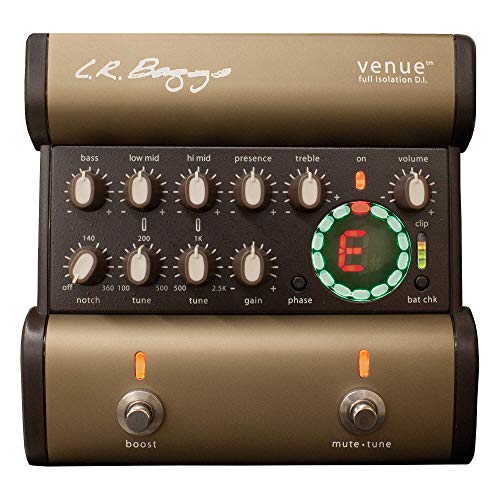
- Gain for passive or active pickups
- Five-band EQ and notch filter
- Tuner, mute, and volume boost
Best For: Performers wanting comprehensive acoustic-guitar stage control
Rugged Passive Routing
Radial Pro DI Passive Direct Box

- Passive mono direct-box design
- Custom transformer with XLR connectivity
- Durable stainless-steel construction
Best For: Live or studio signal routing with minimal controls
Flexible Acoustic Shaping

- Gain for passive and active pickups
- Five-band EQ with tunable bands
- 9V battery or 48V phantom power
Best For: Acoustic players needing detailed tone and feedback control
Budget Signal Conversion
Whirlwind IMP 2 Passive Instrument DI
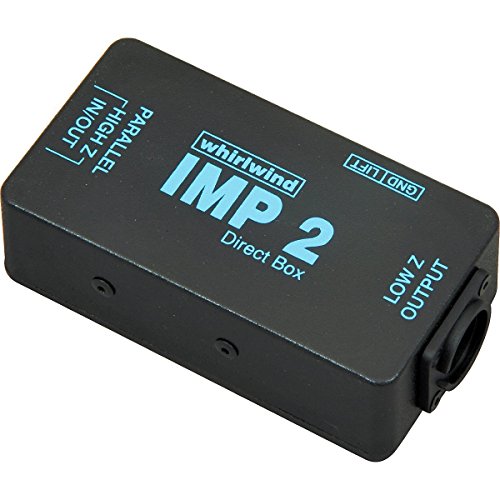
- Affordable one-channel passive design
- Converts unbalanced to balanced mic level
- Riveted transformer and stainless-steel body
Best For: Simple, durable, budget-conscious instrument routing
Warmth-Focused Acoustic DI

- Analog saturation adds warmth and harmonic content.
- Compression, EQ, and filtering shape the signal.
- Notch filter and high-pass control help manage feedback and low frequencies.
Best For: Live acoustic players who want extensive onboard tone control
Clean Active Direct Box

- 800k-ohm input impedance suits instrument signals.
- 48V phantom power supports active operation.
- Polarity switch and 15 dB pad add setup flexibility.
Best For: Players seeking a simple, compact active DI
Compact Acoustic Preamp DI
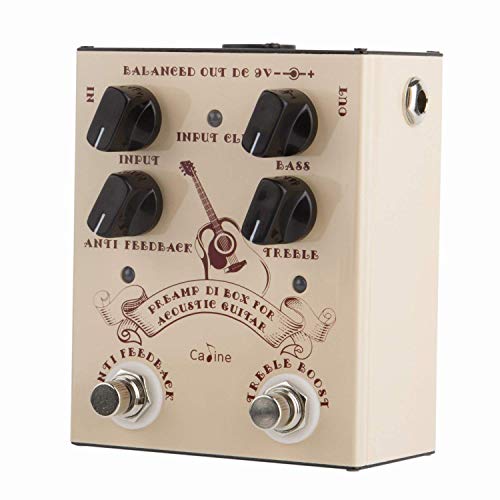
- True-bypass design supports flexible signal routing.
- Anti-feedback footswitch suits acoustic performance use.
- Higher boost and compact pedal format add live convenience.
Best For: Players wanting a compact acoustic preamp pedal with anti-feedback control
Simple Passive Choice
Hosa DIB-443 Sidekick Passive DI Box

- Converts 1/4-inch TS to balanced XLR
- Needs no external power
- Metal housing for live use
Best For: Straightforward acoustic-electric guitar connections to mixers and PA systems
Acoustic Tone-Shaping Pick
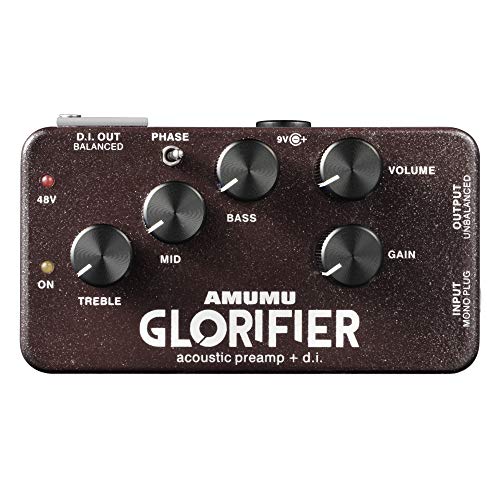
- Three-band EQ and +/-20 dB gain
- Phase switch for feedback control
- Runs on battery, DC, or phantom power
Best For: Acoustic players needing preamp controls and flexible DI connectivity
Compact Active Solution
Radial StageBug SB-4 Direct Box
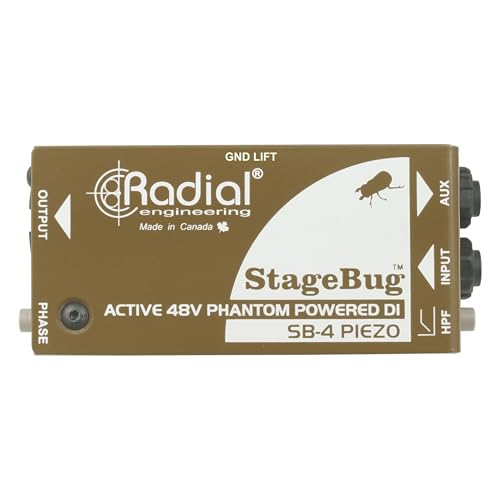
- Designed for piezo pickups
- Adds 1/4-inch auxiliary output
- Includes high-pass filter and polarity switch
Best For: Piezo acoustic-electric guitar rigs needing flexible stage routing
Feature-Rich Control – L.R. Baggs Venue DI
The L.R. Baggs Venue DI is one of the more complete DI boxes for acoustic electric guitars, combining pickup-friendly gain control with tone shaping and stage-oriented features. Its five-band EQ, notch filter, chromatic tuner, mute, and volume boost make it useful when you need more than basic signal balancing.
Best For: Acoustic-electric players who want integrated feedback control, tuning, EQ, and boost functions.
Pros:
- Adjustable gain works with passive and active pickups.
- Five-band EQ includes tunable low-mid and high-mid bands.
- Notch filter, footswitch tuner/mute, and adjustable volume boost add practical stage control.
Cons:
- Its feature set is more elaborate than a basic passive DI.
- Requires a 9-volt battery-powered setup.
The Venue DI is a strong all-in-one choice for performers who need shaping and feedback management directly at their feet. Choose it over a simpler box when its tuner, boost, and expanded controls justify the added complexity.
Rugged Passive Routing – Radial Pro DI Passive Direct Box
The Radial Pro DI is a straightforward passive option among DI boxes for acoustic electric guitars. It uses a custom transformer and a rugged I-beam construction to convert an instrument signal for balanced XLR connection in live or studio systems.
Best For: Guitarists, bassists, keyboard players, and engineers who need durable passive signal conversion.
Pros:
- Passive mono direct-box design requires no listed battery operation.
- Custom transformer supports balanced XLR output.
- Rugged stainless-steel I-beam construction is suited to live and studio use.
Cons:
- Does not list onboard EQ, tuning, or feedback-control features.
- Provides a single mono channel.
The Pro DI makes sense when reliability and clean routing matter more than onboard acoustic-guitar processing. It is a practical, durable link between an instrument and a console or snake system.
Flexible Acoustic Shaping – LR Baggs Para Acoustic D.I.
The LR Baggs Para Acoustic D.I. is designed for players comparing DI boxes for acoustic electric guitars who want substantial tone control without a larger feature set. It combines adjustable gain, five-band EQ, tunable notch and midrange bands, phase inversion, and both XLR and 1/4-inch outputs.
Best For: Acoustic guitarists who need pickup matching, feedback management, and flexible balanced or unbalanced connections.
Pros:
- Gain adjustment accommodates passive and active pickups.
- Five-band EQ includes tunable notch and midrange bands.
- Phase inversion supports sound shaping and feedback control, with 9V battery or 48V phantom power.
Cons:
- Does not list a built-in tuner or footswitch boost.
- Its controls may be more than needed for simple DI routing.
The Para DI is a focused choice for acoustic players who want hands-on EQ and phase control. Its dual power options and two output formats also make it adaptable across different performance and recording setups.
Budget Signal Conversion – Whirlwind IMP 2 Passive Instrument DI
The Whirlwind IMP 2 is a compact, economical choice among DI boxes for acoustic electric guitars. Its inline TRHL transformer converts an unbalanced instrument- or line-level signal to a low-impedance, balanced microphone-level signal for professional audio systems.
Best For: Players and setups needing affordable, durable one-channel instrument-to-mic-level conversion.
Pros:
- Economical single-channel passive instrument DI.
- Transformer conversion provides a balanced low-impedance mic-level signal.
- Riveted TRHL transformer and stainless-steel construction support durability.
Cons:
- Does not list EQ, gain, tuner, or feedback-control functions.
- Offers one channel and a basic inline design.
The IMP 2 is best when the goal is dependable signal conversion at a modest cost. It keeps the setup simple, but players wanting acoustic-specific tone shaping will need separate processing.
Warmth-Focused Acoustic DI – Session DI
For players comparing DI boxes for acoustic electric guitars, the L.R. Baggs Session DI combines direct connection with tone-shaping tools designed for common acoustic-guitar challenges. Its analog saturation, compression, EQ, notch filter, and variable high-pass filter provide practical control for live setups.
Best For: Acoustic guitarists who want warmth, feedback control, and onboard signal shaping.
Pros:
- Analog saturation can enhance warmth and harmonic content.
- Compression and EQ help smooth common problem frequencies.
- Notch and variable high-pass filters address resonant feedback and unwanted low frequencies.
- Mute footswitch works with both 1/4-inch and XLR outputs.
Cons:
- Its multiple tone-shaping features may be more than players seeking a basic DI need.
- The supplied specifications identify a single output channel.
The Session DI is a feature-rich choice when acoustic tone sculpting matters as much as sending a balanced signal to a larger system. It is especially practical for live players managing feedback and uneven stage frequencies.
Clean Active Direct Box – StageBug SB-1
The Radial StageBug SB-1 is a straightforward active option among DI boxes for acoustic electric guitars. Its 800k-ohm input impedance is suited to instrument connections, while phantom power, a polarity switch, and a 15 dB pad add useful flexibility for stage and recording setups.
Best For: Guitarists who want a compact, active DI with clear signal handling and practical connection controls.
Pros:
- 800k-ohm input impedance accommodates instrument signals.
- Can run on 48V phantom power.
- Polarity switch helps with phase-related setup issues.
- 15 dB pad provides added headroom when needed.
Cons:
- It is a single-channel DI box.
- The supplied notes do not list onboard acoustic-specific EQ or feedback filtering.
The StageBug SB-1 focuses on dependable, uncluttered direct-box functionality rather than extensive acoustic processing. Its active design and basic signal-management controls make it a sensible fit for users prioritizing a clear, compact connection path.
Compact Acoustic Preamp DI – Caline CP-40
The Caline CP-40 is a compact preamp and DI option for players comparing DI boxes for acoustic electric guitars. It offers a true-bypass design, an anti-feedback footswitch, and higher boost, with a 1/4-inch audio interface and 9-volt operation.
Best For: Acoustic guitarists who want an affordable-style compact pedal format with boost and anti-feedback control.
Pros:
- Includes a true-bypass function.
- Anti-feedback footswitch targets a common acoustic-guitar performance issue.
- Higher boost can help increase the instrument signal when needed.
- Compact pedal-style format uses a 1/4-inch audio connection.
Cons:
- The supplied specifications list a 1/4-inch audio connector rather than an XLR connector.
- Its listed controls and effects are comparatively limited to volume and boost-oriented operation.
The CP-40 is best suited to players who want pedal-style control in a small package. Its anti-feedback switch and boost make it more performance-focused than a bare utility DI, though users needing an XLR output should verify compatibility with their signal chain.
Simple Passive Choice – Hosa DIB-443 Sidekick Passive DI Box
If you need straightforward DI boxes for acoustic electric guitars, the Hosa DIB-443 converts an unbalanced 1/4-inch TS signal to a balanced XLR output. Its passive, no-power design suits simple connections to mixers, PA systems, and other audio equipment.
Best For: Acoustic-electric guitarists who want a compact, plug-and-play DI for live setups and longer cable runs.
Pros:
- Converts 1/4-inch unbalanced signals to balanced XLR.
- Passive design requires no external power.
- Metal construction is suited to live performance use.
- Can help reduce hum and noise on long cable runs.
Cons:
- Provides signal conversion without the preamp, EQ, or phase controls found on more feature-rich acoustic DI pedals.
- Its single-channel design may be limiting for more complex rigs.
The DIB-443 is a practical budget-style solution when your priority is reliable passive signal conversion rather than acoustic tone shaping. It is especially convenient for players who want fewer power requirements onstage.
Acoustic Tone-Shaping Pick – AMUMU GLORIFIER Preamp DI
Among DI boxes for acoustic electric guitars, the AMUMU GLORIFIER stands out as a preamp-style option with gain, three-band EQ, and feedback control. It is designed for acoustic-electric instruments using piezo, magnetic, under-saddle, or microphone pickups.
Best For: Acoustic players who want DI connectivity plus hands-on control over gain, EQ, phase, and acoustic tone.
Pros:
- Offers +/-20 dB gain control and a three-band EQ.
- Phase switch can help reduce feedback and shape a fuller, warmer tone.
- Provides balanced XLR DI output, unbalanced 1/4-inch output, and 1/4-inch input.
- Can run on a 9V battery, 9V DC adapter, or 48V phantom power.
Cons:
- Requires a power source for operation.
- Its extra controls may be more than needed for players seeking a basic passive DI.
- The supplied notes do not specify a power adapter or battery life.
The GLORIFIER is the more versatile pick for shaping an acoustic-electric signal before it reaches a mixer, PA, recording interface, or microphone preamp. Its multiple power options also make it adaptable across live and recording environments.
Compact Active Solution – Radial StageBug SB-4 Direct Box
The Radial StageBug SB-4 is a compact active option among DI boxes for acoustic electric guitars, particularly when working with piezo pickups. It provides a 1/4-inch input and XLR connection, along with an auxiliary 1/4-inch output, high-pass filter, and polarity switch.
Best For: Piezo-equipped acoustic-electric guitars that need an active DI with practical stage-routing controls.
Pros:
- Designed for instruments with piezo pickups.
- Includes an additional 1/4-inch auxiliary output.
- Features a high-pass filter and polarity switch.
- Provides both 1/4-inch and XLR connectivity.
Cons:
- The supplied notes do not specify its power source or battery requirements.
- It is a one-channel DI, so it may not suit multi-output instrument setups.
- It does not list onboard EQ or gain controls.
The SB-4 is a focused choice for piezo users who value an auxiliary output and basic signal-management controls. Choose it over a passive box when the active format and stage-oriented features better match your setup.
How We Picked These Di Boxes for Acoustic Electric Guitars
We focused on signal reliability, connection options, acoustic-guitar compatibility, controls, portability, and overall use case. The selection includes passive direct boxes for simple live routing, active models that can better suit weaker instrument signals, and acoustic preamp/DI units with tone-shaping features.
We also considered whether each option is useful for stage performance, home recording, rehearsals, or emergency backup duty. A DI should be easy to integrate with a mixer or interface, withstand regular transport, and provide an appropriate balance of simplicity and control.
Quick Comparison
- Best for acoustic tone shaping: L.R. Baggs Venue DI and Session DI.
- Best for straightforward professional routing: Radial Pro DI.
- Best compact active options: Radial StageBug SB-1 and SB-4.
- Best simple passive choices: Whirlwind IMP 2 and Hosa Sidekick.
- Best budget-friendly acoustic-focused option: Caline CP-40 or AMUMU Glorifier.
Key Buying Factors for Di Boxes for Acoustic Electric Guitars
Active Vs. Passive Design
Passive DIs generally need no battery or external power and are easy to use with strong-output instruments. Active DIs use power to buffer the signal and may provide better performance with passive pickups or lower-output sources. Check whether the model requires a battery, phantom power, or both.
Acoustic Preamp Features
If your guitar sounds thin, boomy, or prone to feedback, consider a dedicated acoustic preamp/DI. EQ controls, phase reversal, notch filtering, gain adjustment, and tuner outputs can be more valuable onstage than a basic signal conversion box.
Connections and Signal Matching
Look for a 1/4-inch instrument input, a balanced XLR output, and a suitable thru or link output if you need to feed an amplifier while sending a separate signal to the PA. Ground-lift controls can help address hum caused by connected equipment.
Durability and Portability
Metal housings and protected switches are useful for frequent gigging. Compact models are easier to carry, while larger preamp pedals may offer more controls and footswitch access at the cost of additional space.
Who Should Buy Which Di Boxes for Acoustic Electric Guitars?
Choose a dedicated acoustic preamp/DI if you perform regularly and need feedback control, EQ, or a more polished stage sound. These are particularly useful when your guitar’s onboard preamp is limited.
Choose a passive DI if you mainly need dependable routing from your guitar or pedalboard to a mixer, interface, or PA. It is the simplest choice for strong-output active electronics and backup use.
Choose an active compact DI if portability matters or your pickup benefits from buffering. These models suit musicians who want cleaner integration without carrying a full acoustic preamp.
Before buying, confirm your guitar’s pickup type, available phantom power, desired outputs, and whether you need tone controls. The best DI box is the one that matches your signal level and stage workflow without adding unnecessary complexity.