
Moisture-sensitive filament can cause stringing, bubbling, weak layer adhesion, and inconsistent extrusion. The right dryer helps restore usable filament and keeps open spools ready for reliable printing.
These 10 filament dryers for home workshops range from compact single-spool units to high-capacity cabinets, with options for everyday PLA, PETG, nylon, and advanced drying or annealing workflows.
Best 10 Filament Dryers for Home Workshops Picks for 2026
Best High-Capacity Pick

- Holds four 1 kg or two 2 kg spools
- Dual 200W chambers reach 85°C
- Sealed drying and storage enclosure
Best For: High-volume home workshops
Best for Engineering Filaments
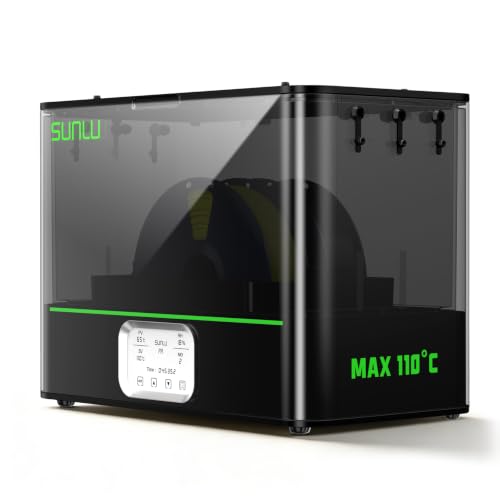
- Dries and anneals in one machine
- 110°C maximum annealing temperature
- 500W heater and dual chambers
Best For: Engineering-material workflows
Best Integrated Storage Design

- Dries, stores, and prints without breaking the seal
- Built-in hygrometer for condition monitoring
- Supports common and engineering filaments
Best For: Sealed storage and direct-feed setups
Best Four-Spool Value

- Holds four 1 kg spools
- Three fans and 360° surround heating
- 35–70°C settings with 99-hour timer
Best For: Multi-printer home workshops
Best Dual-Spool Value
Comgrow SH01 Filament Dryer Box

- Holds two 1kg spools
- Supports 1.75mm and 2.85mm filament
- 40–50°C adjustable drying range
Best For: Home workshops needing simple dual-spool drying and storage
Best Simple Everyday Dryer

- 35–70°C adjustable temperature
- 0–99-hour drying timer
- Supports three filament diameters
Best For: Makers wanting simple controls and flexible single-spool drying
Quiet Everyday Pick

- Adjustable 35–55°C drying
- Print while drying
- Quiet single-spool design
Best For: Hobbyists needing simple, quiet filament drying
High-Capacity Cabinet

- Holds 12 one-kilogram spools
- 100–220°F manual control
- Insulated stainless steel cabinet
Best For: High-volume workshops drying many spools
Advanced Multi-Material System
SUNLU S4 Pro Dual-Chamber Dryer
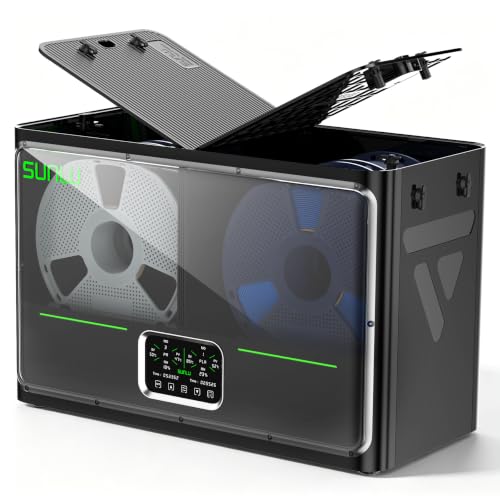
- Two independently controlled chambers
- 85°C maximum temperature
- Drying and annealing modes
Best For: Advanced users working with mixed engineering filaments
Best High-Capacity Pick – Creality Space Pi X4
For home workshops running several printers, this filament dryer for home workshops combines four-spool capacity with dual heating chambers. It can hold four standard 1 kg spools or two 2 kg spools, while its sealed enclosure also supports moisture-controlled storage during printing pauses.
Best For: High-volume users who need organized drying and storage for multiple spools.
Pros:
- Holds up to four 1 kg or two 2 kg spools.
- Dual 200W heating chambers reach up to 85°C.
- Supports 1.75 mm and 2.85 mm filament.
- Sealed enclosure helps limit moisture re-absorption.
Cons:
- Its four-spool capacity requires more workspace than compact dryers.
- The supplied notes do not specify a humidity percentage display or automatic humidity target.
The Space Pi X4 is a practical choice when capacity and ongoing storage matter as much as drying. Its broad temperature range also accommodates common materials and several higher-temperature filaments.
Best for Engineering Filaments – SUNLU E2 Dry and Anneal
The SUNLU E2 stands apart among filament dryers for home workshops by combining filament drying with annealing. Its 110°C annealing chamber and 500W PTC heater make it suited to users working with engineering materials such as nylon, PC, and fiber-reinforced filaments.
Best For: Advanced users printing engineering materials and wanting drying and annealing in one machine.
Pros:
- Combines drying and annealing in a dual-chamber design.
- Reaches up to 110°C for engineering-material applications.
- Supports 1.75 mm, 2.85 mm, and 3.00 mm filament.
- Includes triple-safety features, temperature protection, and a cool-touch exterior.
Cons:
- At 17 pounds, it is substantially heavier than the other listed options.
- Its specialized annealing capability may be unnecessary for users printing mainly PLA.
The E2 is the most technically ambitious option in this group. Choose it if annealing and high-temperature material support justify its larger, heavier format; otherwise, a simpler dryer may be easier to fit into a home workshop.
Best Integrated Storage Design – Polymaker PolyDryer
For makers who want more than occasional drying, the Polymaker PolyDryer combines a drying dock with a sealed storage box. Among filament dryers for home workshops, its dry-store-print workflow is especially convenient because filament can feed directly without breaking the seal.
Best For: Everyday printing setups that prioritize sealed storage, humidity monitoring, and direct feeding.
Pros:
- Combines drying, storage, and printing in one modular system.
- Built-in hygrometer helps monitor storage conditions.
- Supports PA Nylon, PLA, PVB, PETG, ABS, ASA, and TPU.
- Compatible with 1.75 mm, 2.85 mm, and 3.00 mm filament.
Cons:
- The supplied notes do not state a maximum temperature or drying time.
- Its capacity and spool count are not specified in the supplied details.
The PolyDryer is a strong fit for users who want a lower-exposure filament routine between prints. Its heated drying, sealing, desiccant support, and hygrometer create a convenient moisture-management system, though material-specific drying settings are less clearly documented here.
Best Four-Spool Value – SUNLU S4
The SUNLU S4 is designed for home workshops that need to dry several spools at once. This filament dryer for home workshops accommodates four 1 kg rolls, uses three circulation fans and 360-degree heating, and provides eight filament outlets for flexible multi-printer setups.
Best For: Multi-printer users who need four-spool drying with adjustable temperature and timer controls.
Pros:
- Dries up to four 1 kg spools simultaneously.
- Three fans and surround heating support more even internal conditions.
- Offers 35–70°C temperature settings and a timer up to 99 hours.
- Includes eight filament outlets and supports multiple filament diameters.
Cons:
- The 70°C maximum is lower than the Creality X4 and SUNLU E2 limits.
- Its large footprint may be challenging on a crowded workbench.
- The supplied notes describe modification for 3 kg rolls, but that is not its standard stated capacity.
The S4 offers a straightforward way to prepare multiple spools for simultaneous printing. It is particularly appealing when four-spool capacity, flexible outlet placement, and simple timed temperature control matter more than annealing or very high-temperature drying.
Best Dual-Spool Value – Comgrow SH01 Filament Dryer Box
For home workshops needing practical filament dryers for home workshops, the Comgrow SH01 offers room for two 1kg spools while drying filament during printing. Its straightforward controls, sealed design, and support for common filament diameters make it a useful option for routine PLA, PETG, and ABS storage and drying.
Best For: Makers who want dual-spool capacity, in-box drying during printing, and simple temperature and time controls.
Pros:
- Stores two 1kg spools in its large interior.
- Supports 1.75mm and 2.85mm filament.
- Offers adjustable 40–50°C temperature and 6–12-hour drying settings.
- Includes a display for temperature and humidity monitoring.
Cons:
- Its maximum temperature is limited to 50°C.
- The work state must appear on the screen or the motherboard shuts down after three minutes.
- The sealing hole needs to be opened during drying and closed for storage.
The SH01 is a practical choice for everyday filament management, especially when two spools need to stay organized. Its lower temperature ceiling makes it better suited to common materials than demanding high-temperature drying tasks.
Best Simple Everyday Dryer – SUNLU Filament Dryer S2
The SUNLU S2 is one of the more flexible filament dryers for home workshops, combining a spool-holder design with adjustable drying controls. Its broad 35–70°C range, large touch screen, and compatibility with several filament diameters make it suitable for varied printing setups.
Best For: Home users who want easy touch-screen operation, customizable drying times, and support for PLA, TPU, PETG, and ABS.
Pros:
- Adjusts from 35–70°C for different filament needs.
- Allows drying times from 0–99 hours.
- Supports 1.75mm, 2.85mm, and 3.00mm filament.
- A built-in spindle rotates the spool for even drying.
Cons:
- The notes do not specify a multi-spool capacity.
- Its maximum temperature is lower than the Sovol SH03’s 85°C maximum.
- It weighs about 1.51kg, which may matter for compact work areas.
The S2 stands out for accessible controls and broad adjustment rather than high capacity. It is a balanced fit for makers who mainly need one straightforward dryer that can also feed filament while printing.
Best High-Capacity Setup – Sovol SH03 Four-Spool Dryer
For busy home workshops, the Sovol SH03 is a high-capacity alternative among filament dryers for home workshops. It can dry four 1kg spools, operate two chambers independently, and reach up to 85°C, making it well suited to multi-material or multi-printer workflows.
Best For: Users running several printers or multicolor projects who need four-spool capacity and separate temperature control.
Pros:
- Dries up to four 1kg spools at once.
- Uses two independently controlled heating chambers.
- Reaches 85°C, with 50°C in about four minutes and 70°C in about 12 minutes.
- Provides preset settings for 10 filament types.
Cons:
- Its 3.6kg weight is substantially higher than the other listed models.
- The larger four-spool design may take more workspace.
- Operating both 200W heaters may require more power than a smaller dryer.
The SH03 is the strongest match for throughput-focused workshops. Its independent chambers allow drying and storage to happen separately, while the higher temperature ceiling and automatic moisture venting add capability for demanding workflows.
Quiet Everyday Pick – SUNLU S1 Plus
For home workshops seeking filament dryers for home workshops, the SUNLU S1 Plus is a compact, straightforward option for drying one spool while printing. Its adjustable temperature and timer settings cover common filament-care routines without taking up much workspace.
Best For: Hobbyists who want a quiet single-spool dryer with print-while-drying capability.
Pros:
- Adjustable 35–55°C temperature range and 1–99-hour timer.
- Supports standard 1.75mm, 2.85mm, and 3.00mm filament diameters.
- Built-in fan, rollers for printing while drying, and operation below 10dB.
- Large LCD shows temperature and time clearly.
Cons:
- Capacity is limited to one spool.
- Its 35–55°C range may be less suitable for higher-temperature drying needs.
The S1 Plus is a practical entry-level choice when quiet operation, simple controls, and broad spool compatibility matter more than multi-spool capacity or advanced conditioning features.
High-Capacity Cabinet – Hydryer H2O 12-Spool Dryer
The Hydryer H2O is built for home workshops that manage several spools at once. This filament dryer for home workshops holds up to 12 one-kilogram spools and combines active hot-air circulation, insulated construction, and multiple operating modes for extended drying or storage.
Best For: High-volume users who need overnight or multi-day drying for multiple spools.
Pros:
- Large 12-spool capacity with drying performance designed to remain consistent when fully loaded.
- Manual temperature control from 100–220°F, plus Auto and Stay-Dry modes.
- Five-layer safety system includes overheat protection, a thermal fuse, and heating shutoff when the door opens.
- Stainless steel body, double tempered-glass door, triple insulation, and 40dB operation.
Cons:
- At 22 pounds, it is substantially heavier than compact single-spool dryers.
- The humidity display on early batches may read slightly higher than actual chamber humidity.
- It uses a non-automatic feeding system.
The H2O makes the most sense for organized print farms or serious home workshops where capacity, unattended-operation safeguards, and durable cabinet construction justify the larger footprint.
Advanced Multi-Material System – SUNLU S4 Pro Dual-Chamber Dryer
The SUNLU S4 Pro targets demanding home workshops that use several filament types and want more than basic drying. Its two independently controlled chambers can run different programs simultaneously, while automatic humidity control and annealing support help streamline advanced material preparation.
Best For: Experienced users conditioning mixed materials, including engineering and fiber-filled filaments.
Pros:
- Dual chambers allow separate temperatures, drying programs, and annealing settings.
- Reaches up to 85°C and includes a built-in annealing mode.
- Automatic humidity control starts and stops drying around the selected target.
- Holds four 1kg spools and supports materials including PLA, PETG, TPU, PA, PC, nylon, and composites.
Cons:
- Its 458 × 218 × 310mm footprint requires more bench space than a compact dryer.
- The one-year warranty is shorter than the Hydryer H2O’s stated two-year warranty.
With independent chambers, higher-temperature operation, and annealing, the S4 Pro is a strong fit for users who regularly switch between everyday and engineering-grade materials rather than needing only basic moisture removal.
How We Picked These Filament Dryers for Home Workshops
We focused on practical features that affect print reliability: usable spool capacity, maximum temperature, heating consistency, controls, storage design, and compatibility with common 1.75mm and 2.85mm filament. The selection includes compact dryers for occasional use, multi-spool boxes for active workshops, and higher-capacity units for users who manage several materials at once.
We also considered whether each design can dry filament while it feeds to a printer, since that matters when moisture-sensitive materials must remain protected during a long print. Features such as annealing modes, sealed storage, adjustable temperature, and humidity monitoring can add value, but they should support—not replace—sound filament-handling habits.
Quick Comparison
| What to compare | Best fit |
|---|---|
| Single- or small-capacity dryer | One printer, occasional drying, limited workspace |
| Four-spool dryer | Multi-material printing and shared workshop use |
| High-temperature control | Nylon, polycarbonate, and other moisture-sensitive materials |
| Dry-and-anneal operation | Users seeking additional material conditioning |
| Large storage cabinet | Multiple active spools and longer-term dry storage |
Key Buying Factors for Filament Dryers
Capacity and Footprint
Match capacity to your printing routine rather than choosing the largest box automatically. A one- or two-spool dryer is easier to place beside a printer, while four-spool and cabinet-style models make more sense for workshops running several materials. Check the internal dimensions against your actual spool widths and diameters.
Temperature Range and Material Support
PLA and PETG generally need less heat than nylon or other engineering filaments. For broad material compatibility, look for accurate temperature adjustment and a clearly specified maximum temperature. Avoid assuming that a high temperature alone guarantees safe drying; spool construction and the filament maker’s recommendations still matter.
Airflow, Controls, and Monitoring
Consistent heat and airflow are more useful than a high headline temperature. A timer, readable display, humidity information, and simple controls make repeated drying cycles easier. Dual chambers or independent controls can be valuable when different materials need separate settings.
Storage and Feeding
A dryer that supports printing directly from the chamber can reduce reabsorption during long jobs. Look for sealed openings, practical filament guides, and a lid or door that closes securely. If the unit is mainly for storage, consider how easily spools can be loaded and removed.
Who Should Buy Which Filament Dryers for Home Workshops?
Choose a compact single-spool model if you print mostly PLA or PETG and want an affordable way to address occasional moisture problems. A four-spool dryer is better for a home workshop with multiple printers or frequent material changes. Consider a higher-temperature or dry-and-anneal model if you regularly use nylon and other technical filaments and understand their specific drying requirements.
For users who keep many spools available, a large cabinet-style dryer can simplify organization and ongoing dry storage. Whichever model you choose, use the manufacturer’s temperature guidance, allow enough drying time, and store filament sealed with fresh desiccant when it is not in the dryer.