
Fast, dependable media offload is essential when you are moving large video files between cameras, cards, laptops, and backup drives. The right reader can reduce transfer bottlenecks and simplify a mixed-card workflow.
We selected 10 options covering CFexpress Type A and Type B, XQD, SD, microSD, and multi-card setups. Use the guide below to match speed, compatibility, portability, and connectivity to the way you shoot.
Best 10 Memory Card Reader for Videographers Picks for 2026
Pro Workflow Pick
DOCKCASE Smart 8-in-1 CFexpress Reader

- Supports CFexpress Type A and Type B, SD UHS-II, and microSD
- Up to 10Gbps USB connectivity with HDMI and 100W PD
- Touchscreen hub design for creators on the go
Best For: Filmmakers needing broad card support and hub connectivity
Versatile Budget Choice

- Reads SD, microSD, Memory Stick, and CF cards
- Reads and writes four cards simultaneously
- USB-C and USB 3.0 with up to 160MB/s UHS-I speeds
Best For: Users with mixed conventional memory-card formats
Fast CFexpress Specialist
ProGrade Digital Dual-Slot Reader
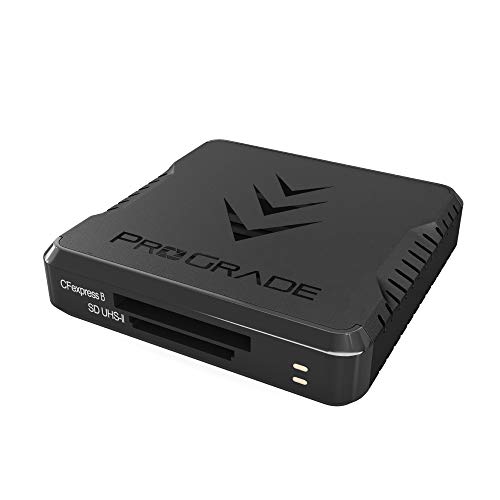
- Dedicated CFexpress Type B and SD card slots
- Up to 1.25GB/s or 10Gbps advertised transfers
- Magnetic laptop mounting system and 2-year warranty
Best For: CFexpress Type B users prioritizing fast field offloads
Format Coverage Pick

- Supports CF, SD, microSD, XD, and Memory Stick formats
- Reads and writes up to five cards simultaneously
- USB-C and USB-A connectivity with 5Gbps transfers
Best For: Teams handling varied legacy and current card formats
Pro-Level Speed

- Up to 10Gbps USB 3.2 Gen 2 transfers
- Dual slots for CFexpress Type A and SDXC
- Magnetic, travel-ready design with 2-year warranty
Best For: Videographers using CFexpress Type A and SDXC cards on location
Flexible Field Pick

- Supports SD and microSD formats
- USB-C and USB 3.0 interfaces up to 5Gbps
- Simultaneous reading and writing of two cards
Best For: SD-based video kits using phones, laptops, cameras, or action cameras
8K Workflow Choice

- Up to 10Gbps USB 3.2 Gen 2 transfers
- Simultaneous CFexpress Type B and SD offloads
- Includes USB-C cable and USB-A adapter
Best For: CFexpress Type B users transferring high-resolution and 8K RAW footage
Fast CFexpress Workflow
2-in-1 CFexpress Type B & SD Reader

- 10Gbps USB 3.2 Gen 2 transfers
- CFexpress Type B and SD slots
- USB-C and USB-A connectivity
Best For: Videographers using CFexpress Type B and SD cards across multiple devices
Pro Media Flexibility
3-in-1 CFexpress, XQD & SD Reader

- Supports CFexpress Type B, XQD, and SD
- Simultaneous two-card transfers
- Includes USB-C and USB-A cables
Best For: Professional crews managing mixed camera cards on location
Travel-Ready 3-in-1
Aluminum CFexpress, XQD & SD Reader

- 10Gbps USB 3.2 Gen 2 interface
- Dual-slot CFexpress/XQD and SD design
- Includes two host-connection cables
Best For: Mobile creators needing broad card-format support in a compact reader
Pro Workflow Pick – DOCKCASE Smart 8-in-1 CFexpress Reader
For videographers working with modern high-capacity media, the DOCKCASE is a feature-rich memory card reader for videographers. It combines CFexpress Type A and Type B support with SD and microSD slots, fast USB connectivity, HDMI output, and a touchscreen interface.
Best For: Filmmakers and creators who need CFexpress support, multi-card flexibility, and hub features in one portable device.
Pros:
- Supports CFexpress Type A, CFexpress Type B, SD UHS-II, and microSD cards.
- Advertised transfer speeds reach up to 800MB/s for Type A, 1000MB/s for Type B, and 312MB/s for UHS-II SD.
- Includes USB-C, USB-A, 4K HDMI, 100W power delivery, and a responsive touchscreen.
- Can support three cards simultaneously, with Type A and Type B unavailable at the same time.
Cons:
- CFexpress Type A and Type B cannot be used simultaneously.
- Its expanded hub features may be more than needed for simple card transfers.
Choose this model when your workflow spans multiple card formats and you also want display and connectivity features. Its CFexpress compatibility and high advertised speeds make it especially suited to demanding on-location video workflows.
Versatile Budget Choice – BENFEI 4-in-1 Card Reader
The BENFEI 4-in-1 is a practical memory card reader for videographers who use common SD, microSD, CF, and Memory Stick media. Its integrated USB-C and USB 3.0 connectors make it suitable for laptops and compatible mobile devices without carrying a separate adapter.
Best For: Videographers and photographers who need broad legacy-card compatibility and simultaneous access to multiple card types.
Pros:
- Handles SD, microSD, Memory Stick, and CF cards.
- Can read and write four cards at the same time.
- Offers USB-C and USB 3.0 connectivity with advertised UHS-I speeds up to 160MB/s.
- Includes an 18-month warranty and plug-and-play operation.
Cons:
- It does not support CF Type I, standard Memory Stick, or Memory Stick Micro (M2).
- Actual transfer speed depends on the card and the USB port.
- It is limited to UHS-I performance rather than newer CFexpress formats.
This reader is a sensible choice for mixed-media kits built around conventional card formats. It offers useful simultaneous card access and flexible USB connections, but professionals using CFexpress cards will need a different reader.
Fast CFexpress Specialist – ProGrade Digital Dual-Slot Reader
The ProGrade Digital PG05.5 is a focused memory card reader for videographers using CFexpress Type B and SD cards. Its USB 3.2 Gen 2 interface is designed for quick transfers, while the magnetic mounting system can help create a compact workstation on a laptop.
Best For: Video professionals who regularly offload CFexpress Type B and SD media and value a streamlined mobile setup.
Pros:
- Dedicated CFexpress Type B and SD dual-slot design.
- Advertised transfer performance reaches up to 1.25GB/s, or 10Gb/s, from both cards simultaneously.
- Includes an adhesive metal plate for magnetic laptop mounting.
- Backed by a 2-year warranty and compatible with desktop, laptop, and tablet systems.
Cons:
- Supports only two card formats and does not include CFexpress Type A, microSD, or CF slots.
- The magnetic mounting setup requires attaching the included adhesive plate.
For a CFexpress Type B-centered workflow, this reader keeps the feature set focused and the connection fast. It is less suitable for mixed-format kits, but its dual-slot design and mounting option can simplify field offloads and post-production transfers.
Format Coverage Pick – Rocketek 7-in-1 Card Reader
The Rocketek 7-in-1 is a broad-compatibility memory card reader for videographers managing cards from different cameras and devices. It includes CF, SD, microSD, XD, and Memory Stick support, plus USB-C and USB-A connections for flexible computer and tablet access.
Best For: Shooters and editors who work with a wide range of legacy and current card formats and want simultaneous multi-card reading.
Pros:
- Supports CF, SD, SDHC, SDXC, microSD, Memory Stick, and xD Picture Card formats.
- Can read and write up to five cards at the same time.
- Provides both USB-C and USB 3.0 connectors with advertised 5Gbps transfer rates.
- Works with Windows, macOS, Linux, Chrome OS, and Android without extra drivers.
Cons:
- Its 5Gbps USB 3.0 interface is slower than the 10Gbps options in this roundup.
- It does not support CFexpress cards.
- The many slots may be unnecessary for users who only use SD or microSD.
This is a strong fit for varied production environments where format coverage matters more than maximum throughput. It offers more legacy-card flexibility than specialized CFexpress readers, though CFexpress-based cameras require another solution.
Pro-Level Speed – CFexpress Type A & SD Reader
For videographers working with CFexpress Type A and SDXC media, the ProGrade Digital PG09 is a fast, rugged memory card reader for videographers. Its USB 3.2 Gen 2 connection supports transfer speeds up to 10Gbps, helping move footage into post-production with less waiting.
Best For: Videographers using CFexpress Type A and SDXC cards who need a fast, portable reader for location or studio workflows.
Pros:
- Supports CFexpress Type A and SDXC cards in two slots.
- Offers up to 10Gbps transfer speeds.
- Dual-slot design supports transfers from both cards.
- Magnetic attachment and included metal plate suit mobile workstations.
Cons:
- It is limited to CFexpress Type A and SDXC media rather than CFexpress Type B.
- The listed USB connectivity includes USB Type A, which may require an adapter for some newer devices.
With its dual-slot layout, compact travel design, and two-year warranty, the PG09 is a strong choice when fast CFexpress Type A and SD offloads are central to your video workflow.
Flexible Field Pick – USB-C/USB-A SD Card Reader
The uni PIXEL is a versatile memory card reader for videographers who use SD and microSD media across cameras, action cameras, phones, and computers. With USB 3.0 and USB-C interfaces, it supports transfers up to 5Gbps and can read or write both cards simultaneously.
Best For: Videographers and creators who regularly move footage from SD or microSD cards to USB-C or USB-A devices.
Pros:
- Supports SD, SDHC, SDXC, microSD, microSDHC, and microSDXC cards.
- USB 3.0 and USB-C interfaces offer up to 5Gbps transfer speeds.
- Dual slots allow simultaneous SD and microSD access.
- Plug-and-play operation requires no additional power supply or driver.
Cons:
- It does not support CFexpress, XQD, Memory Stick, or SIM cards.
- It is not compatible with Lightning-port devices.
- The reader transfers card data but does not connect directly to a camera.
The uni PIXEL is a practical, budget-friendly option for SD-based video kits, especially when you need both USB-C and USB-A compatibility in a compact reader.
8K Workflow Choice – CFexpress Type B & SD Reader
The Lexar RW520 is a high-speed memory card reader for videographers working with CFexpress Type B cards and SD media. Its USB 3.2 Gen 2 connection reaches up to 10Gbps, while the two-slot design supports simultaneous offloads for high-resolution images and 8K RAW video.
Best For: Videographers using CFexpress Type B and SD cards who want a compact reader for fast location or studio transfers.
Pros:
- Designed for CFexpress Type B and SD cards.
- Supports transfer speeds up to 10Gbps.
- Two slots enable simultaneous CFexpress and SD offloads.
- Includes USB-C-to-C cable and USB-C-to-A adapter.
Cons:
- It is not designed for CFexpress Type A cards.
- Actual transfer performance depends on the cards, computer, and connection used.
For cameras using CFexpress Type B, the RW520 combines fast USB 3.2 Gen 2 transfers with broad host connectivity, making it a well-rounded option for demanding video ingest workflows.
Fast CFexpress Workflow – 2-in-1 CFexpress Type B & SD Reader
For videographers who need a practical memory card reader for videographers, this dual-slot model combines CFexpress Type B and SD support with USB 3.2 Gen 2 speeds up to 10Gbps. Its built-in USB-C and USB-A connectivity makes it a flexible choice for transferring large 4K/8K video files and RAW photos between newer and older devices.
Best For: Videographers using CFexpress Type B and SD cards who want a compact reader for Mac, Windows, Linux, Android, or compatible mobile devices.
Pros:
- Supports CFexpress Type B cards up to 2TB and SD cards.
- USB 3.2 Gen 2 provides advertised transfer speeds up to 10Gbps.
- USB-C and USB-A connectivity works with modern and traditional computers.
- Aluminum construction helps with durability and heat dissipation.
Cons:
- Only two media slots are included.
- The supplied details do not specify whether every SD speed class is supported.
This reader is a straightforward fit for creators who primarily use CFexpress Type B and SD media. Plug-and-play operation and dual host connectors make it especially convenient for travel kits and mixed-device editing setups.
Pro Media Flexibility – 3-in-1 CFexpress, XQD & SD Reader
This memory card reader for videographers is designed for teams working with several professional card formats. It combines CFexpress Type B/XQD compatibility with an SD slot, supports simultaneous read/write operations, and uses 10Gbps USB 3.2 Gen 2 connectivity for moving 4K/8K footage and large photo files.
Best For: Professional filmmakers, wedding teams, indie DITs, and expedition creators who use CFexpress, compatible XQD, and SD cards.
Pros:
- One slot supports CFexpress Type B and XQD, while the second supports SD.
- Simultaneous card reading and writing can help with on-location backups.
- Includes both USB-C-to-USB-C and USB-A-to-USB-C cables.
- Compact aluminum body is suited to travel and field kits.
Cons:
- XQD compatibility excludes the listed N/S/H series cards.
- It has two physical slots despite supporting three media formats.
- The supplied details do not establish actual sustained transfer speeds.
Among these options, this model offers the broadest format coverage for crews carrying mixed camera systems. Check your specific XQD series before buying, but the dual-cable setup and simultaneous transfers make it a strong field-oriented choice.
Travel-Ready 3-in-1 – Aluminum CFexpress, XQD & SD Reader
For creators wanting a portable memory card reader for videographers, this dual-slot adapter handles CFexpress Type B, XQD, and SD cards in a slim aluminum housing. Its USB 3.2 Gen 2 interface is rated up to 10Gbps, while included USB-C and USB-A cables support a range of computers, smartphones, and other compatible devices.
Best For: Photographers and videographers who want a compact reader with broad card-format support and a status indicator.
Pros:
- Reads and writes CFexpress Type B, XQD, and SD cards.
- Supports simultaneous use of the two card slots.
- Includes USB-C-to-USB-C and USB-C-to-USB-A cables.
- LED indicator shows the reader’s working status.
Cons:
- The XQD slot and CFexpress Type B slot share one physical slot.
- Compatibility details for operating systems are less complete than the connection details.
- Actual transfer performance may vary by card, device, and files.
This is a sensible travel option when your kit includes multiple card types but space is limited. Its status light, dual cables, and compact aluminum design add practical convenience, while the 10Gbps interface is appropriate for large video transfers.
How We Picked the Best Memory Card Reader for Videographers
We focused on readers that support common video-production formats and provide a practical connection to current computers. The lineup includes dedicated CFexpress readers, combination CFexpress and SD models, XQD-compatible options, and compact multi-format adapters.
Our evaluation criteria included stated interface speed, card compatibility, simultaneous read/write support where available, USB-C and USB-A flexibility, build quality, portability, and workflow convenience. Advertised speeds are maximum theoretical rates; actual performance depends on the card, host device, cable, and file system.
Quick Comparison
| Best For | Look For | Why It Matters |
|---|---|---|
| CFexpress Type B video | USB 3.2 Gen 2 or faster | Shorter transfers for large footage files |
| CFexpress Type A cameras | Dedicated Type A support | Type A and Type B are not interchangeable |
| Mixed camera kits | CFexpress plus SD or XQD slots | One reader covers more of your equipment |
| Travel and backup kits | Compact USB-C design | Less bulk in a field bag |
| Older computers | USB-C and USB-A connectivity | Works across more editing systems |
Key Buying Factors for a Memory Card Reader for Videographers
Card Format and Slot Design
Start with the cards used by your cameras. CFexpress Type A, CFexpress Type B, XQD, SD, and microSD require different slots, and a reader that supports one format may not support another. Combination models are useful for crews with multiple cameras, while a dedicated reader can be smaller and simpler.
Transfer Speed
For high-bitrate 4K, 6K, or 8K footage, prioritize a reader with a fast USB interface and a compatible cable. A 10Gbps USB 3.2 Gen 2 reader can be a strong choice, but the slowest component in the chain determines real-world results. Check whether your computer has the matching port.
Connectivity and Simultaneous Transfers
USB-C is convenient for modern laptops, tablets, and phones, while USB-A remains useful with older desktops and accessories. If you regularly ingest multiple cards, a model that can read several formats at once may save time, though simultaneous performance can vary by system and card combination.
Portability and Durability
For location work, choose a compact reader with a secure slot, a sturdy housing, and a cable that is easy to replace or store. A desktop-oriented model may offer more slots or features, but it can be less convenient in a travel kit.
Who Should Buy Which Memory Card Reader for Videographers?
Choose a dedicated CFexpress Type B reader if your camera uses Type B cards and maximum offload efficiency is the priority. Choose a Type A reader for cameras that specifically use CFexpress Type A; compatibility should take precedence over headline speed.
Choose a CFexpress, SD, or XQD combination reader if you manage several camera systems or want one carry-on solution. Choose a multi-format USB reader for everyday media, older card types, or a mixed device ecosystem. For a minimal field kit, a compact USB-C SD or microSD reader is often enough.
Before buying, verify the exact card types in your cameras, the ports on your editing computer, and whether the included cable supports the advertised transfer rate. The best reader is the one that fits your entire ingest workflow without adding adapters or unnecessary delays.