
Traveling musicians need an interface that fits easily into a bag without creating connection headaches on stage, in rehearsal, or on the road. The right choice depends on whether you need dedicated MIDI ports, USB host support, audio recording, or simply a dependable cable for connecting one instrument.
This roundup covers compact MIDI interfaces, USB-to-MIDI cables, and small audio interfaces with MIDI-friendly workflows. Use the buying guide below to narrow the options by device compatibility, I/O, power, portability, and the way you actually make music while traveling.
Best 10 Midi Interfaces for Traveling Musicians Picks for 2026
Best All-Around MIDI Routing

- Compact 3-in/3-out MIDI interface
- Standalone routing, filtering, merge, and split
- USB-C support for major operating systems
Best For: Traveling musicians needing flexible DIN MIDI control
Best for Mobile Audio Recording
Focusrite Scarlett Solo 4th Gen

- One mic input and one Hi-Z instrument input
- 24-bit/192kHz recording with 120dB dynamic range
- Includes a broad recording software bundle
Best For: Traveling songwriters recording vocals and guitar
Best for Complex Portable Setups

- Standalone USB host for up to eight MIDI devices via hub
- USB, DIN, and optional WIDI connectivity
- Four onboard presets plus advanced routing tools
Best For: Guitarists and producers with multi-device travel rigs
Best Budget Audio Companion

- Two XLR/TRS combo inputs with 48V phantom power
- 24-bit/192kHz recording and direct monitoring
- USB-C bus-powered design for mobile recording
Best For: Windows-based mobile vocal and guitar recording
Best All-Around Pick
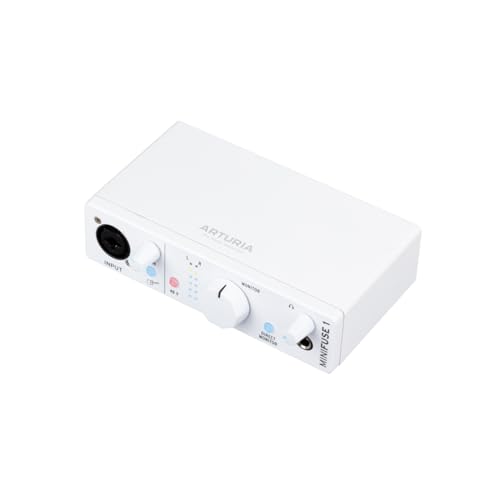
- 5-pin MIDI input and output
- Compact 14.4-ounce audio interface
- Five-year warranty and software bundle
Best For: Traveling musicians needing MIDI plus audio recording
Best for Minimal Kits

- Lightweight 6.5-foot USB-to-MIDI cable
- Driver-free support across major operating systems
- Filtering, mapping, and routing via UxMIDI Tools
Best For: MIDI-only travel setups with minimal cable clutter
Best for Guitar and Vocal Recording
Focusrite Scarlett Solo 3rd Gen

- Mic preamp and Hi-Z instrument input
- 24-bit/192 kHz recording with Air mode
- Compact 12.32-ounce design
Best For: Traveling guitarists and vocalists who prioritize audio recording
Best Compact MIDI Cable

- USB-C MIDI input and output
- LED power and signal indicators
- Plug-and-play Windows and Mac setup
Best For: Traveling keyboardists using compatible MIDI hardware
Best Two-Input Travel Interface
M-Track Duo USB Audio Interface
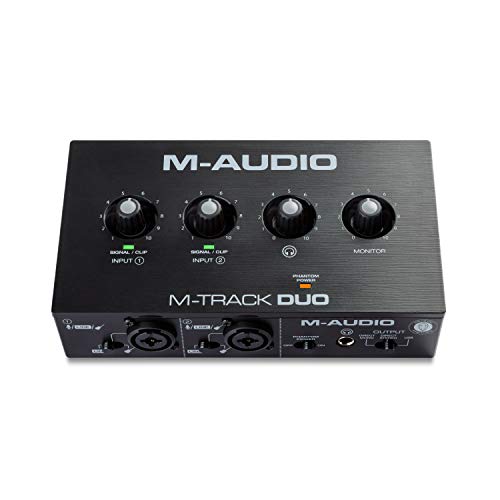
- Two combo XLR/line/instrument inputs
- Phantom power and direct monitoring
- Includes MPC Beats software
Best For: Mobile recording with two microphones or instruments
Best Lightweight Solo Interface
M-Track Solo USB Audio Interface
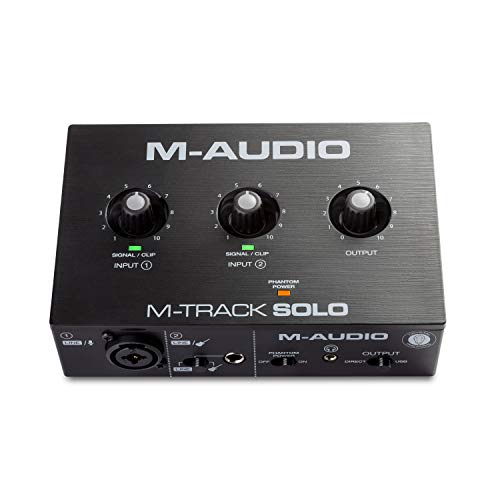
- One combo input plus instrument input
- Weighs 10.6 ounces
- Zero-latency direct monitoring
Best For: Solo mobile recording with a mic and instrument
Best All-Around MIDI Routing – CME U6MIDI Pro
For musicians comparing midi interfaces for traveling musicians, the CME U6MIDI Pro is a compact choice when dependable DIN connectivity and flexible routing matter. It provides three MIDI inputs and outputs, plug-and-play USB-C support, and compatibility with major desktop and mobile operating systems.
Best For: Traveling performers and producers who need standalone MIDI routing, filtering, merging, and splitting in a small setup.
Pros:
- Compact 3-in/3-out MIDI design with USB-C connectivity.
- Works with macOS, iOS, Windows, Android, Linux, and Chrome OS.
- Supports routing, filtering, mapping, merge, split, and thru functions.
- Designed for low-latency, jitter-free transmission across standard MIDI devices.
Cons:
- MIDI-only device, so it does not record microphones or instruments as audio.
- Advanced configuration requires the UxMIDI Tools software.
The U6MIDI Pro balances portability with serious MIDI control. Its standalone operation and broad OS support make it especially practical for mobile rigs built around keyboards, synths, drum machines, and digital pianos.
Best for Mobile Audio Recording – Focusrite Scarlett Solo 4th Gen
Although it is an audio interface rather than a dedicated DIN MIDI box, the Focusrite Scarlett Solo 4th Gen deserves consideration among midi interfaces for traveling musicians who also need to capture vocals or guitar. Its USB-C setup, compact housing, and iOS compatibility suit lightweight recording rigs.
Best For: Songwriters and traveling performers recording one microphone and one instrument with a laptop, Mac, or compatible iPad.
Pros:
- Provides one XLR mic input and one Hi-Z instrument input.
- Offers 24-bit/192kHz recording and a 120dB dynamic range.
- Air mode adds presence and harmonic character to vocals and guitars.
- Includes Ableton Live Lite, Pro Tools Intro+, Cubase LE, and additional plugins.
Cons:
- It is an audio interface, not a standard 5-pin DIN MIDI interface.
- Its two-channel design may be limiting for larger recording setups.
The Scarlett Solo is a strong travel companion when your priority is recording audio rather than routing external MIDI hardware. Its simple input layout keeps a mobile setup manageable while retaining studio-oriented conversion quality.
Best for Complex Portable Setups – CME H4MIDI WC
The CME H4MIDI WC is built for musicians whose travel rigs combine USB MIDI gear, DIN hardware, and possibly a pedalboard. As one of the more versatile midi interfaces for traveling musicians, it can operate as a standalone USB host, connect to a computer over USB-C, and support advanced routing and preset control.
Best For: Guitarists, producers, and performers connecting multiple USB MIDI devices, pedals, keyboards, and hardware instruments without relying on a computer.
Pros:
- Standalone USB host supports up to eight USB MIDI device ports through a hub.
- Offers MIDI thru, split, merge, mapper, and filter functions.
- Supports USB or 9V DC standalone power for mobile and pedalboard use.
- Stores four presets for quick changes between performance setups.
Cons:
- Its broad feature set may require time to configure in HxMIDI Tools.
- WIDI Bluetooth MIDI requires the optional WIDI Core module.
- USB device expansion requires a separate standard USB hub.
With flexible power, extensive USB hosting, and preset recall, the H4MIDI WC is suited to sophisticated portable systems. It is a particularly compelling option when a compact interface must coordinate several MIDI devices on stage or in transit.
Best Budget Audio Companion – PIYONE Q2 Alloy Red
For travelers who need to record audio alongside a MIDI-based setup, the PIYONE Q2 Alloy Red offers a portable two-channel solution. It is worth considering with midi interfaces for traveling musicians when your mobile workflow includes microphones, guitar, or other analog sources rather than only DIN MIDI hardware.
Best For: Mobile creators who want a simple USB-C interface for recording vocals, guitar, or other sources with a Windows computer.
Pros:
- Two combo inputs accept XLR or TRS connections.
- Supports 24-bit/192kHz recording with 48V phantom power.
- USB-C provides data and bus power without an external supply.
- Direct monitoring and a 3.5mm headphone output support low-latency tracking.
Cons:
- It is an audio interface and does not provide dedicated MIDI I/O.
- Supplied details list Windows compatibility, without confirming other operating systems.
- At 0.74 kg, it is heavier than the compact CME MIDI interfaces listed here.
The Q2 Alloy Red is a practical audio add-on for a travel rig centered on recording. Its combination inputs, phantom power, and direct monitoring cover common mobile recording needs, but dedicated MIDI hardware will require a separate interface.
Best All-Around Pick – Arturia MiniFuse 1
For traveling musicians who need more than basic MIDI connectivity, the Arturia MiniFuse 1 combines 5-pin MIDI input and output with audio recording in a compact 14.4-ounce interface. Its plug-and-play workflow, headphone output, and broad software bundle make it a flexible mobile setup for recording voice, guitar, synths, and MIDI gear.
Best For: Musicians who want one compact interface for MIDI, instrument, microphone, and mobile recording tasks.
Pros:
- Includes 5-pin MIDI input and output for synths, controllers, and drum machines.
- Compact 3.9-by-5.9-by-1.65-inch design weighs just 14.4 ounces.
- Offers 192 kHz recording, 48V phantom power, balanced outputs, and a headphone volume control.
- Includes a five-year warranty and a substantial music-production software bundle.
Cons:
- Its single-channel design may be limiting for musicians recording multiple sources at once.
- It is a broader audio interface rather than the smallest possible MIDI-only travel solution.
The MiniFuse 1 is a strong choice when traveling musicians want MIDI ports without giving up microphone, guitar, or synth recording. Choose it over a cable-style interface when built-in audio connections and included software are priorities.
Best for Minimal Kits – CME U2MIDI Pro
The CME U2MIDI Pro is a highly portable USB-to-MIDI cable for traveling musicians who already have an instrument and simply need computer or mobile connectivity. Its 6.5-foot cable has the MIDI technology integrated into the USB connector, helping reduce the clutter of a separate interface box.
Best For: Players who need a lightweight, MIDI-only connection between a 5-pin instrument and a computer, tablet, or phone.
Pros:
- Supports macOS, iOS, Windows, Android, Linux, and ChromeOS without requiring drivers.
- Works with standard MIDI instruments, including keyboards, digital pianos, synths, drum machines, and grooveboxes.
- Supports all 16 MIDI channels and messages including clock, sysex, MTC, and MPE.
- Provides filtering, mapping, routing, merge, and split functions through UxMIDI Tools.
Cons:
- Provides MIDI connectivity only, with no microphone, instrument, headphone, or audio outputs.
- Its USB-A connection may require an adapter with some newer mobile devices.
For a travel rig built around a single MIDI instrument, the U2MIDI Pro is the simplest and lightest option here. Its software controls add useful flexibility, but musicians who also record audio will need a separate interface.
Best for Guitar and Vocal Recording – Focusrite Scarlett Solo 3rd Gen
The Focusrite Scarlett Solo 3rd Gen suits traveling musicians who prioritize guitar, vocal, and instrument recording while also working with MIDI-equipped devices through a computer or mobile setup. It offers a mic preamp, Hi-Z instrument input, Air mode, low-noise outputs, and a compact 12.32-ounce body.
Best For: Guitarists, vocalists, and solo producers who need a portable recording interface with high-quality inputs.
Pros:
- Combines an XLR mic preamp with a Hi-Z instrument input for guitar or bass.
- Records at up to 24-bit/192 kHz and includes switchable Air mode for added clarity.
- Compact 1.71-by-5.65-by-3.77-inch design weighs 12.32 ounces.
- Includes Ableton Live Lite, Pro Tools Intro+, Cubase LE, and Hitmaker Expansion software.
Cons:
- The supplied notes do not list dedicated 5-pin MIDI input or output.
- It has one mic preamp and one instrument input, limiting simultaneous recording options.
The Scarlett Solo is a practical travel interface when audio capture is the priority, especially for guitar and vocals. It is less suitable than the MiniFuse 1 or CME cable for a rig that requires direct 5-pin MIDI ports.
Best Compact MIDI Cable – USB-C MIDI Interface
For musicians seeking MIDI interfaces for traveling musicians, the LEKATO MIDI Cable offers a compact way to connect a keyboard, synthesizer, drum pad, or digital piano to a Mac, Windows PC, or iPad. Its USB-C connection, plug-and-play setup, and status LEDs are useful for mobile editing and recording.
Best For: Traveling keyboardists and producers who need a lightweight MIDI connection for compatible USB-C devices.
Pros:
- USB-C connection supports Mac, Windows, and iPad setups.
- One MIDI input and one MIDI output support up to 16 channels.
- LED indicators show power and signal activity.
- Built-in driver enables plug-and-play use with supported systems.
Cons:
- It is designed for MIDI data, not microphone or instrument audio recording.
- Older or vintage synthesizers may require special compatibility settings or troubleshooting.
This cable is a practical travel option when your setup centers on standard MIDI hardware and a USB-C host. Check compatibility carefully if you use an older instrument.
Best Two-Input Travel Interface – M-Track Duo USB Audio Interface
The M-Audio M-Track Duo is a versatile choice among MIDI interfaces for traveling musicians who also need to record microphones, guitars, or line-level sources. Its two combo inputs, phantom power, and direct monitoring make it suitable for compact recording, streaming, and rehearsal rigs.
Best For: Traveling musicians who need two inputs for vocals, guitar, keyboards, or other line-level sources.
Pros:
- Two combo XLR/line/instrument inputs support flexible recording setups.
- Phantom power accommodates compatible condenser microphones.
- USB/Direct monitoring provides zero-latency monitoring.
- Includes MPC Beats and supports recording software such as Ableton Live Lite.
Cons:
- Its maximum sample rate is 48 kHz.
- It uses USB Type-B rather than USB-C, so a suitable cable or adapter may be needed for some travel devices.
With two inputs and straightforward monitoring, the M-Track Duo offers more simultaneous recording flexibility than a single-input portable interface while remaining compact enough for mobile sessions.
Best Lightweight Solo Interface – M-Track Solo USB Audio Interface
The M-Audio M-Track Solo is a streamlined option for musicians comparing MIDI interfaces for traveling musicians and needing audio recording rather than a dedicated MIDI connection. It combines one combo microphone/line input with a separate line/instrument input in a small, 10.6-ounce enclosure.
Best For: Solo performers and mobile creators recording one microphone plus one instrument or line source.
Pros:
- One combo XLR/line input and one line/instrument input cover common solo setups.
- Phantom power supports compatible condenser microphones.
- USB/Direct monitoring enables zero-latency monitoring.
- Includes MPC Beats and supports Ableton Live Lite.
Cons:
- This is an audio interface, not a dedicated MIDI input/output interface.
- It uses USB Type-B and RCA stereo outputs, which may require extra adapters in some portable rigs.
The M-Track Solo keeps a travel recording kit simple and light. Choose it for microphone-and-instrument recording, but select a dedicated MIDI interface if your main need is MIDI data connectivity.
How We Picked These Midi Interfaces for Traveling Musicians
We focused on practical travel requirements: compact size, useful connectivity, straightforward computer or mobile compatibility, and the ability to solve common mobile-production setups. The selection includes dedicated multi-port MIDI interfaces, USB-to-MIDI cables, USB host hardware, and small audio interfaces for musicians who also record microphones or instruments.
Because these products serve different roles, compare the connection type and workflow rather than assuming every interface is interchangeable. A simple cable may be ideal for one keyboard, while a multi-port interface is better for a rig with several synthesizers, controllers, or sound modules.
Quick Comparison
- Best for multiple MIDI devices: Choose a multi-in/multi-out interface such as the CME U6MIDI Pro.
- Best for connecting a USB MIDI device without a computer: Consider a USB host interface such as the CME H4MIDI WC.
- Best for a single keyboard or synth: A USB-to-MIDI cable such as the CME U2MIDI Pro or LEKATO cable keeps the setup small.
- Best for recording audio and MIDI-style workflows: Compact audio interfaces from Focusrite, Arturia, or M-AUDIO add microphone and instrument inputs.
Key Buying Factors for Midi Interfaces for Traveling Musicians
Ports and Routing
Count the devices you need to connect now, not only the equipment you own. One MIDI input and output is enough for a single keyboard, but multiple DIN ports provide more flexibility for hardware rigs. If you use USB-only controllers, verify whether the interface supports USB host operation or requires a computer.
Device Compatibility and Power
Check operating-system, iOS, USB-C, and adapter requirements before buying. Some interfaces draw power from the host device, while others need an external supply. For travel, bus-powered operation is convenient, but confirm that your tablet or phone can provide adequate power or supports a suitable powered hub.
Audio Needs
A MIDI interface does not replace an audio interface. If you record vocals, guitar, or synthesizer audio, look for combo inputs, microphone preamps, phantom power, headphone monitoring, and appropriate outputs. Audio interfaces may be more versatile, but they can be larger than a dedicated MIDI cable.
Portability and Reliability
Prioritize a sturdy connector, strain relief, clear status indicators, and a compact design that travels well. Also consider whether the cable length suits your setup and whether you can carry the required adapters without adding clutter.
Who Should Buy Which Midi Interfaces for Traveling Musicians?
Choose a dedicated multi-port MIDI interface if you perform or produce with several traditional MIDI devices. Choose a USB-to-MIDI cable if your setup centers on one keyboard or synth and minimal packing matters most. Choose a USB host interface if you want to connect USB MIDI hardware directly to a standalone MIDI setup. Choose a compact audio interface if recording microphones, instruments, or stereo hardware is as important as controlling MIDI gear.
Before ordering, map every connection in your travel rig—including USB type, MIDI DIN ports, power, headphones, and adapters. That simple checklist helps ensure your chosen interface works immediately when space and setup time are limited.