
Choosing a nas enclosure for backups is about more than drive count. The right setup should protect your data, support your storage growth, and fit the way you actually back up files.
Below, we focus on practical options for home users, power users, and small offices, from simple multi-bay enclosures to expansion units and RAID-ready storage systems.
Best 10 Nas Enclosure for Backups Picks for 2026
Budget Home Backup NAS
BUFFALO LinkStation 220 4TB 2-Bay

- Ships with drives and RAID 1 backup support
- Includes backup software for multiple devices
- Subscription-free personal cloud storage
Best For: Home users who want simple shared backups and basic network storage
High-Capacity Enclosure
WAVLINK 4-Bay USB-C 10Gbps Dock

- Four bays and up to 128TB capacity
- 10Gbps USB-C for fast transfers
- Cooling fans and aluminum shell
Best For: Power users needing large local backup storage with flexible drive support
Expansion Backup Bay
Synology DX517 5-Bay Expansion Unit

- Adds five bays to compatible Synology NAS units
- Can be used as a separate local backup volume
- Supports 2.5-inch and 3.5-inch SATA drives
Best For: Synology users who need more bays or a dedicated backup volume
Rack-Mount Backup Expander
QNAP TR-004U 1U 4-Bay Enclosure

- 1U rack-mount direct-attached storage
- USB-C support for Windows, macOS, Linux, and QNAP NAS
- Hardware RAID with RAID 0/1/5/10, JBOD, and individual disks
Best For: Rack-mounted backup storage and NAS expansion
Pro-Grade Backup NAS

- Core i3 processor with 8GB DDR5 RAM, expandable to 96GB
- 10GbE + 2.5GbE networking for fast transfers
- Supports Docker, VMs, RAID, and up to 144TB total capacity
Best For: Power users who need backup storage with advanced NAS features
Simple RAID Backup Box
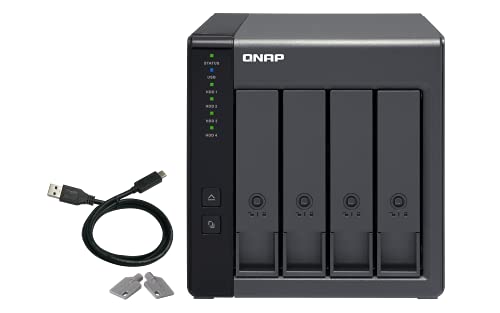
- USB-C direct-attached storage for Windows, macOS, and Linux
- Hardware RAID with RAID 0/1/5, JBOD, and individual disks
- Lockable bays and diskless design for custom drive choice
Best For: Diskless backup storage for PCs and compatible QNAP NAS
High-Capacity DIY Backup Enclosure
8 Bay Mini ITX Micro ATX NAS Case

- 8 hot-swap bays for easy drive changes
- Supports 3.5" HDDs and 2.5" SSDs
- Dual airflow design with 3 silent fans
Best For: DIY backup NAS builds that need lots of drive capacity
Mirrored Desktop Backup Storage
TERRAMASTER D2-320 USB RAID Enclosure

- RAID 1 mirroring for backup protection
- USB 3.2 Gen 2 up to 10Gbps
- Tool-free trays with push-lock design
Best For: Two-drive mirrored backups on a single connected computer
Four-Bay Hot-Swap Storage
TERRAMASTER D4-320 External Hard Drive Enclosure

- Four hot-swappable bays for easy drive access
- USB 3.2 Gen 2 up to 10Gbps
- Quiet cooling with temperature control
Best For: Four-drive local backup storage without RAID
Budget Home Backup NAS – BUFFALO LinkStation 220 4TB 2-Bay
If you want a straightforward nas enclosure for backups without recurring fees, the BUFFALO LinkStation 220 is built around centralized storage for home devices. It ships with drives included, supports RAID 1 for automatic backup, and can be used as a subscription-free personal cloud for photos, videos, and files.
Best For: Home users who want simple shared storage and automated backups for multiple computers and devices.
Pros:
- 2-bay design ships in RAID 1 for automatic backup, with RAID 0 available for full capacity.
- Includes NAS Navigator and PC backup software for automated backups.
- Works with Windows and macOS 15 and earlier, with 24/7 US-based support.
- Closed-system design and SSL encryption add a security-focused approach.
Cons:
- macOS 26 users are directed to Buffalo’s LS 700 series instead.
- Built for basic home storage rather than advanced expansion or high-end performance.
Overall, this is a practical entry-level NAS enclosure for backups if you want easy setup, built-in drives, and a no-subscription approach to home file storage.
Power Protection Pick – UPS for NAS 150W DC Uninterruptible Power Supply
For anyone using a nas enclosure for backups, power protection matters as much as storage. This 150W DC UPS is designed to keep NAS units, routers, and other network gear running through outages, with under-1ms switching and app-based monitoring for status and alerts.
Best For: Users who want compact backup power for a NAS, router, or home server.
Pros:
- Under 1ms instant backup helps prevent reboots and data corruption during outages.
- LiFePO4 battery is rated for 3,000+ charge cycles and a long service life.
- Mobile app shows battery, load, voltage, power history, and alerts.
- Supports Wake-on-LAN remote power-on for compatible network setups.
Cons:
- It is a power unit, not a storage enclosure, so it must be paired with a NAS or drive system.
- 150W output may be too limited for larger or heavily loaded systems.
This is a smart add-on if backup reliability is your priority, especially when you want a compact UPS that focuses on clean power and quick failover.
High-Capacity Enclosure – WAVLINK 4-Bay USB-C 10Gbps Dock
If you need a flexible nas enclosure for backups with room to grow, this WAVLINK 4-bay unit offers support for 3.5-inch and 2.5-inch SATA drives, up to 128TB capacity, and fast 10Gbps USB-C connectivity. It is aimed at users who want large local storage, drive swapping convenience, and extra connectivity in one desktop enclosure.
Best For: Power users who need a large-capacity multi-drive enclosure for backups and file storage.
Pros:
- Four SATA bays support 3.5-inch and 2.5-inch HDDs/SSDs.
- Up to 128TB total capacity gives plenty of room for backups and media.
- 10Gbps USB-C connection supports fast transfers for large files.
- Built-in cooling fans and aluminum shell help manage heat during heavy use.
Cons:
- 2.5-inch drives require separate mounting brackets, which are not included.
- Best suited to direct-attached storage use rather than full NAS-style networking.
For users who want a roomy enclosure and fast local access, this is a capable backup-focused option with more physical expandability than a typical two-bay unit.
Expansion Backup Bay – Synology DX517 5-Bay Expansion Unit
If you already own a compatible Synology system and need a nas enclosure for backups, the DX517 is designed to add five more drive bays through eSATA. It can also be set up as a dedicated local backup solution or a separate volume, giving you a straightforward way to extend storage and keep a local copy of your data.
Best For: Synology owners who want extra bays for expansion or a separate local backup volume.
Pros:
- Adds 5 additional hot-swappable drive bays to compatible Synology NAS units.
- Supports both 2.5-inch and 3.5-inch SATA drives.
- Can be configured as a separate volume for local backup use.
- Purpose-built expansion from the same ecosystem as Synology DiskStation systems.
Cons:
- Diskless unit requires existing drives and a compatible Synology NAS.
- Compatibility depends on the Synology model, so buyers must check support first.
This is a focused expansion choice rather than a standalone enclosure, but it is a strong fit when your goal is to add protected backup capacity inside an existing Synology setup.
Rack-Mount Backup Expander – QNAP TR-004U 1U 4-Bay Enclosure
If you want a nas enclosure for backups that fits into a rack and connects over USB-C, the QNAP TR-004U is built for straightforward direct-attached storage. It supports Windows, macOS, Linux, and QNAP NAS systems, and its hardware RAID options make it easier to match capacity and protection to your workflow.
Best For: Rack-mounted backup storage for QNAP NAS users and multi-OS environments.
Pros:
- 1U rack-mount design for organized installations
- USB Type-C direct-attached storage for Windows, macOS, Linux, and QNAP NAS
- Hardware RAID support: RAID 0, 1, 5, 10, JBOD, and individual disks
- Supports up to four 2.5/3.5-inch SATA drives
Cons:
- Designed as DAS, not a full standalone NAS
- Uses 3 Gbps drive support, which is not the fastest class
- Best fit is tied to compatible backup and expansion use cases
Overall, the TR-004U is a practical choice if your priority is dependable backup expansion in a rack-friendly form factor. It leans into flexibility and RAID control rather than extra NAS apps or standalone features.
Pro-Grade Backup NAS – UGREEN DXP4800 Pro 4-Bay NAS
For buyers who need a nas enclosure for backups plus much more, the UGREEN DXP4800 Pro is a high-performance 4-bay NAS aimed at demanding workflows. It combines a Core i3 processor, DDR5 memory, fast networking, and support for Docker and virtual machines, so it can serve as both a backup target and a broader storage hub.
Best For: Power users, small teams, and IT-focused buyers who want backup storage with advanced NAS features.
Pros:
- Intel Core i3-1315U with 8GB DDR5 RAM, expandable to 96GB
- Dual network ports: 10GbE plus 2.5GbE for fast transfers
- Supports Docker and virtual machines for flexible workflows
- Up to 144TB capacity with 4 HDDs and 2 M.2 SSD slots
Cons:
- More advanced than a simple backup-only enclosure
- Feature set may be overkill if you only need basic storage
- Requires planning if you want to use the SSD slots as cache or storage pool
In short, the DXP4800 Pro is best when backup is just one part of a larger storage strategy. It stands out for performance, networking, and software flexibility rather than being a minimal enclosure.
Simple RAID Backup Box – QNAP TR-004 4-Bay DAS
QNAP TR-004 4 Bay USB Type-C Direct Attached Storage (DAS) with hardware RAID (Diskless)
Check Price On AmazonThe QNAP TR-004 is a straightforward nas enclosure for backups when you want USB Type-C direct-attached storage with hardware RAID. It works with Windows, macOS, and Linux, and it can be used as external storage for NAS backup or to expand a compatible QNAP NAS.
Best For: Users who want a diskless, hardware-RAID backup enclosure for a PC or compatible QNAP NAS.
Pros:
- USB Type-C DAS with support for Windows, macOS, and Linux
- Hardware RAID options: RAID 0, 1, 5, JBOD, and individual disks
- Lockable drive bays for added physical security
- Comes diskless, so you can choose your own 3.5-inch SATA drives
Cons:
- Does not support some older QNAP models
- Cannot host NAS applications
- Storage pool or volume cannot be combined into the connected NAS
The TR-004 is a solid pick if you want a focused backup enclosure instead of a full networked NAS. Its strengths are RAID flexibility, broad OS support, and simple expansion for compatible setups.
High-Capacity DIY Backup Enclosure – 8 Bay Mini ITX Micro ATX NAS Case
If you want a NAS enclosure for backups with lots of room to grow, this 8-bay DIY case is built around expansion and cooling. It supports both 3.5" HDDs and 2.5" SSDs, with hot-swap bays and broad motherboard compatibility for a custom home or small-business storage build.
Best For: DIY users building a high-capacity backup NAS, media server, or private cloud with flexible hardware choices.
Pros:
- 8 hot-swap drive bays for fast drive replacement without shutting the system down
- Works with Mini-ITX and Micro-ATX boards, plus 1U/FLEX power supplies
- Separate upper/lower airflow paths and 3 temperature-controlled fans for cooling
- Thick steel chassis, drive status lights, and front USB 3.0 for everyday use
Cons:
- Motherboard, CPU, and other core components are not included
- Build is more involved than a ready-to-use appliance
- Best suited to low-power NAS parts with limited cooler height
Overall, this is a strong choice if you want maximum bay count and DIY flexibility in a backup-focused enclosure. It is especially appealing when expandability and airflow matter more than plug-and-play simplicity.
Mirrored Desktop Backup Storage – TERRAMASTER D2-320 USB RAID Enclosure
The TERRAMASTER D2-320 is not a NAS, but it can still work well as a backup-oriented storage box when you want direct-attached RAID protection. For a nas enclosure for backups style setup at the desktop, it offers RAID 1 mirroring, tool-free trays, and fast USB 3.2 Gen 2 connectivity.
Best For: Users who want a simple two-drive mirrored backup enclosure with fast USB access.
Pros:
- RAID 1 support provides mirrored backup between two drives
- USB 3.2 Gen 2 connection supports up to 10Gbps transfer speed
- Tool-free trays and push-lock design simplify drive installation
- Compatible with 3.5" HDDs, 2.5" HDDs, and 2.5" SSDs
Cons:
- It is a DAS, not a NAS, so it does not function as a networked storage appliance
- Only supports two drives
- Requires a host computer or server for use
This is a practical pick if your backup workflow centers on one computer and you want mirrored storage without building a full NAS. The main tradeoff is capacity and networking, but the speed and simplicity are attractive.
Four-Bay Hot-Swap Storage – TERRAMASTER D4-320 External Hard Drive Enclosure
If you need a flexible storage box for backups and large media libraries, the TERRAMASTER D4-320 offers four hot-swappable drive bays in a simple direct-attached design. It is not a NAS, but for a nas enclosure for backups workflow that stays tethered to one machine, it gives you a lot of capacity and easy drive handling.
Best For: Users who want four-drive external storage with hot-swap convenience and no RAID complexity.
Pros:
- Four drive bays with hot-swappable, tool-free trays
- USB 3.2 Gen 2 connection supports up to 10Gbps
- Compatible with 3.5" HDDs, 2.5" HDDs, and 2.5" SSDs
- Quiet-focused design with temperature-controlled fan and damping materials
Cons:
- No RAID function, so it does not provide mirrored backup by itself
- It is a DAS rather than a network NAS
- Requires a host device to manage the disks
The D4-320 makes sense when you want more bays than a typical two-disk enclosure and prefer straightforward plug-and-play storage. It is a capacity-first choice for local backup workflows rather than a network sharing solution.
How We Picked the Best Nas Enclosure for Backups
For this roundup, we prioritized backup-first features: drive capacity, RAID or redundancy options, connection speed, reliability, and ease of setup. We also weighed whether each product is better suited to direct-attached storage, NAS expansion, or a full networked backup environment.
Quick Comparison
Some models are best for straightforward local backups over USB, while others are designed to expand an existing NAS or serve as a more complete always-on storage platform. If you want the simplest path, a two-bay or four-bay enclosure is usually enough for versioned backups of home PCs and media. If you expect your archive to grow quickly, choose a higher-capacity bay count or an expansion chassis that can scale later.
Key Buying Factors for a Nas Enclosure for Backups
Bay Count and Drive Support
More bays mean more usable space and more flexibility. Two-bay units are fine for mirrored backup sets, while four- and five-bay options give you more room for RAID protection, separate backup volumes, or mixed-drive configurations.
RAID, Redundancy, and Recovery
A backup enclosure should make recovery straightforward after a drive failure. Look for RAID support if you want redundancy, but remember that RAID is not the same as a true backup. It helps keep storage available, yet you should still maintain separate copies of important data.
Connection Type and Transfer Speed
USB-C DAS enclosures are ideal for fast local backups and easy plug-and-play use. Network NAS systems are better when multiple devices need access or when you want remote backup workflows. Match the interface to your real usage, not just peak speed claims.
Cooling and Build Quality
Backup hardware often runs for long stretches, so temperature control matters. Metal construction, quiet fans, and sensible airflow help improve drive longevity, especially in multi-bay systems.
Who Should Buy Which Nas Enclosure for Backups?
If you want an easy starter setup, choose a compact two-bay unit with included drives or simple RAID support. If you are backing up large media libraries, video files, or development data, a four-bay enclosure offers better headroom. Power users and IT-focused buyers should consider a higher-end NAS or expansion unit that can scale with future storage needs. For small offices or always-on backup tasks, prioritize reliability, cooling, and expandability over novelty features.
In short, the best Nas Enclosure for Backups is the one that matches your storage growth, protection needs, and preferred workflow without making restores complicated.