
Building a home studio does not require a room full of vintage keyboards. The right combination of a MIDI controller, sampler, audio interface, or compact electronic instrument can give you a flexible starting point for composing, recording, and performing.
We selected 10 practical options for different workflows, including beat production, software-based synthesis, live looping, streaming, and beginner recording setups. Use the guide below to match the equipment to your space, software, and creative goals.
Best 10 Synthesizers for Home Studios Picks for 2026
Best Portable Sampler

- Standalone battery-powered sampler with speaker and microphone
- 16 pads, chopping tools, sequencing, and onboard effects
- USB-C, MIDI, line I/O, and microSD support
Best For: Portable beatmaking and DAWless sample-based production
Best Pocket Synth

- Compact analog-style synth with three octaves
- Stylus-controlled touch surface with optional vibrato
- Battery powered with speaker, headphones, and auxiliary connection
Best For: Portable retro sounds and beginner-friendly experimentation
Best Recording Bundle

- Two-input USB-C interface with mic and instrument inputs
- Auto Gain, Clip Safe, Air mode, and 24-bit/192kHz support
- Includes microphone, headphones, cables, and recording software
Best For: Recording synths and other instruments in a compact home studio
Best MIDI Keyboard
MIDIPLUS X4 III MIDI Controller

- 49 full-size velocity-sensitive keys
- Pitch/modulation touch strips and configurable MIDI controls
- USB, MIDI out, sustain, and expression-pedal connections
Best For: Playing and controlling software synthesizers on Mac or Windows
Complete Recording Setup

- Two-channel USB recording interface
- Mic, headphones, and cables included
- Software bundle for recording and production
Best For: Songwriters building a compact home studio
Playful Portable Pick
Otamatone Electronic Synthesizer

- Touch-sensitive stem controls pitch
- Cheek control adds vibrato
- Compact battery-powered design
Best For: Beginners and casual creative play
Beatmaking Controller

- 25 velocity-sensitive mini keys
- Pads, knobs, and arpeggiator included
- Software instruments and sounds bundled
Best For: Home producers controlling virtual instruments
Complete Recording Starter

- MIDI I/O for synths and controllers
- Two mic preamps with +48V phantom power
- Includes mic, headphones, and recording software
Best For: Beginners building an all-in-one home recording setup
Clip Launching Controller
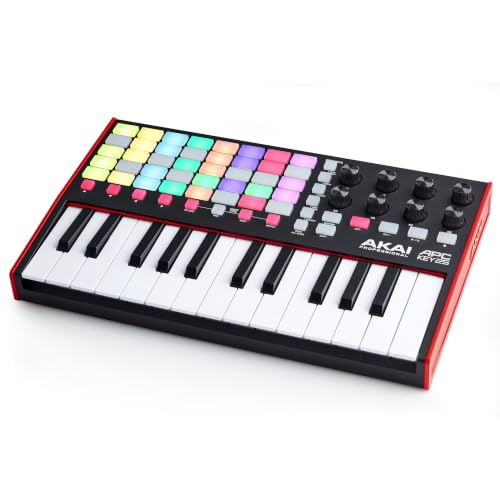
- 25 velocity-sensitive mini keys
- 40 RGB pads for Ableton clip launching
- Eight assignable knobs for hands-on control
Best For: Ableton Live producers using software synthesizers
Streaming Studio Hub

- Loopback function for live streaming
- DSP effects and dedicated mute button
- Includes Cubase AI and WaveLab Cast
Best For: Solo creators combining music production and streaming
Best Portable Sampler – Akai MPC Sample
For producers seeking synthesizers for home studios but wanting a broader sampling workflow, the Akai MPC Sample combines a standalone sampler, sequencer, effects processor, and portable performance setup. Its battery, speaker, microphone, pads, and microSD storage support computer-free beatmaking.
Best For: Beatmakers, sample-based producers, DAWless creators, and musicians who want portable MPC-style production.
Pros:
- Standalone, battery-powered operation with built-in speaker and microphone
- 16 responsive pads, sample chopping, timestretching, repitching, and internal resampling
- Includes more than 100 factory kits and 60 internal effects
- USB-C audio/MIDI, MIDI connectivity, line I/O, and microSD storage support flexible setups
Cons:
- It is primarily a sampler and sequencer rather than a conventional keyboard synthesizer
- MIDI DIN connectivity requires an adapter, which is not included
- The compact 2.4-inch display may feel limiting for detailed editing
The MPC Sample is a strong choice when hands-on sampling and mobile production matter more than traditional synth-keyboard controls. It can also serve as a connected production hub in a home studio.
Best Pocket Synth – Stylophone Original
The Stylophone Original is a compact, battery-powered option for adding distinctive analog-style sounds to a home studio. Its stylus-controlled touch surface offers an unusual playing experience, while the built-in speaker, headphone socket, and computer connection keep it easy to explore.
Best For: Beginners, experimental musicians, and producers who want an inexpensive, portable source of warm retro tones.
Pros:
- Iconic analog sound with three octaves and optional vibrato
- Simple stylus-and-touch-surface interface that is easy to play
- Small battery-powered design with built-in speaker and headphone output
- Can connect to a computer through a 3.5mm stereo cable for recording
Cons:
- Its touch-surface layout is less versatile than a full keyboard
- Requires three AA batteries
- Auxiliary connectivity may require additional equipment for a studio setup
The Stylophone is best viewed as a characterful sound source rather than the centerpiece of a synthesizer rig. Its retro tone and unconventional controls make it useful for quick ideas, accents, and experimentation.
Best Recording Bundle – Focusrite Scarlett 2i2 Studio
Although it is not a synthesizer itself, the Focusrite Scarlett 2i2 Studio is a practical recording companion for synthesizers for home studios. It provides two inputs, instrument connectivity, headphones, a condenser microphone, and bundled software for capturing and developing hardware synth performances.
Best For: Home-studio musicians who need an all-in-one interface package for recording synthesizers, vocals, and instruments.
Pros:
- Two inputs with microphone preamps and Hi-Z instrument inputs
- 24-bit/192kHz operation and a stated 120dB dynamic range
- Auto Gain and Clip Safe help simplify level setting and prevent clipping
- Includes CM25 MkIII microphone, SH-450 headphones, cables, and music software
Cons:
- It requires a computer or compatible mobile device for recording and production
- Two inputs may be limiting for multi-synth or larger hardware setups
- It does not generate synthesizer sounds on its own
The Scarlett 2i2 Studio makes sense as the recording front end for a small studio, especially if you also need a microphone and headphones. Its bundled tools help turn a hardware synth setup into a more complete recording environment.
Best MIDI Keyboard – MIDIPLUS X4 III MIDI Controller
The MIDIPLUS X4 III is a 49-key MIDI controller for playing software synthesizers and controlling virtual instruments in a home studio. Its velocity-sensitive keys, touch controls, octave and transpose settings, and pedal connections provide more expressive control than a computer keyboard.
Best For: Producers who use software synthesizers on Windows or Mac and want a full-size controller with flexible MIDI settings.
Pros:
- 49 full-size velocity-sensitive keys
- Pitch and modulation touch strips support expressive performance
- Offers octave, transpose, velocity-curve, scale, MIDI-channel, and controller settings
- Provides USB, MIDI out, sustain-pedal, and expression-pedal connections
Cons:
- It is a controller and does not produce sounds without connected software or MIDI gear
- Sustain and expression pedals are not included
- Its relatively large footprint may be unsuitable for very small desks
The X4 III is a sensible control surface for software-based synthesizers for home studios. Choose it when playable keys and hands-on MIDI control are more important than onboard sounds or an especially compact format.
Complete Recording Setup – Scarlett Solo Studio 4th Gen
For home studios seeking synthesizers for home studios and other instruments, the Focusrite Scarlett Solo Studio 4th Gen is a practical recording bundle rather than a synthesizer itself. It combines a two-channel USB-C interface with a condenser microphone, headphones, recording software, and production tools.
Best For: Songwriters and home producers who need an all-in-one setup for recording vocals, guitar, and software instruments.
Pros:
- Includes the Scarlett Solo interface, CM25 MkIII microphone, SH-450 headphones, and USB/XLR cables.
- Offers 24-bit/192kHz recording, 120dB dynamic range, one XLR mic preamp, and one Hi-Z instrument input.
- Air mode adds presence and harmonic drive to vocals and guitars.
- Includes Ableton Live Lite, Pro Tools Intro+, Cubase LE, and Hitmaker Expansion.
Cons:
- Provides only two channels, with one microphone input and one instrument input.
- It is a recording interface bundle, so a separate synthesizer is needed for hardware-synth sounds.
- Headphones and microphone are included, but studio monitors are not.
This bundle is a strong starting point for a compact home studio, especially if you want to record a hardware synthesizer alongside vocals or guitar. Its software package also helps you begin working with virtual instruments immediately.
Playful Portable Pick – Otamatone Electronic Synthesizer
The Otamatone is a playful choice for anyone exploring synthesizers for home studios without committing to a conventional keyboard. This portable Japanese electronic instrument uses a touch-sensitive stem for pitch and cheek-squeezing controls for vibrato.
Best For: Beginners, families, and musicians who want an unusual, lightweight instrument for casual creativity at home or on the go.
Pros:
- Touch or slide along the stem to vary pitch and squeeze the cheeks for vibrato.
- Supports low, medium, and high pitch ranges for simple solo playing or group harmonies.
- Compact, lightweight design is suitable for travel, outdoor use, and casual sessions.
- Simple battery-powered operation makes setup quick once three AAA batteries are available.
Cons:
- AAA batteries are required but not included.
- Its playful manual design is less suited to detailed sequencing or traditional studio production.
- It is designed for one player at a time.
The Otamatone is best viewed as a fun supplementary instrument rather than the centerpiece of a production rig. Its expressive controls and portability make it an easy way to add novelty and character to home music-making.
Beatmaking Controller – Akai MPK Mini MK3
The Akai Professional MPK Mini MK3 is a compact USB MIDI controller for synthesizers for home studios, virtual instruments, and beat production. It combines 25 velocity-sensitive mini keys with pads, knobs, a pitch/modulation thumbstick, and a built-in arpeggiator.
Best For: Home producers and beat makers who want hands-on control of virtual synthesizers, samples, drums, and DAW effects in a small workspace.
Pros:
- Includes 25 velocity-sensitive keys, eight MPC-style pads, eight assignable knobs, and pitch/modulation control.
- Built-in arpeggiator offers adjustable resolution, range, and modes.
- USB-powered and compact, making it practical for desktop studios and mobile setups.
- Includes MPC Beats, three virtual instruments, 2GB of sound content, and access to additional bundles and Splice.
Cons:
- It is a MIDI controller rather than a standalone synthesizer and requires a compatible computer or device.
- The 25 mini-key layout offers less range than a full-size keyboard.
- Its single USB connection provides no standalone audio output.
For computer-based production, the MPK Mini MK3 offers an efficient way to play and manipulate software synthesizers without taking over your desk. The pads, knobs, and arpeggiator also make it useful for building beats and shaping plugin sounds.
Complete Recording Starter – AudioBox USB 96 Studio Bundle
For home studios exploring synthesizers for home studios, the AudioBox USB 96 Studio Recording Bundle provides the connectivity and monitoring essentials for adding keyboards, synths, microphones, and other instruments to a computer-based setup. Its MIDI I/O and combo inputs make it a practical foundation for recording and production.
Best For: Beginners and home producers who want an interface, headphones, microphone, and recording software in one bundle.
Pros:
- MIDI In/Out connects synthesizers, drum machines, and controllers.
- Two class-A mic preamps with +48V support simultaneous guitar and vocal recording.
- Zero-latency hardware monitoring and a high-volume headphone output support comfortable tracking.
- Includes headphones, condenser microphone, cables, and Studio One software.
Cons:
- It has two recording channels, so larger multi-input setups may need more hardware.
- This is an audio/MIDI interface bundle rather than a standalone synthesizer.
The AudioBox USB 96 is a sensible all-in-one starting point for connecting a synthesizer to a home studio while also covering vocals, guitar, monitoring, and basic recording needs.
Clip Launching Controller – Akai APC Key 25 MK2
For producers comparing synthesizers for home studios, the Akai APC Key 25 MK2 is a compact USB MIDI controller designed to play software instruments and launch Ableton Live clips. Its mini keys, RGB pad matrix, and assignable knobs support both arrangement and performance workflows.
Best For: Ableton Live users who want portable clip launching, software-instrument control, and hands-on parameter adjustment.
Pros:
- 25 velocity-sensitive mini keys cover two octaves and can be shifted across the melodic range.
- Forty RGB pads provide visual clip feedback and launching control in Ableton Live.
- Eight assignable rotary knobs support volume, pan, effects sends, automation, and macro control.
- USB bus power and compact dimensions make it easy to move between studio and stage.
Cons:
- It is a MIDI controller, not a standalone hardware synthesizer with built-in sound generation.
- The strongest integration is centered on Ableton Live.
The APC Key 25 MK2 is a focused choice for software-based home studios, especially when clip launching and direct Ableton control matter as much as playing virtual synths.
Streaming Studio Hub – Yamaha AG03MK2 USB Mixer
For home studios that combine synthesizers for home studios with streaming or live content, the Yamaha AG03MK2 offers a compact mixer and USB audio interface. Its loopback function, DSP effects, mute button, and bundled Steinberg software are geared toward straightforward broadcast and production workflows.
Best For: Solo streamers, creators, and musicians who need a compact interface for live audio, loopback, and basic production.
Pros:
- Loopback supports combining computer audio with live input for streaming.
- Built-in DSP effects and a mute button are useful during live broadcasts.
- AG Controller provides control from Windows, Mac, and iOS devices.
- Includes Cubase AI and WaveLab Cast software.
Cons:
- Its three-channel design is less suited to larger recording sessions.
- It is a mixer/interface rather than a synthesizer or MIDI controller.
The AG03MK2 makes the most sense when a home studio doubles as a streaming space, delivering convenient routing and live-focused controls in a small footprint.
How We Picked the Best Synthesizers for Home Studios
These picks cover the main ways home producers interact with synthesizer software and electronic instruments. We considered keyboard size, portability, hands-on controls, USB and MIDI connectivity, recording features, bundled software, and how well each product fits a specific studio workflow. Because the selection includes controllers, samplers, mixers, and audio interfaces as well as compact synthesizer-style instruments, the best choice depends on what you already own.
A MIDI controller does not create sound by itself; it operates virtual instruments on a computer or compatible hardware. Audio interfaces and studio bundles focus on recording microphones and instruments, while samplers and standalone electronic instruments can provide more immediate sound-making.
Quick Comparison
| Best For | Recommended Type | What to Look For |
|---|---|---|
| Software synths and beginners | Compact MIDI keyboard | Useful keys, pads, knobs, and dependable USB connectivity |
| Beatmaking and sampling | Sampler or pad controller | Fast sample triggering, sequencing, and performance controls |
| Recording vocals or instruments | Audio interface bundle | Low-latency monitoring, suitable inputs, and included software |
| Streaming and live sessions | USB mixer/interface | Loopback, simple level control, and flexible connections |
| Portable experimentation | Mini electronic instrument | Built-in sound generation, compact size, and battery-friendly operation |
Key Buying Factors for Synthesizers for Home Studios
Choose the Right Control Format
Twenty-five-key controllers are compact and suitable for bass lines, leads, and drum programming, but they may feel restrictive for two-handed playing. Larger keyboards offer more range, while pad-focused devices are often better for finger drumming, clip launching, and sample triggering.
Check Your Connections
USB is the simplest route to a computer, but traditional five-pin MIDI can be important if you plan to connect hardware synthesizers or drum machines. For recording, check whether the interface has the microphone, instrument, or line inputs you need. USB-C may improve compatibility with newer computers, but always verify included cables and power requirements.
Consider Monitoring and Software
Headphone output, direct monitoring, and low-latency operation make recording easier. Bundled digital audio workstation software, virtual instruments, and effects can add substantial value, especially for first-time producers. Confirm that the included software supports your operating system before buying.
Match Features to Your Space
For a small desk, prioritize compact dimensions and a manageable cable setup. If you share a room, headphones and quiet controls may matter more than powerful speakers. A standalone sampler or small electronic instrument can also provide inspiration without requiring a full computer-based workflow.
Who Should Buy Which Synthesizers for Home Studios?
New producers: Choose a studio bundle or compact MIDI keyboard if you want an affordable path into software instruments and recording. Beatmakers: A sampler or pad-oriented controller is the better fit for chopping sounds, sequencing patterns, and performing rhythms. Keyboard players: Select a controller with enough keys for your playing style and the controls required by your virtual synths. Singers and instrumentalists: Prioritize an audio interface bundle with appropriate inputs, headphone monitoring, and recording software. Streamers and live performers: Look for a USB mixer with loopback and straightforward level controls. Curious beginners or gift buyers: A compact standalone electronic instrument offers immediate playability without the complexity of a full studio.