
Shopping for synthesizers under $1,000 means choosing between full-size production keyboards, hands-on analog instruments, compact performance synths, and portable FM models. The right option depends on how you plan to create, perform, and control sounds.
This roundup compares ten notable choices across those categories, focusing on sound design, playability, sequencing, connectivity, portability, and overall value.
Best 10 Synthesizers Under 1000 Picks for 2026
Best All-Around Workstation

- 128-note polyphony for live play and sequencing
- Plug-and-play USB audio/MIDI connectivity
- Motif sound engine with flexible element control
Best For: Home producers and performers needing versatile sounds and simple computer integration
Best for Live Performance

- Over 3,800 ZEN-Core sounds
- Portable 61-key synth-action design
- USB-C, sequencing, and WAV sample import
Best For: Gigging musicians seeking broad sounds and a portable stage keyboard
Best Analog Value

- Warm four-voice analog polyphony
- Built-in 16-step motion sequencer
- 200 presets with hands-on sound shaping
Best For: Players seeking approachable analog synthesis and compact sequencing
Best for Experimental Sound Design
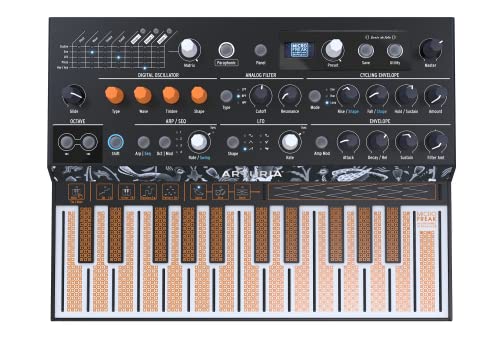
- Hybrid oscillator and analog-filter architecture
- Poly-aftertouch touch-plate keybed
- CV, USB, and MIDI connectivity
Best For: Electronic musicians pursuing unusual sounds, expressive control, and modular integration
Premium Analog Power

- Two wavefolding VCOs plus sub-oscillator
- Expressive 32-key keyboard with aftertouch
- Sequencer, CV, MIDI, and USB-C connectivity
Best For: Analog bass, leads, and hands-on performance
Portable Vintage Polyphony

- JUPITER-8-inspired eight-voice architecture
- K-25m keyboard dock and built-in speakers
- Effects, sequencer, USB-C, and MIDI
Best For: Portable vintage-style polyphonic performance
Hands-On Bass and Motion

- Punchy 2-pole filter with added drive
- 16-step sequencer with real-time editing
- Parameter-lock-style motion sequencing
Best For: Basslines, leads, and evolving monophonic patterns
Best Portable FM Workstation

- 6-operator FM synthesis with 32 algorithms
- Sequencer, arpeggiator, and six effects
- Battery-powered with Bluetooth MIDI
Best For: Portable producers and electronic performers
Best Analog Polyphonic Value

- Eight-voice classic analog polyphony
- Two VCOs per voice for thick tones
- 400 memories with arpeggiator and sequencer
Best For: Studio setups seeking Prophet 600-style analog sounds
Best Compact FM Starter Synth
M-VAVE Portable FM Synthesizer

- Six operators and 32 FM algorithms
- 128 presets with SysEx sound support
- Built-in speaker, battery, and wireless MIDI
Best For: Beginners and mobile sound designers
Best All-Around Workstation – Yamaha MX49BK
For musicians comparing synthesizers under 1000, the Yamaha MX49BK is a versatile choice for production, live performance, and computer-based setups. It combines 128-note polyphony with USB audio/MIDI connectivity and a Motif sound engine in a relatively light 12.5-pound design.
Best For: Home producers and performers who want broad workstation-style sounds, reliable polyphony, and simple computer connectivity.
Pros:
- 128-note polyphony supports live playing and full 16-track sequences.
- Class-compliant USB supports plug-and-play audio and MIDI connection.
- Motif sound engine supports layering, zoning, switching, and control of up to eight elements.
- Records and plays back stereo audio and 16 channels of MIDI through one USB cable.
Cons:
- Its 49-key format offers less range than larger keyboards.
- The engineered-wood construction may be less appealing to players seeking a metal-bodied instrument.
The MX49BK stands out as a practical all-purpose option for producers who value connectivity and high polyphony. Its USB workflow and flexible sound engine make it especially useful when one keyboard needs to cover both studio and stage duties.
Best for Live Performance – Roland JUNO-D6
Among synthesizers under 1000, the Roland JUNO-D6 is geared toward players who need a portable stage keyboard with immediate access to familiar sounds. Its 61 synth-action keys, ZEN-Core engine, USB-C connectivity, and built-in sequencer support both gigs and studio sessions.
Best For: Live musicians who want a lightweight 61-key instrument with stage-ready sounds and expandable sound options.
Pros:
- Offers over 3,800 onboard sounds through the flagship-class ZEN-Core engine.
- Provides acoustic and electric pianos, organs, synths, and other live-performance sounds.
- USB-C supports audio/MIDI connections and mobile battery power.
- Includes an eight-track sequencer and user WAV sample import.
Cons:
- The included package is the synthesizer only.
- Its synth-action keyboard may not suit players who prefer weighted piano keys.
The JUNO-D6 is a strong fit for performers who prioritize sound variety, portability, and a straightforward workflow. Its 61-key layout provides useful playing range without making the instrument excessively heavy for transport.
Best Analog Value – Korg minilogue
For shoppers exploring synthesizers under 1000, the Korg minilogue delivers hands-on analog sound design in a compact 37-key format. Its four-voice polyphony, 16-step sequencer, and tape-style delay make it suitable for both learning synthesis and building original parts.
Best For: Beginners and experienced musicians who want warm analog tones, direct controls, and built-in sequencing.
Pros:
- True analog circuitry produces a warm, punchy sound profile.
- Four-voice polyphony supports layered musical arrangements.
- Built-in polyphonic step and motion sequencer supports recording and recall.
- Includes 200 presets, filters, modulation options, delay, and an oscilloscope display.
Cons:
- Four-note polyphony is more limited than the Yamaha MX49BK’s 128 notes.
- The 37-key layout provides less range than a 61-key keyboard.
- Its analog-focused design may offer fewer built-in sounds than a workstation-style synthesizer.
The minilogue is a compelling choice when the priority is tactile analog synthesis rather than maximum polyphony or workstation breadth. Its sequencer and accessible controls make it useful for both experimentation and finished arrangements.
Best for Experimental Sound Design – Arturia MicroFreak
The Arturia MicroFreak is an unconventional pick for synthesizers under 1000, combining digital oscillator engines with a resonant analog filter and a highly responsive touch-plate keybed. Its compact 2.3-pound design is built for creative sequencing, modulation, and unusual textures.
Best For: Sound designers and electronic musicians who want experimental tones, expressive touch control, and modular-friendly connectivity.
Pros:
- Offers 17 oscillator modes spanning physical modeling, wavetable synthesis, vocoder, noise, and more.
- 25-key PCB keybed provides individual pressure or poly-aftertouch detection.
- Includes a modulation matrix, automation recording, and Spice and Dice sequencing tools.
- CV outputs, USB, and MIDI support integration with computers, modular gear, and other synths.
Cons:
- The 25-key touch-plate keyboard may feel unfamiliar to traditional keyboard players.
- Its advanced feature set may have a steeper learning curve for beginners.
- The compact key range is less suited to extended traditional keyboard parts.
The MicroFreak prioritizes sonic exploration over conventional playability. It is particularly attractive for producers who want a small instrument capable of evolving patterns, expressive sequencing, and hybrid sounds that stand apart from standard analog patches.
Premium Analog Power – Moog Messenger
The Moog Messenger is a strong option for musicians seeking synthesizers under 1000 with classic analog tone, hands-on controls, and modern performance features. Its two wavefolding oscillators, sub-oscillator, versatile ladder filter, and full-size expressive keys make it suitable for both studio sound design and live playing.
Best For: Players and producers who want a portable, powerful monophonic analog synthesizer with full-size keys and extensive sequencing and modulation.
Pros:
- Two variable-shape VCOs with sync, frequency modulation, and a sub-oscillator
- Versatile filter offers low-pass, band-pass, and high-pass modes with resonance bass compensation
- 32 semi-weighted keys include velocity and aftertouch
- Built-in sequencer, arpeggiator, 256 presets, CV, MIDI, and USB-C connectivity
Cons:
- Monophonic architecture limits it to one-note-at-a-time playing
- Its 27.6-inch width and 5.14 kg weight may be less convenient for highly mobile setups
The Messenger stands out for combining Moog’s recognizable analog character with unusually complete performance and connectivity options. It is especially compelling when tactile control, expressive keys, and deep bass-focused sound design matter more than polyphony.
Portable Vintage Polyphony – Roland JUPITER-08
The Roland JUPITER-08 brings classic JUPITER-8-inspired sounds to a compact standalone instrument, making it a practical pick among synthesizers under 1000 for portable setups. It includes a K-25m keyboard dock, built-in speakers, effects, sequencing, and USB-C audio/MIDI connectivity.
Best For: Musicians who want vintage Roland-style tones, portable operation, and flexible sequencing and effects in a compact package.
Pros:
- Eight-voice, two-part architecture with poly mode expansion up to 32 voices
- Includes K-25m keyboard dock and built-in speakers
- 17-type MFX engine plus delay and dedicated reverb with shimmer mode
- USB-C audio/MIDI, traditional MIDI I/O, and external clock input
Cons:
- The included keyboard dock is compact rather than full-size
- Its portable design may offer less hands-on space than a larger keyboard synthesizer
The JUPITER-08 is a flexible choice for players who value portability without giving up polyphonic sequencing, effects, and modern computer connectivity. Its vintage character and built-in speaker also make it convenient for quick sketching and mobile performance.
Hands-On Bass and Motion – Korg monologue
The Korg monologue is a focused monophonic analog synthesizer for shoppers comparing synthesizers under 1000, particularly those interested in bass, leads, and step-based sequencing. Its 16-step controls, parameter-lock-style editing, drive circuit, and expanded LFO provide direct control over moving analog patterns.
Best For: Producers and performers who want an accessible monophonic analog synth with punchy bass, cutting leads, and immediate sequence editing.
Pros:
- 2-pole filter and added drive deliver bass weight and cutting lead tones
- Expanded LFO supports higher rates and deeper modulation
- 16 step buttons enable fast real-time sequence edits
- Push-button-and-knob parameter locking creates evolving motion sequences
Cons:
- Monophonic design is limited to one note at a time
- Its feature set is more focused than the broader connectivity and modulation options of larger synthesizers
The monologue is a practical, performance-friendly choice when immediate sequencing and focused analog sound matter most. Its drive and motion-sequencing controls make it particularly well suited to basslines, lead parts, and rhythmic pattern experimentation.
Best Portable FM Workstation – M-VAVE FM-1 Orange
The M-VAVE FM-1 Orange is a strong option for shoppers comparing synthesizers under 1000 who want classic FM sounds in a compact, battery-powered format. Its 6-operator engine, 128 presets, sequencer, arpeggiator, effects, and flexible MIDI connections make it suitable for both quick sketches and portable performance.
Best For: Portable music production, electronic creators, beginners, and performers who want an all-in-one FM synth.
Pros:
- 6-operator FM engine with 32 algorithms, 128 presets, deep editing, and DX7 SysEx patch import.
- Includes a 16-step sequencer, seven-mode arpeggiator, and six built-in effects.
- Compact 27-key design offers Bluetooth MIDI, USB-C, 3.5mm MIDI, a speaker, and up to 12 hours of battery life.
Cons:
- The compact 27-key silicone keyboard may feel limiting for players who prefer full-size keys.
- Its FM-focused sound engine may be less suitable for shoppers seeking a broad analog-style synthesis palette.
Choose the FM-1 Orange if portability and integrated creative tools matter more than a traditional full-size keyboard. It provides an unusually complete mini workstation for composing, practicing, and performing away from a studio.
Best Analog Polyphonic Value – Behringer PRO-800
The Behringer PRO-800 is worth considering among synthesizers under 1000 for players who prioritize classic analog polyphonic tones. Its eight voices, two VCOs per voice, pure analog signal path, and Prophet 600-inspired design focus on thick pads, detuned sounds, leads, and basses.
Best For: Studio musicians and synth players seeking an affordable analog-style polyphonic instrument in a Eurorack format.
Pros:
- Eight-voice polyphony supports chords and layered arrangements.
- Pure analog VCO, VCF, and VCA signal path delivers classic analog character.
- Two VCOs per voice, unison mode, multiple oscillator shapes, arpeggiator, sequencer, and 400 program memories.
Cons:
- The Eurorack-format design may require a compatible setup or additional integration planning.
- The supplied notes do not indicate a built-in keyboard, so it is less immediately playable than a keyboard synth.
The PRO-800 makes the most sense when authentic analog architecture and polyphonic depth are your priorities. It is a focused choice for adding vintage-style oscillator and filter tones to a modular or studio rig.
Best Compact FM Starter Synth – M-VAVE Portable FM Synthesizer
This black M-VAVE FM synthesizer is a practical pick among synthesizers under 1000 for anyone who wants immediate access to classic FM sounds without a larger setup. It combines 27 silicone keys, 128 presets, six operators, built-in effects, sequencing, and wireless MIDI in a highly portable battery-powered unit.
Best For: Beginners, mobile producers, and players who want a compact synth for practice, sound exploration, and portable creation.
Pros:
- Six operators and 32 algorithms provide hands-on access to classic FM synthesis.
- 128 presets, FM SysEx sound-bank support, six effects, and a seven-mode arpeggiator encourage quick experimentation.
- Built-in speaker, battery operation, 27-key layout, and USB, Bluetooth, and 3.5mm MIDI connections support flexible use.
Cons:
- The small silicone keyboard and compact controls may not suit players wanting a conventional full-size instrument.
- Its feature set is centered on FM synthesis rather than multiple synthesis types.
The black FM Synthesizer is a sensible entry point for portable FM exploration. It offers enough sequencing, effects, presets, and connectivity to stay useful as your workflow develops while remaining easy to carry.
How We Picked the Best Synthesizers Under 1000
We selected instruments that offer a meaningful combination of sound quality, hands-on control, useful performance features, and reliable value at this price level. The list includes analog, digital, FM, and hybrid-style options rather than treating every synthesizer as interchangeable.
Our comparison emphasizes keyboard size, synthesis architecture, polyphony, sequencing, presets, portability, and suitability for studio production or live use. Because needs vary widely, a compact monophonic synth can be a better choice than a larger keyboard if tactile sound design is the priority.
Quick Comparison
| Best For | What to Look For |
|---|---|
| Beginners and producers | Presets, broad sound libraries, computer connectivity, and a playable keyboard |
| Analog sound design | Oscillator and filter controls, modulation options, and sequencing |
| Chord-based performance | Polyphony, adequate key count, velocity response, and dependable patch memory |
| Portable experimentation | Battery power, built-in speaker, compact dimensions, and onboard effects |
| Live performers | Fast controls, patch recall, solid construction, and practical outputs |
Key Buying Factors for Synthesizers Under 1000
Polyphony and Keyboard Size
Monophonic instruments play one note at a time and excel at basses, leads, and sequenced lines. Polyphonic models are more suitable for chords, layered pads, and conventional keyboard parts. Also consider whether you need a compact keybed, 49 or 61 keys, or an instrument designed primarily for desktop use.
Synthesis Type and Sound Design
Analog synths are often chosen for immediate control and animated bass or lead tones. FM instruments can deliver precise bells, electric-piano sounds, metallic textures, and complex digital timbres. Workstation-style and digital models usually provide broader preset coverage, which can be valuable for production and live versatility.
Sequencing, Effects, and Connectivity
An onboard sequencer or arpeggiator can turn a small synth into a complete idea-generation tool. Check whether it supports automation, pattern storage, and synchronization with other equipment. USB, MIDI, audio outputs, Bluetooth, and built-in effects can also determine how easily the instrument fits your setup.
Portability and Workflow
Small instruments are easier to carry and often encourage hands-on experimentation, but they may have fewer keys and controls. A larger keyboard can be more comfortable for performance while taking up substantially more room. Prioritize the workflow you will actually use rather than the longest feature list.
Who Should Buy Which Synthesizers Under 1000?
Choose a versatile production keyboard if you need one instrument for songwriting, MIDI work, live parts, and a broad range of sounds. Choose a polyphonic analog synth if you want hands-on control for chords, pads, and evolving sequences. Choose a monophonic analog model for focused basses, leads, and classic step-sequenced patterns.
Choose a compact digital or FM synth if portability, unusual timbres, built-in sequencing, or battery operation matters most. Players who perform regularly should give extra weight to key feel, patch recall, output options, and durable controls. Finally, reserve part of your budget for essentials such as headphones, cables, a stand, or a suitable MIDI interface.