
Choosing the right wireless video system can simplify a multi-camera production, but range, latency, compatibility, and receiver capacity vary widely between models. The best setup depends on whether you are monitoring several cameras, feeding a switcher, streaming directly, or sending video across a large venue.
We compared 10 video transmitters for multi-camera setups across signal reliability, supported resolutions, connection types, receiver expansion, and practical production features. Use the guide below to narrow the list to the system that fits your cameras, crew, and workflow.
Best 10 Video Transmitters for Multi Camera Setups Picks for 2026
Best All-in-One Crew Monitoring
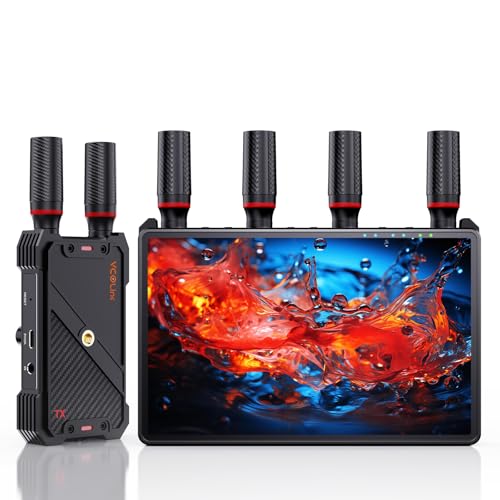
- Built-in 7-inch receiver monitor
- Supports up to five receivers
- 1080p60 with HDMI loop-out
Best For: Multi-person monitoring on film and live-event sets
Best 4K Workflow
FEELWORLD WT1H Wireless Video System
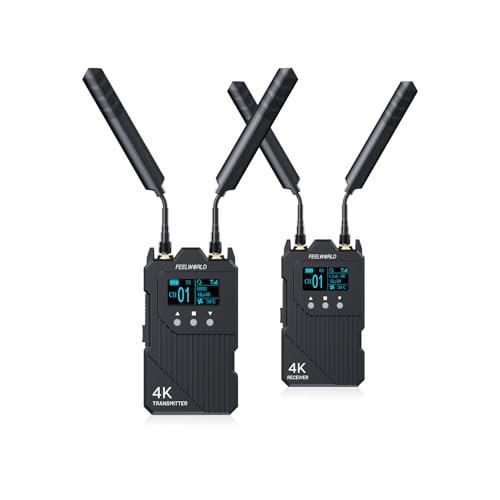
- Transmits up to 4K at 30Hz
- Dual 4K HDMI outputs on receiver
- 1000-foot range with 0.08-second latency
Best For: 4K production and multi-display monitoring
Best Streaming Integration

- UVC output for computer streaming
- Supports up to four monitoring devices
- 1080p60 dual-band transmission
Best For: On-set monitoring with OBS or online streaming
Best Lightweight Link

- Fanless 2W design for quiet shooting
- 1080p60 with 40ms latency
- Supports up to nine monitor endpoints
Best For: Portable, quiet monitoring at events and on location
Flexible Multi-Receiver Pick
VRRIIS WL096 PRO 4K Wireless HDMI System

- Feeds one transmitter to up to five receivers
- 4K30 video with approximately 0.1-second latency
- UVC output supports computer streaming without a capture card
Best For: Multi-camera monitoring and live streaming with flexible receiver placement
Long-Range Production Choice

- Reaches up to 3 km/10,000 feet
- Supports 1080p/60fps at up to 20 Mbps
- Broadcast mode supports unlimited receivers
Best For: Professional long-distance monitoring in complex production environments
Low-Latency Hybrid Pick
Hollyland Pyro S Wireless Video System

- Delivers 4K30 video with approximately 0.05-second latency
- Accepts HDMI and SDI input sources
- Supports up to four receivers or two receivers plus two mobile devices
Best For: Field productions needing low-latency HDMI/SDI monitoring
Long-Range Value Pick
Vrriis 1080p Wireless HDMI Kit

- 1,300-foot claimed open-field range
- 1080p/60Hz with low claimed latency
- Supports up to five receivers
Best For: Full HD multi-camera monitoring on a budget
Professional Collaboration Pick
Hollyland Pyro H Wireless HDMI

- 4K30 and 1080p60 transmission
- Supports up to four receivers
- Includes smart channel scan and UVC streaming
Best For: Film, live-streaming, and event-production teams
SDI Production Pick
Hollyland Mars 4K Wireless System

- Supports HDMI and SDI input/output
- Handles 4K30 HDMI and select SDI frame rates
- Offers up to four app monitoring devices
Best For: SDI-based production and broadcast-style monitoring
Best All-in-One Crew Monitoring – 1-to-5 Wireless HDMI System
For teams comparing video transmitters for multi camera setups, this wireless HDMI system stands out for its built-in 7-inch receiver monitor and support for up to five receivers. It provides 1080p at 60Hz, a claimed 1312-foot line-of-sight range, low latency, HDMI loop-out, and flexible power options for production or live-event monitoring.
Best For: Film crews, studios, and live productions that need several viewers to monitor a camera feed.
Pros:
- Built-in 7-inch monitor reduces the need for an extra screen.
- One transmitter can send to up to five receivers.
- Supports HDMI loop-out, IR remote control, and external HDMI display output.
- Works with NP-F batteries, power banks, or USB-C power.
Cons:
- The stated 1312-foot range is line-of-sight dependent.
- An HDMI cable is not included for external display connection.
- Smartphone and tablet use requires a Type-C-to-HDMI cable.
Its integrated display and multi-receiver design make it especially convenient when several people need an immediate view of the same camera. Consider it a practical collaboration-focused option rather than a compact one-to-one wireless link.
Best 4K Workflow – FEELWORLD WT1H Wireless Video System
The FEELWORLD WT1H is a strong candidate among video transmitters for multi camera setups when 4K support and multiple HDMI outputs matter. It transmits up to 4K at 30Hz, offers a 1000-foot range with 0.08-second latency, and includes transmitter loop-out plus dual HDMI outputs on the receiver.
Best For: 4K camera crews, live events, and productions that need simultaneous HDMI outputs or app-based monitoring.
Pros:
- Supports 4K video transmission at up to 30Hz.
- Receiver provides two simultaneous 4K HDMI outputs.
- Transmitter includes HDMI input and loop-out.
- Supports app monitoring and can feed streaming software through the included Type-C-to-Ethernet adapter.
Cons:
- Its 1000-foot range is less than some alternatives listed here.
- 4K transmission is limited to 30Hz.
- Streaming through a computer requires the Type-C-to-Ethernet adapter setup.
Choose the WT1H when resolution and physical output flexibility are higher priorities than the longest possible range. Its dual receiver outputs are useful for sending one feed to multiple displays without adding another wireless receiver.
Best Streaming Integration – Accsoon CineView HE
The Accsoon CineView HE combines dual-band wireless transmission with direct UVC output, making it one of the more streaming-oriented video transmitters for multi camera setups. It supports 1080p60, a claimed 1200-foot range, latency below 0.06 seconds, and monitoring on up to four receivers or mobile devices.
Best For: Video teams that need shared on-set monitoring and a simple path into OBS, YouTube, or other computer-based streaming platforms.
Pros:
- Dual-band 2.4GHz and 5GHz transmission is designed for stability and interference resistance.
- One transmitter can connect with up to four receivers or mobile devices.
- Receiver UVC output can stream to a computer without a separate capture device.
- Transmitter includes HDMI input and zero-latency lossless loop-out.
Cons:
- Maximum stated video resolution is 1080p60 rather than 4K.
- Battery and charging cables are not included.
- Additional receiver or mobile-device monitoring depends on compatible Accsoon hardware or the SEE App.
CineView HE is a particularly flexible choice for productions that mix camera monitoring with online distribution. Its UVC feature can simplify a streaming rig, while dual-band transmission and long battery claims support extended field use.
Best Lightweight Link – SYNCO XVision HD Transmitter
For portable video transmitters for multi camera setups, the SYNCO XVision HD emphasizes low power use, quiet operation, and easy carrying. It sends 1080p60 video up to a claimed 984 feet, offers 40ms latency, supports up to nine monitor-only endpoints, and includes transmitter HDMI loop-out.
Best For: Mobile crews, weddings, interviews, and live events where silent operation and lightweight equipment are important.
Pros:
- Fanless 2W design helps avoid added shooting noise.
- Supports 1080p60 transmission with claimed 40ms latency.
- Receiver supports up to nine real-time monitor-only endpoints.
- Compact 119g body includes foldable antenna and auto-memory pairing.
Cons:
- NP-F battery is not included.
- The stated 984-foot range is shorter than the longest option in this roundup.
- It is a 1TX+1RX system, so additional endpoints may require compatible setup or devices.
The XVision HD is appealing when portability and quiet operation outweigh 4K capability. Its endpoint support can help distribute a camera view to a larger team, while the low-power design suits longer shoots.
Flexible Multi-Receiver Pick – VRRIIS WL096 PRO 4K Wireless HDMI System
For video transmitters for multi camera setups, the VRRIIS WL096 PRO stands out when you need one transmitter to feed several viewing points. It supports 4K30 transmission, offers 20 manually selectable 5GHz channels, and includes UVC output for computer-based streaming.
Best For: Multi-camera monitoring, live streaming, and outdoor filming where multiple receivers and flexible power options are useful.
Pros:
- Transmits to up to five receivers for distributed monitoring.
- Supports 4K30 video with approximately 0.1-second latency.
- UVC output supports computer monitoring and streaming at up to 1080p/60Hz without a capture card.
- LCD displays show connection status, signal strength, channel, and resolution.
Cons:
- Approximately 0.1-second latency is not ideal for highly time-sensitive applications.
- The listed 1,500-foot range depends on operating conditions and setup.
- Batteries are not included.
The combination of multi-receiver support, loop-out monitoring, UVC connectivity, and multiple power methods makes this a practical choice for productions that need flexible signal distribution rather than a single point-to-point link.
Long-Range Production Choice – DJI SDR Transmission Combo
The DJI SDR Transmission Combo is built for demanding production environments where stable long-distance monitoring matters. It delivers 1080p/60fps video, uses automatic frequency hopping across multiple bands, and supports HDMI, SDI, USB-C, and broadcast-mode monitoring.
Best For: Professional crews needing extended-range monitoring, strong interference management, and multiple monitoring recipients.
Pros:
- Offers transmission distances up to 3 km/10,000 feet with enhanced penetration.
- Supports 1080p/60fps video at up to a 20 Mbps bitrate.
- Automatic frequency hopping across 2.4GHz, 5.8GHz, and DFS bands helps manage interference.
- Broadcast mode allows each transmitter to connect to an unlimited number of receivers.
Cons:
- Video transmission is specified up to 1080p/60fps rather than 4K.
- The combo requires a 12V battery.
- Its advanced production features may be more than needed for simple home monitoring.
With SDI and HDMI outputs, USB-C monitoring, low stated latency of 35ms, and unlimited receivers in Broadcast mode, this is the strongest fit here for larger crews and complex multi-camera monitoring workflows.
Low-Latency Hybrid Pick – Hollyland Pyro S Wireless Video System
The Hollyland Pyro S is a versatile option among video transmitters for multi camera setups, combining HDMI and SDI connectivity with low-latency wireless transmission. It supports 4K30 video, dual-band operation, and distribution to multiple receivers or mobile devices.
Best For: Camera crews that need HDMI/SDI flexibility, quick monitoring, and included battery power for location work.
Pros:
- Provides up to 1,300 feet of line-of-sight transmission with approximately 0.05-second latency.
- Supports video up to 4K30 at 8–12 Mbps.
- Each transmitter can connect to up to four receivers, or two receivers and two mobile devices.
- Includes two NP-F570 batteries and a dual-bay charger.
Cons:
- The 1,300-foot range is specified for line-of-sight use.
- The transmitter has one HDMI input and one SDI input, which may limit simultaneous source connections.
- It supports up to four Pyro S receivers rather than unlimited receivers.
Its particularly low stated latency, dual HDMI/SDI inputs, and included NP-F batteries make the Pyro S a convenient field system for productions that need fast monitoring and a moderate number of viewing endpoints.
Long-Range Value Pick – Vrriis 1080p Wireless HDMI Kit
For buyers comparing video transmitters for multi camera setups, the Vrriis wireless HDMI kit emphasizes long-range 1080p delivery, straightforward setup, and flexible power. It can transmit up to 1,300 feet in an open field, though walls and other obstructions can reduce coverage.
Best For: Budget-conscious multi-camera monitoring where Full HD resolution and multiple receiver support are sufficient.
Pros:
- Supports up to 1080p at 60Hz with a claimed 0.05-second latency.
- Offers HDMI loop out, dual HDMI output on the receiver, and IR remote extension.
- Supports up to one transmitter and five receivers, with USB-C, adapters, and NP-F battery power options.
Cons:
- It does not provide 4K transmission.
- Range can be substantially reduced by walls, metal, brick, or glass.
- The package does not include NP-F batteries.
This is a practical choice when a multi-camera crew needs Full HD feeds, local monitoring, and flexible powering without moving to a more specialized production system.
Professional Collaboration Pick – Hollyland Pyro H Wireless HDMI
The Hollyland Pyro H is designed for video transmitters for multi camera setups that need higher-resolution monitoring and collaboration. It combines 4K30 transmission, dual-band operation, smart channel scanning, and support for up to four receivers in a production-oriented package.
Best For: Film crews, live-streaming teams, and event productions that need multiple wireless monitoring points and UVC streaming.
Pros:
- Transmits up to 4K at 30fps and supports 1080p at 60fps.
- Offers a claimed 1,300-foot range and 60ms latency in suitable conditions.
- Supports up to four receivers, HollyView app monitoring, HDMI loop out, and UVC computer streaming.
Cons:
- The listed range and latency depend on the shooting environment.
- The system is limited to HDMI connectivity rather than HDMI and SDI.
- The package includes one transmitter and one receiver, so additional receivers may be needed for larger crews.
With its smart channel scan and receiver expansion, the Pyro H is the most collaboration-focused option here, especially when several crew members need to view a camera feed at once.
SDI Production Pick – Hollyland Mars 4K Wireless System
For video transmitters for multi camera setups that use professional video infrastructure, the Hollyland Mars 4K stands out with both HDMI and SDI connectivity. It supports 4K30 over HDMI, HD formats over HDMI or SDI, and broadcast-oriented decimal-point SDI frame rates.
Best For: Production crews using SDI equipment, video switchers, and on-set monitoring workflows.
Pros:
- Supports up to 4K30 over HDMI and 23.98, 29.97, and 59.94 fps SDI output.
- Provides HDMI and SDI input/output options for broader equipment compatibility.
- Supports app monitoring on up to four mobile devices and multiple wired monitors when paired with receivers.
Cons:
- Its claimed 450-foot line-of-sight range is shorter than the other listed systems.
- It has a claimed 66ms latency, higher than the Vrriis system’s stated figure.
- QC/PD and 5V/2A charging are not supported, according to the supplied notes.
The Mars 4K is the strongest fit when SDI support and production-standard frame rates matter more than maximum wireless range, making it especially relevant for switcher-based or broadcast-style setups.
How We Picked the Best Video Transmitters for Multi Camera Setups
We focused on the features that matter during real shoots rather than relying on advertised range alone. Our comparison considers wireless stability, usable distance, latency, resolution and frame-rate support, HDMI or SDI connectivity, receiver capacity, loop-through outputs, power options, and streaming compatibility. Systems with UVC output can connect directly to compatible computers or streaming devices, while SDI support is especially useful for professional cameras and production switchers.
Advertised range assumes favorable conditions and clear line of sight. Walls, competing wireless networks, crowded venues, and antenna placement can reduce performance, so practical reliability matters as much as the headline distance.
Quick Comparison
- Best for extended range: DJI SDR Transmission offers a long-distance 1080p workflow designed for demanding locations.
- Best for flexible professional connectivity: Hollyland Pyro S and Mars 4K models support combinations of HDMI and SDI, depending on the production need.
- Best for 4K wireless monitoring: FEELWORLD WT1H, Hollyland Pyro H, and compatible 4K systems support high-resolution video at manageable latency.
- Best for direct streaming: Accsoon CineView HE and selected UVC-equipped transmitters can simplify computer-based streaming.
- Best for multiple viewers: Systems supporting several receivers are useful when a director, focus puller, and client each need a feed.
Key Buying Factors for Video Transmitters for Multi-Camera Setups
Camera and Switcher Compatibility
Check every camera’s output before buying. HDMI is common on mirrorless and compact cameras, while SDI is preferred for longer cable runs and many cinema or broadcast systems. Confirm connector type, supported frame rates, and whether the transmitter accepts the exact signal your cameras produce.
Range, Latency, and Interference
Low latency is critical for live switching, remote focus, and director monitoring. Long range is useful outdoors or on large sets, but a stable signal is more valuable than a maximum-distance claim. Dual-band or interference-resistant systems may perform better in crowded venues, though placement and local regulations still matter.
Receiver Count and Expansion
A one-to-one kit may be sufficient for a small crew, but multi-camera productions often need several viewing points. Look for systems that support multiple receivers or applications without creating an unwieldy pairing process. Loop-out ports can also let you monitor locally while transmitting wirelessly.
Power and Operating Time
Battery-powered units improve mobility but require spare batteries and a charging plan. Check battery format, USB or DC options, estimated runtime, and whether the transmitter blocks camera ports or adds excessive weight to a small rig.
Who Should Buy Which Video Transmitters for Multi Camera Setups?
Choose a compact HDMI system if you are filming with mirrorless cameras, small camcorders, or a simple livestream rig. Choose a dual HDMI/SDI system if your cameras or switcher use both interfaces, or if you need a more adaptable professional workflow. For events and large locations, prioritize stable long-range transmission and interference management over maximum resolution. For studio monitoring, receiver expansion and loop-out connections may be more important than extreme range.
Before ordering, verify the complete signal path: camera output, transmitter input, wireless bandwidth, receiver output, monitor or switcher input, and any computer used for streaming. Matching those details will prevent the most common compatibility problems and help your selected system perform as intended.