
COMICA Revo S Wireless Handheld Microphone is aimed at creators who want a simple way to capture speech without dealing with cables.
If you are looking for a COMICA Revo S Wireless Handheld Microphone review, the main appeal is clear: handheld form, wireless digital output, and a feature set centered on spoken-word recording.
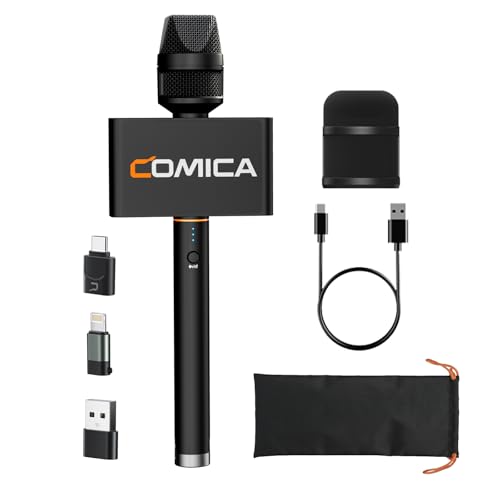
COMICA Revo S Review Summary
COMICA Revo S makes the most sense for interviews, podcast-style speech, vlogging, and content where the mic itself needs to feel natural in the hand.
It is built around a wireless digital output, a 14mm condenser capsule, cardioid pickup, 48kHz/24bit recording, one-key denoise, and USB-C receiver compatibility, so the core value proposition is convenience without giving up too much control over voice capture.
Verdict: if you want a handheld creator mic that is easy to deploy and covers the basics well, the Revo S looks like a sensible buy.
It is less about studio flexibility and more about making spoken audio fast to capture, easy to manage, and portable enough for field use.
Review Scorecard
| Category | Score | Why it scores this way |
|---|---|---|
| Wireless convenience | 9/10 | Wireless digital output and plug-and-play design reduce setup friction. |
| Voice capture focus | 8/10 | The 14mm condenser capsule and cardioid pattern are tuned for speech and interviews. |
| Noise handling | 8/10 | One-key CalMix denoise is a practical fit for imperfect environments. |
| Compatibility | 8/10 | USB-C receiver support covers phones, iPads, laptops, and computers. |
| Battery practicality | 8/10 | Up to 15 hours of use is strong for long recording sessions. |
| Control and flexibility | 7/10 | Three gain levels help, but this is still a streamlined creator mic rather than a deep audio tool. |
| Overall buyer fit | 8/10 | Best for creators who value speed, portability, and spoken-word clarity. |
Key Features and Specifications of COMICA Revo S
The headline feature is the wireless digital output, which lets the microphone work without the cable clutter that usually slows down mobile recording.
That makes the Revo S a better fit for creators who move between rooms, streets, events, or quick indoor setups and need a mic that gets out of the way.
The microphone uses a 14mm condenser capsule with a cardioid polar pattern.
In practical terms, that points the mic toward the voice while helping it stay focused on the speaker rather than everything around them.
For interviews and spoken content, that is a stronger match than a more ambient pickup style.
COMICA also lists 48kHz/24bit recording and one-key CalMix Denoise.
Those specs suggest a product designed to preserve detail while giving users a fast noise-reduction option.
For creators working in living rooms, offices, pop-up sets, or public spaces, that combination is more useful than flashy but hard-to-manage controls.
Battery life is another meaningful part of the package.
The built-in 350mAh battery is rated for up to 15 hours of use, which is the kind of number that matters when you are recording back-to-back interviews, several short videos, or a long session away from power.
The mic also offers three gain levels.
That is a useful middle ground: enough control to adapt sensitivity for different voices and distances, without turning the mic into a complicated audio rig.
Useful listed facts
| Spec | Listed detail |
|---|---|
| Capsule | 14mm condenser |
| Pickup pattern | Cardioid |
| Recording quality | 48kHz/24bit |
| Noise reduction | One-key CalMix Denoise |
| Battery | 350mAh built-in lithium battery |
| Runtime | Up to 15 hours |
| Gain control | 3 levels |
| Connectivity | USB Type-C receiver |
| Compatible devices | iPhone 16/15, Android phones, iPads, laptops, computers |
| Lightning note | OTG-capable USB-C to Lightning adapter required for Lightning devices |
Pros and Cons of COMICA Revo S
Pros
- Wireless digital output keeps the setup simple and portable.
- The handheld format fits interviews and reporter-style content naturally.
- The cardioid pattern and condenser capsule are aligned with speech capture.
- One-key denoise is a practical feature for noisy or unpredictable locations.
- Up to 15 hours of battery life is useful for extended creator workflows.
- Three gain levels add some flexibility without overcomplicating operation.
Cons
- It is optimized for spoken content, not broader studio or music recording use.
- The feature set is intentionally streamlined, so advanced audio users may want more control.
- Lightning users need an OTG-compatible adapter, which adds one more accessory to manage.
Who Should Buy COMICA Revo S?
This microphone fits creators who want a fast, handheld, voice-first setup.
If your work includes interviews, street content, vlog narration, podcast segments, or social video recorded on a phone, the Revo S is designed around those use cases.
It also suits users who prefer plug-and-play convenience over a bigger audio workflow.
The wireless output, USB-C receiver support, and built-in denoise make it easier to start recording quickly and keep moving.
It is a better match for:
- Content creators who film with phones and want cleaner speech capture.
- Interviewers and reporters who need a handheld mic that feels natural in the frame.
- Podcasters or vloggers who record in a variety of locations.
- Users who want a simple gain-adjustable wireless mic rather than a full audio kit.
It is less compelling for:
- Buyers who need a studio-first microphone with deeper routing or mixing control.
- Users who mostly record music or sources beyond spoken voice.
- Lightning-device owners who do not want to rely on an adapter.
Recording Use Cases for COMICA Revo S
Interviews and reporting
The handheld format is the most obvious strength here.
For interviews, it gives the speaker a familiar microphone shape while keeping the setup lightweight and mobile.
That is especially useful when you want the mic visible on camera and the workflow to stay fast.
Vlogs and creator videos
For vlogs, the wireless design matters as much as the sound path.
A mic that avoids cable clutter makes movement easier and keeps the recording process less awkward.
The Revo S feels built for that balance between convenience and intelligibility.
Podcasts and speech clips
The 14mm condenser capsule, cardioid pickup, and 48kHz/24bit recording format make it a reasonable speech tool for podcast segments and short-form voice content.
It is not a replacement for a full studio chain, but it does target voice clarity in a focused way.
Noisy or mixed environments
One-key denoise is the feature that gives this mic extra practical value in imperfect settings.
It cannot magically remove bad audio conditions, but it does show that COMICA expects users to record outside controlled spaces.
That is a smart fit for creators who cannot always choose a quiet room.
Alternatives to COMICA Revo S
If you want a different creator mic approach, the most obvious Amazon alternatives are the Rode Wireless Micro, the DJI Mic 2, and the Hollyland Lark line.
Each points toward a slightly different balance of portability, ecosystem, and creator workflow.
Rode is the safer comparison if you want a compact creator wireless system from an established audio brand.
DJI is the more obvious choice if you want a polished wireless ecosystem for video work.
Hollyland is worth checking if you want a creator-oriented wireless family with multiple variants.
Is COMICA Revo S Worth It?
Yes, if your priority is simple wireless speech capture for creator work. COMICA Revo S looks worth considering when you want a handheld microphone that is easy to use, designed for interviews and vlogs, and equipped with enough practical features to handle real-world recording.
It is not the most advanced option for audio hobbyists, but that is not really the point.
The value is in the combination of wireless convenience, voice-focused pickup, one-key denoise, gain adjustment, and long battery life.
If you want a mic that stays focused on spoken content and reduces friction at setup time, the Revo S is a solid fit.
If you need a deeper studio tool, keep looking.