
Choosing the right air-cleaning setup can make a school makerspace more comfortable, manageable, and suitable for regular 3D printing. The best option depends on printer type, room size, noise limits, and the materials students use.
We’ve gathered 10 promising 3D printer air purifiers for schools, from compact carbon-filter units to higher-capacity systems designed for enclosed printers and shared work areas.
Best 10 3d Printer Air Purifiers for Schools Picks for 2026
High-Capacity Pick

- 250 m³/h airflow and 1700Pa suction
- Five-stage dust and odor filtration
- Real-time PM2.5 display
Best For: School makerspaces needing high airflow and visible particulate monitoring
Enclosure Specialist
Bambu Lab HEPA H13 Filter System

- Pre-filter, HEPA H13, and carbon layers
- 60 m³/h stable airflow
- Quick-swap filters and broad adapter support
Best For: Classrooms using Bambu Lab or other enclosed printers
Quiet Resin Pick

- 35 dB operation and 6W power use
- Built-in VOC sensor with filter reminder
- Designed for many ELEGOO resin printers
Best For: Quiet resin-printing classrooms needing VOC-focused filtration
Compact Resin Odor Control
ELEGOO Mini Air Purifier 2-Pack

- Two compact units for compatible resin printers
- Activated-carbon filtration targets resin odors
- At least 24 hours of battery operation
Best For: Small resin-printing stations needing quiet, compact odor control
Enclosed Fume Filtration
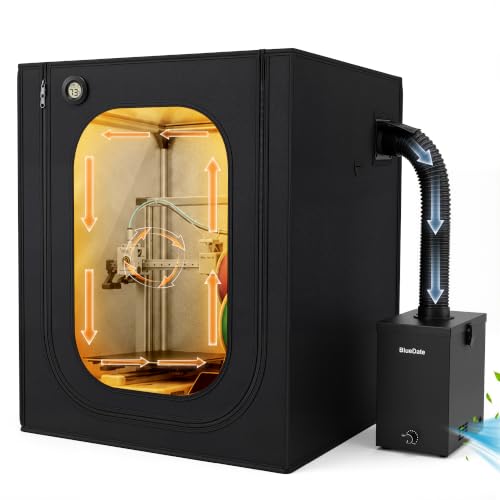
- Enclosure combines extraction with multi-stage filtration
- HEPA and carbon layers target particles and odors
- Stepless speed control and broad printer compatibility
Best For: Larger makerspaces needing enclosed filtration for open-style or resin printers
Quiet Large-Format Resin Filtration
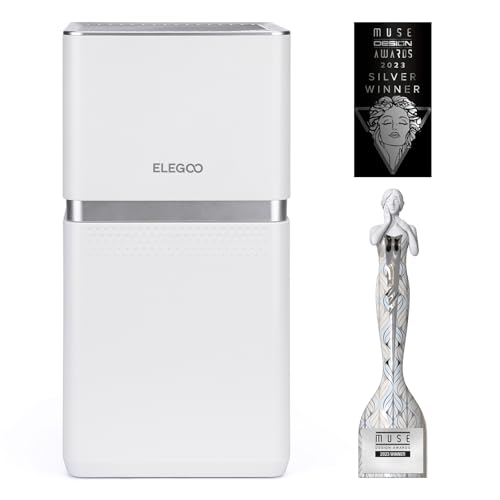
- Quiet 35 dB operation for photocuring printers
- Two fan modes with automatic switching option
- VOC and filter-life reminders support maintenance
Best For: Larger compatible resin printers in quiet classrooms or labs
Best DIY Kit
Customizable 3D Printer Air Purifier
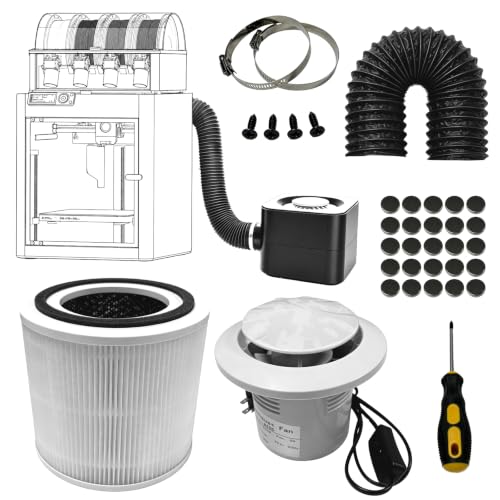
- HEPA plus activated-carbon filtration
- Includes assembly hardware and ducting
- Requires a 3D-printed shell
Best For: School makerspaces with 3D-printing and assembly resources
Best Compact Pair
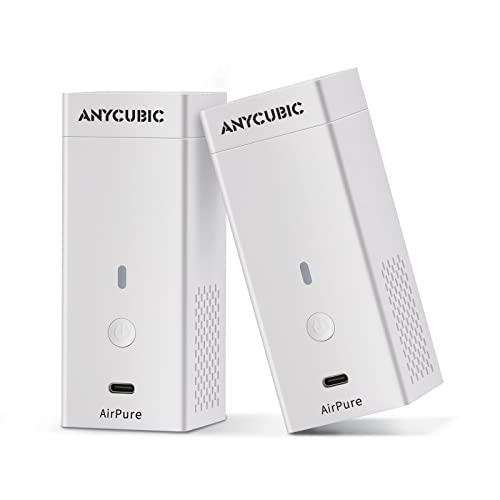
- Two compact purifiers per pack
- High-density activated-carbon filter
- Designed for LCD and DLP printers
Best For: Multiple resin-printing stations with limited desk space
Best Ready-to-Use Option

- Four-stage HEPA and carbon filtration
- Adjustable speed and included duct hardware
- Supports select Bambu Lab and ELEGOO models
Best For: Supported-printer labs wanting a ready-to-use extractor
High-Capacity Pick – Creality 5-Stage Air Purifier
For schools seeking 3d printer air purifiers for schools, the Creality model is a strong room-oriented option. Its 360-degree airflow, 250 m³/h output, real-time PM2.5 display, and five-stage filtration are suited to classrooms or makerspaces with extended printing sessions.
Best For: School makerspaces needing high airflow and visible particulate monitoring.
Pros:
- Delivers up to 250 m³/h of airflow with 1700Pa suction.
- Five-stage filtration targets dust and odors, with a stated 99.99% removal claim.
- Real-time PM2.5 display provides an at-a-glance air-quality reading.
- Filters are rated for up to 1,000 or 1,500 hours, depending on the filter type.
Cons:
- Its 28-pound weight may make repositioning between classrooms less convenient.
- The supplied notes do not specify a noise rating or replacement-filter cost.
The Creality is the most suitable choice here when a school prioritizes broad room purification, strong airflow, and monitoring features over a compact footprint.
Enclosure Specialist – Bambu Lab HEPA H13 Filter System
This purpose-built system is a focused option among 3d printer air purifiers for schools, especially where enclosed Bambu Lab printers are used. It combines a pre-filter, True HEPA H13 media, and activated carbon in a compact design intended to maintain stable enclosure airflow.
Best For: Classrooms or makerspaces using Bambu Lab P1S/X1C or compatible enclosed printers.
Pros:
- Triple-layer filtration targets debris, ultrafine particles, and VOC-related odors.
- True HEPA H13 is rated to capture more than 99.97% of particles down to 0.3 micrometers.
- Compact 5.3-inch design and tool-free quick-swap filter modules simplify installation and upkeep.
- Supports adapters for several other enclosed-printer brands.
Cons:
- Its 60 m³/h airflow is lower than the room-focused Creality unit.
- The default connector is designed for Bambu Lab P1S and X1C, so other printers may require adapters.
- It is intended for enclosed printers rather than general room purification.
Choose this model when the school wants filtration integrated with enclosed printers and values compact maintenance over high-volume room airflow.
Quiet Resin Pick – ELEGOO MARSMATE Air Purifier
The ELEGOO MARSMATE is a practical candidate for schools using resin printers, where low operating noise matters. Among 3d printer air purifiers for schools, it stands out for its 35 dB operation, VOC sensor, and compatibility with a wide range of ELEGOO resin-printer models.
Best For: Resin-printing classrooms that need a quiet, dedicated purifier.
Pros:
- Operates at a stated 35 dB with only 6W of power.
- VOC sensor provides filter-replacement reminders.
- Compatible with many ELEGOO Mars, Saturn, and Jupiter printers and other models with an extension port.
- Replaceable activated-carbon filter is simple to access and change.
Cons:
- The supplied notes rate contaminant filtration at 95%, lower than the HEPA-based options here.
- The activated-carbon filter is listed for up to two months, which may mean more frequent replacement.
- Its resin-focused design may be less suitable for filament-printing classrooms.
MARSMATE makes the most sense for resin labs where quiet operation and VOC awareness are more important than HEPA particle filtration or whole-room airflow.
Flexible Enclosure Option – HEPA H13 Carbon Filter System
This compact system is designed for schools that use multiple enclosed printer brands. It combines HEPA H13 and activated-carbon filtration, with a default Bambu Lab connector and printable adapter support for other enclosed machines, making it a flexible choice among 3d printer air purifiers for schools.
Best For: Multi-brand school makerspaces with enclosed printers.
Pros:
- Triple-layer design addresses larger dust, ultrafine particles, VOCs, and chemical odors.
- HEPA H13 is rated to capture 99.97% of ultrafine particles.
- Supports Bambu Lab and several Creality, Prusa, Elegoo, and Anycubic enclosures with adapters.
- Quick-swap filters require no tools.
Cons:
- Its 60 m³/h airflow is intended for enclosure filtration rather than whole-room purification.
- Adapters may be needed for printers other than the default Bambu Lab models.
- The product notes emphasize that it reduces contaminants but does not replace room ventilation.
For a school with varied enclosed printers, this model offers a useful balance of broad compatibility, HEPA particle capture, and carbon odor control, provided the room still has appropriate ventilation.
Compact Resin Odor Control – ELEGOO Mini Air Purifier 2-Pack
For schools seeking compact 3d printer air purifiers for schools, the ELEGOO Mini Air Purifier 2-Pack is designed to fit inside compatible LCD, DLP, or MSLA resin printers. Its activated-carbon filter targets resin odors, while the rechargeable battery supports extended use without requiring a constant wired connection.
Best For: Classrooms or labs using compatible resin printers where compact, quiet odor control is the priority.
Pros:
- Two compact units can fit inside compatible LCD 3D printers.
- Activated carbon is designed to absorb irritating resin odors.
- Runs for at least 24 hours on a full 2,000mAh charge.
- Rated at a quiet 10 dB.
Cons:
- The carbon filter is expected to last three to six months and must be purchased separately for replacement.
- It is intended for resin odor control rather than broad particulate filtration.
- Fit should be checked because the unit must fit inside the printer.
This two-pack is a practical, low-profile option for resin-printing stations, particularly when space and operating noise matter. Schools should still confirm printer compatibility and follow appropriate ventilation practices.
Enclosed Fume Filtration – BD-60A 3D Printer Enclosure
For schools comparing 3d printer air purifiers for schools, the BD-60A combines a printer enclosure with powered extraction and multi-stage filtration. Its pre-filter, HEPA, and activated-carbon arrangement is designed to address particulate matter, smoke, fumes, dust, and odors from compatible 3D printers.
Best For: Dedicated school makerspaces that have room for a large enclosure and need broader containment for open-style or resin printers.
Pros:
- Four-stage filtration includes pre-filter, HEPA, and activated carbon layers.
- Designed to capture 99.97% of stated plastic particulate pollutants as small as 0.3 microns.
- Enclosure helps reduce noise, retain heat, and limit dust release.
- Stepless speed control supports different airflow and noise preferences.
Cons:
- Its 650 × 750 × 800 mm size and 20-pound weight require substantial space.
- The listed 55 dB noise level may be noticeable in a classroom.
- Compatibility should be verified against the specific printer model.
The BD-60A is the most comprehensive option here for a school lab that can accommodate an enclosure. Its larger footprint and higher noise rating make careful placement important, but it offers containment and filtration beyond a small in-printer odor filter.
Quiet Large-Format Resin Filtration – ELEGOO Marsmate Air Purifier
The ELEGOO Marsmate is a large-format activated-carbon purifier for schools using compatible photocuring printers. As one of the 3d printer air purifiers for schools, it emphasizes quiet operation, selectable fan speeds, and a sensor-based reminder for filter replacement and elevated VOC concentration.
Best For: Resin-printing classrooms or labs using larger ELEGOO Mars and Saturn models where quiet operation and automated monitoring are useful.
Pros:
- 35 dB operating noise is suited to quieter learning environments.
- Low and high fan modes can be selected manually or switched automatically.
- Built-in reminders monitor filter life and VOC concentration.
- Large 210 × 247 × 410 mm design is intended for stronger purification performance.
Cons:
- Its activated-carbon filter is primarily intended for odor and VOC control, not stated HEPA particle filtration.
- The larger design takes more space than a mini in-printer purifier.
- Compatibility depends on listed printer families or an available expansion interface.
Marsmate is a sensible fit when a school wants a quieter, more substantial purifier for photocuring equipment. Before purchase, confirm the printer has the required interface and plan for filter replacement when the unit signals it.
Best DIY Kit – Customizable 3D Printer Air Purifier
For schools seeking 3d printer air purifiers for schools, this DIY kit offers HEPA and activated-carbon filtration in a customizable setup. It fits most mainstream desktop FDM printers, but the housing must be 3D printed and assembled before use.
Best For: School makerspaces with access to a 3D printer and staff or students comfortable with guided assembly.
Pros:
- Combines HEPA and activated-carbon filtration for fine plastic particles, fumes, odors and VOCs.
- Includes the fan, filter cartridge, duct, clamps, screws, magnets and screwdriver.
- Compatible with most mainstream desktop FDM printers.
- STL shell files allow customization of the housing’s shape, size and color.
Cons:
- Requires users to 3D print the outer housing and complete assembly.
- Filter cartridges need periodic replacement.
This is a flexible choice for an instructional makerspace, especially when customization is part of the project. Schools wanting a ready-to-use purifier should consider a fully assembled alternative.
Best Compact Pair – ANYCUBIC Mini Purifier
For schools needing compact 3d printer air purifiers for schools, the ANYCUBIC Mini Purifier is a two-pack designed for placement on or near compatible LCD and DLP 3D printers. Its activated-carbon filter targets resin-printing odors in a small, lightweight format.
Best For: Classrooms with multiple compatible resin printers where small size, portability and odor adsorption are priorities.
Pros:
- Pack of two supports use with multiple printers.
- Compact 4.5-by-1.8-by-1.8-inch design is easy to position.
- High-density activated-carbon filter is designed to absorb resin odors.
- Replaceable filter element can last approximately three to six months, according to the supplied notes.
Cons:
- Uses activated carbon rather than the HEPA-plus-carbon setup found in some larger units.
- Its listed contaminant capability is odors, so the notes do not establish broad particle filtration.
- Noise is listed at up to 45 dB.
The two-unit package makes this a practical space-saving option for resin-printing stations. It is best viewed as a targeted odor-control accessory rather than a whole-room air purifier.
Best Ready-to-Use Option – BD-60B Fume Extractor
For schools comparing 3d printer air purifiers for schools, the BD-60B is a ready-to-use desktop extractor with a four-stage pre-filter, HEPA and activated-carbon design. It is specifically listed as compatible with several Bambu Lab and ELEGOO printers and includes a smoke pipe and magnetic suction hoods.
Best For: School labs using supported Bambu Lab or ELEGOO printers that want a metal-cased purifier without printing custom parts.
Pros:
- Four-stage filtration combines pre-filter, HEPA and activated-carbon layers.
- Listed to capture 99.97% of particles as small as 0.3 microns.
- Stepless speed control helps schools balance airflow and noise.
- Includes a filter, five pre-filters, pipe components, magnetic hoods, power supply and manual.
Cons:
- Compatibility is focused on specified Bambu Lab and ELEGOO models.
- The P2S requires a user-printed riser bracket.
- Listed noise level is 55 dB, and the unit weighs 10.6 pounds.
This is the strongest fit for a supported-printer lab that values included hardware and adjustable extraction. Verify the exact printer model before purchasing, particularly for the P2S installation.
How We Picked These 3d Printer Air Purifiers for Schools
We focused on products that address common classroom concerns: airborne particles, odors, volatile organic compounds (VOCs), noise, maintenance, and printer compatibility. The selection includes HEPA and activated-carbon filtration, compact units for individual printers, larger purifiers for shared spaces, and enclosure-based designs.
Because performance depends on printer type, filament or resin, ventilation, and room layout, no purifier should be treated as a replacement for suitable ventilation or school safety procedures. We also considered practical details such as filter availability, footprint, controls, airflow, and whether a unit is designed for enclosed or open printers.
Quick Comparison
- Best for enclosed FDM printers: Filter systems made for specific Bambu Lab or other enclosed models.
- Best for resin printers: Carbon-focused units compatible with LCD, DLP, or resin printer enclosures.
- Best for small workstations: Mini purifiers with compact footprints and quiet operation.
- Best for larger areas: Higher-airflow units with real-time particle monitoring or broader room coverage.
- Best all-in-one approach: An enclosure with an integrated smoke or odor purifier.
Key Buying Factors for 3d Printer Air Purifiers for Schools
Filtration and Materials
HEPA filtration is useful for capturing fine particles, while activated carbon is important for odors and many gaseous pollutants. Check the stated filter type and replacement schedule rather than relying on broad claims such as “smoke removal” or “TVOC reduction.” For resin printing, use a purifier designed for the printer or enclosure and follow resin-handling guidance.
Airflow and Room Size
A compact purifier may work well near one enclosed printer but be inadequate for a classroom with several machines. Compare airflow ratings, coverage claims, and placement requirements. Position the unit so air passes through the filter without blocking printer access or creating a trip hazard.
Noise, Controls, and Monitoring
Low noise matters during lessons, especially when several units operate at once. Automatic modes, fan-speed controls, filter reminders, and PM2.5 displays can simplify supervision, but sensors do not measure every contaminant and should not be treated as a complete safety assessment.
Compatibility and Upkeep
Confirm dimensions, mounting method, power requirements, and printer compatibility before buying. Favor models with readily available replacement filters and straightforward cleaning instructions. A purifier that is difficult to service may be neglected in a busy school lab.
Who Should Buy Which 3d Printer Air Purifiers for Schools?
Schools with one or two enclosed printers should consider a compatible HEPA-and-carbon filter system that fits directly inside or beside the printer. Resin-printing classrooms should prioritize carbon filtration, enclosed workflows, and strict ventilation and handling practices.
Busy makerspaces may benefit from higher-airflow units or multiple strategically placed purifiers rather than one small device. Teachers managing tight classroom budgets can start with compact units for the most frequently used printers, then add replacements and upgrades as usage grows.
Before purchasing, check your school’s ventilation requirements, approved materials, electrical policies, and maintenance responsibilities. The strongest setup combines suitable filtration with enclosure use, ventilation, good housekeeping, and clear student procedures.