
Printing can release odors, ultrafine particles, and volatile organic compounds, especially when working with resin or certain filaments. A dedicated purifier can help improve the air around your printer when paired with proper ventilation and safe operating practices.
We selected 10 3D printer air purifiers covering enclosed-printer filters, compact carbon units, high-airflow models, and purifier-equipped enclosures. Use the guide below to match filtration, compatibility, noise, and coverage to your setup.
Best 10 3d Printer Air Purifiers Picks for 2026
Best Dedicated Filtration
Bambu Lab HEPA H13 Carbon Filter

- Triple-layer particle and odor filtration
- Ready for Bambu Lab P1S and X1C
- Tool-free quick-swap filter modules
Best For: Bambu Lab owners wanting compact enclosed-printer filtration
Best Large Quiet Resin Option
ELEGOO Marsmate Large Air Purifier
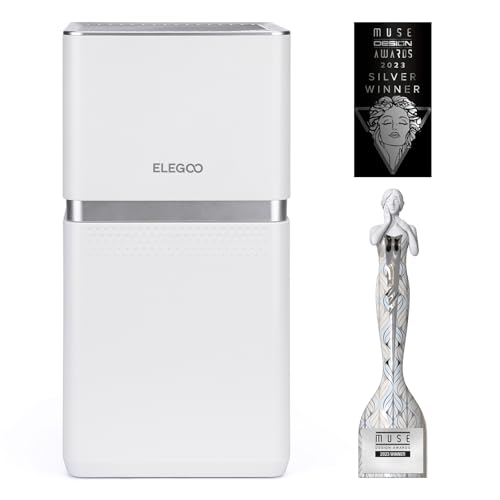
- Quiet operation down to 35 dB
- VOC sensor and filter reminders
- Designed for compatible resin printers
Best For: Resin-printing users who want quiet, monitored operation
Best High-Airflow Choice
Creality 250 m³/h PM2.5 Purifier

- Up to 250 m³/h airflow and 1,700 Pa suction
- Real-time PM2.5 display
- Five-stage filtration with long filter ratings
Best For: FDM workspaces needing high airflow and visible monitoring
Best Quiet Budget-Style Resin Pick

- Rated to remove up to 95% of TVOC
- Quiet 35 dB, 6-watt operation
- Simple replaceable carbon filter
Best For: Compatible resin-printer users seeking quiet VOC control
Best Compact Resin-Printer Pick
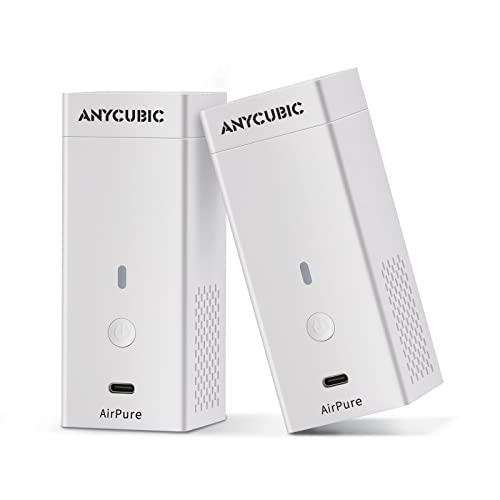
- Tiny battery-powered design for LCD and DLP printers
- High-density activated carbon targets resin odor
- Replaceable filters and two purifiers included
Best For: Compact resin-printing setups needing simple odor control
Best High-Filtration Setup
BD-60B 3D Printer Fume Extractor

- Four-stage HEPA and activated-carbon filtration
- Adjustable speed with active exhaust components
- Designed for specified Bambu Lab and ELEGOO models
Best For: Enclosed compatible printers needing stronger fume extraction
Best Quiet Resin Odor Option
ELEGOO Mini Air Purifier 2-Pack

- Very compact design for compatible LCD printers
- Activated carbon targets resin odor
- Rechargeable battery and claimed 10 dB operation
Best For: Quiet, in-printer odor control for resin printing
Best Enclosed System
Smoke-Purifying 3D Printer Enclosure
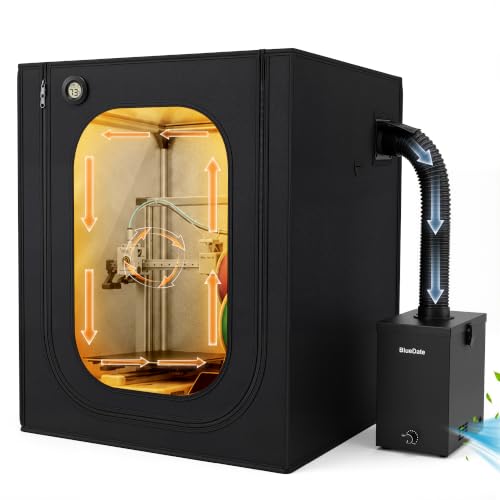
- Enclosure helps contain dust, odors, and particulate emissions
- Four-stage HEPA and activated-carbon filtration
- Adjustable airflow and broad printer compatibility
Best For: Enclosed printing setups needing filtration and noise reduction
Best for Creality K2

- Purpose-built for Creality K2 and K2 Pro
- Four-stage HEPA and activated-carbon filtration
- Includes magnetic hoods, ducting, and replacement pre-filters
Best For: Creality K2 or K2 Pro owners wanting a ready-to-use purifier
Best DIY Option
Customizable 3D Printer Air Purifier Kit
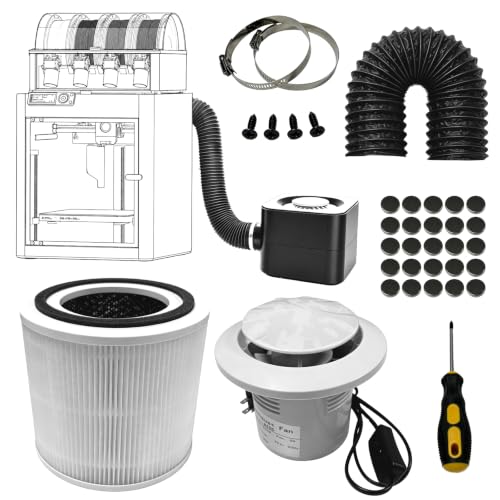
- Requires a self-printed outer housing and assembly
- HEPA and activated carbon filtration for particles and odors
- STL files enable custom housing shapes, sizes, and colors
Best For: Makers who want a customizable FDM filtration project
Best Dedicated Filtration – Bambu Lab HEPA H13 Carbon Filter
For shoppers seeking 3d printer air purifiers built around enclosed-printer emissions, this compact system combines a pre-filter, True HEPA H13 media, and chemically activated carbon. It is ready for Bambu Lab P1S and X1C printers and can be adapted to other enclosed models with compatible connectors.
Best For: Bambu Lab owners and makers who want particle and odor filtration in a compact, maintenance-friendly unit.
Pros:
- Triple-layer design targets debris, ultrafine particles, and printing odors.
- HEPA H13 is specified to capture over 99.97% of particles down to 0.3µm.
- Centrifugal fan provides airflow up to 60 m³/h while maintaining negative pressure.
- Tool-free quick-swap filter modules simplify maintenance.
Cons:
- The default connector is intended for Bambu Lab P1S and X1C; other printers may require adapter kits.
- Its filtration-focused design is less suitable if you need a room-sized general air purifier.
This is the most purpose-built option in the group, particularly for enclosed FDM printing with PLA, PETG, ABS, ASA, or Nylon. Confirm connector availability for your printer before buying.
Best Large Quiet Resin Option – ELEGOO Marsmate Large Air Purifier
This large ELEGOO Marsmate is among the 3d printer air purifiers designed for photocuring and resin-printer setups. It uses activated carbon filtration, offers low and high fan modes, and includes VOC monitoring with replacement reminders.
Best For: Resin-printing users with compatible ELEGOO printers who prioritize quiet operation and VOC-aware maintenance.
Pros:
- Operating noise is rated as low as 35 dB.
- Two fan speeds can be selected manually or set for automatic switching.
- Built-in sensor alerts users when VOC concentration exceeds 1.4 PPM or filter use passes 1,440 hours.
- Large 210 × 247 × 410 mm body is designed for more substantial purification.
Cons:
- The unit is relatively large and weighs 14 pounds.
- Its listed filter type is activated carbon, rather than a HEPA particle filter.
- Compatibility is strongest with specified ELEGOO models or printers equipped with an expansion interface.
Choose this model when quiet resin-printing operation and VOC reminders matter more than a small footprint. Check the expansion interface and printer compatibility before placing it beside your machine.
Best High-Airflow Choice – Creality 250 m³/h PM2.5 Purifier
Creality’s FDM-focused unit stands out among 3d printer air purifiers for its 360-degree airflow design, 250 m³/h rated airflow, and 1,700 Pa suction. A real-time PM2.5 display also gives you a visible way to monitor fine-particle levels during printing.
Best For: FDM users who want strong airflow, on-device air-quality feedback, and extended filter service intervals.
Pros:
- 360-degree intake and turbo airflow are designed for broad air circulation.
- Real-time PM2.5 display shows measured fine-particle concentration.
- Five-stage filtration is specified to remove dust and odors.
- Standard and V-Fold carbon filters are rated for up to 1,000 and 1,500 hours respectively.
Cons:
- The product listing identifies a 2.5-micrometer particle-retention size and does not specify HEPA H13 filtration.
- The 28-pound listed weight makes it less portable than compact desktop units.
- Filter life varies by the filter version and usage conditions.
This is a strong fit for makers who value airflow capacity and visible PM2.5 feedback. Its larger, heavier construction makes it better suited to a dedicated workspace than frequent repositioning.
Best Quiet Budget-Style Resin Pick – ELEGOO MARSMATE TVOC Purifier
The original ELEGOO MARSMATE is a quiet activated-carbon option for compatible resin printers. It is rated to remove up to 95% of TVOC, uses only 6 watts, and includes a VOC sensor to help signal when the filter needs attention.
Best For: Resin-printing users who want low power consumption, quiet operation, and straightforward carbon-filter replacement.
Pros:
- 35 dB operating noise and 6-watt power use support unobtrusive operation.
- VOC sensor provides an early filter-replacement alert.
- Large body is designed for more efficient, longer-running purification.
- Replaceable activated-carbon filter is simple to install.
Cons:
- The listing specifies activated carbon rather than HEPA particle filtration.
- The filter is described as lasting up to two months, so replacement frequency may be higher than hour-rated alternatives.
- Its 14-pound, 16.14-inch-tall design takes considerable workspace.
For compatible resin printers, this MARSMATE emphasizes quiet, low-power VOC management rather than compactness or broad particle filtration. Remove the filter’s protective plastic bag before use and verify your printer has the required expansion port.
Best Compact Resin-Printer Pick – Anycubic Mini Purifier 2-Pack
If you need compact 3d printer air purifiers for an LCD or DLP resin printer, the Anycubic Mini Purifier is designed to fit almost anywhere. Its small, battery-powered body uses activated carbon to target resin odors without taking up much workspace.
Best For: Resin-printer users who want a lightweight, quiet odor-control option in a two-pack.
Pros:
- Compact 4.5 x 1.8 x 1.8-inch design fits easily near a printer.
- High-density, 18 mm activated-carbon filter targets resin odors.
- Replaceable filter is rated for approximately 3–6 months of use.
- Includes two purifiers and operates at up to 40 dB according to the supplied notes.
Cons:
- Activated carbon is intended primarily for odors rather than a broad particulate-filtration setup.
- Replacement filters must be purchased when the carbon element reaches the end of its service life.
This is a practical choice when space and low operating noise matter most. It is especially well matched to Anycubic LCD printers and small resin-printing work areas, though it is not a substitute for room ventilation.
Best High-Filtration Setup – BD-60B 3D Printer Fume Extractor
Among 3d printer air purifiers, the BD-60B is the more substantial option for users who want active exhaust and layered filtration. Its brushless motor, adjustable speed, hose, and magnetic hoods are designed for compatible Bambu Lab and ELEGOO printers.
Best For: Users who need particulate, smoke, fume, and odor filtration for supported enclosed 3D printers.
Pros:
- Four-stage filtration combines pre-filter, HEPA, and activated carbon layers.
- Supplied specifications claim 99.97% capture of particles as small as 0.3 microns.
- Stepless speed control helps adjust airflow and noise for different printers.
- Includes a smoke pipe, pipe joint, magnetic hoods, power supply, and five pre-filters.
Cons:
- At 55 dB and 10.6 pounds, it is larger and louder than a mini purifier.
- Compatibility is limited to listed Bambu Lab and ELEGOO models.
- Bambu Lab P2S users must print their own riser bracket.
The BD-60B is the strongest fit here for users prioritizing active fume extraction over portability. Confirm your exact printer model and mounting requirements before buying, especially for the P2S.
Best Quiet Resin Odor Option – ELEGOO Mini Air Purifier 2-Pack
The ELEGOO Mini Air Purifier is a straightforward choice for shoppers seeking compact 3d printer air purifiers for LCD, DLP, or MSLA resin machines. Each unit uses activated carbon to absorb resin odor and can run on its rechargeable battery.
Best For: Resin-printer owners who want very quiet, in-printer odor control and a two-unit package.
Pros:
- Compatible with LCD printers when there is room inside the printer.
- Activated-carbon block is designed to absorb irritating resin odor.
- Claimed 10 dB noise level supports quiet printing environments.
- Two 2,000mAh battery-powered units can run for at least 24 hours after charging.
Cons:
- The compact design requires sufficient clearance inside the printer.
- Each carbon filter lasts about 3–6 months and replacements are sold separately.
- It focuses on resin odor rather than broad particulate filtration.
This two-pack makes sense for users who want simple, nearly silent odor control inside compatible resin printers. Its small size and battery operation are convenient, but verify internal space and plan for replacement carbon blocks.
Best Enclosed System – Smoke-Purifying 3D Printer Enclosure
For shoppers seeking 3d printer air purifiers with added containment, this BD-60A combines a large enclosure with a desktop smoke purifier. Its multi-stage filtration, adjustable airflow, and broad printer compatibility make it a practical option for open-style and resin setups.
Best For: Users who want an enclosure, odor and particulate filtration, noise reduction, and compatibility with many desktop 3D printers.
Pros:
- Enclosure helps reduce noise, retain heat, resist moisture, and limit dust release.
- Four-stage filtration uses pre-filters, HEPA filtration, and activated carbon for particles and odors.
- Stepless speed control and a DC brushless motor allow airflow adjustment.
- Includes an LED light, smoke pipe, extractor, enclosure, and replacement pre-filters.
Cons:
- Its approximately 20-pound enclosure is substantially larger and less portable than a standalone purifier.
- The listed 55 dB noise level may be noticeable in quiet workspaces.
- Compatibility should be checked carefully against the specific printer model and dimensions.
The BD-60A is the most comprehensive choice here for buyers prioritizing containment and flexible printer support. Its large footprint and enclosure-focused design make it better suited to a dedicated workspace than a compact desktop station.
Best for Creality K2 – Compact Fume Extractor
BlueDate 3D printer Air Purifier Compatible With CREALITY K2,K2 Pro FDM 3D Printer
Check Price On AmazonThis compact option stands out among 3d printer air purifiers for Creality K2-series owners. The BD-60C uses a four-stage filter system, adjustable suction, and magnetic hoods designed for a ready-to-use connection without printing custom parts.
Best For: Creality K2 and K2 Pro users who want a compact, dedicated purifier with included ducting and replacement pre-filters.
Pros:
- Designed to fit the Creality K2 and K2 Pro without requiring 3D-printed parts.
- Four-stage filtration combines pre-filters, HEPA, and activated carbon for particles and odors.
- Stepless speed control supports different airflow and noise preferences.
- Includes a smoke pipe, two magnetic suction hoods, power supply, and five pre-filters.
Cons:
- It is not compatible with the Creality K2 Plus according to the supplied notes.
- Other printer models may require a custom 3D-printed exhaust-port adapter.
- The listed noise level is 55 dB.
The BD-60C is a focused purchase rather than a universal plug-and-play purifier. It makes the most sense when the K2 or K2 Pro is your printer; other setups should account for adapter fabrication before ordering.
Best DIY Option – Customizable 3D Printer Air Purifier Kit
For makers who prefer to build and customize their equipment, this kit offers a hands-on alternative among 3d printer air purifiers. It includes the functional hardware and a three-layer filter, while the outer housing must be 3D printed using the supplied STL files.
Best For: DIY enthusiasts and FDM users who want a customizable purifier housing and are comfortable with basic assembly and 3D printing.
Pros:
- Includes a fan, composite filter cartridge, duct, clamps, screws, magnets, and screwdriver.
- HEPA and activated carbon filtration is designed to capture fine particles and reduce fumes and odors.
- Provided STL files allow customization of the shell’s shape, size, and color.
- Designed to work with most mainstream desktop FDM printers.
Cons:
- The outer housing must be 3D printed by the buyer.
- Self-assembly is required before use.
- The filter cartridge needs periodic replacement to maintain performance.
This kit is appealing if customization and maker involvement matter more than immediate plug-and-play convenience. Buyers without access to a 3D printer should factor in the extra effort or arrange for the housing to be printed separately.
How We Picked These 3d Printer Air Purifiers
We focused on products designed specifically for 3D-printing environments, including units compatible with popular Bambu Lab, ELEGOO, Anycubic, Creality, resin, and FDM printers. We compared the stated filtration approach, airflow, noise claims, printer compatibility, form factor, and practical installation requirements.
Some models emphasize activated carbon for odors and VOCs, while others combine carbon with HEPA filtration or integrate purification into an enclosure. Because manufacturer claims can vary, treat these devices as supplemental filtration—not a replacement for ventilation, enclosure safety, or a properly fitted respirator when required.
Quick Comparison
- Best for enclosed Bambu Lab printers: Choose a model made for the P1S or X1C with a HEPA and carbon filter.
- Best for resin printers: Look for strong activated-carbon filtration and compatibility with the printer’s cover or enclosure.
- Best for larger FDM setups: Prioritize higher airflow, broad intake coverage, and a purifier that can sit outside or inside an enclosure.
- Best for compact workspaces: Mini purifiers are easier to place near a printer, though their smaller filters may require more frequent replacement.
Key Buying Factors for 3d Printer Air Purifiers
Filtration Type
Activated carbon is useful for reducing many printing odors and some VOCs. HEPA filtration is aimed at airborne particles, including fine particulate matter. A combination of HEPA and carbon is generally more versatile, but filter quality, sealing, and airflow also affect real-world performance.
Compatibility and Fit
Check the exact printer models listed by the manufacturer. A purifier designed for a Bambu Lab enclosure may not mount correctly on an ELEGOO resin printer, while a universal unit may require shelf or enclosure placement. Confirm clearance, power requirements, and whether the filter can be accessed without disassembling the printer.
Airflow, Noise, and Monitoring
Higher airflow can clear a larger enclosure more quickly, but it may create more noise. A PM2.5 display, fan-speed control, timer, or automatic mode can make daily use easier. For bedrooms, offices, or shared rooms, prioritize quiet operation and low-vibration construction.
Filter Replacement and Safety
Replacement filters should be easy to find and reasonably priced. Follow the specified replacement schedule, keep the printer enclosed when possible, and ventilate the room. Never rely on a small purifier to eliminate all exposure risks from resin, solvents, or heated materials.
Who Should Buy Which 3d Printer Air Purifiers?
Buy a printer-specific filter if you want a neat installation and already own a compatible enclosed printer. Choose a larger standalone purifier if you operate multiple machines or need more flexible placement. Select a compact carbon unit for a small resin printer or occasional printing in a limited workspace. Choose a purifier-equipped enclosure if you need both containment and filtration in one setup.