
3D printing can introduce ultrafine particles, odors, and volatile organic compounds into shared work areas. The right air purifier can help maker spaces manage emissions more effectively alongside enclosure ventilation and safe printing practices.
We compared ten options for different printer types, room sizes, materials, and budgets, focusing on filtration, airflow, noise, compatibility, and replacement-filter practicality.
Best 10 3d Printer Air Purifiers for Maker Spaces Picks for 2026
Best Integrated Fit

- Four-stage HEPA and carbon filtration
- Adjustable fan speed and 110–240V support
- Designed for select Bambu Lab and ELEGOO printers
Best For: Compatible enclosed Bambu Lab and ELEGOO printer stations
Best for Resin Printers

- Designed for compatible resin printers
- 35 dB operation and 6W power use
- VOC sensor provides filter-change reminders
Best For: Quiet ELEGOO resin-printing stations
Best Flexible Setup

- Three-stage HEPA H13 and carbon filtration
- 60 m³/h airflow for enclosed printers
- Adapters support a broad range of brands
Best For: Multi-brand enclosed-printer workspaces
High-Output Pick

- 250 m³/h airflow with up to 1700 Pa suction
- Real-time PM2.5 display
- Five-stage filtration with long filter ratings
Best For: Busy maker spaces needing strong airflow and live air-quality feedback
Quiet Resin-Printing Pick
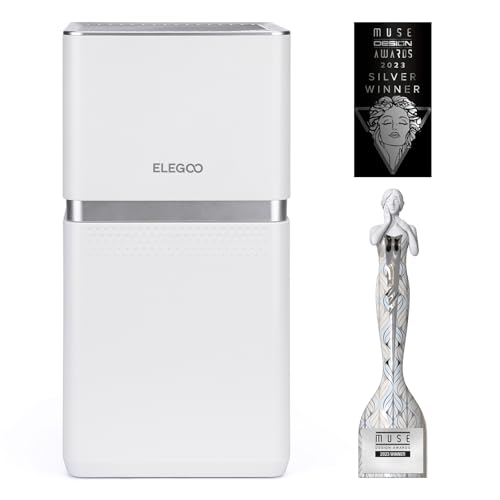
- Quiet 35 dB operation
- VOC monitoring with replacement reminders
- Low, high, and automatic fan modes
Best For: Shared resin-printing spaces that prioritize quiet operation
Enclosed Workspace Pick
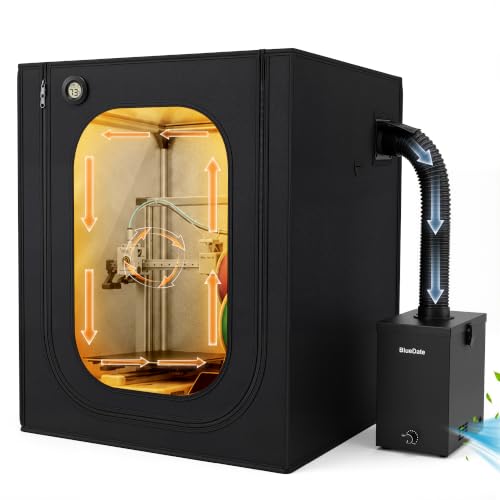
- Enclosure with integrated smoke and fume extraction
- Multi-stage HEPA and activated-carbon filtration
- Stepless speed control and broad listed compatibility
Best For: Maker spaces seeking enclosure-based containment for FDM or resin printing
Compact Odor Control

- Two compact activated-carbon units
- At least 24 hours of battery runtime
- Designed for compatible resin printers
Best For: Small resin-printing stations needing quiet odor control
Multi-Stage Coverage

- Six-layer HEPA and carbon filtration
- Three adjustable fan modes
- Works with resin and FDM printers
Best For: Shared spaces with mixed printer types and heavier air-cleaning needs
Targeted Fume Extraction
BD-60C Air Purifier for K2 Series

- HEPA and activated-carbon filtration
- Includes pipe and magnetic suction hoods
- Stepless speed control with replacement filters
Best For: CREALITY K2 and K2 Pro printers needing ducted extraction
Best Integrated Fit – BD-60B Printer Air Purifier
For maker spaces using compatible enclosed Bambu Lab or ELEGOO printers, the BD-60B is a purpose-built option among 3d printer air purifiers for maker spaces. Its four-stage filter setup combines pre-filtration, HEPA filtration, and activated carbon, while adjustable fan speed lets teams balance airflow and noise.
Best For: Bambu Lab and ELEGOO users who want a ready-to-use, compact fume extractor with flexible speed control.
Pros:
- Four-stage filtration targets particles, smoke, fumes, and odors.
- Stepless speed adjustment supports different printer and noise requirements.
- Includes a smoke pipe, pipe joint, magnetic suction hoods, power supply, and replacement pre-filters.
- Metal housing and compact dimensions suit crowded workbenches.
Cons:
- Compatibility is specifically listed for certain Bambu Lab and ELEGOO models.
- The P2S requires a separately printed riser bracket.
- Listed noise level is 55 dB.
The BD-60B stands out when direct compatibility and included accessories matter more than minimal size or the quietest operation. Verify the printer model and connection requirements before outfitting a shared workspace.
Best Enclosed-Printer Coverage – H13 Filter System for Enclosed Printers
This enclosed-printer filtration system is a strong candidate for maker spaces running varied filament types. It pairs a pre-filter, HEPA H13 filter, and thick activated-carbon bed, with a 60 m³/h centrifugal fan designed to maintain stable airflow through the filter stages.
Best For: Shared workshops with enclosed Bambu Lab, Creality, Prusa, Elegoo, Anycubic, or similar printers and a need for broad adapter compatibility.
Pros:
- HEPA H13 filtration is specified to capture 99.97% of ultrafine particles.
- Activated carbon targets odors and VOCs associated with materials such as ABS, ASA, and nylon.
- Default connector supports Bambu Lab P1S and X1C, with printable adapters for additional models.
- Quick-swap filter modules simplify maintenance.
Cons:
- Not recommended for open-frame printers without an enclosure.
- Printable adapters may be needed for many supported brands.
- The product notes emphasize that it reduces emissions but does not replace room ventilation.
With broad compatibility and a clearly specified three-layer design, this system is practical for a mixed enclosed-printer area. Maker spaces should still provide suitable ventilation, especially when printing ABS, ASA, or nylon.
Best for Resin Printers – ELEGOO MARSMATE Air Purifier
The ELEGOO MARSMATE is designed specifically for photocuring and resin-printing environments, making it a focused choice among 3d printer air purifiers for maker spaces. Its activated-carbon filter, internal VOC sensor, and automatic low- or high-speed modes prioritize simple, quiet operation.
Best For: Resin-printing stations using compatible ELEGOO Mars, Saturn, or Jupiter printers, particularly where low noise is important.
Pros:
- Designed for a range of ELEGOO resin printers with an extension port.
- Operates at a listed 35 dB with 6W power consumption.
- Built-in VOC sensor can alert users when filter replacement is needed.
- Replaceable activated-carbon filter is accessed through the upper cover.
Cons:
- Filtration is based on activated carbon rather than a listed HEPA stage.
- Compatibility depends on the printer having an extension port.
- The listed filter life is up to two months, so shared spaces need a replacement routine.
MARSMATE is best viewed as a quiet, resin-focused purifier rather than a general-purpose particulate system. Its sensor and automatic fan modes can make routine operation easier in a dedicated ELEGOO-compatible resin area.
Best Flexible Setup – Mintion V1 Filter System
The Mintion V1 offers a compact external filtration setup for shared enclosed-printer areas. Its pre-filter, HEPA H13, and activated-carbon stages address both particles and VOC-related odors, while optional printed adapters broaden its usefulness across brands.
Best For: Maker spaces that run multiple enclosed printer brands and want a complete, adaptable filter kit.
Pros:
- Three-stage filtration combines pre-filtration, HEPA H13, and activated carbon.
- Supports common materials including PLA, PETG, ABS, ASA, and nylon.
- Factory pre-configured for Bambu Lab P1S and X1C, with optional adapters for other brands.
- Includes a power adapter, sealing cap, screws, tools, and instructions.
Cons:
- Adapters for some printer brands may need to be printed separately.
- The product is intended for enclosed printers.
- Filter replacement remains necessary to maintain performance.
The Mintion V1 is a practical middle ground for educational, studio, and professional spaces that do not want a purifier locked to one printer ecosystem. Its included hardware and 60 m³/h airflow make installation and routine use straightforward.
High-Output Pick – Creality 360° Air Purifier
For maker spaces looking for 3d printer air purifiers with strong airflow and visible air-quality feedback, the Creality model combines 250 m³/h airflow, up to 1700 Pa of suction, and a real-time PM2.5 display. Its five-stage filtration is designed to address dust and odors during extended printing sessions.
Best For: Busy maker spaces that want high airflow, live PM2.5 monitoring, and long filter intervals.
Pros:
- 360° airflow and powerful suction are designed to circulate and capture air without disturbing prints.
- Real-time PM2.5 display provides visible particulate-level feedback.
- Five-stage filtration targets dust and odors, with the supplied notes citing 99.99% removal.
- Standard filters are rated for up to 1,000 hours, while the V-Fold activated-carbon filter is rated for up to 1,500 hours.
Cons:
- The listed 28-pound weight may make it less convenient to move between workstations.
- The product notes describe an FDM version, so resin-printer compatibility should be verified for your setup.
This is a strong choice when a shared workspace needs noticeable airflow and straightforward particulate monitoring. Its larger, heavier design is better suited to a designated purification station than frequent repositioning.
Quiet Resin-Printing Pick – ELEGOO Marsmate Air Purifier
The ELEGOO Marsmate is a practical option for maker spaces prioritizing quiet operation around resin printers. It runs at a stated 35 dB, offers low and high fan modes plus automatic switching, and includes VOC monitoring with filter-replacement reminders.
Best For: Resin-printing areas where low noise, VOC awareness, and ELEGOO printer compatibility matter.
Pros:
- 35 dB operating noise is designed to minimize disruption in shared spaces.
- Low, high, and automatic fan modes offer flexible operation.
- A built-in sensor monitors VOC concentration and can remind users when replacement is needed.
- Large housing is compatible with several ELEGOO Saturn and Mars models and may work with other printers that have expansion interfaces.
Cons:
- Compatibility with other brands depends on having a suitable expansion interface.
- The supplied notes identify activated carbon filtration but do not specify a multi-stage HEPA system.
- Its 14-pound weight and large dimensions may require dedicated bench space.
Choose the Marsmate when quiet operation and resin-printing compatibility are more important than maximum airflow specifications. Confirm the printer interface and available workspace before buying for a multi-printer lab.
Enclosed Workspace Pick – BD-60A 3D Printer Enclosure
For maker spaces needing more than a standalone purifier, the BD-60A combines a printer enclosure with smoke and fume extraction. Its listed filtration setup uses pre-filters, HEPA stages, and activated carbon, while stepless speed control lets users balance airflow and noise across compatible printers.
Best For: Shared workspaces that want enclosure-based containment for open-style FDM or resin printers.
Pros:
- Enclosure helps reduce noise, retain heat, resist moisture, and limit released dust and fumes.
- The multi-stage design targets particulate matter, smoke, fumes, and odors; the notes cite 99.97% capture for particles as small as 0.3 microns.
- Stepless speed control supports different airflow and noise preferences.
- Broad compatibility is listed for selected Bambu Lab, Creality, ELEGOO, Anycubic, and FLASHFORGE models.
Cons:
- The 650 × 750 × 800 mm enclosure requires substantial floor or bench space.
- At a listed 55 dB, it is louder than the ELEGOO Marsmate.
- Compatibility should be checked carefully against the specific printer model and enclosure dimensions.
The BD-60A is the most containment-focused option here, especially for spaces using open-style printers. It makes the most sense when the enclosure itself is useful and the workspace can accommodate its sizable footprint.
Compact Odor Control – ELEGOO Mini Air Purifier
For maker spaces seeking compact 3d printer air purifiers for maker spaces, the ELEGOO Mini Air Purifier is a simple option for compatible LCD, DLP, and MSLA resin printers. Its activated-carbon filter targets resin odor, while the small battery-powered design fits inside printers that have enough room.
Best For: Resin-printing stations that need compact, low-noise odor control and the convenience of two units.
Pros:
- Two-pack provides coverage for separate resin printers or work areas.
- Activated carbon is designed to absorb irritant resin odors.
- Runs for at least 24 hours on its 2,000mAh battery after charging.
- Compact 44 × 44 × 107mm size and listed 10dB noise level suit enclosed printer spaces.
Cons:
- Compatibility depends on whether the purifier fits inside the printer.
- Includes one carbon block per unit, and replacement carbon must be purchased separately.
- Designed for resin odor control rather than broad particle filtration.
The ELEGOO is best viewed as a small, quiet odor-control accessory rather than a room-sized purifier. Its two-unit format and long battery runtime make it practical for distributed resin-printing setups, provided replacement filters are readily available.
Multi-Stage Coverage – Phrozen Air Purifier Max
The Phrozen Air Purifier Max is a larger choice for maker spaces comparing 3d printer air purifiers for maker spaces across both resin and FDM workflows. Its six-layer filtration system combines activated carbon and HEPA filtration to address dust, smoke, odors, VOCs, and plastic fumes near the workstation.
Best For: Shared maker spaces running resin and FDM printers that want adjustable purification modes and quick filter changes.
Pros:
- Designed for both resin and FDM 3D printers.
- Six-layer filtration includes activated carbon and HEPA elements.
- Three fan modes—Power, Balanced, and Quiet—support different print jobs.
- Slide-out filters and a replacement reminder light simplify maintenance.
Cons:
- At 10kg and roughly 11.7 × 11.59 × 17 inches, it requires substantial floor or workstation space.
- Its listed 42dB noise level is higher than ultra-quiet mini units.
- The supplied notes do not specify filter replacement intervals or costs.
With broad contaminant coverage and selectable fan speeds, the Air Purifier Max is suited to active shared workspaces rather than cramped printer enclosures. Its larger footprint and weight are trade-offs for more substantial filtration capability.
Targeted Fume Extraction – BD-60C Air Purifier for K2 Series
BlueDate 3D printer Air Purifier Compatible With CREALITY K2,K2 Pro FDM 3D Printer
Check Price On AmazonFor maker spaces using a CREALITY K2 or K2 Pro, this BD-60C offers targeted extraction alongside filtration. Among 3d printer air purifiers for maker spaces, it stands out for its smoke pipe, magnetic hoods, adjustable airflow, and layered HEPA and activated-carbon design.
Best For: CREALITY K2 and K2 Pro users who want a ready-to-use external fume extractor with ducting accessories.
Pros:
- Four-stage filtration combines pre-filter, HEPA, and activated-carbon elements.
- Supplied smoke pipe and two magnetic suction hoods support targeted extraction.
- Stepless speed control lets users adjust airflow for different printer needs.
- Includes five pre-filters, with compatible replacement filters available.
Cons:
- Compatibility is specifically listed for CREALITY K2 and K2 Pro, not K2 Plus.
- Other printer models require a 3D-printed exhaust-port adapter.
- Its 55dB noise level is louder than the listed mini and Phrozen options.
The BD-60C is a specialized, accessory-rich solution for compatible CREALITY printers. It offers flexible airflow and replaceable filtration, but buyers should verify printer compatibility and account for its higher operating noise before deploying it in a shared room.
How We Picked the Best 3d Printer Air Purifiers for Maker Spaces
We evaluated these products for the needs of classrooms, libraries, workshops, and community labs where multiple users may operate printers for extended periods. Our comparison emphasizes filtration design, activated-carbon capacity, airflow, noise, printer compatibility, controls, maintenance, and the availability of replacement filters.
Because printer emissions vary by material and machine, no standalone purifier should be treated as a substitute for ventilation, an enclosure, or manufacturer safety guidance. HEPA filtration is most relevant to airborne particles, while activated carbon helps address odors and some gaseous compounds.
Quick Comparison
- Best for enclosed FDM printers: Look for a compact unit that fits the printer or enclosure and supports HEPA plus activated carbon.
- Best for larger shared spaces: Prioritize higher airflow, broad intake coverage, and readily available replacement filters.
- Best for resin-printing areas: Choose a model designed for resin odors and VOC control, with substantial carbon media.
- Best for quiet workspaces: Check the published noise rating and favor adjustable fan speeds or quiet modes.
- Best for multiple printers: Consider a larger room purifier or several strategically placed units instead of relying on one small device.
Key Buying Factors for 3d Printer Air Purifiers for Maker Spaces
Filtration and Carbon Capacity
A true HEPA or HEPA H13 filter can capture fine particles, but carbon quantity matters when odor and vapor control are priorities. Thin carbon layers may be useful for light-duty printing, while heavier cartridges generally offer more adsorption capacity. Confirm what the manufacturer means by terms such as “smoke removal” or “TVOC reduction.”
Airflow and Room Coverage
Compare airflow figures such as cubic meters per hour with the size of the room and the number of active printers. A high-flow model may clean shared air faster, but only if it can circulate air throughout the space. For enclosed printers, a compatible localized filter may be more efficient at the source.
Compatibility, Noise, and Maintenance
Verify dimensions, power requirements, mounting method, and compatibility with your printer or enclosure. A purifier that is difficult to install may be left unused. Also check filter-life estimates, replacement cost, indicator lights, and whether the fan is quiet enough for instruction, meetings, or public-facing spaces.
Controls and Safety
Useful features include multiple fan speeds, timers, automatic operation, PM2.5 displays, and filter-change alerts. These features improve consistency, but sensor readings should not be interpreted as a complete measure of VOC exposure.
Who Should Buy Which 3d Printer Air Purifiers for Maker Spaces?
Choose a compact printer-mounted or enclosure-compatible purifier if your maker space runs one or two enclosed machines and needs source-level odor and particle control. Choose a high-airflow purifier for larger rooms, open-frame printers, or several machines operating together. Choose a resin-focused model with substantial activated carbon when resin printing and odor management are central concerns. Choose multiple small units when printers are spread across separate benches or rooms.
For the best results, combine filtration with enclosure lids, outdoor exhaust where appropriate, regular filter replacement, good housekeeping, and clear operating procedures for staff and visitors.