
Choosing the right 3D scanner can make the difference between a smooth scan-to-print workflow and hours of cleanup. The best models balance accuracy, tracking, speed, and software support for your projects.
Below, we focus on 10 standout 3D scanners for 3D printing, with options for beginners, hobbyists, and advanced users who need better detail, faster capture, or more flexible scanning modes.
Best 10 3d Scanners Picks for 2026
Premium AI Multi-Mode Scanner
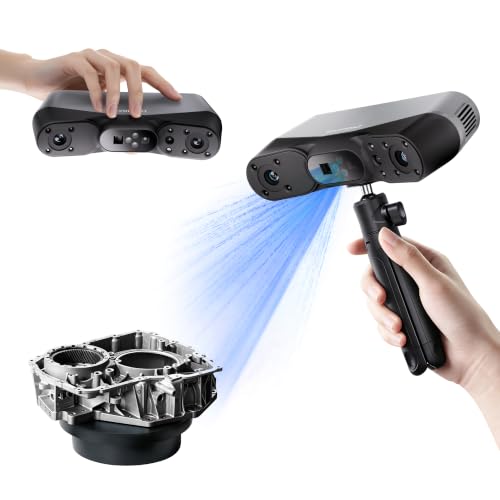
- Up to 0.03 mm single-frame accuracy
- Five scan modes for varied objects
- WiFi 6 and battery grip for mobility
Best For: Precision modeling, reverse engineering, and outdoor scanning
Entry-Level Medium-Format Scanner

- 0.07 mm accuracy and 0.10 mm resolution
- Markerless AI tracking helps resume scans
- JMStudio handles scanning, editing, and optimization
Best For: Beginners and hobbyists starting with handheld 3D scanning
Portable Dual-Mode Scanner

- 0.03 mm accuracy with 0.1 mm resolution
- Blue laser and NIR structured light modes
- Wireless design with Wi-Fi 6 and batteries
Best For: Portable scanning for miniatures, body scans, and mixed workflows
Industrial Blue-Laser Scanner

- Up to 0.01 mm precision and 0.02 mm accuracy
- Four modes including blue laser and structured light
- Handles shiny or dark surfaces without spray
Best For: Industrial measurement, reverse engineering, and automated scanning
Precision Small-Format Scanner

- Up to 0.02 mm accuracy for compact objects
- Blue LED structured light for fine detail
- Mono texture only and mainly for indoor use
Best For: Small indoor objects and high-detail 3D printing prep
AI-Powered All-Rounder

- Single-frame accuracy up to 0.03 mm
- Five modes for small parts, large objects, and more
- Wi-Fi 6 and AI segmentation streamline scanning
Best For: Versatile 3D scanning across printing, reverse engineering, and field use
Fast Dual-Mode Precision Scanner

- Up to 0.02 mm accuracy with blue laser lines
- Blue light and NIR modes for flexible scanning
- Scans objects from 5 mm to 2000 mm
Best For: Fast, high-accuracy scans across very small to very large objects
Industrial-Precision 3D Scanner
Revopoint MetroY Ultra for Tight-Tolerance Work

- Up to 0.01 mm single-frame precision
- Five scanning modes for different object types
- Scans dark, shiny, and metallic parts without spray
Best For: Tight-tolerance parts, inspection, and reverse engineering
Metrology-Focused 3D Scanner
Creality CR-Scan Raptor for Mixed-Size Objects
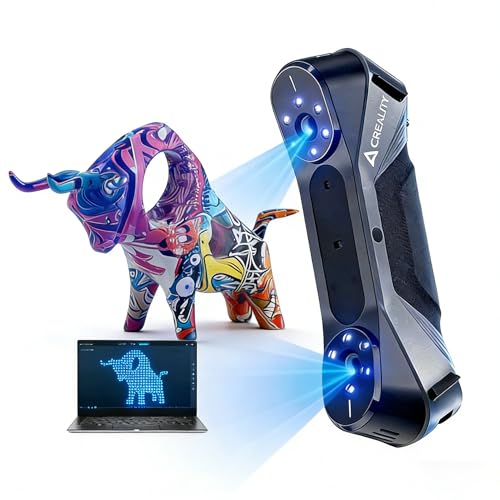
- 0.02 mm maximum accuracy for measurement work
- Blue laser and infrared structured light modes
- Handles objects from 5 mm to 2000 mm
Best For: Precision scanning with full-color support and mixed object sizes
Beginner-Friendly Wireless 3D Scanner
Creality Ferret Pro for Portable Scanning

- Wi-Fi 6 wireless scanning across multiple platforms
- 105 g lightweight body for easy portability
- Up to 0.1 mm accuracy with 24-bit color capture
Best For: Beginners and portable everyday scanning
Premium AI Multi-Mode Scanner – Revopoint POP 4
If you want a high-end option among 3d scanners, the Revopoint POP 4 is built for detailed 3D printing, reverse engineering, and precision modeling. It combines strong accuracy, fast capture speeds, and multiple scan modes so you can handle everything from tiny parts to larger objects with more confidence.
Best For: Users who need an accurate, versatile scanner for detailed modeling, outdoor work, and mixed object sizes.
Pros:
- Single-frame accuracy up to 0.03 mm, with volumetric accuracy rated at 0.03 mm + 0.05 mm x L(m)
- Five scanning modes, including blue laser lines, deep-hole scanning, and full-field structured light
- Scans objects from 10 x 10 x 10 mm up to 2 x 2 x 2 m
- WiFi 6 support and a battery grip for mobile scanning sessions
Cons:
- AI object segmentation is Windows only
- Some advanced features may be more than casual users need
Overall, the POP 4 stands out as a flexible, pro-leaning scanner with a strong feature set for demanding workflows. If your priority is precision plus adaptability, this is one of the more capable 3d scanners in this group.
Entry-Level Medium-Format Scanner – 3DMakerpro Fox
The 3DMakerpro Fox is an approachable choice for buyers comparing 3d scanners for the first time. It focuses on solid detail capture, markerless tracking, and a simplified software experience, making it a practical entry point for hobbyists and beginners who want usable scans without a steep learning curve.
Best For: Beginners and hobbyists who want an accessible handheld scanner for 3D printing and basic modeling.
Pros:
- 0.07 mm accuracy and 0.10 mm resolution for useful detail capture
- Markerless AI visual tracking can relock onto the object after movement
- JMStudio combines scanning, editing, and optimization in one workflow
- Designed as an entry-level medium-format scanner
Cons:
- Not aimed at the highest-precision industrial use cases
- Fewer advanced capabilities than premium scanner models
Fox is a sensible pick if you want reliable basics and software that helps streamline the process. For first-time users, it offers a straightforward way to get started with 3d scanners without overcomplicating the setup.
Portable Dual-Mode Scanner – Creality Pika
The Creality Pika is a compact option in the 3d scanners market for users who want portability without giving up useful detail. With blue laser and NIR structured light modes, it can handle small parts, collectibles, and even life-size body scans while keeping the workflow wireless and mobile-friendly.
Best For: Makers who want a lightweight, wireless scanner for small objects, body scanning, and travel-friendly use.
Pros:
- Up to 0.03 mm accuracy and 0.1 mm resolution
- Dual-mode scanning: 7-line blue laser and NIR structured light
- AI body completion, AI retexturing, and AI hole filling
- Wi-Fi 6, 3-inch touchscreen, and dual swappable batteries
Cons:
- Full feature set may be more than a casual user needs
- Wireless convenience can add complexity versus a simple plug-in scanner
Creality Pika is especially compelling if you value flexibility and portability in a single device. It blends strong accuracy with smart features, making it a well-rounded pick for users who need one scanner for multiple scanning scenarios.
Industrial Blue-Laser Scanner – Revopoint MetroX Pro
For buyers looking at premium 3d scanners for precision work, the Revopoint MetroX Pro leans heavily into industrial-grade capture and measurement. It combines high-precision blue laser modes, structured light scanning, and automated turntable support to streamline detailed scans of shiny, dark, or feature-rich objects.
Best For: Industrial measurement, reverse engineering, and high-detail object scanning with automated workflows.
Pros:
- Single-frame precision up to 0.01 mm and accuracy up to 0.02 mm
- Four scanning modes, including cross-line lasers, parallel lines, and full-field blue structured light
- Can scan shiny or dark surfaces without spray in laser modes
- Dual-axis turntable and PC-to-mobile live streaming support efficient scanning
Cons:
- Heavier and more workstation-like than compact portable scanners
- Paid Revo Design and Revo Measure software are sold separately
The MetroX Pro is best suited to users who need fine detail, reliable surface capture, and workflow automation. Among 3d scanners aimed at serious work, it offers one of the strongest blends of precision and versatility.
Precision Small-Format Scanner – 3DMakerpro Seal Lite
If you want a 3d scanner for small parts, the 3DMakerpro Seal Lite is built around high-detail indoor capture rather than broad all-purpose use. Its blue LED light source and short-wavelength structured light are aimed at reproducing fine dents, edges, and textures on objects from 10 to 300 mm.
Best For: Small indoor objects, 3D printing prep, and users who want very fine detail on compact models.
Pros:
- Blue LED light source is designed for fine structured-light detail capture.
- Rated up to 0.02 mm accuracy for small-format scanning.
- Supports scan-back and anti-shake features for steadier handheld use.
- JMStudio software includes visual tracking, error correction, and auto-alignment.
Cons:
- Captures mono texture only, so it is not a color-focused scanner.
- Recommended mainly for indoor use.
- Has a learning curve and may need a relatively powerful PC.
Overall, the Seal Lite makes sense if detail matters more than versatility. It is a focused pick for smaller prints and precision models, especially when you are willing to spend time learning the workflow.
AI-Powered All-Rounder – Revopoint POP 4
The Revopoint POP 4 is a flexible 3d scanner built for users who need one device that can handle many scanning jobs. It combines multiple scanning modes, AI segmentation, and wireless features, making it a strong choice when you want fast capture for both precision work and larger objects.
Best For: Users who want a versatile scanner for 3D printing, reverse engineering, and mixed indoor/outdoor projects.
Pros:
- Single-frame accuracy up to 0.03 mm for detailed scanning.
- Five scanning modes cover small parts, large objects, and different surface types.
- AI object segmentation helps separate the target from background noise on Windows.
- Built-in Wi-Fi 6 supports wireless scanning and live cross-screen preview.
Cons:
- Some features are limited by platform, such as AI segmentation on Windows only.
- Outdoor battery grip is sold separately.
- Advanced capabilities may be more than casual users need.
For buyers who want broad capability instead of a single-purpose tool, the POP 4 stands out. Its mix of speed, accuracy, and mode variety makes it a practical upgrade path for serious scanning workflows.
Fast Dual-Mode Precision Scanner – Creality CR-Scan Raptor
The Creality CR-Scan Raptor is a 3d scanner focused on high-precision capture with blue laser and NIR modes. It is designed to handle both small detailed objects and very large subjects, so it suits users who want speed without giving up fine edge detail.
Best For: High-accuracy scanning of everything from small parts to large objects, including faces, bodies, and artifacts.
Pros:
- Up to 0.02 mm scanning accuracy with thin 0.1 mm blue laser lines.
- 2-in-1 blue light and NIR modes support marker and marker-free scanning.
- Scans objects from 5 mm to 2000 mm, covering a very wide size range.
- Blue light mode reaches up to 60 fps for fast capture.
Cons:
- Needs a high-performance computer to run properly.
- Class 1 blue light still requires careful eye safety awareness.
- More advanced than a simple plug-and-play scanner.
The Raptor is a strong option when precision and speed both matter. Its dual-mode design gives it the flexibility to tackle very different scanning tasks, but it is best matched to users who can support its hardware demands.
Industrial-Precision 3D Scanner – Revopoint MetroY Ultra for Tight-Tolerance Work
If you need a 3D scanner for measurement-focused work, the Revopoint MetroY Ultra is built around accuracy, speed, and flexible capture modes. It’s aimed at small to medium objects, with blue laser scanning, structured light, and workflow tools that suit reverse engineering, inspection, and 3D printing prep.
Best For: Tight-tolerance parts, industrial inspection, and users who want multiple scanning modes in one handheld system.
Pros:
- Up to 0.01 mm single-frame precision and 0.015 + 0.04 mm x L(m) volumetric accuracy
- Five scanning modes, including laser cross-lines, parallel lines, single-line, structured light, and turntable scanning
- Up to 90 FPS scanning speed with NVIDIA GPU support, or 60 FPS on CPU
- Can scan dark, shiny, and metallic surfaces without spray, and works outdoors up to 100,000 lux
Cons:
- Best suited to small and medium objects rather than very large scenes
- Higher system requirements, especially on Windows
- Wireless and battery features add flexibility, but the setup is still geared toward serious workflows
Overall, the MetroY Ultra is the most industrial-leaning option here, especially if you care more about detail and measurement consistency than beginner simplicity.
Metrology-Focused 3D Scanner – Creality CR-Scan Raptor for Mixed-Size Objects
The Creality CR-Scan Raptor is a practical 3D scanner for buyers who want metrology-grade accuracy without giving up versatility. It combines blue laser and infrared structured light scanning, so it can handle everything from small parts to larger objects while still keeping the workflow relatively straightforward.
Best For: Users who want a versatile scanner for precision parts, full-color capture, and mixed object sizes.
Pros:
- Maximum accuracy of 0.02 mm for industrial-style measurement work
- Supports objects from 5 mm to 2000 mm, covering both small and large scans
- Blue parallel 7-line laser plus infrared structured light for different scanning scenarios
- Can scan black and metal objects with low dependence on powder coating, and supports outdoor use up to 30,000 lux
Cons:
- Requires a relatively capable Windows or macOS system
- Outdoor performance is limited compared with higher-lux scanners
- Best results still depend on using the right mode for the subject
For shoppers comparing 3D scanners, the Raptor stands out as a balanced pick: precise enough for measurement work, but flexible enough for color capture and larger everyday objects.
Beginner-Friendly Wireless 3D Scanner – Creality Ferret Pro for Portable Scanning
If you’re looking for an easy entry into 3D scanners, the Creality CR-Scan Ferret Pro is built for portability and simple wireless use. It’s a lightweight handheld option with Wi-Fi 6, full-color scanning, and enough flexibility for hobbyists, DIY creators, and casual 3D printing projects.
Best For: Beginners, portable scanning, and users who want a lightweight wireless scanner for everyday projects.
Pros:
- Wireless scanning with Wi-Fi 6 and cross-platform support for Windows, macOS, Android, and iOS
- Lightweight at 105 g, making it easy to carry and scan on the go
- 24-bit full-color scanning with anti-shake tracking and up to 0.1 mm accuracy
- Includes useful accessories like a WiFi box, tripod, power bank, phone holder, and carrying case
Cons:
- Not suitable for very small or highly detailed items like jewelry or precision parts
- Best results depend on avoiding reflective, transparent, or very dark surfaces
- Accuracy is lower than the more industrial-oriented scanners in this set
The Ferret Pro is the most approachable of these 3D scanners, especially if you value wireless convenience, travel-friendly size, and simple setup over maximum precision.
How We Picked These 3d Scanners
We prioritized scanners that deliver a strong mix of accuracy, usable scanning range, tracking stability, and software features. Because real-world scanning matters more than spec sheets alone, we also looked at portability, setup simplicity, lighting compatibility, and how well each scanner suits 3D printing workflows.
Quick Comparison: Which Type Fits Your Needs?
If you want an easy all-rounder, choose a versatile handheld model with solid tracking and broad object support. If your main goal is small parts and fine surface detail, a higher-accuracy short-range scanner is usually the better fit. For bodies, larger objects, or mobile scanning, look for wider capture range, fast frame rates, and flexible illumination modes.
Key Buying Factors for 3d Scanners
Accuracy and Resolution
Accuracy is one of the most important specs for 3d Scanners, especially if you plan to print replacement parts, fit components together, or reproduce fine textures. Higher accuracy helps reduce post-processing and improves print-ready geometry.
Object Size and Scanning Range
Match the scanner to what you actually scan. Small-format scanners are better for miniatures, mechanical parts, and detailed objects, while medium- and large-format options are more practical for tools, décor, and body scanning.
Tracking and Lighting Technology
Blue laser, structured light, and hybrid systems each have tradeoffs. Laser systems often handle detail and surface geometry well, while structured light can be fast and convenient on suitable surfaces. Anti-shake tracking and AI-assisted alignment can also make scanning much easier for beginners.
Software and Export Workflow
Good hardware is only half the story. Look for software that makes mesh cleanup, alignment, and export straightforward. If you use CAD or slicer software regularly, make sure the scanner supports the file formats and workflow you need.
Who Should Buy Which 3d Scanners?
Beginners should focus on easy setup, reliable tracking, and forgiving software. Makers and hobbyists who scan a variety of objects may want a balanced handheld model with strong versatility. Advanced users and professionals should lean toward the most accurate 3d Scanners with better detail capture, faster scanning, and more robust control over scan modes. If your priority is 3D printing, choose the scanner that best matches your typical object size and required level of precision rather than the highest spec alone.