
Handheld 3D scanners make it easier to capture parts, props, figures, and mechanical objects without a fixed turntable setup. The right model can save time, reduce cleanup, and deliver dependable scans for 3D printing or reverse engineering.
In this roundup, we focus on practical buying factors like accuracy, tracking, speed, software, and portability so you can choose a scanner that fits your workflow and budget.
Best 10 Handheld 3d Scanners Picks for 2026
Refined Precision Starter
Revopoint POP3 Plus 3D Scanner, Full-Color Scan
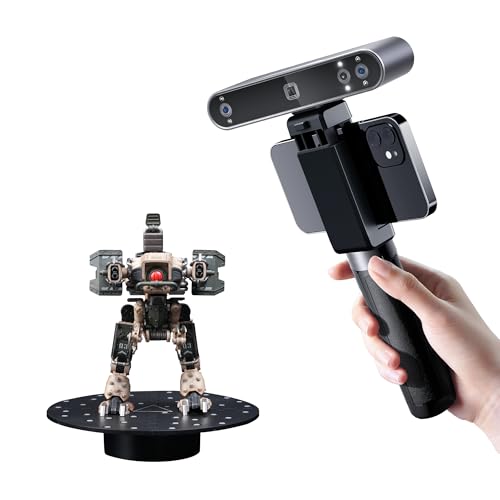
- 20-micron accuracy with updated calibration
- Full-color scanning with HD RGB camera
- Wi‑Fi 6 and USB-C connectivity for portability
Best For: General-purpose users who want a lightweight color scanner
Wireless Outdoor Pick
Creality Otter Lite Wireless 3D Scanner
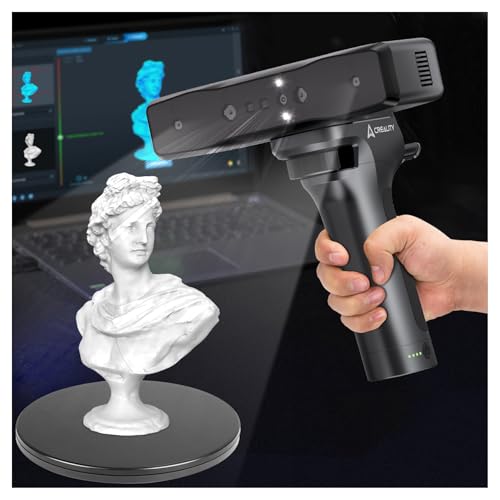
- 0.05 mm accuracy with infrared structured light
- Wi‑Fi and battery handle for cable-free use
- Works with smartphone display and outdoor lighting
Best For: Users who want wireless scanning with mobile control
Advanced AI Flagship
Revopoint POP 4 3D Scanner, AI Segmentation

- Up to 0.03 mm single-frame accuracy
- Five scan modes for varied surfaces and sizes
- AI segmentation and live wireless preview
Best For: Advanced scanning projects that need precision and flexibility
Entry-Level Medium Scan
3DMakerpro Fox Entry-Level Medium-Format 3D Scanner

- 0.07 mm accuracy and 0.10 mm resolution
- Markerless AI tracking helps recover lost scans
- JMStudio streamlines scanning, editing, and optimization
Best For: Beginners who want an easier medium-format handheld scanner
Premium Precision Workhorse
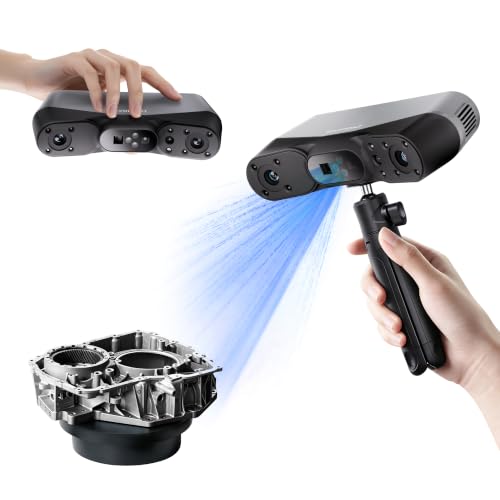
- Up to 0.03 mm single-frame accuracy
- Five scanning modes for indoor/outdoor jobs
- WiFi 6, battery grip, and AI segmentation
Best For: Serious users scanning small parts, large objects, or challenging surfaces
Wireless Starter Pick
Wireless Beginner-Friendly Scanner

- 0.1 mm accuracy with 30FPS scanning
- WiFi 6 bridge for wireless portability
- Anti-shake tracking for steadier captures
Best For: Beginners and mobile creators who want easy wireless scanning
Lightweight Detail Scanner
Lightweight AI Tracking Scanner

- 0.05 mm accuracy with blue light scanning
- AI visual tracking plus JMStudio software
- 250g body designed for portability
Best For: Makers scanning medium objects for printing or display
Premium Precision Scanner

- 0.02mm accuracy with 0.1mm fine-detail resolution
- Blue laser + NIR scanning for small to very large objects
- 24-bit color, anti-shake tracking, and marker-free scanning
Best For: Users who need maximum detail and broad object-size flexibility
Portable Value Scanner

- Up to 30 FPS point cloud capture with ASIC processing
- Dual-mode scanning for wide-range and detailed objects
- Built-in RGB camera and low-power portable operation
Best For: Users who want a lightweight, flexible scanner for color models
Beginner-Friendly Wireless Scanner

- WiFi6 wireless scanning on Windows, macOS, Android, and iOS
- 0.1mm accuracy with 24-bit full-color and anti-shake tracking
- Lightweight 105g body with included accessories
Best For: Beginners who want a portable wireless scanner for everyday 3D projects
Refined Precision Starter – Revopoint POP3 Plus 3D Scanner, Full-Color Scan
If you’re comparing handheld 3d scanners for detailed captures and easy everyday use, the Revopoint POP3 Plus stands out with stronger accuracy, faster scanning, and full-color output. It is built for medium-sized objects and supports a wide range of workflows, from 3D printing to design and preservation.
Best For: Users who want a lightweight handheld scanner with color capture, broad software support, and improved precision for general-purpose scanning.
Pros:
- Up to 20 microns of accuracy with a new calibration board and refined precision.
- Scans at up to 18 fps with a 9-axis IMU to help stabilize shaky handheld captures.
- HD RGB camera, pixel mapping, and Flash LED lighting support full-color models.
- Works with iOS, Android, Windows, and macOS over Wi-Fi 6 or USB-C.
Cons:
- Revo Scan is only compatible with x86_64 architecture.
- Best suited to medium-sized objects rather than ultra-small or huge scan jobs.
Overall, the POP3 Plus is a flexible choice if you want a portable scanner that balances accuracy, color, and software convenience. Its broad file export support also makes it easier to move scans into CAD, modeling, and slicing tools.
Wireless Outdoor Pick – Creality Otter Lite Wireless 3D Scanner
Among handheld 3d scanners, the Creality Otter Lite is aimed at users who want cordless control and reliable scans in changing environments. Its 0.05 mm accuracy, mobile app support, and outdoor-friendly lighting make it a practical option for mixed indoor and outdoor work.
Best For: Buyers who want a wireless handheld scanner with strong accuracy, mobile control, and good performance in variable lighting.
Pros:
- 0.05 mm accuracy with infrared structured light for detailed captures.
- Built-in Wi-Fi and Lite Bridge battery handle remove cable restrictions.
- Smartphone-based real-time display through the Creality Scan app.
- Dual LED fill lights help scanning in low light or bright outdoor conditions.
Cons:
- Recommended specs are tied to Windows and macOS support.
- Focused on practical scanning versatility rather than advanced industrial feature depth.
The Otter Lite makes sense if you value freedom of movement and simpler setup over a tethered workflow. It combines portable hardware with export-ready output formats for 3D printing and modeling tasks.
Advanced AI Flagship – Revopoint POP 4 3D Scanner, AI Segmentation
If you’re shopping handheld 3d scanners for demanding modeling or reverse-engineering work, the Revopoint POP 4 pushes into higher-end territory. It combines very fine accuracy, multiple scan modes, and AI-assisted cleanup to handle everything from small parts to large objects.
Best For: Advanced users who need high accuracy, multi-mode scanning, and AI-assisted workflow tools for complex projects.
Pros:
- Single-frame accuracy up to 0.03 mm for fine surface detail.
- Five scanning modes cover small parts, dark objects, reflective surfaces, and deep holes.
- AI object segmentation helps isolate the target and reduce background noise.
- Built-in Wi‑Fi 6 supports wireless scanning and live cross-screen preview.
Cons:
- AI object segmentation is Windows only.
- Some outdoor features depend on accessories such as the separate filter or battery grip.
The POP 4 is the most feature-rich option in this group, especially if you need precision across difficult materials and lighting conditions. Its mix of scan modes and post-processing tools is built for serious production workflows.
Entry-Level Medium Scan – 3DMakerpro Fox Entry-Level Medium-Format 3D Scanner
For buyers who want approachable handheld 3d scanners without jumping straight into a complex setup, the 3DMakerpro Fox is a beginner-friendly medium-format option. It focuses on usable detail, markerless tracking, and streamlined software so you can get to a scan faster.
Best For: Beginners and hobbyists who want an easy-to-use scanner for medium-format objects, 3D printing, and basic inspection work.
Pros:
- 0.07 mm accuracy and 0.10 mm resolution for useful detail.
- Markerless AI visual tracking can relock onto the object after fast movement.
- JMStudio combines scanning, editing, and optimizing in one workflow.
- Designed for scanning, modeling, measurement, and quality inspection.
Cons:
- Heavier than the other options listed here at 2.39 pounds.
- Positioned as an entry-level scanner, so it is less ambitious than higher-end models.
The Fox is a straightforward pick if you want to learn handheld scanning without giving up practical accuracy. It is best when you value simple software and reliable results over premium feature depth.
Premium Precision Workhorse – Multi-Mode Precision Scanner
If you want handheld 3d scanners that can handle everything from tiny parts to larger field jobs, the Revopoint POP 4 Premium stands out for its mix of accuracy, speed, and scanning modes. It is built for 3D printing, reverse engineering, and detailed modeling, with options for indoor, outdoor, and difficult-surface capture.
Best For: Users who need high-accuracy handheld scanning across small parts, outdoor scenes, and reflective or dark objects.
Pros:
- Single-frame accuracy up to 0.03 mm for fine detail capture.
- Five scanning modes cover structured light, laser, deep holes, and outdoor use.
- Up to 105 fps in multi-line laser mode and 5,000,000 points/s in full-field mode.
- WiFi 6 support and a battery grip make mobile scanning more practical.
Cons:
- AI object segmentation is Windows only.
- Full feature set may be more than casual users need.
- Best performance depends on choosing the right mode for the object and lighting.
Overall, this is a strong pick if you need a versatile handheld scanner that is designed for serious accuracy and difficult capture conditions. Its broad mode selection is the main reason to consider it over simpler scanners.
Wireless Starter Pick – Wireless Beginner-Friendly Scanner
The Creality CR-Scan Ferret Pro is a practical choice among handheld 3d scanners if you want wireless convenience without giving up solid accuracy. It combines 0.1 mm accuracy, fast 30FPS scanning, and anti-shake tracking to make everyday 3D capture smoother for printing, design, and reverse engineering.
Best For: Beginners and mobile users who want a wireless handheld scanner that is easy to track and simple to move around.
Pros:
- 0.1 mm accuracy and 0.16 mm resolution for detailed models.
- WiFi 6 bridge provides faster wireless data transfer than WiFi 5.
- Anti-shake tracking and one-shot 3D imaging help improve scan stability.
- Works with iOS, Android, Windows, and supported Mac setups.
Cons:
- Not ideal for highly reflective, transparent, or extremely dark surfaces.
- Outdoor scanning is limited to ambient light up to 30,000 lux.
- Wireless use depends on compatible devices and the bridge accessory.
For buyers who value portability and easier scanning over advanced material handling, the Ferret Pro hits a useful middle ground. It is especially appealing if you want wireless capture with broad device support.
Lightweight Detail Scanner – Lightweight AI Tracking Scanner
If you are comparing handheld 3d scanners for detailed print prep, the 3DMakerpro Moose Lite is built around precision and simple workflow. It uses blue light technology, AI visual tracking, and integrated JMStudio software to help you scan, edit, and optimize models in one place.
Best For: Makers who want a lightweight handheld scanner for medium objects and detailed 3D printing projects.
Pros:
- 0.05 mm accuracy and 0.10 mm resolution for fine detail.
- AI visual tracking helps keep scans aligned more easily.
- JMStudio combines scanning, editing, and optimizing in one workflow.
- Lightweight 250g design makes it easy to carry and use anywhere.
Cons:
- 10FPS scanning speed is slower than faster handheld options.
- Best suited to medium objects rather than very large capture jobs.
- Plastic body is less premium than some metal-bodied scanners.
The Moose Lite is a smart fit if you care more about detail and workflow simplicity than raw speed. Its lightweight build and AI tracking make it approachable for regular scanning sessions.
Premium Precision Scanner – Creality CR-Scan Raptor
If you want handheld 3D scanners with high-end detail capture, the Creality CR-Scan Raptor is built for demanding scans across small parts, full bodies, and larger objects. Its blue laser and NIR modes give it unusual range, while the 0.02mm accuracy claim makes it a strong pick for users who care about fine geometry and clean edges.
Best For: Reverse engineering, industrial design, miniatures, automotive parts, and color 3D capture.
Pros:
- 0.02mm accuracy and 0.1mm fine-detail resolution for precise scans
- Dual blue laser and NIR scanning supports objects from 5×5×5mm up to 2000×2000×2000mm
- Up to 60fps blue laser scanning and 24-bit full-color capture
- Anti-shake tracking, autofocus stability, and marker-free scanning support
Cons:
- Requires stronger recommended hardware for best results on Windows and macOS
- May be more scanner than casual users need for simple hobby scans
Overall, the Raptor stands out as the most advanced option in this group for users who need accuracy, speed, and flexibility in one handheld unit. It is especially compelling if you scan a mix of tiny and large subjects and want color texture capture as well.
Portable Value Scanner – Creality CR-Scan Ferret
The Creality CR-Scan Ferret is a practical choice for handheld 3D scanners if you want a lighter, more portable setup with straightforward color scanning. It supports both wide-range and high-accuracy modes, making it useful when you need one scanner that can handle larger subjects and more detailed work without a complicated workflow.
Best For: Portable scanning, full-color models, and users who want flexible Android or PC use.
Pros:
- Up to 30 FPS point cloud capture and 60 FPS image processing with ASIC chipset
- Dual-mode scanning covers wide-range objects and finer-detail capture
- Built-in RGB camera captures full-color textures
- Low power draw supports power-bank use and mobile scanning setups
Cons:
- Not positioned for ultra-fine detail compared with higher-precision scanners
- Android mobile scanning is supported, but compatibility is more limited than newer models
For buyers who value portability and speed over top-tier precision, the Ferret is a balanced handheld option. It is best viewed as a convenient all-rounder for color scans and everyday 3D printing projects.
Beginner-Friendly Wireless Scanner – Creality CR-Scan Ferret Pro
The Creality CR-Scan Ferret Pro is aimed at buyers who want handheld 3D scanners that are easy to start with and simple to move between devices. With WiFi6 wireless scanning, anti-shake tracking, and full-color capture, it is designed to make everyday 3D scanning less intimidating for beginners and hobbyists.
Best For: Entry-level creators, 3D printing hobbyists, and wireless scanning across mobile and desktop devices.
Pros:
- Easy to use for beginners with a quick-start workflow
- WiFi6 wireless scanning works with Windows, macOS, Android, and iOS
- 0.1mm accuracy with 24-bit full-color scanning and anti-shake technology
- Lightweight 105g design with included accessories and carrying case
Cons:
- Not suitable for very small or highly detailed items like jewelry or precision parts
- Best results depend on avoiding reflective, transparent, or very dark surfaces
The Ferret Pro is a strong pick if you want a practical, travel-friendly scanner with broad device support and low setup friction. It does not chase ultra-fine detail, but it offers a good mix of portability, color capture, and wireless convenience.
How We Picked the Best Handheld 3d Scanners
We prioritized Handheld 3d Scanners that balance real-world scan quality with usability. That means strong tracking, useful accuracy claims, workable scan speeds, and features such as wireless operation, color capture, and compatibility with common desktop and mobile setups.
We also looked for options that suit different users: first-time buyers who need simple operation, hobbyists scanning medium-size objects, and advanced users who want finer detail for product work, inspection, or reverse engineering.
Quick Comparison
For a fast shortlist, think in terms of use case rather than specs alone. Entry-level models are best for learning and casual scanning. Midrange Handheld 3d Scanners usually offer the best value for makers and 3D printing. Higher-end models are better when fine detail, faster capture, and tighter accuracy matter most.
Key Buying Factors for Handheld 3d Scanners
Accuracy and Resolution
Lower claimed accuracy numbers can be helpful for detailed parts, but they are not the whole story. Look at whether the scanner is designed for small objects, medium objects, or larger surfaces, and whether it can maintain detail across the full scan.
Tracking Stability
Good tracking reduces drift and missing data. Features like anti-shake processing, better target recognition, and more robust software help Handheld 3d Scanners stay locked onto the object, especially on plain or reflective surfaces.
Scan Speed and Workflow
Faster frame rates can shorten capture time, but speed only matters if the software and tracking are reliable. If you scan a lot of moving setups or larger surfaces, a faster scanner can make a noticeable difference.
Color, Wireless Use, and Compatibility
Full-color scanning matters for visual models, cosplay, art, and archival work. Wireless or phone-friendly operation can improve convenience, while PC compatibility often gives you more control and processing power.
Who Should Buy Which Handheld 3d Scanners?
Beginners and casual makers should focus on ease of use and stable tracking over top-end specifications. If you scan parts for 3D printing, choose a versatile midrange model with solid accuracy and straightforward software.
Advanced users, product designers, and reverse-engineering workflows should look for higher accuracy, better fine-detail capture, and stronger tracking performance. If portability matters, Handheld 3d Scanners with wireless support can be especially convenient for on-site scanning and faster job turnaround.