
Choosing a 3D scanner for jewelry is mostly about precision, fine detail, and reliable capture of reflective, small-scale surfaces. The right model can save hours in modeling, prototyping, repair, and custom design work.
Below, you’ll find a buyer-focused roundup of 10 strong options, followed by a concise guide to help you compare accuracy, scanning method, and workflow fit before you buy.
Best 10 3d Scanner for Jewelry Picks for 2026
Precision Small-Format Choice

- Blue LED source targets fine detail capture
- Up to 0.02mm accuracy for tiny features
- Indoor small-format workflow with JMStudio
Best For: Small jewelry pieces and detail-focused indoor scanning
Auto-Focus Detail Scanner

- Dual 13MP autofocus cameras for sharp detail
- 0.033mm accuracy with dot-free alignment
- Works across major operating systems
Best For: Jewelry scanning with a clean, sticker-free workflow
Portable Dual-Mode Scanner

- Wireless WiFi 6.0 scanning and streaming
- Dual modules for different surface types
- RGB camera captures color textures
Best For: Portable scanning with color texture and flexible workflows
Beginner-Friendly Medium-Format Pick

- Entry-level scanner with medium-format design
- 0.07mm accuracy and 0.10mm resolution
- Markerless AI tracking simplifies rescans
Best For: Beginners who want an easy scan-to-model workflow
Compact Precision
Revopoint MINI 2 for Small-Object Scanning
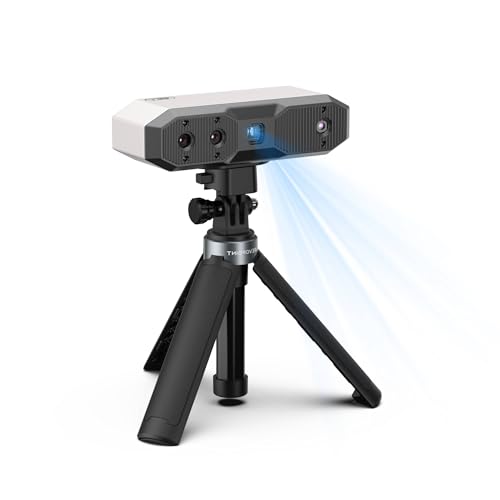
- 0.02 mm precision for fine jewelry detail
- USB or Wi‑Fi 6 connectivity in a 175 g body
- Best on small items; spray may help on some surfaces
Best For: Jewelers and creators scanning rings, pendants, and other small detailed parts
Metrology Inspection
Revopoint MetroY Ultra CMM Measurement Kit

- 0.01 mm precision with certified measurement workflow
- Five scan modes for small to medium parts
- CMM edition includes ball plate and Revo Measure software
Best For: Precision inspection teams that need verified scans and report generation
Wireless Versatility
Creality Otter Lite for Small and Large Objects

- Quad-lens design captures jewelry and larger objects
- Wi‑Fi 6 wireless scanning with built-in battery
- 30 FPS with anti-shake tracking and backtracking
Best For: Buyers who want a wireless scanner that can handle jewelry and larger items
Refined Color Scanning
Revopoint POP3 Plus 3D Scanner, Full-Color Scan
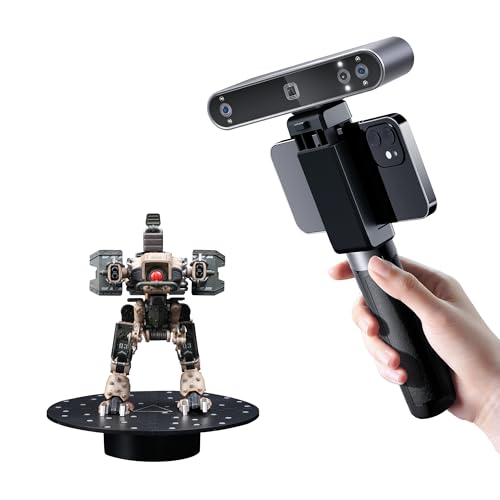
- 20-micron claimed accuracy with improved calibration
- Optical zoom adds point-cloud detail for small features
- Lightweight, portable scanner with full-color capture
Best For: Portable, color-capable scans of small to medium objects
Standalone Precision
3DMakerpro Toucan 3D Scanner, Premium Version

- Standalone scanner with on-device editing and exporting
- Up to 0.03 mm accuracy and 48MP color capture
- Sized for small objects, including jewelry-scale items
Best For: Users who want a fully standalone handheld scanner for detailed small-object capture
Industrial Detail Capture
Creality CR-Scan Raptor 3D Scanner
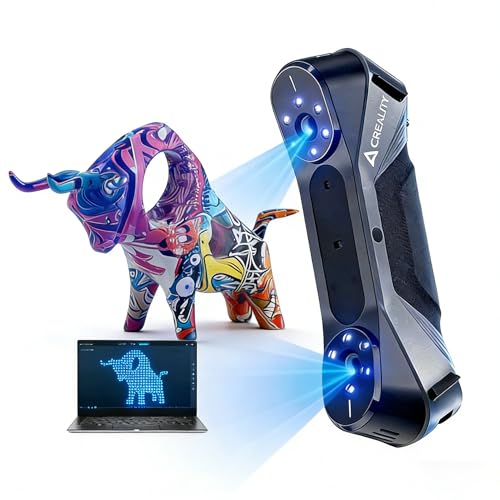
- Up to 0.02 mm accuracy with 60 fps scanning
- Laser and infrared modes for different object types
- Handles black and metal objects with less powder dependence
Best For: High-accuracy scanning with flexible modes for detailed small objects and mixed materials
Precision Small-Format Choice – 3DMakerpro Seal Lite
If you want a 3d scanner for jewelry and other tiny objects, the 3DMakerpro Seal Lite is built around small-format capture and fine detail. Its blue LED light source and claimed 0.02mm accuracy make it a strong fit for pieces where edges, dents, and surface texture matter more than broad coverage.
Best For: Small jewelry pieces, delicate details, and indoor scanning workflows where accuracy matters.
Pros:
- Blue LED light source is designed to capture finer structured-light detail.
- Up to 0.02mm accuracy is aimed at tiny features and edge textures.
- Supports scan-back and anti-shake features for steadier handheld use.
- JMStudio includes visual tracking, error correction, auto-alignment, and export options.
Cons:
- Mono texture only, so it is not a color-focused scanner.
- Recommended for indoor use and small objects from 10 to 300mm.
- There is a learning curve, and it needs a relatively powerful PC.
For buyers focused on precision over convenience, this model offers a practical small-object scanning setup. It is best treated as a detail-first tool for jewelry, not a general-purpose scanner for every job.
Auto-Focus Detail Scanner – Matter and Form THREE
The Matter and Form THREE is a strong 3d scanner for jewelry if you want a cleaner workflow and very fine detail. Its dual 13MP autofocusing cameras are designed to keep tiny objects sharp, while the feature-based alignment avoids the need for tracking dots.
Best For: Jewelry, miniature objects, and users who want high precision without tracking stickers.
Pros:
- Dual 13MP autofocusing cameras help maintain sharp detail on small items.
- 0.033mm accuracy is aimed at professional-grade results.
- No tracking dots are needed, which simplifies setup and cleanup.
- Works with Windows, Mac, Linux, iOS, Android, and Chromebooks.
Cons:
- Heavier than portable handheld options at 9.46 pounds.
- Capture distance is best suited to the stated 20cm to 100cm range.
If you care most about precision and straightforward handling of small objects, this scanner stands out. The cross-platform software support also makes it easier to fit into different workstations without extra friction.
Portable Dual-Mode Scanner – Revopoint INSPIRE 2
The Revopoint INSPIRE 2 is a flexible 3d scanner for jewelry when you need portability and solid detail capture. Its wireless design, dual scanning modules, and built-in RGB camera make it suitable for users who want both mobile scanning and full-color output.
Best For: Portable scanning, mixed-material objects, and users who want color texture capture with detail.
Pros:
- Built-in WiFi 6.0 supports wireless mobile scanning and streaming.
- Dual modes combine infrared structured light and multi-line laser scanning.
- Up to 0.05 mm accuracy and 0.03 mm precision support detailed models.
- Built-in RGB camera captures true-to-life color and synchronized texture.
Cons:
- Minimum system requirements are fairly demanding for some setups.
- Revo Design is paid software and Windows-only.
- Outdoor scanning is limited to shaded or semi-bright conditions.
This model makes sense if you value flexibility as much as accuracy. It is especially appealing when your workflow benefits from wireless operation, color capture, and a broader range of object types.
Beginner-Friendly Medium-Format Pick – 3DMakerpro Fox
The 3DMakerpro Fox is a practical 3d scanner for jewelry if you want an entry-level option that still emphasizes useful detail. Its medium-format design, 0.07mm accuracy, and markerless AI visual tracking make it easier to scan real objects without a complicated setup.
Best For: Beginners and hobbyists who want an approachable scanner for medium-sized objects and detail-oriented projects.
Pros:
- Entry-level positioning makes it approachable for first-time users.
- 0.07mm accuracy and 0.10mm resolution support useful detail capture.
- Markerless AI visual tracking helps the scanner relock after movement.
- JMStudio handles scanning, editing, and optimization in one workflow.
Cons:
- It is a medium-format scanner, so it is less specialized for very tiny items.
- No color or texture features are highlighted in the supplied notes.
For buyers who want a lower-barrier path into 3D scanning, Fox balances simplicity with respectable detail. It is a good fit when you want a reliable learning platform rather than a highly specialized jewelry scanner.
Compact Precision – Revopoint MINI 2 for Small-Object Scanning
If you need a 3d scanner for jewelry, the Revopoint MINI 2 is built around small-object precision and detailed capture. Its blue light system, fast scan speed, and larger capture range make it a practical option for rings, pendants, and other intricate pieces where fine surface detail matters. For best results, Revopoint notes that scanning spray may help depending on material and color.
Best For: Jewelers and makers scanning small, detailed items for 3D printing, modeling, or reverse engineering.
Pros:
- Up to 0.02 mm single-frame precision for fine detail capture
- Blue light technology helps filter ambient light interference
- RGB camera and flash LEDs improve texture, color, and marker recognition
- Lightweight 175 g body with USB or Wi‑Fi 6 connection options
Cons:
- Revopoint recommends scanning spray for some materials and colors
- Best suited to small items within its stated scanning volume
- Revo Design is sold separately and Windows-only
The MINI 2 is a strong choice when your priority is detail over sheer size. It is especially appealing if you want a portable scanner that can handle tiny geometry and deliver files ready for downstream design or printing work.
Metrology Inspection – Revopoint MetroY Ultra CMM Measurement Kit
For buyers comparing a 3d scanner for jewelry with industrial-grade inspection tools, the Revopoint MetroY Ultra stands out for precision and measurement workflow. It combines multiple scan modes, fast capture speeds, and a CMM-focused kit that includes a carbon fiber ball plate and Revo Measure software for certified reporting. While it is aimed at industrial use, its ability to handle small parts and dark or shiny surfaces can be useful in highly detailed workflows.
Best For: Industrial users who need verified measurement data, scan-to-report workflow, and accurate capture of small to medium parts.
Pros:
- 0.01 mm single-frame precision and 0.015 mm + 0.04 mm/m volumetric accuracy
- Five scanning modes, including laser lines and full-field blue structured light
- Up to 90 FPS scanning speed with NVIDIA GPU support
- CMM edition includes ball plate and Revo Measure software for reporting
Cons:
- Requires Windows 10/11 for Revo Measure
- Higher system requirements for best performance
- Heavier and more industrial than a typical handheld scanner
This is more specialized than a casual scanner, but it offers a serious measurement workflow for precision-driven work. If your buying decision centers on verification, reporting, and repeatable accuracy, the MetroY Ultra has a clear advantage.
Wireless Versatility – Creality Otter Lite for Small and Large Objects
If you want a 3d scanner for jewelry that also handles bigger objects, the Creality Otter Lite offers a flexible middle ground. Its quad-lens system is designed to capture fine details on jewelry and other small items, while also adapting to larger objects. With Wi‑Fi 6 wireless operation, anti-shake tracking, and 30 FPS scanning, it is built for users who want mobility without giving up workflow stability.
Best For: Users who want one wireless scanner for small detailed pieces and larger everyday objects.
Pros:
- Quad-lens system supports both small and large object scanning
- 30 FPS scanning with anti-shake tracking and backtracking
- Fully wireless workflow with Wi‑Fi 6 and built-in battery
- CrealityScan software is free for lifetime use and regularly updated
Cons:
- Battery life is listed at up to 3 hours
- Portable design may be less specialized than metrology-focused scanners
- Performance depends on maintaining stable tracking during freehand use
The Otter Lite is a practical pick if you want a portable, wireless scanner that is not limited to tiny objects. It gives you enough flexibility for jewelry detail work while still covering larger scanning jobs.
Refined Color Scanning – Revopoint POP3 Plus 3D Scanner, Full-Color Scan
If you need a 3d scanner for jewelry, the Revopoint POP3 Plus is a practical option for capturing medium-sized pieces with detailed geometry and full-color output. Its claimed 20-micron accuracy, 1.5x and 2x optical zoom, and portable body make it a flexible pick for scanning items like rings, pendants, and other small craft objects as part of a broader workflow.
Best For: Makers and sellers who want a portable, color-capable scanner for detailed scans of small to medium objects.
Pros:
- Up to 20 microns of accuracy with a new calibration board for refined detail capture
- Optical zoom and 30% more point cloud detail help preserve small features
- Full-color scanning with HD RGB camera and Flash LED lighting
- Lightweight 190g design with Wi‑Fi 6 or USB-C connectivity
Cons:
- Software is only compatible with x86_64 architecture
- Best suited to medium-sized objects rather than specialized jewelry-only workflows
Overall, the POP3 Plus offers a balanced mix of portability, color capture, and improved precision. It is a strong general-purpose scanner if you want jewelry-adjacent detail without moving into a heavier industrial setup.
Standalone Precision – 3DMakerpro Toucan 3D Scanner, Premium Version
For buyers looking for a 3d scanner for jewelry that does not depend on a computer, the 3DMakerpro Toucan stands out with fully onboard scanning, editing, modeling, and exporting. Its up to 0.03 mm accuracy, 48MP color camera, and support for smaller scan sizes make it well matched to detailed object work, including jewelry-sized items.
Best For: Users who want a fully standalone handheld scanner for detailed small-object capture.
Pros:
- Completely standalone operation with scanning, editing, modeling, and exporting on-device
- Up to 0.03 mm accuracy and 0.05 mm resolution for fine detail
- Captures objects as small as 135 × 185 mm, which suits jewelry and figurines
- Built-in 48MP color camera, onboard storage, and up to 120 minutes of cordless scanning
Cons:
- Handheld scanning requires practice and familiarity for best results
- Geomagic Wrap Lite software license is not included
- Working distance of 200–1000 mm may limit close-up convenience for some users
The Toucan is appealing if you value self-contained hardware and want to avoid tethering your scan setup to a PC. It is a capable choice for detail-focused scanning, though it rewards users who are willing to learn handheld technique.
Industrial Detail Capture – Creality CR-Scan Raptor 3D Scanner
If you’re comparing a 3d scanner for jewelry with higher-end detail needs, the Creality CR-Scan Raptor brings metrological precision and multiple scan modes into one package. With up to 0.02 mm accuracy, 60 fps scanning, and blue laser plus infrared structured light options, it is built for users who want sharper edge detail and flexible capture across small and large objects.
Best For: Users who want high-accuracy scanning with flexible modes for detailed small objects and mixed materials.
Pros:
- Up to 0.02 mm accuracy for metrology-grade detail capture
- Blue parallel 7-line laser and infrared structured light for different scan needs
- Can scan black and metal objects with low dependence on powder coating
- 24-bit full-color output and support for outdoor scanning up to 30000 lux
Cons:
- Requires a capable Windows or macOS system with at least 8 cores and 16 threads
- More feature-rich than a simple entry-level scanner
For users who want strong accuracy and broader scanning flexibility, the Raptor is the most technically ambitious option here. It makes sense when detail, material versatility, and scan speed matter more than simplicity.
How We Picked the Best 3d Scanner for Jewelry
For a 3d Scanner for Jewelry, we prioritized real-world usefulness over spec sheets alone. That means looking at stated accuracy, ability to handle small objects, color capture where relevant, tracking stability, and whether the scanner is practical for bench, studio, or portable use.
We also considered setup complexity, scanning speed, and how well each device fits common jewelry tasks such as ring capture, wax model inspection, CAD reference creation, and custom piece documentation.
Quick Comparison
In general, the most precise scanners are the best fit for tiny components, prongs, and engraved details. Portable handheld scanners are better when you need flexibility, while compact desktop units can be easier for controlled scans of rings, pendants, and small settings. If your workflow depends on realistic appearance as well as geometry, full-color scanning matters more.
Key Buying Factors for a 3d Scanner for Jewelry
Accuracy and Small-Object Detail
Jewelry work demands tight dimensional capture. Look for strong stated accuracy and high-resolution capture, especially if you need to reproduce fine edges, filigree, stone seats, or surface texture.
Surface Handling and Tracking
Shiny metals can challenge any scanner. Features like improved tracking, anti-shake stabilization, blue light or structured light systems, and no-marker workflows can simplify scans, though some reflective pieces may still need scan prep.
Color Vs. Geometry
If you only need CAD-ready geometry, color is secondary. If you’re documenting gemstones, enamel, finishes, or product presentation, a full-color 3d Scanner for Jewelry can be more useful.
Form Factor and Workflow
Choose a desktop scanner for repeatable bench use and small parts, or a handheld/portable model if you need to move around larger pieces or scan on location. Also check whether the software export format fits your CAD or printing pipeline.
Who Should Buy Which 3d Scanner for Jewelry?
High-precision desktop users, custom jewelers, and design studios should lean toward scanners built for fine detail and small-object accuracy. Retail shops and repair counters may prefer an easy-to-use, compact model that speeds up documentation and client previews.
If you need portability for events, fieldwork, or flexible studio setups, a handheld option makes more sense. If your priority is detailed micro features and repeatable small-part scans, choose the most accurate model you can fit into your budget.
Ultimately, the best choice depends on whether your work centers on precision, speed, color capture, or mobility. Matching the scanner to your actual jewelry workflow will matter more than chasing the biggest feature list.