
A first flash can make indoor portraits sharper, brighten backlit faces, and give you more control when available light falls short. The right choice depends less on the biggest specification and more on how you plan to shoot.
These 10 options range from compact, simple flashes to larger speedlights with room to learn off-camera lighting. Before buying, check your camera’s hot shoe and the flash’s stated compatibility—especially if you want automatic exposure or wireless control.
Best 10 Camera Flashes for Beginners Picks for 2026
Best for Bounce Lighting
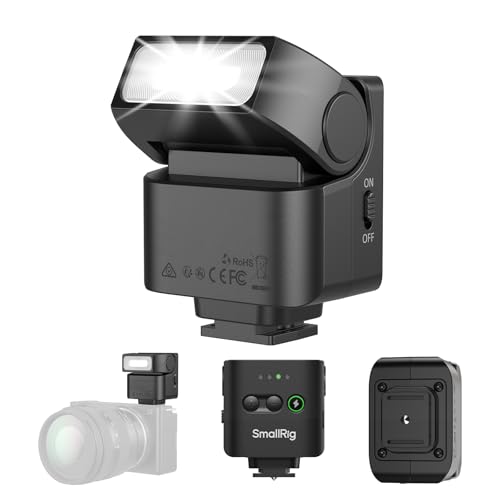
- 85° upward-tilting head
- Four manual power levels
- USB-C rechargeable; no TTL
Best For: Practicing bounce lighting with a compact flash
Best for Quick Recharging

- Four manual power levels
- Rated 60-minute USB-C recharge
- Cable not included; no TTL
Best For: Portable manual flash with quick recharging
Best for Pocket Carry

- 31 g pocket-size build
- Five manual power levels
- Verify hot-shoe compatibility
Best For: Lightweight street and travel shooting
Best for Learning Off-Camera Lighting

- GN33 output with LCD
- S1/S2 optical and 3.5 mm sync
- Four AA batteries required
Best For: Practicing manual and off-camera flash setups
Best for Easy Setup

- GN60 manual flash output
- Built-in Godox 2.4G X wireless system
- HSS requires a separate compatible trigger
Best For: Learning manual, off-camera lighting
Best Compact Bounce Flash
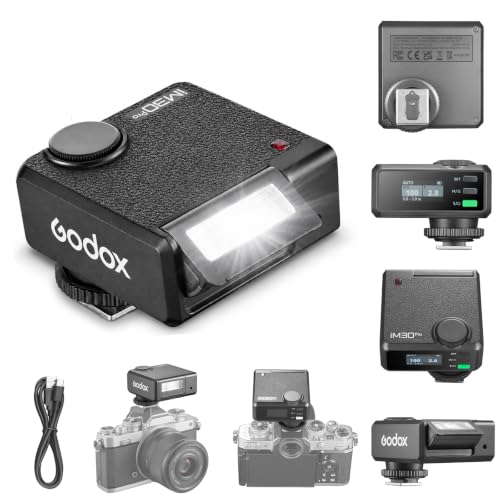
- Tilting head for bounce flash
- Smart AUTO and manual output modes
- USB-C rechargeable; no TTL or HSS
Best For: Portable everyday bounce lighting
Best Lightweight Manual Fill Flash
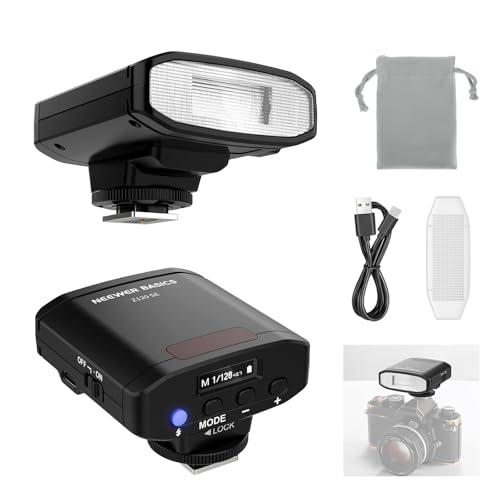
- Compact 4.52-ounce design
- Manual power and optical slave modes
- No TTL or HSS; check center-contact hot shoe
Best For: Lightweight, close-range manual fill
Best Pocket Flash

- Five manual power levels
- USB-C rechargeable
- Up to 440 full-power flashes
Best For: Portable portraits and still life
Best Heavy-Duty Pick

- RT-16 wireless transmitter included
- Tilting, swiveling flash head
- Eight manual power selections
Best For: Learning bounce and off-camera lighting
Best Mini Flash for Bounce Practice

- Flash angle adjusts up to 90°
- Four manual brightness levels
- Constant-light focusing aid
Best For: Practicing indoor bounce flash
Best for Bounce Lighting – SmallRig RS-22 Mini Flash
Among camera flashes for beginners, the SmallRig RS-22 stands out for its tilting head: you can aim it upward to bounce light rather than relying only on direct flash. It is a compact, manual option for compatible cameras with a standard single-contact hot shoe.
Best For: Beginners who want a lightweight flash for practicing bounce lighting.
Pros:
- Head tilts upward 85° for more flexible lighting.
- Four manual power settings make output straightforward to adjust.
- USB-C rechargeable battery is rated for 700–2,000 flashes per charge, depending on power.
Cons:
- No TTL automatic flash exposure.
- Not compatible with several listed camera models; check your hot shoe before buying.
The tilting head makes this a more versatile tiny flash than a fixed-head model, but you will need to set flash power yourself and confirm camera compatibility.
Best for Quick Recharging – ULANZI SL01 Mini Flash
The ULANZI SL01 is one of the smaller camera flashes for beginners who prefer a simple manual light. Its four power settings cover basic adjustments, while the USB-C battery is rated for more than 500 full-power flashes.
Best For: Beginners who want a portable, rechargeable flash for a compatible single-contact hot shoe.
Pros:
- Four power levels, from full power to 1/8.
- Rated to recharge in about 60 minutes and supports use while charging.
- Compact design weighs approximately 0.07 lb.
Cons:
- No TTL or automatic flash exposure.
- Charging cable and charger are not included.
- Several camera models are excluded; verify compatibility first.
This is a practical choice if small size and a short stated recharge time matter more to you than automatic exposure. Be prepared to adjust power manually.
Best for Pocket Carry – Godox iM20 Mini Flash
If portability tops your list of camera flashes for beginners, the Godox iM20 is worth a look. This 31 g mini flash offers five manual power levels and is rated for up to 440 full-power flashes per charge.
Best For: Beginners who want a pocket-size flash for casual street or travel photography.
Pros:
- Weighs just 31 g.
- Five adjustable power levels offer more steps than the four-level mini flashes here.
- USB-C charging and an approximately three-second stated recycle time.
Cons:
- Manual output requires you to set flash power yourself.
- Hot-shoe compatibility needs careful checking; the supplied listing gives conflicting examples for some Sony models.
The iM20 prioritizes easy carry and basic output control. Review the seller’s hot-shoe contact examples against your camera before ordering, especially if its model appears in conflicting compatibility lists.
Best for Learning Off-Camera Lighting – PHOTOOLEX FK310 Speedlite
For shoppers comparing camera flashes for beginners who want room to experiment, the PHOTOOLEX FK310 is a larger GN33 speedlite with an LCD, manual controls, and S1/S2 optical triggering. It also includes a stand and color filters for trying different setups.
Best For: Beginners interested in manual flash techniques and simple off-camera lighting.
Pros:
- LCD shows mode, power level, and battery status.
- S1/S2 optical modes and a 3.5 mm sync port provide off-camera triggering options.
- Includes a stand, pouch, and 12 color filters.
Cons:
- Requires four AA batteries.
- Much larger than the mini flashes in this roundup.
- Supplied notes conflict on the number and range of power settings; confirm these before purchase.
The FK310 offers more ways to learn flash placement and creative effects than a pocket-size unit, but it adds bulk and relies on manual exposure control.
Best for Easy Setup – Godox TT600
Among camera flashes for beginners, the Godox TT600 suits anyone ready to practice manual flash and build a wireless lighting setup. Its GN60 output and built-in Godox 2.4G X system offer more room to experiment than a small on-camera fill flash.
Best For: Beginners who want a powerful manual flash they can later use off-camera with Godox gear.
Pros:
- GN60 output provides substantial lighting power.
- Built-in Godox X wireless system supports remote setups and control of up to five groups.
- Works with many cameras that have a standard hot shoe; runs on four AA batteries.
Cons:
- Manual flash operation requires learning to set output yourself.
- High-speed sync requires a compatible Godox TTL wireless trigger, sold separately; it does not work when the flash is mounted directly on the camera.
Choose the TT600 for lighting flexibility rather than automatic exposure convenience. Check your camera’s hot shoe and budget for a compatible trigger if off-camera control or high-speed sync matters to you.
Best Compact Bounce Flash – Godox iM30Pro
The Godox iM30Pro is a compact choice among camera flashes for beginners who want to try softer bounce lighting without carrying a full-size speedlite. Its tilting head and Smart AUTO mode make it approachable, though AUTO requires you to enter your camera’s ISO and aperture.
Best For: Everyday photographers who want a small flash with bounce capability and a simplified output option.
Pros:
- Head locks at 45°, 60°, 75°, and 90° for direct or ceiling-bounced light.
- Smart AUTO estimates output from the ISO and aperture you set; manual power is also adjustable from 1/1 to 1/128.
- USB-C rechargeable battery is rated for up to 550 full-power flashes.
Cons:
- No TTL or high-speed sync.
- GN15 output offers less reach than a more powerful speedlite; check hot-shoe compatibility before buying.
The iM30Pro is appealing when portability and bounce control matter more than maximum power. Its AUTO mode reduces guesswork, but it is not the same as through-the-lens flash metering.
Best Lightweight Manual Fill Flash – NEEWER Basics Z120 SE
For shoppers comparing camera flashes for beginners, the NEEWER Basics Z120 SE keeps things simple: it is a small, manual flash designed for cameras with a standard center-contact hot shoe. Its diffuser and GN12 output make it better suited to nearby fill light than long-distance illumination.
Best For: Beginners who want a lightweight on-camera fill flash and are comfortable setting flash power manually.
Pros:
- Compact 4.52-ounce design is easy to carry.
- Adjustable power from 1/128 to full, plus S1 and S2 optical slave modes.
- Built-in 2000mAh battery is rated for up to 500 full-power flashes.
Cons:
- No TTL, automatic flash exposure, high-speed sync, or camera-menu control.
- Requires a standard center-contact hot shoe; on applicable mirrorless cameras, use a mechanical rather than electronic shutter.
- For reliable synchronization, set shutter speed to 1/200 second or slower.
The Z120 SE is a practical way to learn basic manual fill lighting without adding much weight. Verify your camera’s hot shoe and shutter settings before ordering, since compatibility is central to getting it to fire.
Best Pocket Flash – Godox iM22 Mini Camera Flash
Among camera flashes for beginners, the Godox iM22 is a compact choice for learning manual flash without carrying a full-size speedlight. Its single-contact hot shoe and five power settings keep the setup straightforward, provided your camera is compatible.
Best For: Beginners who want a pocketable flash for portraits or still life.
Pros:
- Five manual power levels from 1/1 to 1/32.
- USB-C charging, with up to 440 full-power flashes and a stated 3-second recycle time.
- Small, lightweight design that is easy to carry.
Cons:
- Manual exposure control means you must set flash power yourself.
- Requires a compatible hot shoe; excluded models include the Sony ZV-1F and A9 III.
Choose the iM22 for simple, portable fill light rather than extensive lighting controls. Check your camera’s hot shoe before buying.
Best Heavy-Duty Pick – Godox TT520III Speedlight
The Godox TT520III gives shoppers comparing camera flashes for beginners room to practice both on-camera bounce flash and off-camera lighting. It includes an RT-16 transmitter for wireless triggering and has a head that tilts and swivels.
Best For: Beginners ready to learn manual bounce and off-camera flash techniques.
Pros:
- Included RT-16 transmitter supports 16-channel wireless triggering.
- Adjustable head supports vertical and horizontal rotation for bounce lighting.
- Eight manual power selections, from 1/128 to full power.
Cons:
- No TTL automatic exposure or high-speed sync.
- Requires four AA batteries, sold separately.
- Not compatible with several listed camera models, including the Canon R50 and Sony ZV-1F.
This is the more flexible learning tool if you are willing to set exposure manually. Verify hot-shoe compatibility before ordering.
Best Mini Flash for Bounce Practice – ULANZI SL03 Mini Flash
For beginners who want to try softer indoor lighting, the ULANZI SL03 stands out among mini camera flashes for beginners because its flash angle adjusts up to 90 degrees. A white wall or ceiling can help bounce the light, while four brightness levels let you adjust the output manually.
Best For: Beginners practicing indoor bounce flash with a compatible single-contact hot shoe.
Pros:
- Adjustable flash angle allows indoor bounce lighting.
- Four manual brightness settings: 1/1, 1/2, 1/4, and 1/8.
- Offers a constant-light focusing aid in flash mode.
Cons:
- No TTL or automatic flash exposure.
- Requires a compatible single-contact hot shoe; excluded models include the Canon R50 and Sony ZV-1F.
- Bounce lighting depends on a suitable nearby wall or ceiling.
The SL03 offers a compact way to experiment with direct and bounced light. Confirm camera compatibility and expect to adjust flash power yourself.
How We Picked These Camera Flashes for Beginners
We focused on practical starting points: compact flashes that are easy to carry, affordable manual speedlights for learning light control, and models with features such as adjustable power or wireless triggering. We also considered whether each flash offers a clear reason to choose it, rather than treating every mini flash as interchangeable. The listed specifications are useful for narrowing the field, but they cannot confirm how well a flash will work with every camera body.
Quick Comparison: Which Type Fits Your Needs?
Small mini flashes such as the SmallRig RS-22, ULANZI SL01, Godox iM20, and Godox iM22 suit casual fill light and a lightweight kit. The ULANZI SL03 also combines flash and video-light functions. More capable compact options include the Godox iM30Pro, with its listed auto/manual modes, and the rechargeable NEEWER Basics Z120 SE. Full-size speedlights such as the PHOTOOLEX FK310, Godox TT600, and Godox TT520III offer more scope to adjust lighting as your skills grow.
Key Buying Factors for Camera Flashes for Beginners
Camera and Hot-Shoe Compatibility
Start with your exact camera model, not just its brand. A flash may fit a standard hot shoe yet lack the contacts or communication needed for automatic exposure, high-speed sync, or camera-menu control. Check the maker’s compatibility list and your camera’s hot-shoe type before ordering.
Manual or Automatic Exposure
Manual power is valuable for learning: you choose the flash output and get repeatable results when the subject distance stays similar. An automatic mode can be quicker when people move or you shoot changing scenes. Do not assume “auto” means your camera supports TTL; confirm the specific exposure method offered.
Power, Recycle Time, and Light Direction
A guide number can help compare flashes, but only when the rating uses comparable ISO and zoom settings. A small direct flash is convenient for nearby subjects; a larger speedlight generally gives you more flexibility for bouncing light, if its head tilts or swivels. Check recycle time and battery type if you expect to shoot several frames in succession.
Wireless Plans
Off-camera flash can produce more flattering portraits than direct on-camera light. If that is your goal, verify which transmitter, receiver, and radio system a flash requires. “Wireless” does not mean every brand’s trigger will work with it.
Who Should Buy Which Camera Flashes for Beginners?
For a pocketable first flash: look at the SmallRig RS-22, ULANZI SL01, Godox iM20, or iM22, then choose by controls, power source, and confirmed fit. For a compact flash with more shooting flexibility: compare the Godox iM30Pro and NEEWER Z120 SE; consider the SL03 if a video-light function matters. For learning manual flash or building an off-camera setup: compare the PHOTOOLEX FK310, Godox TT600, and TT520III, paying particular attention to head movement and trigger compatibility. Buy for the lighting you will actually use now, with enough room for the next skill you want to learn.