
Small studios need lighting that is controllable, space-efficient, and dependable without requiring a full professional setup. The right flash can improve exposure consistency, freeze motion, and give portraits or product photos a more polished look.
This roundup covers compact speedlights, manual flashes, TTL-compatible options, and studio strobes so you can match power, triggering, and portability to your workspace.
Best 10 Camera Flashes for Small Studios Picks for 2026
Best Compact Studio Strobe
Godox MS300V 300W Studio Strobe

- 300W output with GN58 guide number
- Bowens mount for versatile modifiers
- 0.1–1.8-second recycle time
Best For: Small studio portraits and product photography
Best Wireless Hot-Shoe Flash

- Detachable 2.4GHz wireless transmitter
- Controls up to eight flashes
- Includes filter holder and gels
Best For: Portable off-camera and tabletop lighting
Best Wireless Monolight Value

- 300Ws output with 50-step adjustment
- Built-in 2.4G wireless control
- Adjustable LED modeling lamp
Best For: Controlled portrait and commercial studio setups
Best Value Manual Flash

- GN33 output with eight power levels
- Manual, S1, and S2 optical modes
- Includes stand, filters, pouch, and 24-month warranty
Best For: Small studios building a flexible manual lighting setup
Best Portable Strobe

- 120Ws output with TTL and 1/8000s HSS
- 3000mAh battery supports up to 420 flashes
- 2.4GHz wireless and app control for multiple flashes
Best For: Portable studio and outdoor portrait lighting
Best Compact Fill Flash
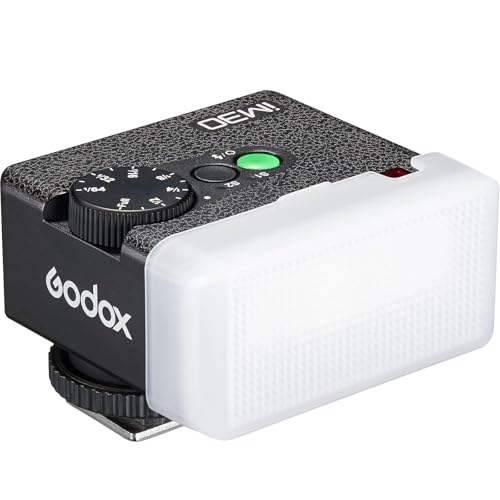
- 78g design with GN15 output
- Seven manual power levels plus S1/S2 modes
- Includes diffuser cover and storage bag
Best For: Portable fill lighting and tabletop studio work
High-Output Pick

- 76Ws output, TTL, and 1/8000s HSS
- Up to 600 flashes with 1.5s recycle
- Wireless groups plus dual LED modeling lights
Best For: Nikon portrait and small-studio setups needing high output and wireless control
Budget Compact Pick

- Eight manual levels from 1/1 to 1/128
- Tiny 1.3-ounce design with 500–700 flashes
- 5600K fill light for basic studio and creator work
Best For: Beginners needing a lightweight, simple manual fill flash
Manual Studio Value
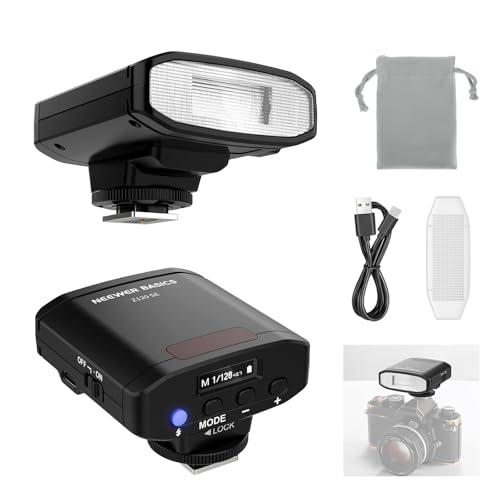
- GN12 output with manual, S1, and S2 modes
- 2000mAh battery and up to 500 full-power flashes
- Compact body with built-in diffuser
Best For: Manual portrait, product, and creator setups using standard hot shoes
Best Compact Studio Strobe – Godox MS300V 300W Studio Strobe
For camera flashes for small studios, the Godox MS300V offers substantial 300W output in a compact body. Its fast 0.1–1.8-second recycle time, Bowens mount, adjustable LED modeling lamp, and wireless control make it a practical choice for portrait and product setups.
Best For: Small studio portrait photographers who want powerful, modifier-friendly lighting with remote adjustment.
Pros:
- 300W output with GN58 guide number and fast recycling.
- Bowens mount supports a broad range of light modifiers.
- Built-in 2.4G wireless compatibility and anti-preflash function.
- Compact 28.3cm length with a lightweight 1.3kg net weight.
Cons:
- No HSS function.
- Wireless trigger and some accessories may need to be purchased separately.
The MS300V is a strong all-around pick when consistent output and modifier compatibility matter more than portability for on-camera use. Remove the lamp cover before operation, as specified by the manufacturer.
Best Wireless Hot-Shoe Flash – FlashQ Q20II Black
The FlashQ Q20II is a compact option for camera flashes for small studios where flexible placement and simple manual control are priorities. Its detachable 2.4GHz transmitter, wireless power adjustment, and built-in gels make it useful for tabletop, portrait, and creative off-camera lighting.
Best For: Small studio users who need a portable hot-shoe flash that can be positioned away from the camera.
Pros:
- Detachable 2.4GHz transmitter supports wireless triggering and power adjustment.
- Can control up to eight flashes simultaneously.
- Manual output ranges from 1/64 to 1/1, with seven LED video-light levels.
- Includes a filter holder and color gels.
Cons:
- Guide number is lower than that of the listed studio strobes.
- Uses two AA batteries.
- Does not provide the large modifier compatibility of a Bowens-mount monolight.
Choose the Q20II when portability and wireless positioning are more important than maximum power. Its tilt capability, tripod mount, and included gels add useful flexibility for compact setups.
Best Budget Manual Speedlite – NEEWER TT560 Camera Flash
The NEEWER TT560 is a straightforward, budget-friendly choice among camera flashes for small studios. It uses manual output control, offers eight power levels, and supports S1/S2 optical slave modes and PC sync for basic off-camera lighting.
Best For: Beginners and budget-conscious photographers who are comfortable setting flash power manually.
Pros:
- Eight manual power levels from 1/128 to 1/1.
- Tilts 0°–90° and rotates 0°–270° for bounce and directional lighting.
- Supports S1/S2 optical slave modes and PC sync.
- Includes low-battery indication, power saving, and overheating protection.
Cons:
- No TTL, HSS, automatic flash exposure, or camera-menu control.
- Requires four AA batteries, which are not included.
- Some listed cameras are incompatible; a standard center-contact hot shoe is required.
The TT560 can serve well in a simple manual-lighting workflow, but compatibility and mechanical-shutter requirements should be checked before purchase. It is best suited to controlled setups rather than fast-changing shooting conditions.
Best Wireless Monolight Value – Godox MS300V Bowens Mount
For camera flashes for small studios, this Godox MS300V monolight combines 300Ws output with precise manual adjustment and a built-in 2.4G wireless system. Its adjustable LED modeling lamp and Bowens mount make it suitable for repeatable portrait, commerce, and product-lighting arrangements.
Best For: Small studios that want a controllable monolight for planned portrait or commercial lighting setups.
Pros:
- Power adjusts from 1/32 to 1/1 across 50 steps.
- Built-in 2.4G wireless system supports 16 groups and 32 channels.
- LED modeling lamp brightness adjusts from 5% to 100%.
- Stable output is specified at no more than 2% tolerance during extended use.
Cons:
- Reflector is not included.
- Wireless trigger is sold separately.
- It is a studio monolight rather than a compact on-camera flash.
This version is a practical choice for photographers who value repeatable power and remote adjustment. Budget separately for a reflector and compatible trigger if those accessories are not already part of the studio kit.
Best Value Manual Flash – PHOTOOLEX FK300 Speedlite
For camera flashes for small studios, the PHOTOOLEX FK300 offers a straightforward, affordable setup with GN33 output, manual control, and optical slave modes. Its universal single-contact hot shoe and included stand make it practical for portraits, product photography, and basic off-camera lighting.
Best For: Small studios needing a versatile manual flash with strong output and useful accessories.
Pros:
- GN33 output provides useful reach for indoor portraits, events, and studio work.
- Manual, S1, and S2 modes support on-camera and optical off-camera setups.
- Eight power levels from 1/128 to 1/1 allow flexible exposure adjustment.
- Includes a stand, protective pouch, 12 color filters, and a 24-month warranty.
Cons:
- Manual exposure control does not provide TTL automation.
- Wireless triggering uses optical pulse rather than a dedicated radio system.
- It is not water resistant.
The FK300 is a sensible choice when dependable manual control and broad camera compatibility matter more than advanced automation. Its included accessories also help a small studio get started without assembling a separate kit.
Best Portable Strobe – NEEWER Q120 120Ws Flash
The NEEWER Q120 is a powerful option among camera flashes for small studios, combining 120Ws output with TTL, HSS, battery power, and app control. Its compact monolight-style design suits photographers who need studio-like output indoors or portable performance for outdoor portraits and commercial shoots.
Best For: Small studios and mobile photographers who need high output, TTL, HSS, and wireless control.
Pros:
- 120Ws output and a 28–105mm zoom head provide substantial coverage.
- TTL, manual, MULTI, and up to 1/8000s HSS support varied shooting styles.
- 3000mAh battery delivers up to 420 full-power flashes with a 1.5-second recycle time.
- Built-in 2.4GHz wireless control and app support enable multi-flash adjustments.
Cons:
- Full Q System and Godox X System compatibility cannot be used simultaneously.
- Firmware updates may be needed for full compatibility with supported triggers.
- At 1.8 pounds, it is less lightweight than a basic speedlite.
The Q120 stands out when a small studio needs more power and automation than a conventional hot-shoe flash. Its integrated battery and wireless features make it particularly useful for moving between studio and outdoor sessions.
Best Compact Fill Flash – Godox iM30 Mini Flash
For small studios that need a simple secondary light, the Godox iM30 is one of the most compact camera flashes for small studios. Weighing 78g, it provides GN15 output, seven manual power levels, and S1/S2 optical slave modes for basic fill, tabletop, and lightweight multi-light setups.
Best For: Compact cameras, tabletop photography, and studio users who need an inexpensive fill light.
Pros:
- Extremely compact 78g design is easy to carry and position.
- Seven power levels from 1/64 to 1/1 provide basic exposure control.
- S1 and S2 optical slave modes support simple off-camera lighting.
- Diffuser cover helps soften harsh shadows and protects the flash head.
Cons:
- GN15 output is better suited to fill light than large-space illumination.
- Requires two AAA batteries, which are not included.
- Single-contact hot-shoe compatibility should be verified before purchase, and some lenses may cause shadows.
The iM30 is a practical choice when portability and simplicity outweigh power. It works well as a small fill or accent light, but photographers needing broad coverage or advanced camera communication should consider a more capable flash.
High-Output Pick – NEEWER Z2PRO-N 76Ws TTL Flash
For photographers comparing camera flashes for small studios, the NEEWER Z2PRO-N stands out when you need substantial output, TTL automation, and wireless control. Its 76Ws power, 1/8000s HSS, rechargeable battery, and modeling lights make it well suited to portrait and product setups that demand flexibility.
Best For: Nikon photographers building a small studio around TTL, wireless multi-light control, and high-output portrait or still-life work.
Pros:
- Powerful 76Ws output with TTL, HSS up to 1/8000s, and manual adjustment from 1/1 to 1/256.
- Supports four wireless groups, 32 channels, and 99 IDs with compatible transmitters.
- Battery provides up to 600 full-power flashes with a 1.5-second recycle time.
- Dual LED modeling lights help preview light and shadow placement.
Cons:
- Q and X wireless systems cannot be used simultaneously.
- QPRO-N transmitters and a 5V/3A charger are not included.
- Compatibility and accurate TTL operation may require a firmware update; it is not compatible with the Nikon D810.
This is the most capable option here for a small studio that expects to grow into wireless multi-light work. Its Nikon-specific compatibility and accessory requirements should be checked before ordering.
Budget Compact Pick – NEEWER N12 Mini Camera Flash
If you need straightforward camera flashes for small studios, the NEEWER N12 keeps the setup simple and portable. It offers manual power control, a 5600K daylight balance, and a palm-sized design for basic portraits, product photos, and fill-light duties.
Best For: Beginners, creators, and small-studio users who want an inexpensive manual fill flash with minimal bulk.
Pros:
- Eight manual power levels from 1/1 to 1/128 provide useful output control.
- Compact 1.3-ounce design adds very little weight to the camera.
- Built-in rechargeable battery supports approximately 500 to 700 flashes.
- 5600K color temperature provides consistent daylight-balanced fill light.
Cons:
- No TTL or camera-menu control.
- Guide number 12 is better suited to fill light and close-range work than high-output studio lighting.
- Not compatible with several Canon entry-level models, including the SL3, T7, T100, and 4000D.
The N12 is a practical entry point when portability and price matter more than power or automation. Confirm your camera’s hot-shoe compatibility before buying, especially with the listed Canon exclusions.
Manual Studio Value – NEEWER Z120 SE Mini Speedlite
The NEEWER Z120 SE is a compact choice for camera flashes for small studios when manual control is sufficient. Its GN12 output, built-in 2000mAh battery, optical slave modes, and diffuser make it useful for simple portrait, product, and creator lighting setups.
Best For: Shooters with a standard center-contact hot shoe who want an affordable manual flash with optical slave triggering.
Pros:
- Manual output adjusts from 1/1 to 1/128, with S1 and S2 optical slave modes.
- Built-in 2000mAh battery supports up to 500 full-power flashes.
- 0.1- to 1.8-second recycle time supports repeated shooting.
- Compact 4.52-ounce body includes a translucent diffuser for softer fill light.
Cons:
- No TTL, HSS, automatic exposure, or camera-menu control.
- Fujifilm and other mirrorless cameras must use mechanical shutter mode.
- For reliable synchronization, shutter speed should be 1/200s or slower.
The Z120 SE offers more triggering flexibility than a basic single-contact flash while remaining small and affordable. It is a good fit for controlled manual setups, but users wanting TTL or high-speed sync should choose a more advanced model.
How We Picked the Best Camera Flashes for Small Studios
We compared these Camera Flashes for Small Studios by looking at power output, control options, triggering systems, recycling behavior, compatibility, size, and overall usefulness in a compact shooting space. The selection includes both on-camera flashes and monolights because small studios often benefit from a hybrid lighting kit.
We also considered whether each model is better suited to portraits, tabletop work, product photography, occasional fill light, or mobile shooting. Manual units can be excellent value for controlled setups, while TTL and radio-compatible flashes are more convenient when subject distance or lighting conditions change frequently.
Quick Comparison
| Type | Best For | Main Advantage |
|---|---|---|
| Compact studio strobe | Portraits and products | Higher output and consistent recycling |
| Manual speedlight | Budget lighting and simple setups | Low cost and straightforward controls |
| TTL speedlight | Changing subjects or locations | Automatic exposure support |
| Mini flash | Travel and fill light | Small size and low weight |
| Battery-powered strobe | Portable studio work | More power without relying on AC power |
Key Buying Factors for Camera Flashes for Small Studios
Power and Light-Shaping Compatibility
Choose enough output for your shooting distance and modifiers. A compact speedlight may handle headshots and tabletop scenes, while a 120Ws or 300Ws strobe gives more flexibility with softboxes, umbrellas, lower ISO settings, and smaller apertures. A Bowens mount is particularly useful because it supports a wide range of affordable modifiers.
Manual, TTL, and Triggering
Manual flash is predictable and often the best choice for a fixed studio arrangement. TTL is more convenient for moving subjects or mixed indoor and outdoor work. Check whether the flash supports your camera system, optical triggering, radio control, or a specific transmitter ecosystem before buying.
Recycle Time, Power Source, and Heat
Fast recycling matters when photographing people or products in batches. Battery-powered models are easier to reposition, while AC-powered strobes can be practical for a permanent studio. Also consider battery capacity, spare-battery cost, and ventilation if you expect long sessions at higher power.
Size and Studio Workflow
A smaller flash is easier to place in a tight room, but very compact models may offer less power and fewer modifier options. Confirm the mounting method, stand compatibility, hot-shoe fit, and whether the controls are easy to reach when the light is mounted.
Who Should Buy Which Camera Flashes for Small Studios?
Choose a compact studio strobe if you primarily photograph portraits, products, food, or crafts in one location and want more consistent power than a shoe-mounted flash can provide.
Choose a manual speedlight if you are building an inexpensive first lighting kit, using fixed flash positions, or learning off-camera lighting. These models work well when you are comfortable adjusting power manually.
Choose a TTL or radio-compatible flash if you regularly change camera position, photograph active subjects, or want a faster setup with fewer test shots.
Choose a mini flash if portability is more important than maximum output. These are useful for fill light, small product scenes, travel, and cameras with limited hot-shoe space.