
Choosing the right flash can make product photos look cleaner, sharper, and more consistent. The best option depends on your camera system, workspace, subject size, and whether you need portable TTL control or dependable studio power.
This roundup compares 10 flashes and strobes suited to product photography, including affordable manual units, wireless speedlights, and complete monolight kits.
Best 10 Camera Flashes for Product Photography Picks for 2026
Best Nikon TTL Speedlight

- Nikon i-TTL with manual and multi-flash modes
- 2.4G wireless range up to 100 meters
- HSS to 1/8000s with 20-200mm zoom
Best For: Nikon users building flexible on- or off-camera lighting
Best Portable Studio Strobe

- 300Ws battery-powered outdoor strobe
- Up to 1,000 full-power flashes
- Bowens mount for common modifiers
Best For: Mobile product shoots using manual exposure
Best Canon Round-Head Flash

- Canon TTL with HSS up to 1/8000s
- Detachable SU-1 fill-light component
- Rechargeable 2980mAh battery and 76Ws output
Best For: Canon users needing flexible TTL bounce lighting
Best Compact Studio Strobe

- 300W manual studio output
- 150W adjustable LED modeling lamp
- Bowens mount and wireless remote control
Best For: Controlled studio product setups with manual lighting
Best Complete Studio Setup

- Two 180W monolights with 5600K strobe output
- Includes softboxes, stands, cables, and trigger set
- Wireless synchronization rated up to 30 meters
Best For: Indoor product studios and small-business setups
Best Compact Universal Option

- GN33 output with eight manual power levels
- Manual, S1, and S2 optical trigger modes
- Includes stand, pouch, and 12 color filters
Best For: Simple manual tabletop and off-camera lighting
Best TTL Upgrade
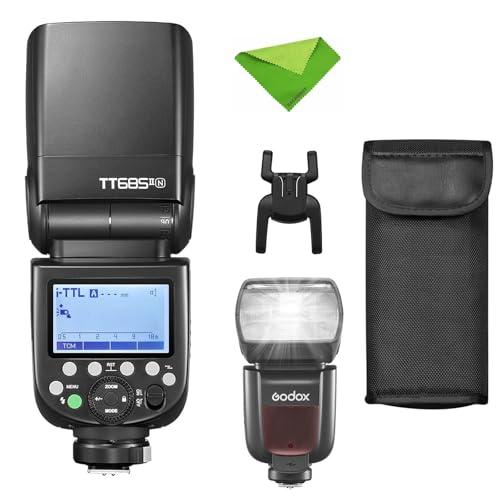
- Nikon i-TTL with TTL-to-manual TCM conversion
- 2.4G wireless X system for compatible triggers
- 20-200mm zoom and 1/8000-second HSS
Best For: Nikon photographers building versatile TTL product-lighting setups
Best Wireless Value

- GN60 output with manual power control
- 2.4G wireless transmission up to 100 meters
- Works with several standard hot-shoe camera brands
Best For: Manual off-camera product lighting on a budget
Best Nikon TTL Speedlight – Godox TT685II-N
For photographers comparing camera flashes for product photography, the Godox TT685II-N is a flexible Nikon-compatible speedlight with TTL automation, manual control, and wireless triggering. Its broad zoom range and adjustable head make it useful when you need to shape light around products without building a full studio setup.
Best For: Nikon users who want a versatile on-camera or off-camera flash for changing setups.
Pros:
- Nikon i-TTL support helps automate exposure in changing light.
- Built-in 2.4G wireless transmission and reception support setups up to 100 meters.
- Tilts from -7° to 120° and rotates 330° for bounce lighting.
- HSS up to 1/8000s, 22 manual power levels, and a 20-200mm zoom range.
Cons:
- Requires four AA batteries; an external power pack is sold separately.
- Designed for Nikon cameras, so compatibility should be confirmed before purchase.
The TT685II-N is a strong all-purpose choice when you need TTL convenience now but want manual and wireless control as your product-lighting skills develop.
Best Portable Studio Strobe – NEEWER Q300 300Ws
The NEEWER Q300 is a battery-powered 300Ws option for photographers seeking camera flashes for product photography outside a traditional studio. It uses manual controls rather than TTL or HSS, but its Bowens mount, modeling lamp, and long battery capacity suit deliberate product-lighting arrangements.
Best For: Outdoor and mobile product shoots where high output and battery operation matter more than TTL automation.
Pros:
- 300Ws output with 1/64 to 1/1 power adjustment and stable 5600K color.
- 7800mAh battery provides up to 1,000 full-power flashes.
- Standard Bowens mount accepts softboxes, umbrellas, and reflectors.
- Supports manual, multi, S1, S2, and quick modes, including adjustable flash duration.
Cons:
- Does not support TTL or HSS; sync speed is no more than 1/200s with the Q Compact trigger.
- The compatible QPRO transmitter is not included.
- Some Canon EOS models are specifically excluded from compatibility.
Choose the Q300 when you want the control and modifier compatibility of a studio strobe in a portable form, provided manual exposure and standard sync speeds fit your workflow.
Best Canon Round-Head Flash – Godox V1 Pro C
The Godox V1 Pro C combines Canon TTL compatibility with a round flash head designed for soft, even illumination. Among camera flashes for product photography, it stands out for its detachable SU-1 fill light, built-in 2.4GHz wireless system, and rechargeable battery designed for repeated shooting.
Best For: Canon photographers who want a cordless TTL flash with bounce and fill-light flexibility.
Pros:
- Canon TTL support simplifies exposure in changing conditions.
- Detachable SU-1 fill light lets the unit function as bounce flash and fill light.
- Supports up to 100 consecutive full-power flashes.
- Offers 76Ws output, 1/1 to 1/256 manual adjustment, and HSS up to 1/8000s.
Cons:
- It is designed for Canon cameras, so other camera systems require a different version.
- The unit is not water resistant.
- Its 1/250s listed sync speed is lower than its maximum HSS speed.
The V1 Pro C is a capable Canon-oriented choice for compact setups where TTL, repeatability, and a separate fill-light option are more useful than studio-strobe output.
Best Compact Studio Strobe – Godox MS300V 300W
The Godox MS300V is a compact 300W manual strobe for controlled product setups. For camera flashes for product photography, it offers consistent output, a bright adjustable LED modeling lamp, wireless remote control, and a Bowens mount for building a modifier-based lighting arrangement.
Best For: Studio product photographers who prefer manual control and Bowens-mount accessories.
Pros:
- 300W output with GN58 and a 0.1-1.8-second recycle time.
- 150W LED modeling lamp adjusts from 5% to 100%.
- Wireless control supports output, modeling light, and buzzer adjustments.
- Standard Bowens mount works with a wide range of modifiers.
Cons:
- Does not have HSS and uses a maximum sync speed of 1/200 or 1/250s.
- Manual exposure control may be less convenient than TTL for rapidly changing setups.
- The lamp cover should be removed before use.
The MS300V makes the most sense as a dependable budget-conscious studio light for repeatable product scenes, especially when you already use Bowens-compatible modifiers.
Best Manual Value – NEEWER TT560 Speedlite
The NEEWER TT560 is a practical manual option among camera flashes for product photography, especially when you want repeatable output and off-camera flexibility without TTL complexity. Its eight power levels, bounce/swivel head, and S1/S2 optical slave modes support controlled tabletop lighting, but you must adjust exposure and flash power yourself.
Best For: Budget-conscious photographers using a compatible camera with a standard center-contact hot shoe and mechanical shutter.
Pros:
- Eight manual power settings from 1/128 to 1/1 for controlled exposure.
- Tilts 0°–90° and rotates 0°–270° for bounce and directional lighting.
- S1/S2 optical slave modes and PC sync support off-camera setups.
- GN38 output and AA battery power make it suitable for portable shoots.
Cons:
- No TTL, HSS, automatic exposure, or camera-menu control.
- Requires four AA batteries, which are not included.
- Fujifilm and other mirrorless cameras must use mechanical shutter mode.
The TT560 is a straightforward choice if you are comfortable metering or adjusting exposure manually. Confirm your camera’s hot-shoe compatibility and observe the recommended 1/200-second-or-slower sync speed before ordering.
Best Complete Studio Setup – Godox K180A Two-Light Kit
The Godox K180A is a full studio solution for camera flashes for product photography, combining two 180W monolights with softboxes, stands, and a wireless trigger system. Its adjustable output and included diffusion accessories are useful for creating softer, more even illumination across products.
Best For: Beginners, small businesses, and indoor product photographers who need a ready-to-use two-light studio setup.
Pros:
- Includes two 180W monolights, two softboxes, two stands, cables, and trigger components.
- Adjustable 5600K strobe output from 1/8 power to full power.
- Softboxes help diffuse light and reduce harsh shadows on products.
- Wireless control is specified for distances up to 30 meters.
Cons:
- This is a mains-powered studio kit rather than a compact, battery-powered flash.
- Manual operation and a maximum sync speed of 1/200 second limit automation.
- The setup is less portable than a standalone speedlite.
For a fixed shooting area, the K180A offers more complete coverage than a single hot-shoe flash because it provides two lights and modifiers in one package. Its studio-oriented design makes it especially practical for repeatable catalog and still-life work.
Best Compact Universal Option – PHOTOOLEX FK300 Flash
The PHOTOOLEX FK300 is a compact manual speedlite for camera flashes for product photography, offering GN33 output, eight power levels, and S1/S2 optical triggering. Its universal single-contact hot shoe and included stand make it a flexible starting point for simple tabletop or off-camera lighting arrangements.
Best For: Photographers who want an affordable, broadly compatible manual flash with basic creative accessories.
Pros:
- GN33 output provides useful reach for indoor and tabletop work.
- Eight power levels from 1/128 to 1/1 support fine manual adjustments.
- Manual, S1, and S2 modes enable direct or optical off-camera use.
- Includes a protective pouch, flash stand, and 12 color filters.
Cons:
- No TTL or automatic exposure control is listed.
- The package is the FK300 without a dedicated radio trigger.
- It is not water resistant.
The FK300 is a sensible choice when you need a simple hot-shoe flash that can also respond to another flash optically. Its broad listed camera compatibility and included accessories add value, provided you are comfortable setting exposure manually.
Best TTL Upgrade – Godox TT685II-N Nikon Flash
For Nikon users comparing camera flashes for product photography, the Godox TT685II-N offers TTL automation, manual control, and flexible wireless operation. Its 20-200mm zoom range and up to 1/8000-second high-speed sync make it adaptable for tabletop setups, creative angles, and lenses with different focal lengths.
Best For: Nikon photographers who want a versatile on-camera or wireless flash with TTL support and broad lens coverage.
Pros:
- Built-in Godox 2.4G wireless X system supports compatible flashes and triggers.
- TCM converts TTL exposure to manual mode quickly and helps retain the selected exposure value.
- 20-200mm automatic or manual zoom accommodates a wide range of lenses.
- Supports high-speed sync up to 1/8000 second.
Cons:
- Designed specifically for Nikon i-TTL cameras rather than universal camera compatibility.
- At approximately 0.5 kg, it is less compact than simpler speedlights.
The TT685II-N is a strong choice when product work calls for repeatable exposure and off-camera expansion. Its Nikon-specific TTL compatibility and wireless ecosystem make it more suitable for planned lighting setups than basic manual flash use.
Best Wireless Value – Godox TT600 Manual Flash
The Godox TT600 is a practical option among camera flashes for product photography when you prefer manual lighting control and broad camera compatibility. It combines a GN60 output, 2.4G wireless transmission, and support for up to five groups and 32 channels for flexible multi-light arrangements.
Best For: Photographers who need an affordable manual speedlight for off-camera product setups across multiple camera brands.
Pros:
- Compatible with standard hot shoes on Canon, Nikon, Pentax, Olympus, Fujifilm, and Panasonic cameras.
- GN60 output provides strong illumination for larger subjects or bounced lighting.
- Built-in 2.4G wireless system offers transmission distances up to 100 meters.
- Provides approximately 230 full-power flashes with 0.1-2.6-second recycling time.
Cons:
- Cannot provide HSS when mounted directly on the camera hot shoe.
- TTL wireless trigger is sold separately for remote control and HSS functions.
- Requires four AA batteries, which are not included.
Choose the TT600 if you are comfortable setting flash power manually and want plenty of output for bounce or off-camera lighting. It is less convenient for automatic exposure, but its wireless range and multi-group control offer room to grow.
Best Simple Starter Kit – Godox TT520III Bounce Flash
The Godox TT520III is a straightforward choice among camera flashes for product photography, especially for beginners who want a compact manual kit. It includes a diffuser, mini stand, storage bag, and transmitter, while its bounce head, optical slave modes, and adjustable output support basic tabletop lighting.
Best For: Beginners and budget-conscious photographers using standard hot-shoe cameras who want a simple manual flash kit.
Pros:
- Broad compatibility with Canon, Nikon, Sony, Fujifilm, Olympus, Panasonic, Pentax, Leica, and Ricoh standard hot shoes.
- GN33 output with eight power levels from 1/128 to full power.
- 330-degree horizontal and 120-degree angle adjustment supports bounce lighting.
- Includes a diffuser, mini stand, RT transmitter, and storage bag.
Cons:
- Manual-only operation does not provide TTL exposure automation.
- Lower GN33 output is less powerful than the TT600 or TT685II-N.
- Its listed sync speed is 1/250 second, limiting high-speed shooting.
The TT520III makes sense for controlled product scenes where you can adjust the flash position and power between shots. Its included accessories reduce the need for immediate add-ons, though more demanding setups may benefit from a stronger flash with TTL or HSS.
How We Picked the Best Camera Flashes for Product Photography
We focused on flash systems that can produce controlled, repeatable lighting for ecommerce images, catalogs, social media, and small studio work. Selection factors included power output, wireless triggering, TTL or manual control, high-speed sync, compatibility, recycle performance, mounting flexibility, and overall value.
Because product photographers work in very different environments, this list includes both hot-shoe speedlights and studio strobes. A speedlight is easier to transport and can work in a small tabletop setup, while a monolight generally offers more power, faster recycling, and better compatibility with large modifiers.
Quick Comparison
| Type | Best For | Main Advantage | Potential Limitation |
|---|---|---|---|
| TTL speedlight | Portable product setups | Automatic exposure and wireless flexibility | Less power than most studio strobes |
| Manual speedlight | Budget-conscious tabletop work | Low cost and simple operation | Requires manual exposure adjustments |
| Studio monolight | Dedicated studios and larger products | Higher output and consistent results | Less portable; usually needs stands and modifiers |
| Two-light kit | Complete product lighting | Includes multiple lights and accessories | More storage space and setup time |
Key Buying Factors for Camera Flashes for Product Photography
Power and Light Control
Look for enough output to shoot at useful apertures while lighting through umbrellas, softboxes, or diffusion panels. Studio strobes rated around 300Ws are better suited to larger products or light-loss-heavy modifiers, while speedlights work well for small tabletop scenes.
Manual, TTL, and Wireless Control
Manual power is often preferable for product photography because consistent output makes a series of images easier to match. TTL is valuable when subjects or camera positions change quickly. Built-in 2.4GHz radio systems can simplify off-camera operation, but confirm that the trigger supports your camera brand.
Camera Compatibility
Check the exact Canon, Nikon, Sony, Fujifilm, or universal version before buying. TTL and high-speed sync functions are typically brand-specific, whereas basic manual firing may work across more cameras. Also verify hot-shoe design, especially with newer mirrorless bodies.
Modifiers and Mounting
Product photography benefits from soft, directional light. Bowens-style mounts offer access to a broad range of softboxes, reflectors, grids, and beauty dishes. A tilting or swiveling head is useful when bouncing light, but off-camera mounting usually provides better control.
Who Should Buy Which Camera Flashes for Product Photography?
- Choose a TTL speedlight if you need portability, camera-specific automation, or a flexible off-camera setup.
- Choose a manual speedlight if you are building a low-cost tabletop system and can set exposure consistently.
- Choose a 300Ws studio strobe if you photograph larger products, use substantial modifiers, or want faster recycling and stronger output.
- Choose a two-light kit if you are starting from scratch and need a coordinated setup for key, fill, rim, or background lighting.
For most controlled product work, prioritize reliable manual power, wireless triggering, modifier compatibility, and repeatable color over maximum automation. A modest flash used with good diffusion and careful positioning can outperform a more powerful unit used without light control.