
Great food photography depends on controlled, flattering light—not simply the brightest flash. The right setup can reveal texture, reduce harsh shadows, and keep colors consistent from one dish to the next.
This roundup compares 10 lighting options for food photographers, including speedlights, macro ring flashes, rechargeable LED panels, and softbox kits. Use the buying guide below to match the light source to your camera, workspace, and shooting style.
Best 10 Camera Flashes for Food Photography Picks for 2026
Macro Detail Specialist

- Soft, shadowless ring illumination
- Eight lens adapter rings included
- 11 manual brightness levels
Best For: Close-up food and macro photography
Pocket Fill Light

- 5500K daylight-balanced output
- CRI 95+ color rendering
- Rechargeable and pocket-sized
Best For: Portable food photos and video
Tabletop Studio Pair

- Two daylight-balanced LED panels
- 90+ CRI for natural color
- Mini tripods and color filters included
Best For: Indoor tabletop food photography
Best Compact Pick
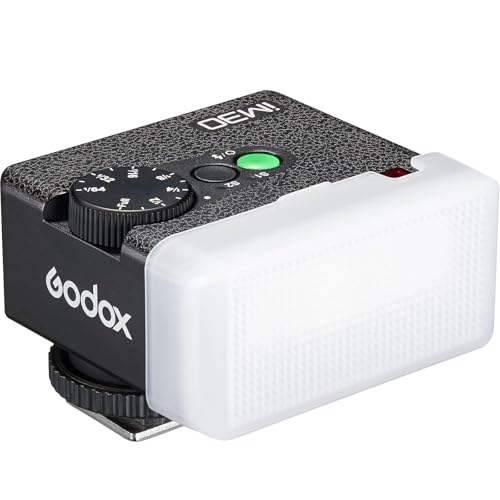
- 78g pocket-sized design
- Seven manual power levels
- Diffuser included
Best For: Portable tabletop food photography with compatible cameras
Best High-Output Manual Flash

- GN33 high-output flash
- Eight manual power levels
- S1/S2 optical modes
Best For: Off-camera food lighting and larger tabletop setups
Best Continuous Light
ULANZI VL-81 Bi-Color LED Light
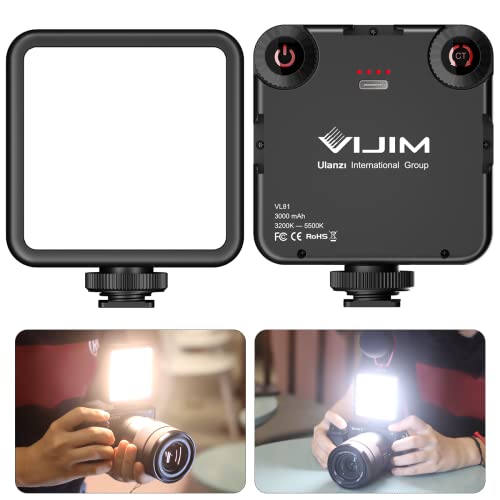
- 3200K–5600K adjustable color temperature
- CRI95 output with included softbox
- Rechargeable 3000mAh battery
Best For: Portable tabletop food photography and video lighting
Best Compact Manual Flash
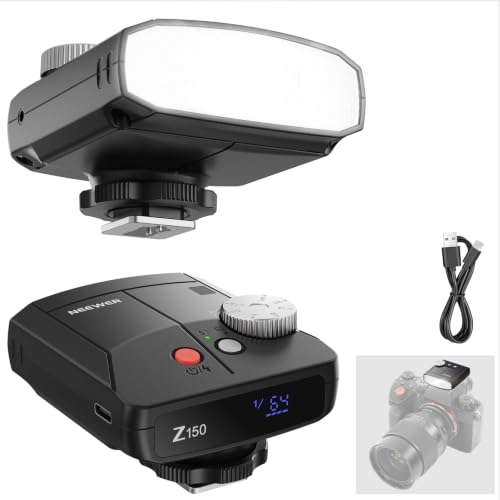
- 20Ws output with GN15
- Manual power from 1/64 to 1/1
- Lightweight 3.6-ounce retro design
Best For: Manual fill light on compatible cameras
Macro Detail Specialist – Godox ML150 II Ring Flash
For close-up food work, the Godox ML150 II is one of the more specialized camera flashes for food photography. Its lens-surrounding ring design provides soft, shadowless illumination, while 11 brightness levels help you fine-tune exposure and contrast on small dishes, ingredients, and plating details.
Best For: Macro-style food photography where even, controlled lighting around the lens is more important than long-distance flash power.
Pros:
- Ring illumination helps reduce harsh shadows and provides controlled contrast.
- Includes eight adapter rings for 49mm through 77mm lens diameters.
- Offers 11 brightness levels for manual lighting adjustments.
- Works for food, flowers, insects, portraits, and dental photography.
Cons:
- Its GN12 output is more suited to close subjects than larger scenes.
- Uses four AA batteries and connects to the camera by wire.
- Manual exposure control may require more setup than an automatic flash.
The ML150 II is a practical choice when your food images depend on consistent, near-lens lighting. The included rings improve compatibility, but confirm your lens diameter and remember that this macro-focused design is not intended to replace a powerful bounce speedlight.
Pocket Fill Light – Ulanzi VL49 LED
The Ulanzi VL49 is a compact continuous-light alternative among camera flashes for food photography. Its 5500K daylight balance, CRI 95+ rating, and five brightness settings make it useful for adding adjustable fill to tabletop scenes, product shots, and short food videos without carrying a full-size flash.
Best For: Portable tabletop photography, food video, and quick fill lighting when you want to preview the effect continuously.
Pros:
- Small, lightweight design weighs about 130g and fits easily in a portable kit.
- CRI 95+ LEDs support natural-looking color in food and product images.
- Five brightness levels provide adjustable output.
- Built-in 2000mAh battery and USB-C charging support mobile use.
Cons:
- It is an LED fill light rather than a conventional flash.
- Its output and battery runtime may be limited for large tabletop scenes.
- It is not water resistant.
The VL49 suits creators who value portability and continuous control over maximum power. Its three cold-shoe mounts and 1/4-inch screw hole also make it easy to add to a compact camera, phone, or tabletop rig.
Flexible Bounce Speedlight – Godox TT520III Manual Flash
The Godox TT520III is a conventional manual speedlight for photographers who want more reach and bounce control than a small LED panel. As one of the adaptable camera flashes for food photography, it offers GN33 power, wireless operation, a diffuser, and a head that adjusts horizontally and vertically for shaping tabletop light.
Best For: Food photographers who want to bounce or position a more powerful manual flash around a tabletop setup.
Pros:
- GN33 output provides substantially more reach than a macro ring unit.
- Power adjusts across eight stops from 1/128 to full power with fine-tuning.
- 330-degree horizontal and 120-degree vertical adjustment supports bounce lighting.
- Includes a diffuser, mini stand, wireless transmitter, and storage bag.
Cons:
- Manual operation does not provide TTL exposure automation.
- Requires separately purchased batteries according to the supplied notes.
- Not water resistant.
The TT520III is the strongest all-purpose lighting option in this group for controlled bounce setups. Its manual controls reward deliberate exposure work, while the diffuser and wireless features give you more flexibility when lighting food from off camera.
Tabletop Studio Pair – EMART 60 LED Light Kit
The EMART 60 LED kit is a practical continuous-light solution for tabletop food photography. The two 5500K panels provide 1400 lumens each, 90+ CRI color rendering, adjustable angles, and included filters, making them useful when you want stable illumination and easy visibility while arranging a dish.
Best For: Home tabletop setups, recipe content, and product-style food photography requiring two continuous lights.
Pros:
- Two 60-LED panels provide balanced illumination from multiple directions.
- 5500K daylight balance and 90+ CRI support natural-looking food colors.
- 180-degree angle adjustment helps shape the light around a tabletop scene.
- Includes mini tripods and multiple color filters for creative effects.
Cons:
- Corded power limits placement compared with battery-powered lights.
- The included mini tripods reach only 11 inches.
- Designed for indoor use and is not water resistant.
This kit is better suited to a small home studio than a mobile shoot. Because the lights are continuous, you can see the shadows and highlights before taking the photo, while the two-panel format makes it easier to separate fill from key lighting.
Best Compact Pick – Godox iM30 Mini Flash
For photographers seeking compact camera flashes for food photography, the Godox iM30 offers portable fill light in a simple manual design. Its seven power levels and included diffuser can help manage brightness and soften harsh shadows in tabletop setups.
Best For: Portable food photography with compatible single-contact hot-shoe cameras.
Pros:
- Very lightweight at 78g and compact enough for travel.
- Seven adjustable power levels from 1/64 to 1/1.
- Includes a diffuser kit for softer light and flash-head protection.
- Can deliver up to 230 flashes with two AAA batteries.
Cons:
- Manual exposure control requires the photographer to set power.
- Batteries are sold separately.
- Wide-angle or telephoto lenses may produce shadows.
The iM30 is a practical choice when portability and straightforward operation matter more than high output or advanced automation. Verify that your camera has a compatible single-contact hot shoe before buying.
Best Soft-Light Kit – Torjim 16-Inch Softbox Lighting Kit
Although it is not a flash, the Torjim kit is a useful alternative for camera flashes for food photography when you want continuous, shadow-softening illumination. Its two softboxes, adjustable LED bulbs, and rotating heads are suited to controlled indoor tabletop scenes.
Best For: Indoor food photography, video, and live-streaming setups that benefit from continuous soft light.
Pros:
- Two 16-inch softboxes help spread light evenly and reduce shadows.
- LED bulbs offer a 3000–7500K color-temperature range.
- Each head rotates up to 210° for flexible positioning.
- Includes two tripods, two diffusers, two bulbs, and a remote.
Cons:
- Requires setup space and is less portable than a speedlight.
- Continuous lighting may be less convenient than a battery-powered flash for location work.
- The listed CRI is 80, which may be less suitable for highly color-critical work.
This kit makes sense for photographers who can leave their lighting in place and want to see the effect continuously while styling food. It is especially practical for indoor shoots, video, and overhead or side-lit tabletop arrangements.
Best High-Output Manual Flash – PHOTOOLEX FK300 Speedlite
The PHOTOOLEX FK300 is a stronger manual option among camera flashes for food photography, with a GN33 output and eight power settings. Its S1 and S2 optical modes also support off-camera lighting, useful for shaping highlights and shadows around plated dishes.
Best For: Food photographers who need higher output and manual off-camera lighting flexibility.
Pros:
- GN33 output provides more reach than a compact mini flash.
- Eight power levels range from 1/128 to 1/1.
- S1 and S2 optical slave modes support wireless setups.
- Includes a stand, pouch, and 12 color filters.
Cons:
- It is a manual flash without a supplied trigger.
- Optical triggering may require line-of-sight or a compatible master flash.
- Not weather resistant.
Choose the FK300 when you want substantial output for bounce, diffusion, or off-camera food-lighting arrangements. Its universal single-contact hot shoe is broadly compatible, but confirm your camera and triggering workflow before purchasing.
Best Continuous Light – ULANZI VL-81 Bi-Color LED Light
For food photography, the ULANZI VL-81 is a compact continuous-light alternative to camera flashes. Its adjustable warm-to-white output and included softbox help create softer, more controlled illumination while you compose and style each dish.
Best For: Food photographers who want portable, adjustable continuous lighting for stills, video, and smartphone shooting.
Pros:
- Bi-color adjustment from 3200K to 5600K helps match ambient light and food styling.
- 81 beads, CRI95 output, and a softbox provide bright, softened illumination.
- Built-in 3000mAh battery offers up to 150 minutes at maximum brightness or 480 minutes at minimum brightness.
- Three cold-shoe mounts allow multiple lights or accessories to be connected.
Cons:
- This is a constant LED light rather than a conventional camera flash.
- It is not water resistant.
The VL-81 makes sense when you want to see the lighting effect continuously and adjust color temperature quickly. Its small size, rechargeable battery, and softbox make it particularly practical for tabletop food setups and mobile content creation.
Best Compact Manual Flash – NEEWER Z150 Mini Camera Flash
The NEEWER Z150 is a small manual flash for photographers who prefer a simple, portable burst of light. For food photography, its adjustable 1/64-to-1/1 output can add fill light and reveal detail, but exposure must be set manually.
Best For: Experienced users with a compatible camera and standard center-contact hot shoe who want a lightweight manual flash.
Pros:
- Compact 3.6-ounce design is easy to keep in a tabletop or travel kit.
- Manual output from 1/64 to full power supports fine control over fill light.
- Offers Manual, S1, and S2 optical slave modes for straightforward off-camera triggering.
- 20Ws output, GN15, and a 6000K color temperature provide a useful daylight-style burst.
Cons:
- No TTL, HSS, automatic flash exposure, or camera-menu control.
- Maximum shutter speed is 1/200 second.
- Compatibility is limited; some cameras are specifically excluded, and mirrorless models may require mechanical-shutter mode.
The Z150 is best suited to controlled food setups where you are comfortable adjusting flash power and camera settings yourself. Confirm the camera compatibility and center-contact hot shoe requirements before ordering.
Best for Macro Food Details – NEEWER RF1-S Macro Ring Flash
The NEEWER RF1-S is a Sony-compatible macro ring flash designed for even, close-up illumination. For food photography, its circular coverage and independently controlled flash tubes can help highlight textures, garnishes, and small details with reduced harsh shadows.
Best For: Sony users photographing macro-style food details, ingredients, plants, insects, or small studio subjects.
Pros:
- 80-degree coverage helps evenly illuminate close subjects and minimize harsh shadows.
- TTL, manual, and MULTI modes offer automatic, controlled, or stroboscopic lighting.
- Independent A/B tubes and adjustable ratios from 8:1 to 1:8 provide contrast control.
- Includes eight lens adapter rings for 49mm through 77mm filter threads and four color gels.
Cons:
- Designed for Sony cameras, so it is not a universal ring-flash solution.
- Requires four AA batteries and weighs about 13 ounces.
- Its macro ring design is more specialized than a general-purpose flash.
The RF1-S is a strong fit when your food images depend on close-up texture and even frontal lighting. Its TTL support simplifies exposure, while the tube controls, gels, and adapter rings leave room for more deliberate styling.
How We Picked the Best Camera Flashes for Food Photography
We evaluated these options for the factors that matter most when photographing meals, ingredients, plated dishes, and small tabletop scenes. Our comparison considers light control, compatibility, portability, power, color consistency, ease of use, and value. Because food photography setups vary widely, the list includes both true flashes and continuous LED lights that can serve as practical alternatives for stills, video, styling, and focus-sensitive work.
Manual speedlights are useful when you want short bursts of power and precise exposure control. Ring flashes can provide even close-up illumination, while LED panels make it easier to preview shadows and highlights before pressing the shutter.
Quick Comparison
| Type | Best For | Main Advantage | Potential Trade-Off |
|---|---|---|---|
| Macro ring flash | Close-ups and detail shots | Even front lighting | Less dimensional than off-camera light |
| Manual speedlight | Flexible tabletop setups | Portable, directional output | Requires more exposure adjustment |
| Mini flash | Travel and small cameras | Compact size | Lower output and shorter reach |
| LED panel | Previewable continuous lighting | Simple positioning and video compatibility | Usually less peak power than flash |
| Softbox kit | Home studios | Large, soft illumination | Less portable and slower to set up |
Key Buying Factors for Camera Flashes for Food Photography
Compatibility and Triggering
Check the hot-shoe design, camera-brand support, and whether the unit is manual, TTL-compatible, or triggered wirelessly. Single-contact flashes can work across many cameras but typically require manual exposure. Confirm that an adapter, sync system, or dedicated version is included when needed.
Light Quality and Control
Look for adjustable power, a tilting or swiveling head, diffusion, and compatibility with umbrellas, softboxes, reflectors, or grids. A larger light source placed close to the food generally produces softer shadows. For macro work, a ring flash can help illuminate tight details evenly.
Color and Brightness
Consistent color is important when photographing ingredients and packaging. LED models with adjustable color temperature or high color-rendering ratings can be useful, especially when matching ambient light. Flash power matters when bouncing light or shooting at smaller apertures.
Workspace and Power
Rechargeable panels are convenient for mobile shoots, while studio kits suit a dedicated tabletop area. Consider battery life, recycle time, heat, mounting options, and the room needed for stands or modifiers.
Who Should Buy Which Camera Flashes for Food Photography?
- Choose a macro ring flash for close-up ingredient, garnish, and texture photography where even frontal light is the priority.
- Choose a manual speedlight if you want an affordable, adaptable flash for bounce lighting, side lighting, and off-camera experiments.
- Choose a mini flash for travel, compact camera bags, or small tabletop scenes where portability matters more than maximum output.
- Choose an LED panel if you want to see the lighting effect in real time, record video, or work with a simple continuous-light workflow.
- Choose a softbox kit for larger dishes, recipe content, and consistent studio-style lighting in a permanent or semi-permanent setup.
Whichever option you select, a diffuser, reflector, and neutral backdrop can improve results as much as additional power. Start with the lighting style you use most often, then add modifiers before upgrading to a more powerful unit.